Roots
By the end of this section, you will be able to:
- Identify the two types of root systems
- Describe the three zones of the root tip and summarize the role of each zone in root growth
- Describe the structure of the root
- List and describe examples of modified roots
The roots of seed plants have three major functions: anchoring the plant to the soil, absorbing water and minerals and transporting them upwards, and storing the products of photosynthesis. Some roots are modified to absorb moisture and exchange gases. Most roots are underground. Some plants, however, also have adventitious roots, which emerge above the ground from the shoot.
Types of Root Systems
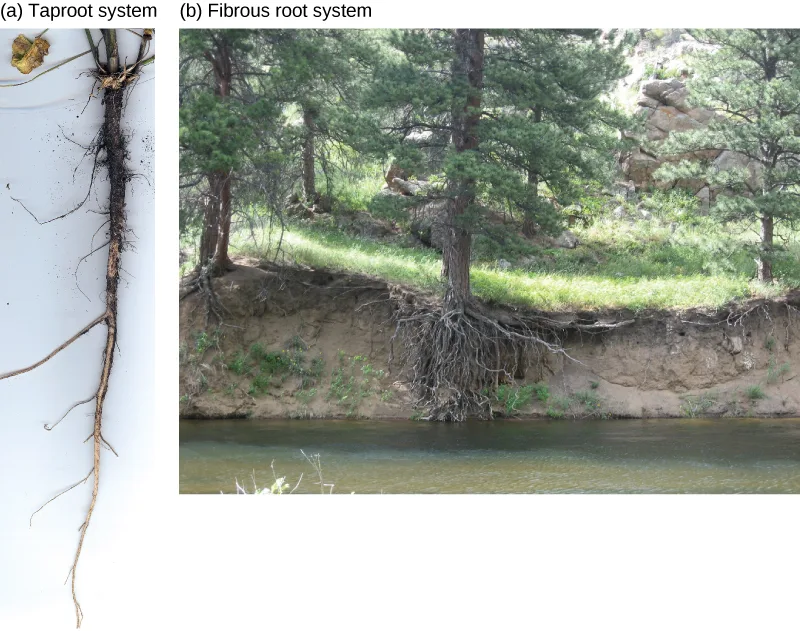
Root systems are mainly of two types (pictured below). Dicots have a tap root system, while monocots have a fibrous root system. A tap root system has a main root that grows down vertically, and from which many smaller lateral roots arise. Dandelions are a good example; their tap roots usually break off when trying to pull these weeds, and they can regrow another shoot from the remaining root. A tap root system penetrates deep into the soil. In contrast, a fibrous root system is located closer to the soil surface, and forms a dense network of roots that also helps prevent soil erosion (lawn grasses are a good example, as are wheat, rice, and corn). Some plants have a combination of tap roots and fibrous roots. Plants that grow in dry areas often have deep root systems, whereas plants growing in areas with abundant water are likely to have shallower root systems.
Root Growth and Anatomy
Root growth begins with seed germination. When the plant embryo emerges from the seed, the radicle of the embryo forms the root system. The tip of the root is protected by the root cap, a structure exclusive to roots and unlike any other plant structure. The root cap is continuously replaced because it gets damaged easily as the root pushes through soil. The root tip can be divided into three zones: a zone of cell division, a zone of elongation, and a zone of maturation and differentiation (pictured below). The zone of cell division is closest to the root tip; it is made up of the actively dividing cells of the root meristem. The zone of elongation is where the newly formed cells increase in length, thereby lengthening the root. Beginning at the first root hair is the zone of cell maturation where the root cells begin to differentiate into special cell types. All three zones are in the first centimeter or so of the root tip.
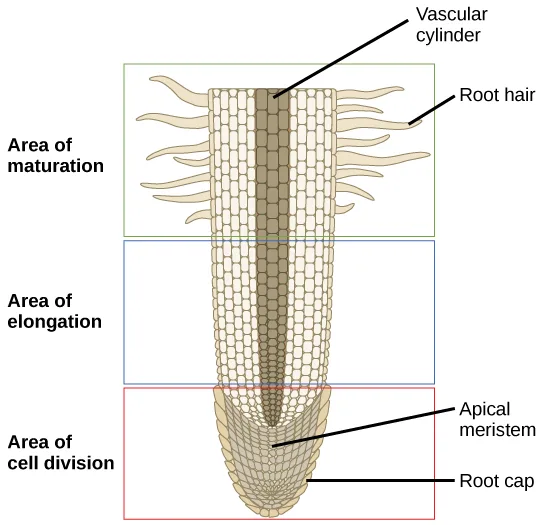
Extended description
The root tip is drawn as a tapering column split into three bracketed zones, top to bottom. The top zone, outlined in green and labeled ‘Area of maturation,’ shows a wide column of rectangular cells with long root hairs projecting outward on both sides; a line from ‘Vascular cylinder’ points to the darker central column of cells, and a line from ‘Root hair’ points to one of the projecting hairs. The middle zone, outlined in blue and labeled ‘Area of elongation,’ shows the same rectangular cells without root hairs, somewhat narrower than those above. The bottom zone, outlined in red and labeled ‘Area of cell division,’ tapers to a rounded point; a line from ‘Apical meristem’ points to the small, densely packed cells at its center, and a line from ‘Root cap’ points to the outer layer of cells covering the tip.
The root has an outer layer of cells called the epidermis, which surrounds areas of ground tissue and vascular tissue. The epidermis provides protection and helps in absorption. Root hairs, which are extensions of root epidermal cells, increase the surface area of the root, greatly contributing to the absorption of water and minerals.
Inside the root, the ground tissue forms two regions: the cortex and the pith (pictured below). Compared to stems, roots have lots of cortex and little pith. Both regions include cells that store photosynthetic products. The cortex is between the epidermis and the vascular tissue, whereas the pith lies between the vascular tissue and the center of the root.
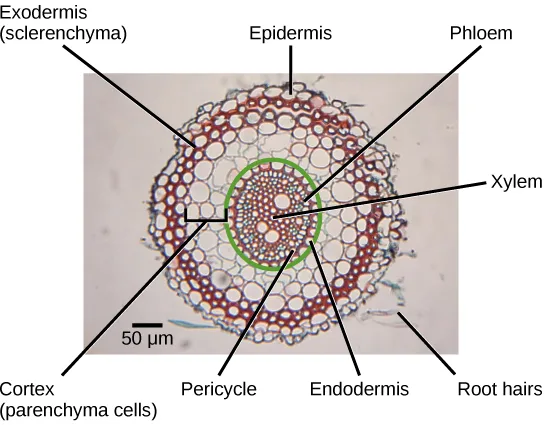
Extended description
Eight leader lines run from labels positioned around the edge of the circular micrograph into the stained tissue. Across the top, left to right: ‘Exodermis (sclerenchyma)’ points to a banded outer ring; ‘Epidermis’ points to the single-cell-thick outermost rim; ‘Phloem’ points to patches just outside a thin green circle drawn near the center. A separate line from ‘Xylem,’ at the right, points to the cluster of cells inside that green circle. Across the bottom, left to right: ‘Cortex (parenchyma cells)’ points to the wide band of tissue between the exodermis and the green circle; ‘Pericycle’ points to the ring just inside the green circle; ‘Endodermis’ points to the green circle itself; ‘Root hairs’ points to thin filaments projecting from the lower right edge of the root. A scale bar reading ‘50 µm’ sits at the lower left of the micrograph.
The vascular tissue in the root is arranged in the inner portion of the root, which is called the stele (pictured below). A layer of cells known as the endodermis separates the stele from the ground tissue in the outer portion of the root. The endodermis is exclusive to roots, and serves as a checkpoint for materials entering the root’s vascular system. A waxy substance called suberin is present on the walls of the endodermal cells. This waxy region, known as the Casparian strip, forces water and solutes to cross the plasma membranes of endodermal cells instead of slipping between the cells. This ensures that only materials required by the root pass through the endodermis, while toxic substances and pathogens are generally excluded. The outermost cell layer of the root’s vascular tissue is the pericycle, an area that can give rise to lateral roots. In dicot roots, the xylem and phloem of the stele are arranged alternately in an X shape, whereas in monocot roots, the vascular tissue is arranged in a ring around the pith.
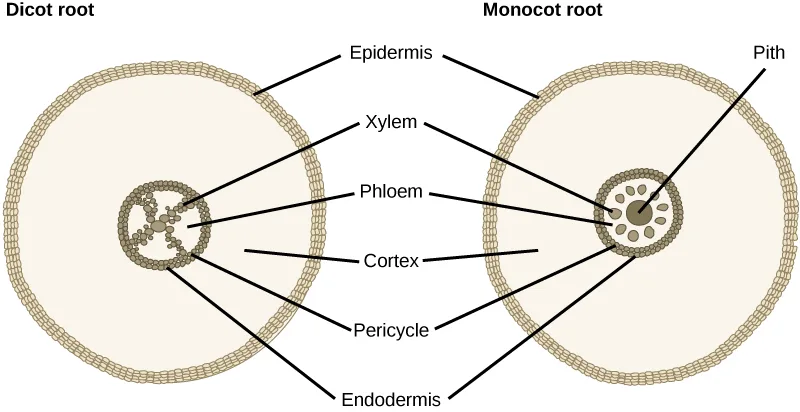
Extended description
Two identically styled root cross sections sit side by side, labeled ‘Dicot root’ (left) and ‘Monocot root’ (right), each a large pale circle ringed by a fine-celled outer band. A line from ‘Epidermis,’ positioned between the two circles, points to that outer band on the dicot circle; the monocot circle is drawn with the same outer band. On the right, a line from ‘Pith’ points to a solid small circle at the very center of the monocot circle, a feature the dicot circle lacks. Five more labels run down the right margin, each with two branching leader lines, one into each circle: ‘Xylem’ points to the star-shaped cluster of cells at the dicot’s center and to the ring of larger rounded cells surrounding the monocot’s pith; ‘Phloem’ points to the smaller cells filling the gaps of the dicot’s X and to the ring of small cells between the xylem and the pith in the monocot; ‘Cortex’ points to the wide band of tissue between the outer layer and the inner cluster in each circle; ‘Pericycle’ points to the thin ring just outside each central cluster; ‘Endodermis’ points to the ring just outside the pericycle in each circle.
Root Modifications
Root structures may be modified for specific purposes. For example, some roots are bulbous and store starch. Aerial roots and prop roots are two forms of aboveground roots that provide additional support to anchor the plant. Tap roots, such as carrots, turnips, and beets, are examples of roots that are modified for food storage (pictured below).

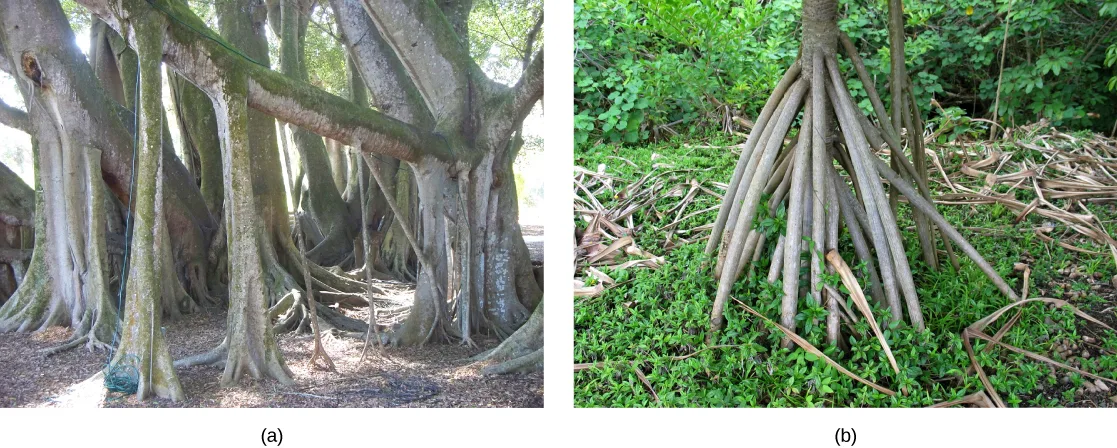
Epiphytic roots enable a plant to grow on another plant. For example, the epiphytic roots of orchids develop a spongy tissue to absorb moisture. The banyan tree (Ficus sp.) begins as an epiphyte, germinating in the branches of a host tree; aerial roots develop from the branches and eventually reach the ground, providing additional support (pictured below). In screwpine (Pandanus sp.), a palm-like tree that grows in sandy tropical soils, aboveground prop roots develop from the nodes to provide additional support.
Summary
Roots help to anchor a plant, absorb water and minerals, and serve as storage sites for food. Taproots and fibrous roots are the two main types of root systems. In a taproot system, a main root grows vertically downward with a few lateral roots. Fibrous root systems arise at the base of the stem, where a cluster of roots forms a dense network that is shallower than a taproot. The growing root tip is protected by a root cap. The root tip has three main zones: a zone of cell division (cells are actively dividing), a zone of elongation (cells increase in length), and a zone of maturation (cells differentiate to form different kinds of cells). Root vascular tissue conducts water, minerals, and sugars. In some habitats, the roots of certain plants may be modified to form aerial roots or epiphytic roots.
Key terms
- adventitious root — aboveground root that arises from a plant part other than the radicle of the plant embryo.
- Casparian strip — waxy coating that forces water to cross endodermal plasma membranes before entering the vascular cylinder, instead of moving between endodermal cells.
- endodermis — layer of cells in the root that forms a selective barrier between the ground tissue and the vascular tissue, allowing water and minerals to enter the root while excluding toxins and pathogens.
- fibrous root system — type of root system in which the roots arise from the base of the stem in a cluster, forming a dense network of roots; found in monocots.
- pericycle — outer boundary of the stele from which lateral roots can arise.
- root cap — protective cells covering the tip of the growing root.
- root hair — hair-like structure that is an extension of epidermal cells; increases the root surface area and aids in absorption of water and minerals.
- stele — inner portion of the root containing the vascular tissue; surrounded by the endodermis.
- tap root system — type of root system with a main root that grows vertically with few lateral roots; found in dicots.
Practice
Identify the two types of root systems
Compare a tap root system with a fibrous root system. For each type, name a plant that provides a food in the human diet. Which type of root system is found in monocots? Which type of root system is found in dicots?
Show model answer
Did your answer mention:
A root system with a main root that grows vertically and only a few lateral roots, found in dicots, is called a ________.
This root type penetrates deep into the soil; dandelions are a familiar example, since pulling one often snaps this main root and leaves it to regrow a new shoot.A root system in which roots arise from the base of the stem in a cluster, forming a dense network closer to the soil surface, is called a ________.
Lawn grasses and cereal crops like wheat, rice, and corn — all monocots — grow this shallow, erosion-resisting tangle of many small roots instead of one dominant root.Describe the three zones of the root tip and summarize the role of each zone in root growth
Newly-formed root cells begin to form different cell types in the ________.
This is the zone farthest from the root tip, beginning where the first root hair appears.The protective cells that cover the tip of a growing root are collectively called the ________.
It is continuously replaced because it gets damaged easily as the root pushes through soil, and it covers the tip where the zone of cell division sits.In the root tip’s zone of ________, newly formed cells increase in length, lengthening the root.
This zone sits between the zone of cell division nearest the tip and the zone of maturation farther back, where root hairs eventually appear.Describe the structure of the root
The ________ forces selective uptake of minerals in the root.
This cell layer’s waxy Casparian strip forces materials to cross plasma membranes instead of slipping between cells, sitting between the cortex and the stele.What might happen to a root if the pericycle disappeared?
Show model answer
Did your answer mention:
A hair-like extension of a root epidermal cell that increases the root’s surface area and aids in absorbing water and minerals is called a ________.
These first appear where the zone of elongation ends and the zone of maturation begins.The inner portion of the root that contains the vascular tissue, surrounded by the endodermis, is called the ________.
This region holds the root’s xylem and phloem, arranged in an X shape in dicots and a ring around the pith in monocots.The waxy region on endodermal cell walls that forces water and solutes to cross the plasma membrane instead of slipping between cells is called the ________.
This structure is made of a waxy substance called suberin, and it ensures that only materials the root needs pass through the endodermis while toxic substances and pathogens are excluded.List and describe examples of modified roots
Roots that enable a plant to grow on another plant are called ________.
Orchids and the banyan tree begin life attached to, or growing on, a host plant instead of rooting in soil.An aboveground root that arises from a plant part other than the radicle of the plant embryo is called a(n) ________.
Unlike a typical root system that begins at the embryo’s radicle, this one grows directly from the shoot, above the ground.In some habitats, the roots of certain plants may be modified to form ________ or epiphytic roots.
These roots grow above ground, like the ones that let the banyan tree’s branches reach down and eventually reach the soil.This section is adapted from Biology 2e, Section 30.3: Roots by Mary Ann Clark, Jung Choi, Matthew Douglas, and OpenStax, © OpenStax, licensed under CC BY-NC-SA 4.0. Access the original for free at openstax.org. Changes: figures re-encoded as WebP with a concise custom alt describing each image rather than the source’s longer walk-through alt text; two figures re-kinded from the manifest’s file-extension “photo” guess to “diagram” (Figure_30_03_02, the labeled root-tip zone drawing, and Figure_30_03_04, the labeled dicot/monocot cross-section schematic — both hand-drawn line diagrams, not photographs); a longdesc added to Figure_30_03_02, Figure_30_03_03f, and Figure_30_03_04, whose leader-line labels are not carried by their one- or two-sentence captions; the end-of-section Review Questions and Critical Thinking Questions adapted into the closing interactive Practice block (multiple choice and self-check respectively); rubric checkpoints added to each self-check, decomposing its model answer (the source solution) into check-off clauses with no new claims; seven key-term recall items (tap root system, fibrous root system, root cap, root hair, stele, Casparian strip, adventitious root) added from the glossary, plus two cloze recall items built from the section summary’s own sentences (the root tip’s zone of elongation; aerial roots as a root modification).