Transport of Water and Solutes in Plants
By the end of this section, you will be able to:
- Define water potential and explain how it is influenced by solutes, pressure, gravity, and the matric potential
- Describe how water potential, evapotranspiration, and stomatal regulation influence how water is transported in plants
- Explain how photosynthates are transported in plants
The structure of plant roots, stems, and leaves facilitates the transport of water, nutrients, and photosynthates throughout the plant. The phloem and xylem are the main tissues responsible for this movement. Water potential, evapotranspiration, and stomatal regulation influence how water and nutrients are transported in plants. To understand how these processes work, we must first understand the energetics of water potential.
Water Potential
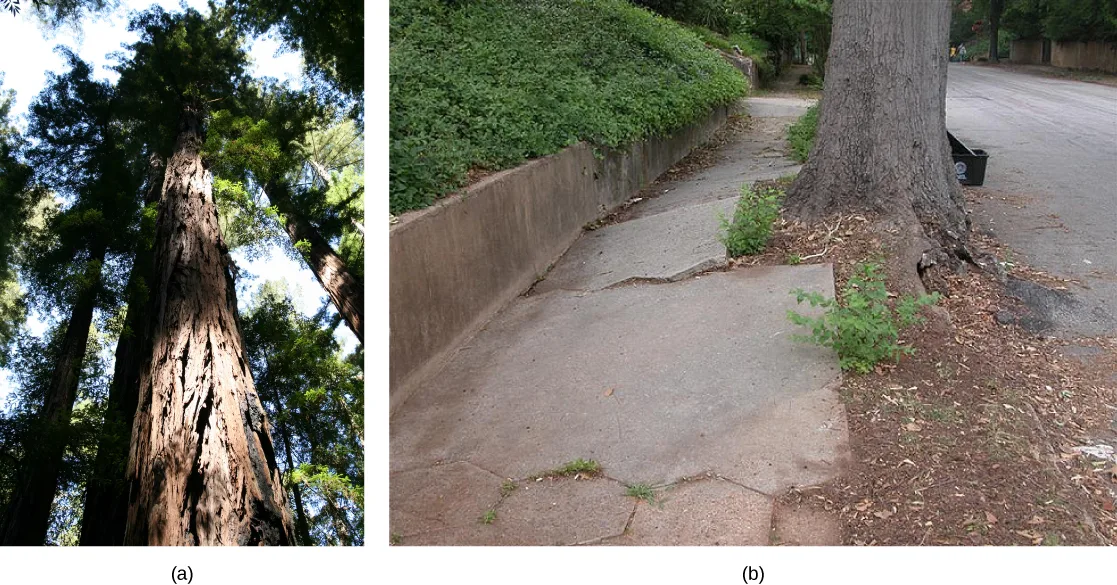
Plants are phenomenal hydraulic engineers. Using only the basic laws of physics and the simple manipulation of potential energy, plants can move water to the top of a 116-meter-tall tree (pictured below). Plants can also use hydraulics to generate enough force to split rocks and buckle sidewalks (also pictured below). Plants achieve this because of water potential.
Water potential is a measure of the potential energy in water. Plant physiologists are not interested in the energy in any one particular aqueous system, but are very interested in water movement between two systems. In practical terms, therefore, water potential is the difference in potential energy between a given water sample and pure water (at atmospheric pressure and ambient temperature). Water potential is denoted by the Greek letter ψ (psi) and is expressed in units of pressure (pressure is a form of energy) called megapascals (MPa). The potential of pure water (Ψwpure H₂O) is, by convenience of definition, designated a value of zero (even though pure water contains plenty of potential energy, that energy is ignored). Water potential values for the water in a plant root, stem, or leaf are therefore expressed relative to Ψwpure H₂O.
The water potential in plant solutions is influenced by solute concentration, pressure, gravity, and factors called matrix effects. Water potential can be broken down into its individual components using the following equation:
where Ψs, Ψp, Ψg, and Ψm refer to the solute, pressure, gravity, and matric potentials, respectively. “System” can refer to the water potential of the soil water (Ψsoil), root water (Ψroot), stem water (Ψstem), leaf water (Ψleaf) or the water in the atmosphere (Ψatmosphere): whichever aqueous system is under consideration. As the individual components change, they raise or lower the total water potential of a system. When this happens, water moves to equilibrate, moving from the system or compartment with a higher water potential to the system or compartment with a lower water potential. This brings the difference in water potential between the two systems (ΔΨ) back to zero (ΔΨ = 0). Therefore, for water to move through the plant from the soil to the air (a process called transpiration), Ψsoil must be > Ψroot > Ψstem > Ψleaf > Ψatmosphere.
Water only moves in response to ΔΨ, not in response to the individual components. However, because the individual components influence the total Ψsystem, by manipulating the individual components (especially Ψs), a plant can control water movement.
Solute Potential
Solute potential (Ψs), also called osmotic potential, is related to the solute concentration (in molarity). That relationship is given by the van ’t Hoff equation: Ψs = –Mi RT; where M is the molar concentration of the solute, i is the van ’t Hoff factor (the ratio of the amount of particles in the solution to amount of formula units dissolved), R is the ideal gas constant, and T is temperature in Kelvin degrees. The solute potential is negative in a plant cell and zero in distilled water. Typical values for cell cytoplasm are –0.5 to –1.0 MPa. Solutes reduce water potential (resulting in a negative Ψw) by consuming some of the potential energy available in the water. Solute molecules can dissolve in water because water molecules can bind to them via hydrogen bonds; a hydrophobic molecule like oil, which cannot bind to water, cannot go into solution. The energy in the hydrogen bonds between solute molecules and water is no longer available to do work in the system because it is tied up in the bond. In other words, the amount of available potential energy is reduced when solutes are added to an aqueous system. Thus, Ψs decreases with increasing solute concentration. Because Ψs is one of the four components of Ψsystem or Ψtotal, a decrease in Ψs will cause a decrease in Ψtotal. The internal water potential of a plant cell is more negative than pure water because of the cytoplasm’s high solute content (see the figure below). Because of this difference in water potential water will move from the soil into a plant’s root cells via the process of osmosis. This is why solute potential is sometimes called osmotic potential.
Plant cells can metabolically manipulate Ψs (and by extension, Ψtotal) by adding or removing solute molecules. Therefore, plants have control over Ψtotal via their ability to exert metabolic control over Ψs.
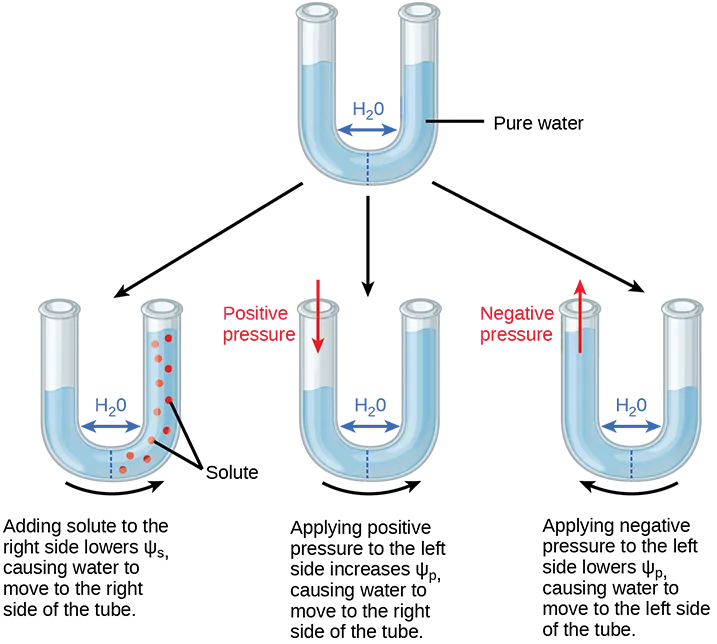
Extended description
At top, a single U-shaped tube labeled ‘Pure water’ holds equal water levels (marked H₂O) on both sides, with three black arrows branching down to three more U-tubes below. The left U-tube shows red dots labeled ‘Solute’ added to the right side only, with the right water level higher than the left, captioned ‘Adding solute to the right side lowers Ψs, causing water to move to the right side of the tube.’ The middle U-tube shows a red downward arrow labeled ‘Positive pressure’ applied to the left side, with the right water level higher than the left, captioned ‘Applying positive pressure to the left side increases Ψp, causing water to move to the right side of the tube.’ The right U-tube shows a red upward arrow labeled ‘Negative pressure’ applied to the left side, with the left water level higher than the right, captioned ‘Applying negative pressure to the left side lowers Ψp, causing water to move to the left side of the tube.’
Positive water potential is placed on the left side of the tube by increasing Ψp such that the water level rises on the right side. Could you equalize the water level on each side of the tube by adding solute, and if so, how?
Show model answer
Did your answer mention:
Pressure Potential
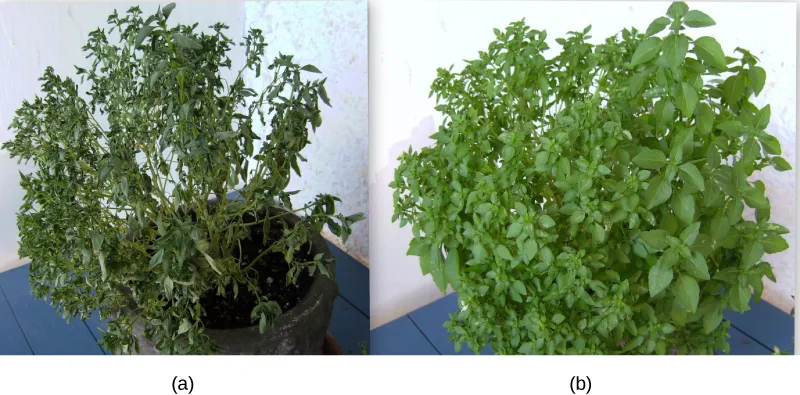
Pressure potential (Ψp), also called turgor potential, may be positive or negative (see the figure above). Because pressure is an expression of energy, the higher the pressure, the more potential energy in a system, and vice versa. Therefore, a positive Ψp (compression) increases Ψtotal, and a negative Ψp (tension) decreases Ψtotal. Positive pressure inside cells is contained by the cell wall, producing turgor pressure. Pressure potentials are typically around 0.6–0.8 MPa, but can reach as high as 1.5 MPa in a well-watered plant. A Ψp of 1.5 MPa equates to about 218 pounds per square inch (1.5 MPa x 145 lb/in-2 MPa-1 ≈ 218 lb/in-2). (Source note: the source uses 140 pounds per square inch per megapascal and gets 210; one megapascal is 145.04 pounds per square inch.) As a comparison, most automobile tires are kept at a pressure of 30–34 psi. An example of the effect of turgor pressure is the wilting of leaves and their restoration after the plant has been watered (pictured below). Water is lost from the leaves via transpiration (approaching Ψp = 0 MPa at the wilting point) and restored by uptake via the roots.
A plant can manipulate Ψp via its ability to manipulate Ψs and by the process of osmosis. If a plant cell increases the cytoplasmic solute concentration, Ψs will decline, Ψtotal will decline, the ΔΨ between the cell and the surrounding tissue will decline, water will move into the cell by osmosis, and Ψp will increase. Ψp is also under indirect plant control via the opening and closing of stomata. Stomatal openings allow water to evaporate from the leaf, reducing Ψp and Ψtotal of the leaf and increasing Ψ between the water in the leaf and the petiole, thereby allowing water to flow from the petiole into the leaf.
Gravity Potential
Gravity potential (Ψg) is always negative to zero in a plant with no height. It always removes or consumes potential energy from the system. The force of gravity pulls water downwards to the soil, reducing the total amount of potential energy in the water in the plant (Ψtotal). The taller the plant, the taller the water column, and the more influential Ψg becomes. On a cellular scale and in short plants, this effect is negligible and easily ignored. However, over the height of a tall tree like a giant coastal redwood, the gravitational pull of about –0.01 MPa m-1 is equivalent to an extra 1 MPa of resistance (Source note: the source says –0.1 MPa per meter and 10 MPa; the gravitational component of water potential is ρgh, about 0.0098 MPa per meter, so a 100-meter tree adds about 1 MPa.) that must be overcome for water to reach the leaves of the tallest trees. Plants are unable to manipulate Ψg.
Matric Potential
Matric potential (Ψm) is always negative to zero. In a dry system, it can be as low as –2 MPa in a dry seed, and it is zero in a water-saturated system. The binding of water to a matrix always removes or consumes potential energy from the system. Ψm is similar to solute potential because it involves tying up the energy in an aqueous system by forming hydrogen bonds between the water and some other component. However, in solute potential, the other components are soluble, hydrophilic solute molecules, whereas in Ψm, the other components are insoluble, hydrophilic molecules of the plant cell wall. Every plant cell has a cellulosic cell wall and the cellulose in the cell walls is hydrophilic, producing a matrix for adhesion of water: hence the name matric potential. Ψm is very large (negative) in dry tissues such as seeds or drought-affected soils. However, it quickly goes to zero as the seed takes up water or the soil hydrates. Ψm cannot be manipulated by the plant and is typically ignored in well-watered roots, stems, and leaves.
Movement of Water and Minerals in the Xylem
Solutes, pressure, gravity, and matric potential are all important for the transport of water in plants. Water moves from an area of higher total water potential (higher Gibbs free energy) to an area of lower total water potential. Gibbs free energy is the energy associated with a chemical reaction that can be used to do work. This is expressed as ΔΨ.
Transpiration is the loss of water from the plant through evaporation at the leaf surface. It is the main driver of water movement in the xylem. Transpiration is caused by the evaporation of water at the leaf–atmosphere interface; it creates negative pressure (tension) equivalent to –2 MPa at the leaf surface. This value varies greatly depending on the vapor pressure deficit, which can be negligible at high relative humidity (RH) and substantial at low RH. Water from the roots is pulled up by this tension. At night, when stomata shut and transpiration stops, the water is held in the stem and leaf by the adhesion of water to the cell walls of the xylem vessels and tracheids, and the cohesion of water molecules to each other. This is called the cohesion–tension theory of sap ascent.
Inside the leaf at the cellular level, water on the surface of mesophyll cells saturates the cellulose microfibrils of the primary cell wall. The leaf contains many large intercellular air spaces for the exchange of oxygen for carbon dioxide, which is required for photosynthesis. The wet cell wall is exposed to this leaf internal air space, and the water on the surface of the cells evaporates into the air spaces, decreasing the thin film on the surface of the mesophyll cells. This decrease creates a greater tension on the water in the mesophyll cells (see the figure below), thereby increasing the pull on the water in the xylem vessels. The xylem vessels and tracheids are structurally adapted to cope with large changes in pressure. Rings in the vessels maintain their tubular shape, much like the rings on a vacuum cleaner hose keep the hose open while it is under pressure. Small perforations between vessel elements reduce the number and size of gas bubbles that can form via a process called cavitation. The formation of gas bubbles in xylem interrupts the continuous stream of water from the base to the top of the plant, causing a break termed an embolism in the flow of xylem sap. The taller the tree, the greater the tension forces needed to pull water, and the more cavitation events. In larger trees, the resulting embolisms can plug xylem vessels, making them nonfunctional.
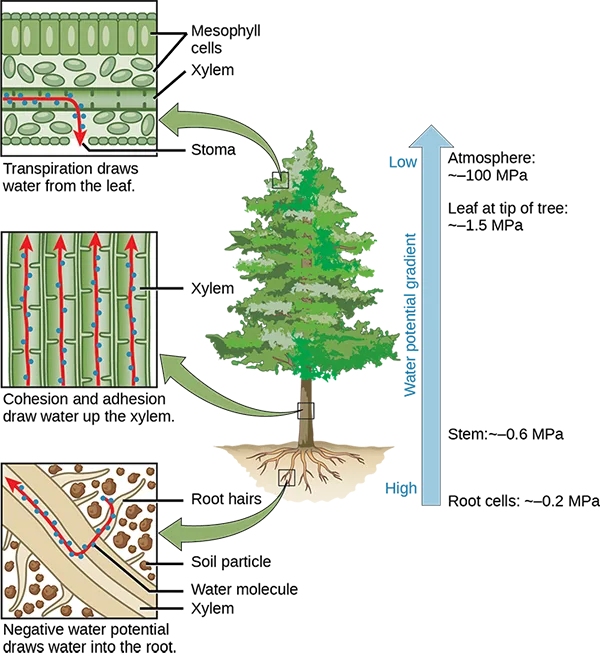
Extended description
Three boxed cross-section panels run down the left side, each joined by a green arrow to a small square on a central pine tree illustration at the matching height. The top panel is labeled ‘Mesophyll cells’ (pointing to two rows of oval cells sandwiching a central band) and ‘Xylem’ (the central band); a red arrow with trailing blue dots runs rightward through the band, then turns down and exits through a gap labeled ‘Stoma,’ captioned ‘Transpiration draws water from the leaf.’ The middle panel, labeled ‘Xylem,’ shows four parallel vertical tube segments, each with a red upward arrow and trailing blue dots, captioned ‘Cohesion and adhesion draw water up the xylem.’ The bottom panel shows diagonal root strands crossing brown soil particles, labeled ‘Root hairs,’ ‘Soil particle,’ ‘Water molecule,’ and ‘Xylem’; a solid red arrow with trailing blue dots curves up and to the left through the strand, captioned ‘Negative water potential draws water into the root.’ To the right of the tree, a vertical blue arrow with a single arrowhead at its top, labeled ‘Water potential gradient’, points up from ‘High’ at the bottom to ‘Low’ at the top, alongside four values aligned to the tree’s height, top to bottom: Atmosphere approximately −100 MPa, Leaf at tip of tree approximately −1.5 MPa, Stem approximately −0.6 MPa, and Root cells approximately −0.2 MPa.
Which of the following statements is false?
Cohesion and adhesion act on the water-conducting tissue described throughout this section — check which vascular tissue each option names for the middle step of the pathway.Transpiration—the loss of water vapor to the atmosphere through stomata—is a passive process, meaning that metabolic energy in the form of ATP is not required for water movement. The energy driving transpiration is the difference in energy between the water in the soil and the water in the atmosphere. However, transpiration is tightly controlled.
Control of Transpiration
The atmosphere to which the leaf is exposed drives transpiration, but also causes massive water loss from the plant. Up to 90 percent of the water taken up by roots may be lost through transpiration.
Leaves are covered by a waxy cuticle on the outer surface that prevents the loss of water. Regulation of transpiration, therefore, is achieved primarily through the opening and closing of stomata on the leaf surface. Stomata are surrounded by two specialized cells called guard cells, which open and close in response to environmental cues such as light intensity and quality, leaf water status, and carbon dioxide concentrations. Stomata must open to allow air containing carbon dioxide and oxygen to diffuse into the leaf for photosynthesis and respiration. When stomata are open, however, water vapor is lost to the external environment, increasing the rate of transpiration. Therefore, plants must maintain a balance between efficient photosynthesis and water loss.
Plants have evolved over time to adapt to their local environment and reduce transpiration (pictured below). Desert plant (xerophytes) and plants that grow on other plants (epiphytes) have limited access to water. Such plants usually have a much thicker waxy cuticle than those growing in more moderate, well-watered environments (mesophytes). Aquatic plants (hydrophytes) also have their own set of anatomical and morphological leaf adaptations.
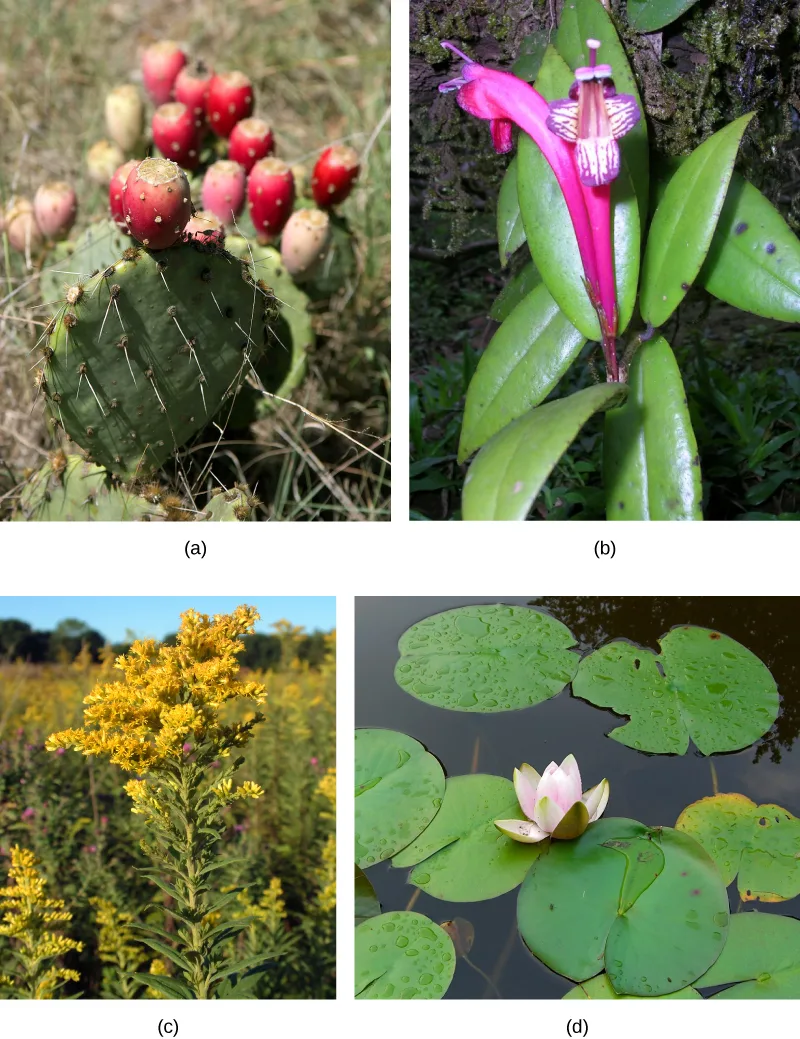
Xerophytes and epiphytes often have a thick covering of trichomes or of stomata that are sunken below the leaf’s surface. Trichomes are specialized hair-like epidermal cells that secrete oils and substances. These adaptations impede air flow across the stomatal pore and reduce transpiration. Multiple epidermal layers are also commonly found in these types of plants.
Transportation of Photosynthates in the Phloem
Plants need an energy source to grow. In seeds and bulbs, food is stored in polymers (such as starch) that are converted by metabolic processes into sucrose for newly developing plants. Once green shoots and leaves are growing, plants are able to produce their own food by photosynthesizing. The products of photosynthesis are called photosynthates, which are usually in the form of simple sugars such as sucrose.
Structures that produce photosynthates for the growing plant are referred to as sources. Sugars produced in sources, such as leaves, need to be delivered to growing parts of the plant via the phloem in a process called translocation. The points of sugar delivery, such as roots, young shoots, and developing seeds, are called sinks. Seeds, tubers, and bulbs can be either a source or a sink, depending on the plant’s stage of development and the season.
The products from the source are usually translocated to the nearest sink through the phloem. For example, the highest leaves will send photosynthates upward to the growing shoot tip, whereas lower leaves will direct photosynthates downward to the roots. Intermediate leaves will send products in both directions, unlike the flow in the xylem, which is always unidirectional (soil to leaf to atmosphere). The pattern of photosynthate flow changes as the plant grows and develops. Photosynthates are directed primarily to the roots early on, to shoots and leaves during vegetative growth, and to seeds and fruits during reproductive development. They are also directed to tubers for storage.
Translocation: Transport from Source to Sink
Photosynthates, such as sucrose, are produced in the mesophyll cells of photosynthesizing leaves. From there they are translocated through the phloem to where they are used or stored. Mesophyll cells are connected by cytoplasmic channels called plasmodesmata. Photosynthates move through these channels to reach phloem sieve-tube elements (STEs) in the vascular bundles. From the mesophyll cells, the photosynthates are loaded into the phloem STEs. The sucrose is actively transported against its concentration gradient (a process requiring ATP) into the phloem cells using the electrochemical potential of the proton gradient. This is coupled to the uptake of sucrose with a carrier protein called the sucrose-H⁺ symporter.
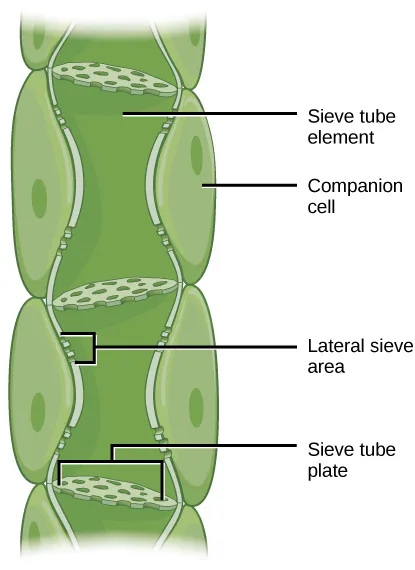
Phloem STEs have reduced cytoplasmic contents, and are connected by a sieve plate with pores that allow for pressure-driven bulk flow, or translocation, of phloem sap. Companion cells are associated with STEs. They assist with metabolic activities and produce energy for the STEs (see the figure below).
Extended description
A vertical column of large, barrel-shaped cells is stacked end to end, each pinched into a wavy-lined junction with the next. ‘Sieve tube element’ labels the body of the topmost cell; a column of narrower, lighter-green cells, each with an oval nucleus, running down the right side is labeled ‘Companion cell.’ Partway down, a small bracket labels the pinched junction between two segments ‘Lateral sieve area.’ Near the bottom, a bracket labels a diagonally stippled oval patch inside one segment ‘Sieve tube plate.’
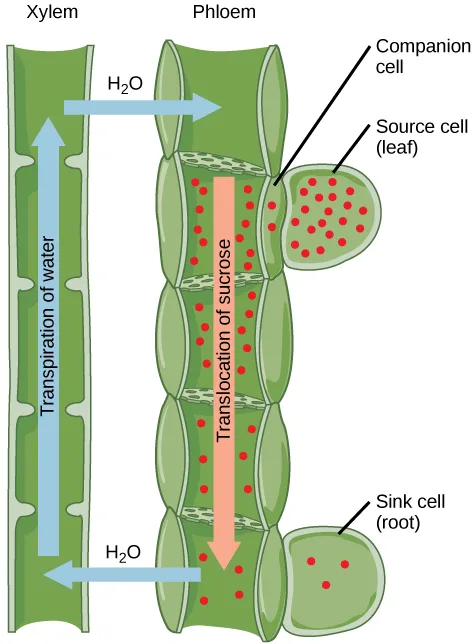
Once in the phloem, the photosynthates are translocated to the closest sink. Phloem sap is an aqueous solution that contains up to 30 percent sugar, minerals, amino acids, and plant growth regulators. The high percentage of sugar decreases Ψs, which decreases the total water potential and causes water to move by osmosis from the adjacent xylem into the phloem tubes, thereby increasing pressure. This increase in total water potential causes the bulk flow of phloem from source to sink (see the figure below). Sucrose concentration in the sink cells is lower than in the phloem STEs because the sink sucrose has been metabolized for growth, or converted to starch for storage or other polymers, such as cellulose, for structural integrity. Unloading at the sink end of the phloem tube occurs by either diffusion or active transport of sucrose molecules from an area of high concentration to one of low concentration. Water diffuses from the phloem by osmosis and is then transpired or recycled via the xylem back into the phloem sap.
Extended description
Two parallel vertical columns are labeled ‘Xylem’ (left) and ‘Phloem’ (right) at the top. A blue arrow with a single arrowhead at its top spans the full length of the xylem column, labeled ‘Transpiration of water.’ Two horizontal blue arrows, both labeled ‘H₂O,’ cross between the columns: one near the top points right, from xylem into phloem; one near the bottom points left, from phloem into xylem. The phloem column is a stack of sieve-tube-like cells with a downward orange arrow running its full length, labeled ‘Translocation of sucrose,’ inside which red dots are dense near the top and sparse near the bottom. At the upper right, a round cell packed with many red dots is labeled ‘Source cell (leaf),’ attached to the phloem column at a point labeled ‘Companion cell.’ At the lower right, a round cell holding only three red dots is labeled ‘Sink cell (root).’
Summary
Water potential (Ψ) is a measure of the difference in potential energy between a water sample and pure water. The water potential in plant solutions is influenced by solute concentration, pressure, gravity, and matric potential. Water potential and transpiration influence how water is transported through the xylem in plants. These processes are regulated by stomatal opening and closing. Photosynthates (mainly sucrose) move from sources to sinks through the plant’s phloem. Sucrose is actively loaded into the sieve-tube elements of the phloem. The increased solute concentration causes water to move by osmosis from the xylem into the phloem. The positive pressure that is produced pushes water and solutes down the pressure gradient. The sucrose is unloaded into the sink, and the water returns to the xylem vessels.
Key terms
- megapascal (MPa) — pressure units that measure water potential.
- sink — growing parts of a plant, such as roots and young leaves, which require photosynthate.
- source — organ that produces photosynthate for a plant.
- translocation — mass transport of photosynthates from source to sink in vascular plants.
- transpiration — loss of water vapor to the atmosphere through stomata.
- water potential (Ψw) — the potential energy of a water solution per unit volume in relation to pure water at atmospheric pressure and ambient temperature.
Practice
Define water potential and explain how it is influenced by solutes, pressure, gravity, and the matric potential
The pressure units used to measure water potential are called ________.
This SI-derived pressure unit is what water potential (Ψ) is expressed in throughout the section.The potential energy of a water solution per unit volume, relative to pure water at atmospheric pressure and ambient temperature, is called ________.
This is denoted with the Greek letter Ψ throughout the section, and pure water is defined to have a value of zero.Which statement about the four components of water potential is true?
Re-check each option against the section’s own sentence about that specific component — three of them state the reverse of what the section says.Describe how water potential, evapotranspiration, and stomatal regulation influence how water is transported in plants
When stomata open, what occurs?
Stomata are the pathway through which both carbon dioxide enters and water vapor exits the leaf — think about which direction water moves through an open pore, and what that does to the rate.The loss of water vapor to the atmosphere through stomata is called ________.
This passive process requires no metabolic energy and is the main driver of water movement in the xylem.Water potential and transpiration influence how water is transported through the ________ in plants.
This vascular tissue’s vessels and tracheids are structurally adapted to withstand the tension created by transpiration.Explain how photosynthates are transported in plants
Which cells are responsible for the movement of photosynthates through a plant?
Tracheids and vessel elements belong to the xylem, the tissue for water transport — rule those combinations out and think about which phloem cell type carries the sugar solution, plus the cell type that powers it.An organ that produces photosynthate for a plant is called a ________.
This is where photosynthesis actually happens — think of the highest leaves versus the lowest ones, and which way each sends its sugars.A growing part of a plant, such as a root or young leaf, that requires photosynthate is called a ________.
Seeds, tubers, and bulbs can serve as this or as the structure that produces photosynthate, depending on the plant’s stage of development and the season.The mass transport of photosynthates from a source to a sink in vascular plants is called ________.
This process delivers sucrose through the phloem to growing shoot tips, roots, or developing seeds, depending on the plant’s stage of development.The process of bulk flow transports fluids in a plant. Describe the two main bulk flow processes.
Show model answer
Did your answer mention:
This section is adapted from Biology 2e, Section 30.5: Transport of Water and Solutes in Plants by Mary Ann Clark, Jung Choi, Matthew Douglas, and OpenStax, © OpenStax, licensed under CC BY-NC-SA 4.0. Access the original for free at openstax.org. Changes: figures re-encoded as WebP; two figures re-kinded after inspection — Figure_30_05_06 and Figure_30_05_07 from the manifest’s file-extension “photo” guess to “diagram” (both are line-drawn schematic illustrations, not photographs, despite being stored as JPEGs); the two Visual Connection figures’ source alt text, which was letter-spaced screen-reader spelling (e.g., “p s i dash s”), rewritten as plain description, and a longdesc added to both plus the two other labeled diagrams (Figure_30_05_06, Figure_30_05_07) whose panel layout, labels, and arrows are not carried by their captions; Figure_B30_05_03’s source alt text, which stated the water-potential gradient is “low at the roots and high in the leaves,” corrected to “high at the roots and low in the atmosphere” to match the diagram’s own “Low”/“High” labels and its printed values (root cells ≈ −0.2 MPa vs. atmosphere ≈ −100 MPa) — reported as a source defect; the block equation for Ψsystem set in KaTeX, the section’s only inline math, with every other Ψ subscript and superscript kept as plain Unicode text with HTML sub/sup, matching the source’s own markup; the two notes wrapping a Visual Connection rendered as their figure followed by the paired exercise (a self-check for the prose-keyed item, a multiple choice for the option-keyed item), kept in the body under the objective each argues; the end-of-section Review Questions and the Critical Thinking Question adapted into the closing interactive Practice block; rubric checkpoints added to each self-check, decomposing its model answer (the source solution) into check-off clauses with no new claims; six key-term recall items (megapascal, water potential, transpiration, source, sink, translocation) added from the glossary and one cloze from the Section Summary (xylem); one locally authored multiple choice built strictly from the section’s own sentences about the four water-potential components (solute, pressure, gravity, matric potential), disclosed here since it has no source exercise counterpart. Two numbers are corrected with visible Source notes: 1.5 MPa is about 218 pounds per square inch at 145 per megapascal, and the gravitational water potential is about –0.01 MPa per meter, an extra megapascal for the tallest trees rather than ten (errata 433–434).