Nutritional Requirements of Plants
By the end of this section, you will be able to:
- Describe how plants obtain nutrients
- List the elements and compounds required for proper plant nutrition
- Describe an essential nutrient
Plants are unique organisms that can absorb nutrients and water through their root system, as well as carbon dioxide from the atmosphere. Soil quality and climate are the major determinants of plant distribution and growth. The combination of soil nutrients, water, and carbon dioxide, along with sunlight, allows plants to grow.
The Chemical Composition of Plants
Since plants require nutrients in the form of elements such as carbon and potassium, it is important to understand the chemical composition of plants. The majority of volume in a plant cell is water; it typically comprises 80 to 90 percent of the plant’s total weight. Soil is the water source for land plants, and can be an abundant source of water, even if it appears dry. Plant roots absorb water from the soil through root hairs and transport it up to the leaves through the xylem. As water vapor is lost from the leaves, the process of transpiration and the polarity of water molecules (which enables them to form hydrogen bonds) draws more water from the roots up through the plant to the leaves. Plants need water to support cell structure, for metabolic functions, to carry nutrients, and for photosynthesis.
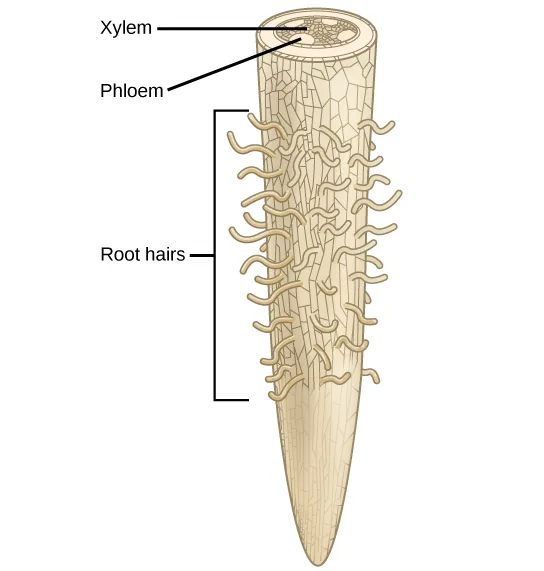
Plant cells need essential substances, collectively called nutrients, to sustain life. Plant nutrients may be composed of either organic or inorganic compounds. An organic compound is a chemical compound that contains carbon, such as carbohydrates, lipids, proteins, and nucleic acids and is made by a living organism. Carbon that was obtained from atmospheric CO₂ is incorporated into organic molecules by plants and as such, composes the majority of the dry mass within most plants. An inorganic compound does not contain carbon (except CO₂) and is not part of, or produced by, a living organism. Inorganic substances, which form the majority of the soil solution, are commonly called minerals: those required by plants include nitrogen (N) and potassium (K) for structure and regulation.
Essential Nutrients
Plants require only light, water, and about 20 elements to support all their biochemical needs: these 20 elements are called essential nutrients (see the table below). For an element to be regarded as essential, three criteria are required: 1) a plant cannot complete its life cycle without the element; 2) no other element can perform the function of the element; and 3) the element is directly involved in plant nutrition.
Essential Elements for Plant Growth
| Macronutrients | Micronutrients |
|---|---|
| Carbon (C) | Iron (Fe) |
| Hydrogen (H) | Manganese (Mn) |
| Oxygen (O) | Boron (B) |
| Nitrogen (N) | Molybdenum (Mo) |
| Phosphorus (P) | Copper (Cu) |
| Potassium (K) | Zinc (Zn) |
| Calcium (Ca) | Chlorine (Cl) |
| Magnesium (Mg) | Nickel (Ni) |
| Sulfur (S) | Cobalt (Co) |
| Sodium (Na) | |
| Silicon (Si) |
Macronutrients and Micronutrients
The essential elements can be divided into two groups: macronutrients and micronutrients. Nutrients that plants require in larger amounts are called macronutrients. About half of the essential elements are considered macronutrients: carbon, hydrogen, oxygen, nitrogen, phosphorus, potassium, calcium, magnesium and sulfur. The first of these macronutrients, carbon (C), is required to form carbohydrates, proteins, nucleic acids, and many other compounds; it is therefore present in all macromolecules. On average, the dry weight (excluding water) of a cell is 45 percent carbon. As shown below, carbon is a key part of plant biomolecules, followed by oxygen (45 percent) and hydrogen (6 percent), which are the next two most abundant elements in plants.
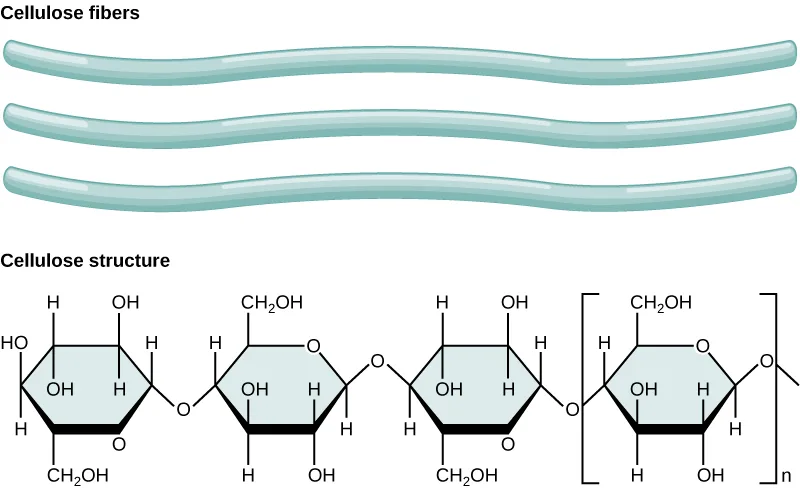
The third most abundant element in plant cells is nitrogen (N); it is part of proteins and nucleic acids. Nitrogen is also used in the synthesis of some vitamins. In addition to being macronutrients that are part of many organic compounds, hydrogen and oxygen also form water. Oxygen is necessary for cellular respiration; plants use oxygen to store energy in the form of ATP. Phosphorus (P), another macromolecule, is necessary to synthesize nucleic acids and phospholipids. As part of ATP, phosphorus enables food energy to be converted into chemical energy through oxidative phosphorylation. Likewise, light energy is converted into chemical energy during photophosphorylation in photosynthesis, and into chemical energy to be extracted during respiration. Sulfur is part of certain amino acids, such as cysteine and methionine, and is present in several coenzymes. Sulfur also plays a role in photosynthesis as part of the electron transport chain, where hydrogen gradients play a key role in the conversion of light energy into ATP. Potassium (K) is important because of its role in regulating stomatal opening and closing. As the openings for gas exchange, stomata help maintain a healthy water balance; a potassium ion pump supports this process.
Magnesium (Mg) and calcium (Ca) are also important macronutrients. The role of calcium is twofold: to regulate nutrient transport, and to support many enzyme functions. Magnesium is important to the photosynthetic process. These minerals, along with the micronutrients, which are described below, also contribute to the plant’s ionic balance.
In addition to macronutrients, organisms require various elements in small amounts. These micronutrients, or trace elements, are present in very small quantities. They include boron (B), chlorine (Cl), manganese (Mn), iron (Fe), zinc (Zn), copper (Cu), molybdenum (Mo), nickel (Ni), silicon (Si), and sodium (Na).
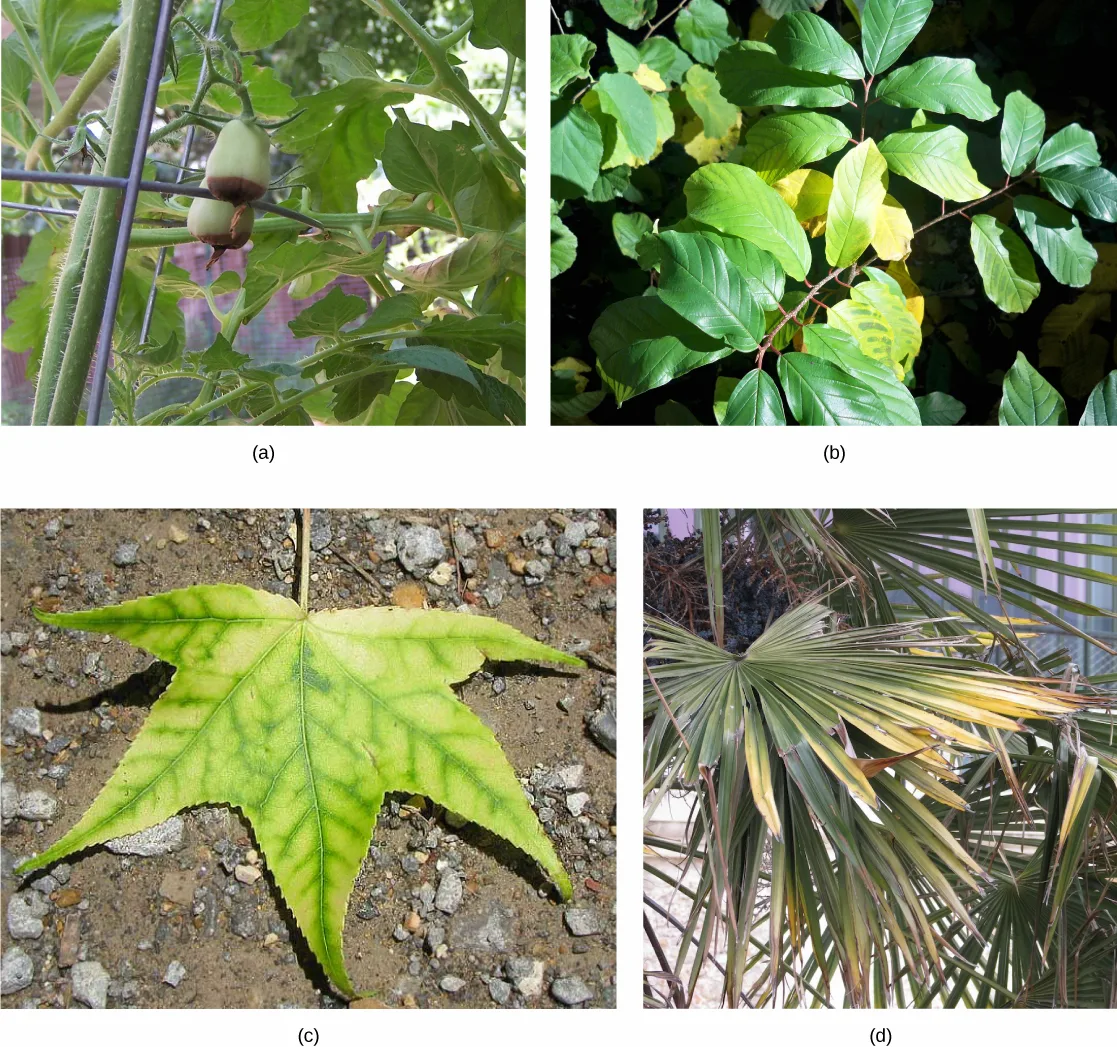
Deficiencies in any of these nutrients—particularly the macronutrients—can adversely affect plant growth; depending on the specific nutrient, a lack can cause stunted growth, slow growth, or chlorosis (yellowing of the leaves). Extreme deficiencies may result in leaves showing signs of cell death.
Everyday Connection. Hydroponics
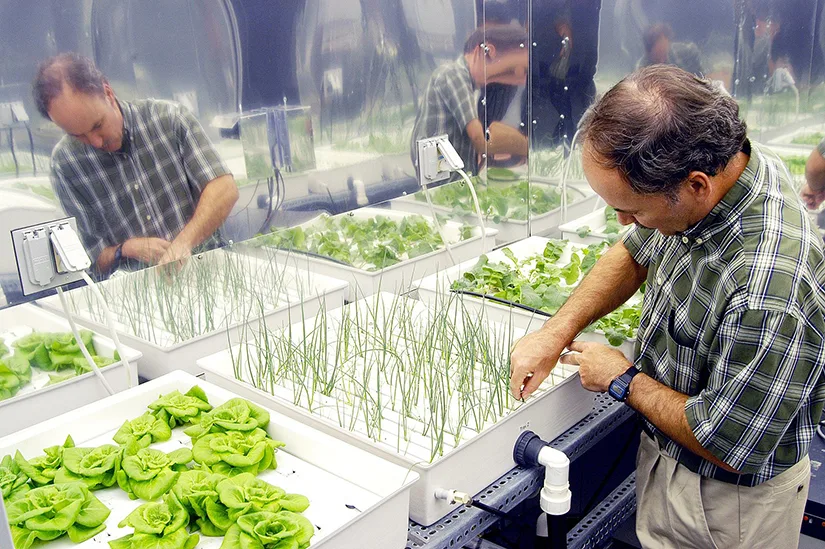
Hydroponics is a method of growing plants in a water-nutrient solution instead of soil. Since its advent, hydroponics has developed into a growing process that researchers often use. Scientists who are interested in studying plant nutrient deficiencies can use hydroponics to study the effects of different nutrient combinations under strictly controlled conditions. Hydroponics has also developed as a way to grow flowers, vegetables, and other crops in greenhouse environments. You might find hydroponically grown produce at your local grocery store. Today, many lettuces and tomatoes in your market have been hydroponically grown.
Summary
Plants can absorb inorganic nutrients and water through their root system, and carbon dioxide from the environment. The combination of organic compounds, along with water, carbon dioxide, and sunlight, produce the energy that allows plants to grow. Inorganic compounds form the majority of the soil solution. Plants access water though the soil. Water is absorbed by the plant root, transports nutrients throughout the plant, and maintains the structure of the plant. Essential elements are indispensable elements for plant growth. They are divided into macronutrients and micronutrients. The macronutrients plants require are carbon, nitrogen, hydrogen, oxygen, phosphorus, potassium, calcium, magnesium, and sulfur. Important micronutrients include iron, manganese, boron, molybdenum, copper, zinc, chlorine, nickel, cobalt, silicon, and sodium.
Key terms
- inorganic compound — chemical compound that does not contain carbon; it is not part of or produced by a living organism.
- macronutrient — nutrient that is required in large amounts for plant growth; carbon, hydrogen, oxygen, nitrogen, phosphorus, potassium, calcium, magnesium, and sulfur.
- micronutrient — nutrient required in small amounts; also called trace element.
- organic compound — chemical compound that contains carbon.
Practice
Describe how plants obtain nutrients
What is the main water source for land plants?
Plant roots absorb this substance through root hairs, and it can be an abundant water source even when it appears dry.Research the life of Jan Baptista van Helmont. What did the van Helmont experiment show?
Show model answer
Did your answer mention:
Plants can absorb inorganic nutrients and water through their ________, and carbon dioxide from the environment.
Fine hairs on this organ are the entry point, and the xylem carries what they take up upward to the leaves.List the elements and compounds required for proper plant nutrition
The nutrient that is part of carbohydrates, proteins, and nucleic acids, and that forms biomolecules, is ________.
On average, this element makes up 45 percent of a cell’s dry weight, more than any other.Most ________ are necessary for enzyme function.
These are the trace elements a plant needs only in very small quantities, as opposed to the nine elements it needs in bulk.List two essential macronutrients and two essential micronutrients.
Show model answer
Did your answer mention:
What type of plant problems result from nitrogen and calcium deficiencies?
Show model answer
Did your answer mention:
A chemical compound that contains carbon is called an ________ compound.
Carbohydrates, lipids, proteins, and nucleic acids are all examples, and this kind of compound is made by a living organism.A chemical compound that does not contain carbon, and is not part of or produced by a living organism, is called an ________ compound.
Most of the soil solution is made of substances of this kind, commonly called minerals.A nutrient that is required in large amounts for plant growth is called a ________.
Carbon, hydrogen, oxygen, nitrogen, phosphorus, potassium, calcium, magnesium, and sulfur all belong to this group.A nutrient required in only small amounts is called a ________.
Boron, chlorine, manganese, iron, zinc, copper, molybdenum, nickel, silicon, and sodium all belong to this group.Assign each essential element to the nutrient group it belongs to.
Macronutrients
Micronutrients
Describe an essential nutrient
For an element to be regarded as essential, all of the following criteria must be met, except:
Re-read the three genuine essentiality criteria in the paragraph above — one option restates none of them.Plants require only light, water, and about 20 elements to support all their biochemical needs; these 20 elements are called ________.
The paragraph above opens by naming this exact term for the 20 elements, right before it lists the three criteria an element must meet.Essential elements are ________ elements for plant growth.
This is the summary’s one-word restatement of the criterion that a plant cannot complete its life cycle without the element.This section is adapted from Biology 2e, Section 31.1: Nutritional Requirements of Plants by Mary Ann Clark, Jung Choi, Matthew Douglas, and OpenStax, © OpenStax, licensed under CC BY-NC-SA 4.0. Access the original for free at openstax.org. Changes: figures re-encoded as WebP; the root-tip diagram (Figure_31_01_01) and the cellulose-fiber diagram (Figure_31_01_02) re-kinded from the manifest’s file-extension “photo” guess to “diagram,” since both are line drawings rather than captured photographs; a fresh alt written for all four vendored figures, describing what each drawing or photo shows rather than reusing the source’s own terse alt text; the essential-elements table kept as a Markdown table in the body and also built as a sortbins exercise (a subset of twelve of its twenty elements, interleaved) in the Practice group for “List the elements and compounds required for proper plant nutrition”; the Everyday Connection note (Hydroponics) rendered as a callout with its bold name, italic title, and figure kept inside it; the Link to Learning note rendered as a callout with descriptive link text, keeping the source’s own openstax.org short URL; the four Review Questions and all three Critical Thinking Questions adapted into the closing interactive Practice block (multiple choice and self-check respectively); rubric checkpoints added to each self-check, decomposing its model answer (the source solution) into check-off clauses with no new claims; four key-term recall items (organic compound, inorganic compound, macronutrient, micronutrient) added from the glossary; two summary-derived cloze recall items added (“root system” and “indispensable”); one multiple choice written locally under “Describe an essential nutrient” (which elements are called “essential nutrients,” built strictly from the section’s own opening sentence of the Essential Nutrients subsection), since the module’s own exercise sets leave that objective’s group thin after its one Review Question is placed — disclosed in the ledger; the Critical Thinking question’s “Jan Babtista van Helmont” and the solution’s “micro nutrients” corrected to “Jan Baptista van Helmont” and “micronutrients” (reported as source defects); the Link to Learning’s openstax.org redirect (/l/plant_mineral) is no longer linked — its destination, kscience.co.uk/animations/minerals.htm, returned 404 on September 5, 2026, so the callout names the resource and its site for the reader to search instead (erratum 316).