The Soil
By the end of this section, you will be able to:
- Describe how soils are formed
- Explain soil composition
- Describe a soil profile
Plants obtain inorganic elements from the soil, which serves as a natural medium for land plants. Soil is the outer loose layer that covers the surface of Earth. Soil quality is a major determinant, along with climate, of plant distribution and growth. Soil quality depends not only on the chemical composition of the soil, but also the topography (regional surface features) and the presence of living organisms. In agriculture, the history of the soil, such as the cultivating practices and previous crops, modify the characteristics and fertility of that soil.
Soil develops very slowly over long periods of time, and its formation results from natural and environmental forces acting on mineral, rock, and organic compounds. Soils can be divided into two groups: organic soils are those that are formed from sedimentation and primarily composed of organic matter, while those that are formed from the weathering of rocks and are primarily composed of inorganic material are called mineral soils. Mineral soils are predominant in terrestrial ecosystems, where soils may be covered by water for part of the year or exposed to the atmosphere.
Soil Composition
Soil consists of these major components (shown below):
- inorganic mineral matter, about 40 to 45 percent of the soil volume
- organic matter, about 5 percent of the soil volume
- water and air, about 50 percent of the soil volume
The amount of each of the four major components of soil depends on the amount of vegetation, soil compaction, and water present in the soil. A good healthy soil has sufficient air, water, minerals, and organic material to promote and sustain plant life.
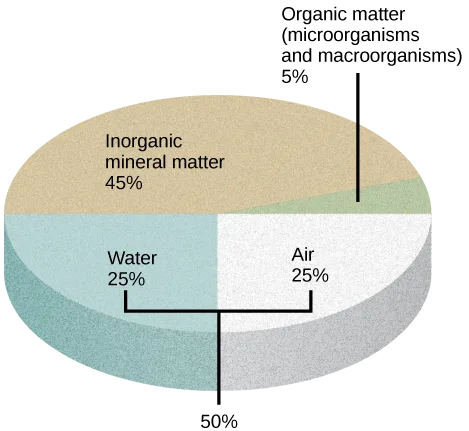
Extended description
Reading clockwise from the largest wedge: inorganic mineral matter fills nearly half the pie, labeled 45%. Beside it, a thin sliver labeled ‘Organic matter (microorganisms and macroorganisms) 5%’ sits at the boundary with the next wedge. The pie’s other half is split evenly into two equal wedges, ‘Water 25%’ on the left and ‘Air 25%’ on the right; a bracket joins these two wedges beneath the pie and is labeled 50%.
Soil compaction can result when soil is compressed by heavy machinery or even foot traffic. How might this compaction change the soil composition?
Show model answer
Did your answer mention:
The organic material of soil, called humus, is made up of microorganisms (dead and alive), and dead animals and plants in varying stages of decay. Humus improves soil structure and provides plants with water and minerals. The inorganic material of soil consists of rock, slowly broken down into smaller particles that vary in size. Soil particles that are 0.1 to 2 mm in diameter are sand. Soil particles between 0.002 and 0.1 mm are called silt, and even smaller particles, less than 0.002 mm in diameter, are called clay. Some soils have no dominant particle size and contain a mixture of sand, silt, and humus; these soils are called loams.
Soil Formation
Soil formation is the consequence of a combination of biological, physical, and chemical processes. Soil should ideally contain 50 percent solid material and 50 percent pore space. About one-half of the pore space should contain water, and the other half should contain air. The organic component of soil serves as a cementing agent, returns nutrients to the plant, allows soil to store moisture, makes soil tillable for farming, and provides energy for soil microorganisms. Most soil microorganisms—bacteria, algae, or fungi—are dormant in dry soil, but become active once moisture is available.
Soil distribution is not homogenous because its formation results in the production of layers; together, the vertical section of a soil is called the soil profile. Within the soil profile, soil scientists define zones called horizons. A horizon is a soil layer with distinct physical and chemical properties that differ from those of other layers. Five factors account for soil formation: parent material, climate, topography, biological factors, and time.
Parent Material
The organic and inorganic material in which soils form is the parent material. Mineral soils form directly from the weathering of bedrock, the solid rock that lies beneath the soil, and therefore, they have a similar composition to the original rock. Other soils form in materials that came from elsewhere, such as sand and glacial drift. Materials located in the depth of the soil are relatively unchanged compared with the deposited material. Sediments in rivers may have different characteristics, depending on whether the stream moves quickly or slowly. A fast-moving river could have sediments of rocks and sand, whereas a slow-moving river could have fine-textured material, such as clay.
Climate
Temperature, moisture, and wind cause different patterns of weathering and therefore affect soil characteristics. The presence of moisture and nutrients from weathering will also promote biological activity: a key component of a quality soil.
Topography
Regional surface features (familiarly called “the lay of the land”) can have a major influence on the characteristics and fertility of a soil. Topography affects water runoff, which strips away parent material and affects plant growth. Steep soils are more prone to erosion and may be thinner than soils that are relatively flat or level.
Biological factors
The presence of living organisms greatly affects soil formation and structure. Animals and microorganisms can produce pores and crevices, and plant roots can penetrate into crevices to produce more fragmentation. Plant secretions promote the development of microorganisms around the root, in an area known as the rhizosphere. Additionally, leaves and other material that fall from plants decompose and contribute to soil composition.
Time
Time is an important factor in soil formation because soils develop over long periods. Soil formation is a dynamic process. Materials are deposited over time, decompose, and transform into other materials that can be used by living organisms or deposited onto the surface of the soil.
Physical Properties of the Soil
Soils are named and classified based on their horizons. The soil profile has four distinct layers: 1) O horizon; 2) A horizon; 3) B horizon, or subsoil; and 4) C horizon, or soil base (shown below). The O horizon has freshly decomposing organic matter—humus—at its surface, with decomposed vegetation at its base. Humus enriches the soil with nutrients and enhances soil moisture retention. Topsoil—the top layer of soil—is usually two to three inches deep, but this depth can vary considerably. For instance, river deltas like the Mississippi River delta have deep layers of topsoil. Topsoil is rich in organic material; microbial processes occur there, and it is the “workhorse” of plant production. The A horizon consists of a mixture of organic material with inorganic products of weathering, and it is therefore the beginning of true mineral soil. This horizon is typically darkly colored because of the presence of organic matter. In this area, rainwater percolates through the soil and carries materials from the surface. The B horizon is an accumulation of mostly fine material that has moved downward, resulting in a dense layer in the soil. In some soils, the B horizon contains nodules or a layer of calcium carbonate. The C horizon, or soil base, includes the parent material, plus the organic and inorganic material that is broken down to form soil. The parent material may be either created in its natural place, or transported from elsewhere to its present location. Beneath the C horizon lies bedrock.
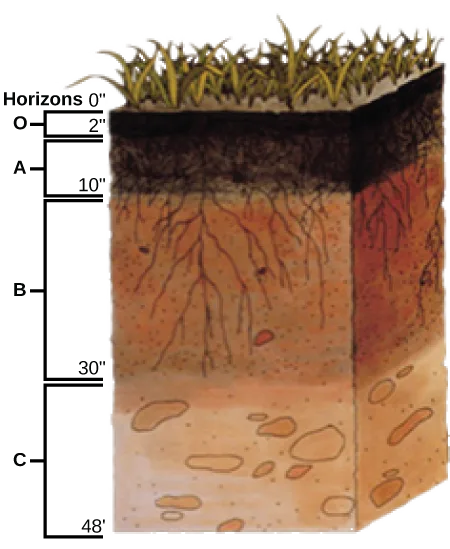
Extended description
The block is cut away to show its cross-section, with grass growing from the top surface. A vertical scale at the left, labeled ‘Horizons,’ marks four bands top to bottom. The O horizon runs from 0 to 2 inches: a thin, near-black band of freshly decomposing organic matter just beneath the grass. The A horizon runs from 2 to 10 inches: a dark reddish-brown band packed with a dense mat of fine roots. The B horizon runs from 10 to 30 inches: a lighter reddish-orange band where the roots continue but grow sparser and thicker, tapering out about two-thirds of the way down and not reaching the band’s base. The C horizon runs from 30 to 48 inches: the lightest, tan-colored band, with no roots and about a dozen light orange oval rock fragments scattered through it.
Which horizon is considered the topsoil, and which is considered the subsoil?
Show model answer
Did your answer mention:
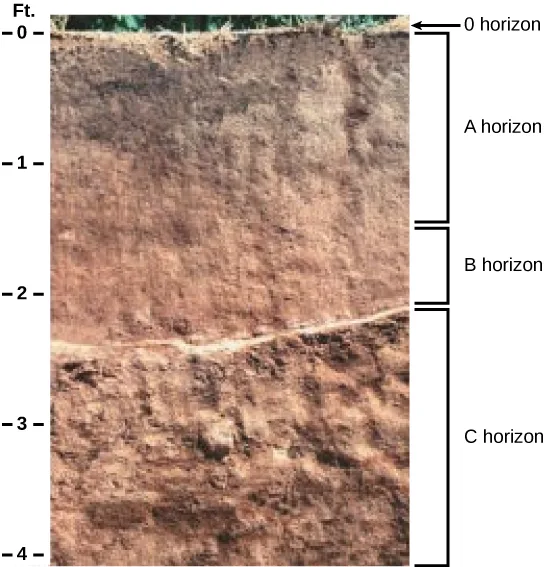
Some soils may have additional layers, or lack one of these layers. The thickness of the layers is also variable, and depends on the factors that influence soil formation. In general, immature soils may have O, A, and C horizons, whereas mature soils may display all of these, plus additional layers (shown below).
Career Connection. Soil Scientist.
A soil scientist studies the biological components, physical and chemical properties, distribution, formation, and morphology of soils. Soil scientists need to have a strong background in physical and life sciences, plus a foundation in mathematics. They may work for federal or state agencies, academia, or the private sector. Their work may involve collecting data, carrying out research, interpreting results, inspecting soils, conducting soil surveys, and recommending soil management programs.
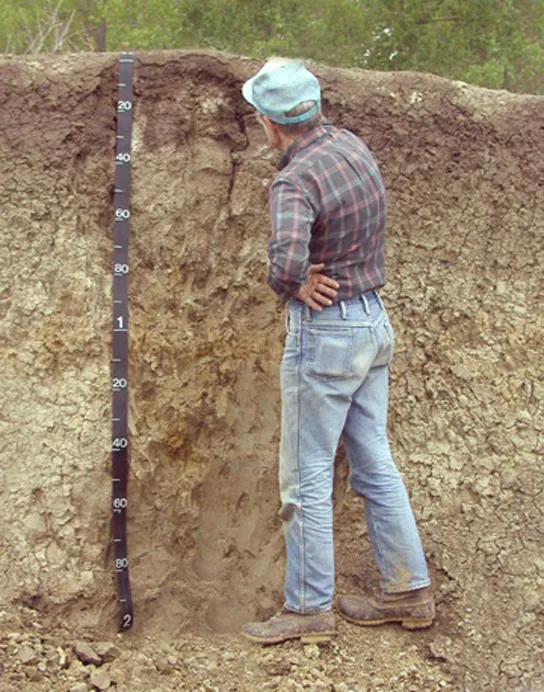
Many soil scientists work both in an office and in the field. According to the United States Department of Agriculture (USDA): “a soil scientist needs good observation skills to analyze and determine the characteristics of different types of soils. Soil types are complex and the geographical areas a soil scientist may survey are varied. Aerial photos or various satellite images are often used to research the areas. Computer skills and geographic information systems (GIS) help the scientist to analyze the multiple facets of geomorphology, topography, vegetation, and climate to discover the patterns left on the landscape.” (National Resources Conservation Service / United States Department of Agriculture, “Careers in Soil Science”) Soil scientists play a key role in understanding the soil’s past, analyzing present conditions, and making recommendations for future soil-related practices.
Summary
Plants obtain mineral nutrients from the soil. Soil is the outer loose layer that covers the surface of Earth. Soil quality depends on the chemical composition of the soil, the topography, the presence of living organisms, the climate, and time. Agricultural practice and history may also modify the characteristics and fertility of soil. Soil consists of four major components: 1) inorganic mineral matter, 2) organic matter, 3) water and air, and 4) living matter. The organic material of soil is made of humus, which improves soil structure and provides water and minerals. Soil inorganic material consists of rock slowly broken down into smaller particles that vary in size, such as sand, silt, and loam.
Soil formation results from a combination of biological, physical, and chemical processes. Soil is not homogenous because its formation results in the production of layers called a soil profile. Factors that affect soil formation include: parent material, climate, topography, biological factors, and time. Soils are classified based on their horizons, soil particle size, and proportions. Most soils have four distinct horizons: O, A, B, and C.
Key terms
- A horizon — consists of a mixture of organic material with inorganic products of weathering.
- B horizon — soil layer that is an accumulation of mostly fine material that has moved downward.
- bedrock — solid rock that lies beneath the soil.
- C horizon — layer of soil that contains the parent material, and the organic and inorganic material that is broken down to form soil; also known as the soil base.
- clay — soil particles that are less than 0.002 mm in diameter.
- horizon — soil layer with distinct physical and chemical properties, which differs from other layers depending on how and when it was formed.
- humus — organic material of soil; made up of microorganisms, dead animals, and plants in varying stages of decay.
- loam — soil that has no dominant particle size.
- mineral soil — type of soil that is formed from the weathering of rocks and inorganic material; composed primarily of sand, silt, and clay.
- O horizon — layer of soil with humus at the surface and decomposed vegetation at the base.
- organic soil — type of soil that is formed from sedimentation; composed primarily of organic material.
- parent material — organic and inorganic material in which soils form.
- rhizosphere — area of soil affected by root secretions and microorganisms.
- sand — soil particles between 0.1–2 mm in diameter.
- silt — soil particles between 0.002 and 0.1 mm in diameter.
- soil profile — vertical section of a soil.
- soil — outer loose layer that covers the surface of Earth.
Practice
Describe how soils are formed
Which factors affect soil quality?
The section’s opening paragraph names three of these on their own, then the fourth option gathers them together with one more.What is the term used to describe the solid rock that lies beneath the soil?
Mineral soils form directly from the weathering of this material, and share its original composition.Name and briefly explain the factors that affect soil formation.
Show model answer
Did your answer mention:
Describe how topography influences the characteristics and fertility of a soil.
Show model answer
Did your answer mention:
The organic and inorganic material in which soils form is called the ________.
Mineral soils form directly from the weathering of bedrock, one example of this.Explain soil composition
Soil particles that are 0.1 to 2 mm in diameter are called ________.
These are the largest of the three named mineral particle sizes.Describe the main differences between a mineral soil and an organic soil.
Show model answer
Did your answer mention:
The organic material of soil, made up of microorganisms and dead animals and plants in varying stages of decay, is called ________.
This material improves soil structure and provides plants with water and minerals.A soil that has no dominant particle size, containing a mixture of sand, silt, and humus, is called a ________.
It is the balanced mix of sand, silt, clay, and humus that gardeners prize — no single particle size dominates.Describe a soil profile
A soil consists of layers called ________ that taken together are called a ________.
The smaller term names one layer; the larger term names the whole vertical stack of them.The vertical section of a soil, made up of distinct layers, is called the ________.
Soil scientists divide this vertical section into zones called horizons.A soil layer with distinct physical and chemical properties that differ from those of other layers is called a ________.
A soil profile is built from a stack of these zones.The soil layer with freshly decomposing organic matter at its surface and decomposed vegetation at its base is called the ________.
This uppermost layer is where topsoil is found.This section is adapted from Biology 2e, Section 31.2: The Soil by Mary Ann Clark, Jung Choi, Matthew Douglas, and OpenStax, © OpenStax, licensed under CC BY-NC-SA 4.0. Access the original for free at openstax.org. Changes: figures re-encoded as WebP; a longdesc added to the two Visual Connection diagrams (the soil-composition pie chart, Figure_31_02_01, and the soil-horizon cross-section, Figure_31_02_02), whose percentage and depth labels are not fully carried by their one-line captions, the second written to avoid stating which horizon is topsoil and which is subsoil, the answer to the question beneath it; the two notes of class visual-connection rendered as their figure followed by a self-check, kept in the body, since both are keyed with prose solutions rather than a choice; the interactive and career notes rendered as a Link to Learning callout with descriptive link text and a Career Connection callout keeping its title and figure; the Career Connection’s closing footnote citation kept as a parenthetical after the sentence it supports; the end-of-section Review Questions and Critical Thinking Questions adapted into the closing interactive Practice block (multiple choice and self-check respectively); rubric checkpoints added to each self-check, decomposing its model answer (the source solution) into check-off clauses with no new claims; six key-term recall items (parent material, humus, loam, soil profile, horizon, O horizon) added from the glossary to round out all three Practice groups with an auto-graded item each; and the Topography subsection’s “Stees soils are more prone to erosion,” repeated verbatim in the Critical Thinking solution for “Describe how topography influences the characteristics and fertility of a soil,” corrected to “Steep soils are more prone to erosion” in both places — the printed edition sets the same sentence as “Steeps soils,” a different misreading of the same word, confirming the CNXML’s “Stees” is not a deliberate spelling — reported as a source defect.