Nutritional Adaptations of Plants
By the end of this section, you will be able to:
- Understand the nutritional adaptations of plants
- Describe mycorrhizae
- Explain nitrogen fixation
Plants obtain food in two different ways. Autotrophic plants can make their own food from inorganic raw materials, such as carbon dioxide and water, through photosynthesis in the presence of sunlight. Green plants are included in this group. Some plants, however, are heterotrophic: they are totally parasitic and lacking in chlorophyll. These plants, referred to as holo-parasitic plants, are unable to synthesize organic carbon and draw all of their nutrients from the host plant.
Plants may also enlist the help of microbial partners in nutrient acquisition. Particular species of bacteria and fungi have evolved along with certain plants to create a mutualistic symbiotic relationship with roots. This improves the nutrition of both the plant and the microbe. The formation of nodules in legume plants and mycorrhization can be considered among the nutritional adaptations of plants. However, these are not the only type of adaptations that we may find; many plants have other adaptations that allow them to thrive under specific conditions.
Link to Learning
This video reviewing basic concepts about photosynthesis lets you click each tab in the left panel to select a topic for review.
Nitrogen Fixation: Root and Bacteria Interactions
Nitrogen is an important macronutrient because it is part of nucleic acids and proteins. Atmospheric nitrogen, which is the diatomic molecule N₂, or dinitrogen, is the largest pool of nitrogen in terrestrial ecosystems. However, plants cannot take advantage of this nitrogen because they do not have the necessary enzymes to convert it into biologically useful forms. However, nitrogen can be “fixed,” which means that it can be converted to ammonia (NH₃) through biological, physical, or chemical processes. As you have learned, biological nitrogen fixation (BNF) is the conversion of atmospheric nitrogen (N₂) into ammonia (NH₃), exclusively carried out by prokaryotes such as soil bacteria or cyanobacteria. Biological processes contribute 65 percent of the nitrogen used in agriculture. The following equation represents the process:
N₂ + 16 ATP + 8 e⁻ + 8 H⁺ → 2 NH₃ + 16 ADP + 16 Pi + H₂
The most important source of BNF is the symbiotic interaction between soil bacteria and legume plants, including many crops important to humans (pictured below). The NH₃ resulting from fixation can be transported into plant tissue and incorporated into amino acids, which are then made into plant proteins. Some legume seeds, such as soybeans and peanuts, contain high levels of protein, and serve among the most important agricultural sources of protein in the world.
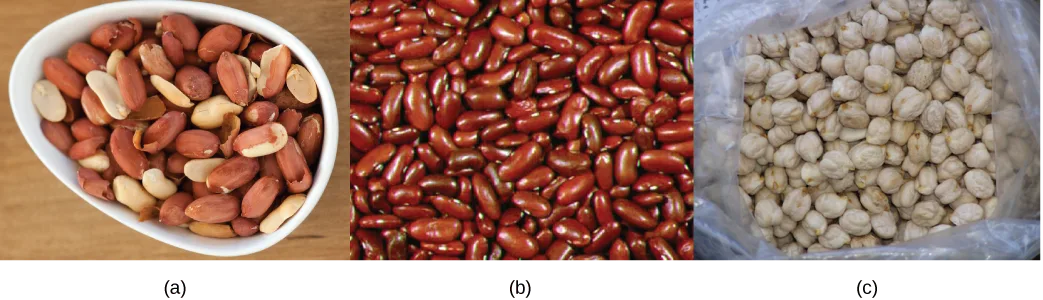
Farmers often rotate corn (a cereal crop) and soy beans (a legume), planting a field with each crop in alternate seasons. What advantage might this crop rotation confer?
Show model answer
Did your answer mention:
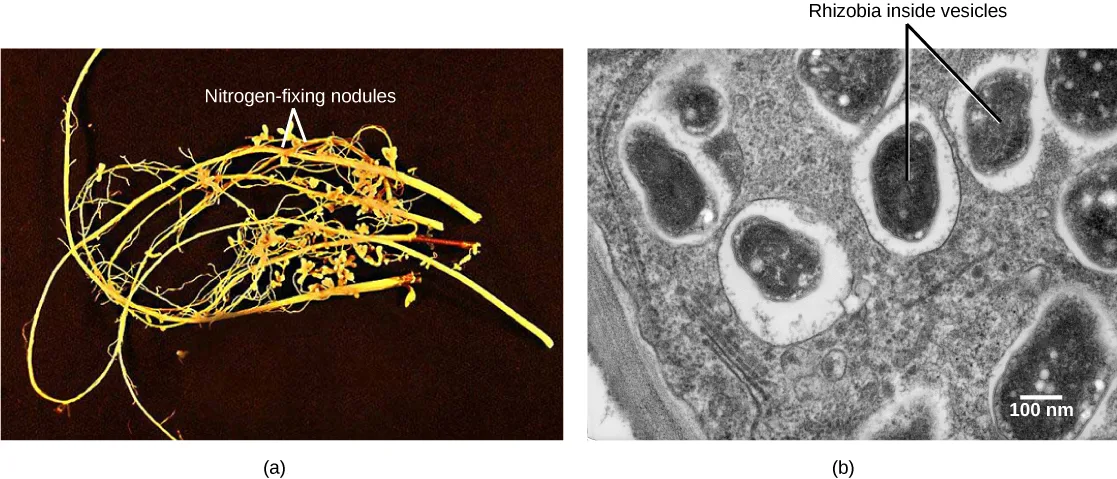
Soil bacteria, collectively called rhizobia, symbiotically interact with legume roots to form specialized structures called nodules, in which nitrogen fixation takes place. This process entails the reduction of atmospheric nitrogen to ammonia, by means of the enzyme nitrogenase. Therefore, using rhizobia is a natural and environmentally friendly way to fertilize plants, as opposed to chemical fertilization that uses a nonrenewable resource, such as natural gas. Through symbiotic nitrogen fixation, the plant benefits from using an endless source of nitrogen from the atmosphere. The process simultaneously contributes to soil fertility because the plant root system leaves behind some of the biologically available nitrogen. As in any symbiosis, both organisms benefit from the interaction: the plant obtains ammonia, and bacteria obtain carbon compounds generated through photosynthesis, as well as a protected niche in which to grow (pictured below).
Mycorrhizae: The Symbiotic Relationship between Fungi and Roots
A nutrient depletion zone can develop when there is rapid soil solution uptake, low nutrient concentration, low diffusion rate, or low soil moisture. These conditions are very common; therefore, most plants rely on fungi to facilitate the uptake of minerals from the soil. Fungi form symbiotic associations called mycorrhizae with plant roots, in which the fungi actually are integrated into the physical structure of the root. The fungi colonize the living root tissue during active plant growth.
Through mycorrhization, the plant obtains mainly phosphate and other minerals, such as zinc and copper, from the soil. The fungus obtains nutrients, such as sugars, from the plant root (pictured below). Mycorrhizae help increase the surface area of the plant root system because hyphae, which are narrow, can spread beyond the nutrient depletion zone. Hyphae can grow into small soil pores that allow access to phosphorus that would otherwise be unavailable to the plant. The beneficial effect on the plant is best observed in poor soils. The benefit to fungi is that they can obtain up to 20 percent of the total carbon accessed by plants. Mycorrhizae functions as a physical barrier to pathogens. It also provides an induction of generalized host defense mechanisms, and sometimes involves production of antibiotic compounds by the fungi.
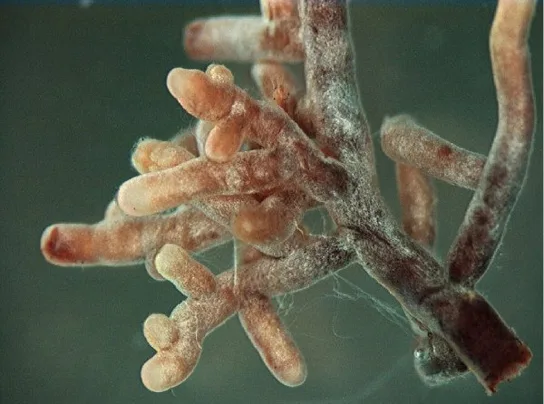
There are two types of mycorrhizae: ectomycorrhizae and endomycorrhizae. Ectomycorrhizae form an extensive dense sheath around the roots, called a mantle. Hyphae from the fungi extend from the mantle into the soil, which increases the surface area for water and mineral absorption. This type of mycorrhizae is found in forest trees, especially conifers, birches, and oaks. Endomycorrhizae, also called arbuscular mycorrhizae, do not form a dense sheath over the root. Instead, the fungal mycelium is embedded within the root tissue. Endomycorrhizae are found in the roots of more than 80 percent of terrestrial plants.
Nutrients from Other Sources
Some plants cannot produce their own food and must obtain their nutrition from outside sources. This may occur with plants that are parasitic or saprophytic. Some plants are mutualistic symbionts, epiphytes, or insectivorous.
Plant Parasites
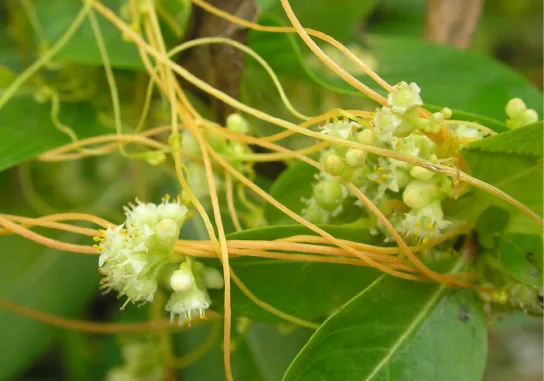
A parasitic plant depends on its host for survival. Some parasitic plants have no leaves. An example of this is the dodder (pictured below), which has a weak, cylindrical stem that coils around the host and forms suckers. From these suckers, cells invade the host stem and grow to connect with the vascular bundles of the host. The parasitic plant obtains water and nutrients through these connections. The plant is a total parasite (a holoparasite) because it is completely dependent on its host. Other parasitic plants (hemiparasites) are fully photosynthetic and only use the host for water and minerals. There are about 4,100 species of parasitic plants.
Saprophytes
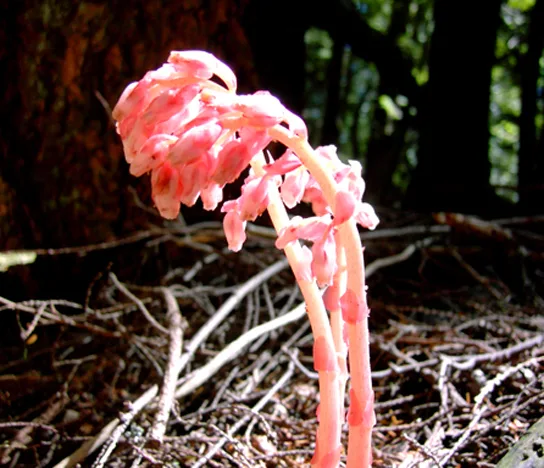
A saprophyte is a plant that does not have chlorophyll and gets its food from dead matter, similar to bacteria and fungi (note that fungi are often called saprophytes, which is incorrect, because fungi are not plants). Plants like these use enzymes to convert organic food materials into simpler forms from which they can absorb nutrients (pictured below). Most saprophytes do not directly digest dead matter: instead, they parasitize fungi that digest dead matter, or are mycorrhizal, ultimately obtaining photosynthate from a fungus that derived photosynthate from its host. Saprophytic plants are uncommon; only a few species are described.
Symbionts
A symbiont is a plant in a symbiotic relationship, with special adaptations such as mycorrhizae or nodule formation (see the mycorrhizal root tips and soybean nodules pictured above).

Epiphytes
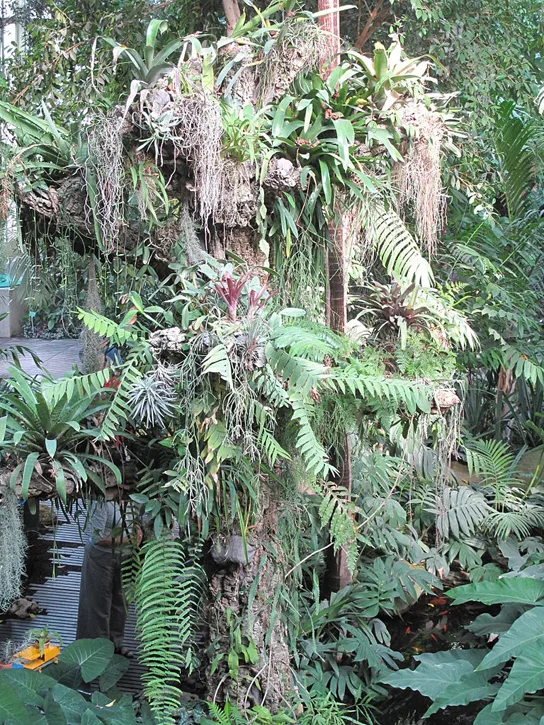
An epiphyte is a plant that grows on other plants, but is not dependent upon the other plant for nutrition (pictured below). Epiphytes have two types of roots: clinging aerial roots, which absorb nutrients from humus that accumulates in the crevices of trees; and aerial roots, which absorb moisture from the atmosphere.
Insectivorous Plants
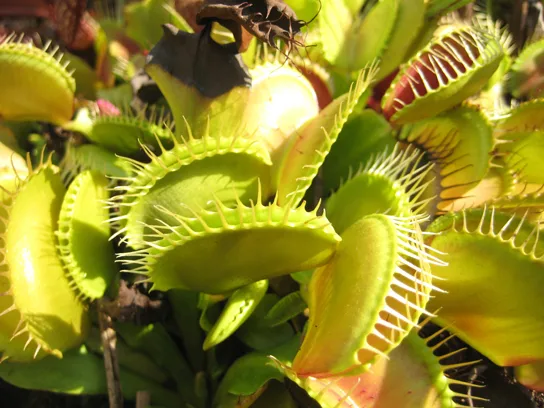
An insectivorous plant has specialized leaves to attract and digest insects. The Venus flytrap is popularly known for its insectivorous mode of nutrition, and has leaves that work as traps (pictured below). The minerals it obtains from prey compensate for those lacking in the boggy (low pH) soil of its native North Carolina coastal plains. There are three sensitive hairs in the center of each half of each leaf. The edges of each leaf are covered with long spines. Nectar secreted by the plant attracts flies to the leaf. When a fly touches the sensory hairs, the leaf immediately closes. Next, fluids and enzymes break down the prey and minerals are absorbed by the leaf. Since this plant is popular in the horticultural trade, it is threatened in its original habitat.
Summary
Atmospheric nitrogen is the largest pool of available nitrogen in terrestrial ecosystems. However, plants cannot use this nitrogen because they do not have the necessary enzymes. Biological nitrogen fixation (BNF) is the conversion of atmospheric nitrogen to ammonia. The most important source of BNF is the symbiotic interaction between soil bacteria and legumes. The bacteria form nodules on the legume’s roots in which nitrogen fixation takes place. Fungi form symbiotic associations (mycorrhizae) with plants, becoming integrated into the physical structure of the root. Through mycorrhization, the plant obtains minerals from the soil and the fungus obtains photosynthate from the plant root. Ectomycorrhizae form an extensive dense sheath around the root, while endomycorrhizae are embedded within the root tissue. Some plants—parasites, saprophytes, symbionts, epiphytes, and insectivores—have evolved adaptations to obtain their organic or mineral nutrition from various sources.
Key terms
- epiphyte — plant that grows on other plants but is not dependent upon other plants for nutrition.
- insectivorous plant — plant that has specialized leaves to attract and digest insects.
- nitrogenase — enzyme that is responsible for the reduction of atmospheric nitrogen to ammonia.
- nodules — specialized structures that contain Rhizobia bacteria where nitrogen fixation takes place.
- parasitic plant — plant that is dependent on its host for survival.
- rhizobia — soil bacteria that symbiotically interact with legume roots to form nodules and fix nitrogen.
- saprophyte — plant that does not have chlorophyll and gets its food from dead matter.
- symbiont — plant in a symbiotic relationship with bacteria or fungi.
Practice
Understand the nutritional adaptations of plants
What term describes a plant that requires nutrition from a living host plant?
This kind of plant, like the dodder, coils its stem around a host and taps directly into its vascular bundles for water and nutrients.A plant that is dependent on its host for survival is called a ________.
This plant’s suckers invade a host’s stem and tap into its vascular bundles for water and nutrients — the dodder is a well-known example.A plant that does not have chlorophyll and gets its food from dead matter is called a ________.
Unlike fungi (which are commonly, but incorrectly, given this same name), most of these rare plants don’t digest dead matter directly — they parasitize a fungus that already has.What is the term for the symbiotic association between fungi and cyanobacteria?
This crust-like growth clings to the bark of the pine trunk shown earlier in the section, and the module cross-references its own chapter on fungi for more.A plant in a symbiotic relationship with bacteria or fungi is called a ________.
This kind of plant’s special adaptations include forming root nodules or partnering with mycorrhizal fungi — the general term for one partner in any mutualistic pairing.A plant that grows on other plants but is not dependent upon them for nutrition is called an ________.
This plant’s clinging aerial roots pull nutrients from humus trapped in tree crevices, while its other aerial roots absorb moisture straight from the air.A plant with specialized leaves that attract and digest insects is called a(n) ________.
The Venus flytrap is the best-known example: sensitive hairs inside the trap trigger the leaf to snap shut around its prey.Describe mycorrhizae
Through mycorrhization, a plant obtains important nutrients such as ________.
Re-read the body paragraph naming exactly which trace minerals accompany the phosphate mycorrhizal fungi deliver to the plant.Ectomycorrhizae form an extensive dense sheath around the root, while ________ are embedded within the root tissue.
This form doesn’t build a dense mantle around the root — instead the fungal mycelium works directly into the root tissue, and it’s the type found in more than 80 percent of terrestrial plants.Fungi form symbiotic associations called ________ with plants, becoming integrated into the physical structure of the root.
This fungal partnership becomes physically integrated into the root itself — unlike the option describing a bulge that legume roots grow, or the option naming the soil bacteria that colonize it.Explain nitrogen fixation
Which process produces an inorganic compound that plants can easily use?
This is the process that converts atmospheric N₂ into ammonia — the same conversion the section’s opening equation describes.The soil bacteria that symbiotically interact with legume roots to form nodules and fix nitrogen are collectively called ________.
The soybean-nodule figure’s transmission electron micrograph shows these nitrogen-fixing bacteria packed inside vesicles within a nodule cell.The specialized root structures that contain rhizobia bacteria, where nitrogen fixation takes place, are called ________.
These bulbous swellings form on legume roots — soybean roots studied under a microscope show masses of bacteria packed inside them.The enzyme responsible for the reduction of atmospheric nitrogen to ammonia is called ________.
Rhizobia use this enzyme to carry out the exact chemical conversion the section’s opening equation shows: atmospheric N₂ becoming ammonia.Why is biological nitrogen fixation an environmentally friendly way of fertilizing plants?
Show model answer
Did your answer mention:
What is the main difference, from an energy point of view, between photosynthesis and biological nitrogen fixation?
Show model answer
Did your answer mention:
Why is a root nodule a nutritional adaptation of a plant?
Show model answer
Did your answer mention:
This section is adapted from Biology 2e, Section 31.3: Nutritional Adaptations of Plants by Mary Ann Clark, Jung Choi, Matthew Douglas, and OpenStax, © OpenStax, licensed under CC BY-NC-SA 4.0. Access the original for free at openstax.org. Changes: figures re-encoded as WebP with a custom alt written from each image rather than reusing the source’s own bare “Photo shows…” alts; Figure_31_03_01abc re-kinded from the manifest’s file-extension “diagram” guess to “photo” (three side-by-side photographs of legumes, not a diagram); the interactive note rendered as a Link to Learning callout keeping its video URL; the note wrapping the Visual Connection Question rendered as its figure followed by a self-check (the source keys prose, not a lettered choice), kept in the body; the genus name in Figure 31.11’s caption, printed in the module as “Bradyrhyzobium japonicum,” corrected to the standard spelling “Bradyrhizobium japonicum” — reported as a source defect; the end-of-section Review Questions and Critical Thinking Questions adapted into the closing interactive Practice block (multiple choice and self-check respectively); rubric checkpoints added to each self-check, decomposing its model answer (the source solution) into check-off clauses with no new claims; eight key-term recall items added from the glossary, one per definition; the thin “Describe mycorrhizae” objective group — served by only one Review Question in the source — filled out with a cloze text-in and a select-the-term multiple choice, both built from the section’s own summary sentence on ectomycorrhizae, endomycorrhizae, and mycorrhizae, with no new claim.