Asexual Reproduction
By the end of this section, you will be able to:
- Compare the mechanisms and methods of natural and artificial asexual reproduction
- Describe the advantages and disadvantages of natural and artificial asexual reproduction
- Discuss plant life spans
Many plants are able to propagate themselves using asexual reproduction. This method does not require the investment required to produce a flower, attract pollinators, or find a means of seed dispersal. Asexual reproduction produces plants that are genetically identical to the parent plant because no mixing of male and female gametes takes place. Traditionally, these plants survive well under stable environmental conditions when compared with plants produced from sexual reproduction because they carry genes identical to those of their parents.
Many different types of stems exhibit asexual reproduction (pictured below). The corm is used by gladiolus. (Source note: the source adds garlic here; garlic forms a bulb, as this page’s own figure and the Stems section’s bulb examples show.) Bulbs, such as a scaly bulb in lilies and a tunicate bulb in daffodils, are other common examples. A potato is a stem tuber, while parsnip propagates from a taproot. Ginger and iris produce rhizomes, while ivy uses an adventitious root (a root arising from a plant part other than the main or primary root), and the strawberry plant has a stolon, which is also called a runner.
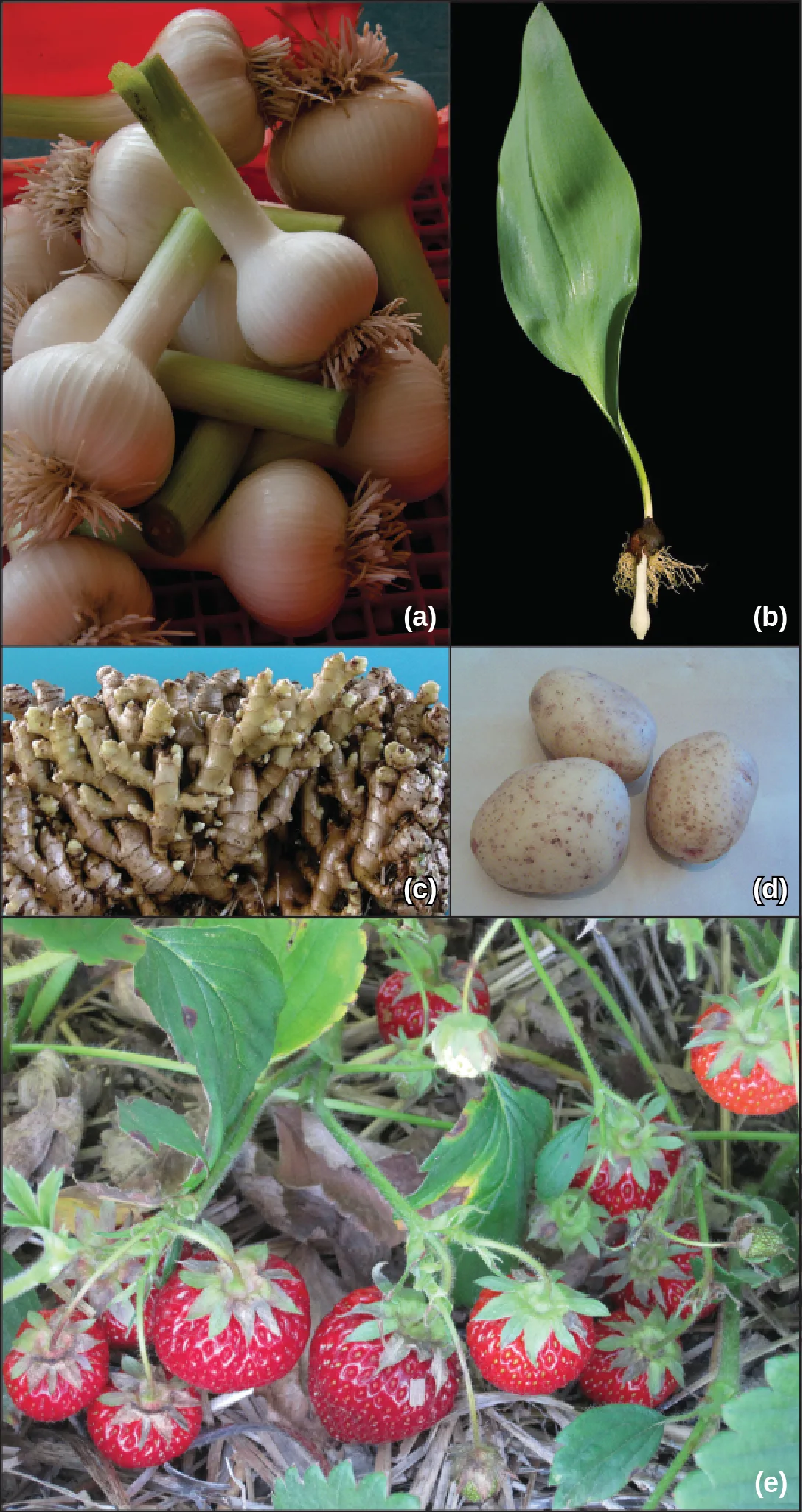
Some plants can produce seeds without fertilization. Either the ovule or part of the ovary, which is diploid in nature, gives rise to a new seed. This method of reproduction is known as apomixis.
An advantage of asexual reproduction is that the resulting plant will reach maturity faster. Since the new plant is arising from an adult plant or plant parts, it will also be sturdier than a seedling. Asexual reproduction can take place by natural or artificial (assisted by humans) means.
Natural Methods of Asexual Reproduction
Natural methods of asexual reproduction include strategies that plants have developed to self-propagate. Many plants—like ginger, onion, gladioli, and dahlia—continue to grow from buds that are present on the surface of the stem. In some plants, such as the sweet potato, adventitious roots or runners can give rise to new plants (pictured below). In Bryophyllum and kalanchoe, the leaves have small buds on their margins. When these are detached from the plant, they grow into independent plants; or, they may start growing into independent plants if the leaf touches the soil. Some plants can be propagated through cuttings alone.
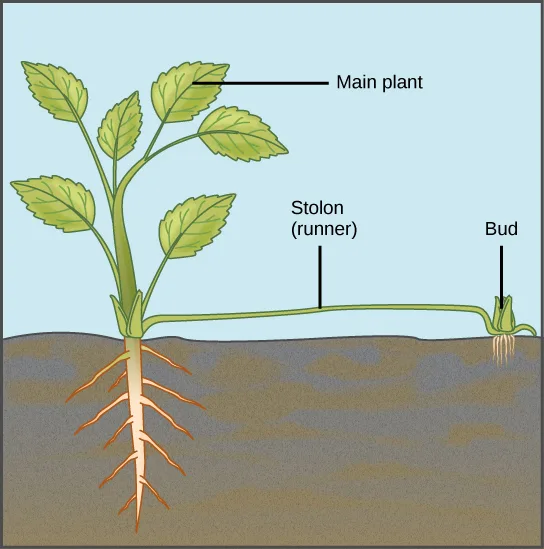
Extended description
The main plant, leafy and rooted in soil at left, is labeled ‘Main plant.’ A horizontal stem labeled ‘Stolon (runner)’ runs from its base along the soil surface to the right, ending at a small sprout labeled ‘Bud,’ which has grown its own short roots down into the soil.
Artificial Methods of Asexual Reproduction
These methods are frequently employed to give rise to new, and sometimes novel, plants. They include grafting, cutting, layering, and micropropagation.
Grafting
Grafting has long been used to produce novel varieties of roses, citrus species, and other plants. In grafting, two plant species are used; part of the stem of the desirable plant is grafted onto a rooted plant called the stock. The part that is grafted or attached is called the scion. Both are cut at an oblique angle (any angle other than a right angle), placed in close contact with each other, and are then held together (pictured below). Matching up these two surfaces as closely as possible is extremely important because these will be holding the plant together. The vascular systems of the two plants grow and fuse, forming a graft. After a period of time, the scion starts producing shoots, and eventually starts bearing flowers and fruits. Grafting is widely used in viticulture (grape growing) and the citrus industry. Scions capable of producing a particular fruit variety are grafted onto root stock with specific resistance to disease.
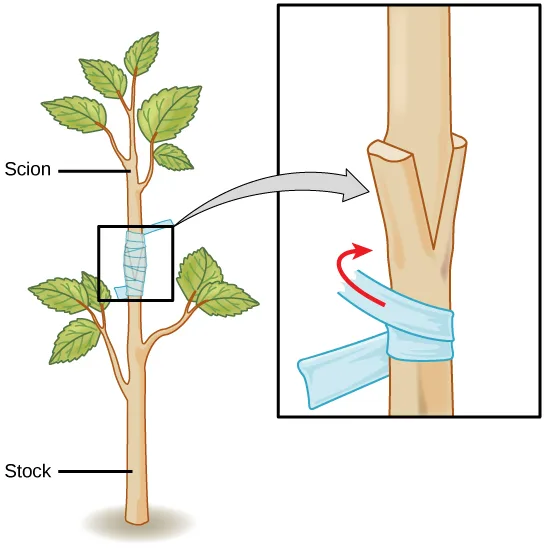
Extended description
At left, a small leafy sapling: its upper leafy stem is labeled ‘Scion’ and its bare lower trunk is labeled ‘Stock.’ A black square outlines the graft union partway up the trunk, wrapped in light blue tape, and a gray arrow leads from that square to a boxed close-up at right. The close-up shows the same union enlarged: a V-shaped notch cut into the top of the stock, the scion’s wedge-cut base set into it, a strip of light blue tape wound diagonally below the cut, and a red curved arrow showing the direction the tape wraps around the stem.
Cutting
Plants such as coleus and money plant are propagated through stem cuttings, where a portion of the stem containing nodes and internodes is placed in moist soil and allowed to root. In some species, stems can start producing a root even when placed only in water. For example, leaves of the African violet will root if kept in water undisturbed for several weeks.
Layering
Layering is a method in which a stem attached to the plant is bent and covered with soil. Young stems that can be bent easily without any injury are preferred. Jasmine and bougainvillea (paper flower) can be propagated this way (pictured below). In some plants, a modified form of layering known as air layering is employed. A portion of the bark or outermost covering of the stem is removed and covered with moss, which is then taped. Some gardeners also apply rooting hormone. After some time, roots will appear, and this portion of the plant can be removed and transplanted into a separate pot.
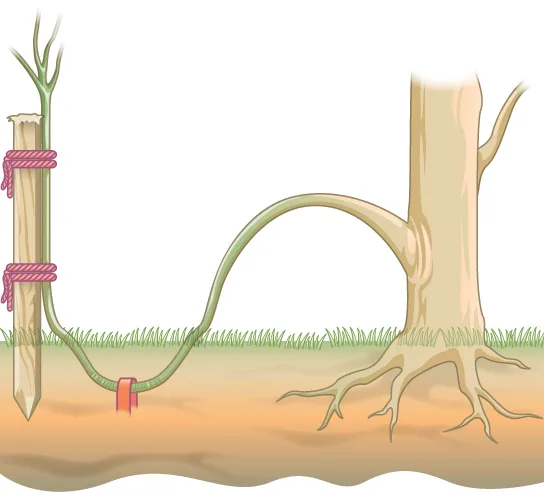
Extended description
At left, a short stake driven into the ground; a thin stem is tied to it with two pink cords, one near the top and one lower down, both above the soil line. Below the ties the stem bends down into a cross-section of soil, marked by a small red peg where it first dips under, then arcs back up on the right and merges into the base of a mature tree with a thick trunk and a wide, spreading root system. Grass tufts mark the soil surface on both sides of the buried arch.
Micropropagation
Micropropagation (also called plant tissue culture) is a method of propagating a large number of plants from a single plant in a short time under laboratory conditions (pictured below). This method allows propagation of rare, endangered species that may be difficult to grow under natural conditions, are economically important, or are in demand as disease-free plants.
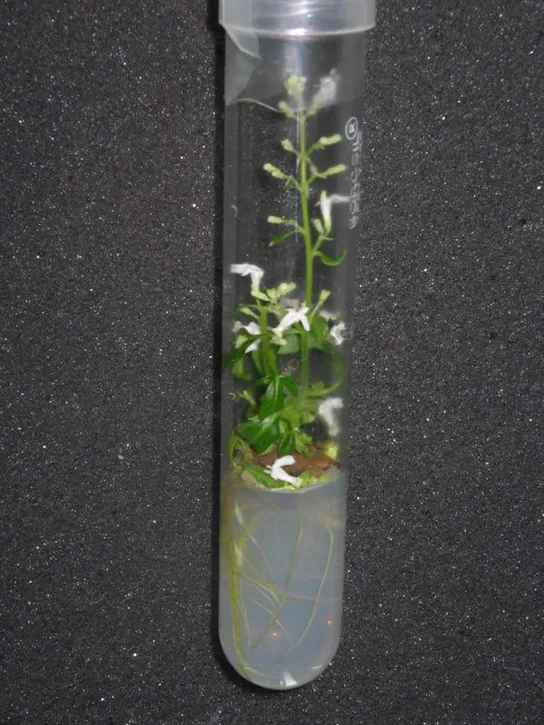
To start plant tissue culture, a part of the plant such as a stem, leaf, embryo, anther, or seed can be used. The plant material is thoroughly sterilized using a combination of chemical treatments standardized for that species. Under sterile conditions, the plant material is placed on a plant tissue culture medium that contains all the minerals, vitamins, and hormones required by the plant. The plant part often gives rise to an undifferentiated mass known as callus, from which individual plantlets begin to grow after a period of time. These can be separated and are first grown under greenhouse conditions before they are moved to field conditions.
Plant Life Spans
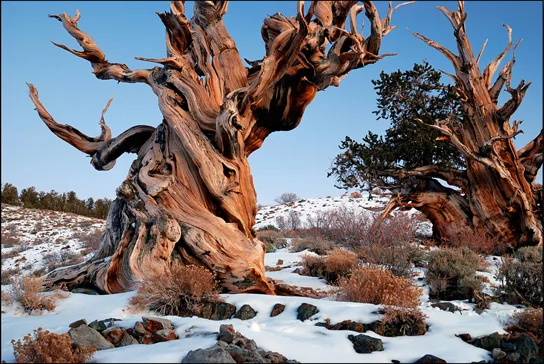
The length of time from the beginning of development to the death of a plant is called its life span. The life cycle, on the other hand, is the sequence of stages a plant goes through from seed germination to seed production of the mature plant. Some plants, such as annuals, only need a few weeks to grow, produce seeds and die. Other plants, such as the bristlecone pine, live for thousands of years. Some bristlecone pines have a documented age of 4,500 years (pictured below). Even as some parts of a plant, such as regions containing meristematic tissue—the area of active plant growth consisting of undifferentiated cells capable of cell division—continue to grow, some parts undergo programmed cell death (apoptosis). The cork found on stems, and the water-conducting tissue of the xylem, for example, are composed of dead cells.
Plant species that complete their lifecycle in one season are known as annuals, an example of which is Arabidopsis, or mouse-ear cress. Biennials such as carrots complete their lifecycle in two seasons. In a biennial’s first season, the plant has a vegetative phase, whereas in the next season, it completes its reproductive phase. Commercial growers harvest the carrot roots after the first year of growth, and do not allow the plants to flower. Perennials, such as the magnolia, complete their lifecycle in two years or more.
In another classification based on flowering frequency, monocarpic plants flower only once in their lifetime; examples include bamboo and yucca. During the vegetative period of their life cycle (which may be as long as 120 years in some bamboo species), these plants may reproduce asexually and accumulate a great deal of food material that will be required during their once-in-a-lifetime flowering and setting of seed after fertilization. Soon after flowering, these plants die. Polycarpic plants form flowers many times during their lifetime. Fruit trees, such as apple and orange trees, are polycarpic; they flower every year. Other polycarpic species, such as perennials, flower several times during their life span, but not each year. By this means, the plant does not require all its nutrients to be channelled towards flowering each year.
As is the case with all living organisms, genetics and environmental conditions have a role to play in determining how long a plant will live. Susceptibility to disease, changing environmental conditions, drought, cold, and competition for nutrients are some of the factors that determine the survival of a plant. Plants continue to grow, despite the presence of dead tissue such as cork. Individual parts of plants, such as flowers and leaves, have different rates of survival. In many trees, the older leaves turn yellow and eventually fall from the tree. Leaf fall is triggered by factors such as a decrease in photosynthetic efficiency, due to shading by upper leaves, or oxidative damage incurred as a result of photosynthetic reactions. The components of the part to be shed are recycled by the plant for use in other processes, such as development of seed and storage. This process is known as nutrient recycling.
The aging of a plant and all the associated processes is known as senescence, which is marked by several complex biochemical changes. One of the characteristics of senescence is the breakdown of chloroplasts, which is characterized by the yellowing of leaves. The chloroplasts contain components of photosynthetic machinery such as membranes and proteins. Chloroplasts also contain DNA. The proteins, lipids, and nucleic acids are broken down by specific enzymes into smaller molecules and salvaged by the plant to support the growth of other plant tissues.
The complex pathways of nutrient recycling within a plant are not well understood. Hormones are known to play a role in senescence. Applications of cytokinins and ethylene delay or prevent senescence; in contrast, abscisic acid causes premature onset of senescence.
Summary
Many plants reproduce asexually as well as sexually. In asexual reproduction, part of the parent plant is used to generate a new plant. Grafting, layering, and micropropagation are some methods used for artificial asexual reproduction. The new plant is genetically identical to the parent plant from which the stock has been taken. Asexually reproducing plants thrive well in stable environments.
Plants have different life spans, dependent on species, genotype, and environmental conditions. Parts of the plant, such as regions containing meristematic tissue, continue to grow, while other parts experience programmed cell death. Leaves that are no longer photosynthetically active are shed from the plant as part of senescence, and the nutrients from these leaves are recycled by the plant. Other factors, including the presence of hormones, are known to play a role in delaying senescence.
Key terms
- apomixis — process by which seeds are produced without fertilization of sperm and egg.
- cutting — method of asexual reproduction where a portion of the stem contains nodes and internodes is placed in moist soil and allowed to root.
- grafting — method of asexual reproduction where the stem from one plant species is spliced to a different plant.
- layering — method of propagating plants by bending a stem under the soil.
- micropropagation — propagation of desirable plants from a plant part; carried out in a laboratory.
- monocarpic — plants that flower once in their lifetime.
- polycarpic — plants that flower several times in their lifetime.
- scion — the part of a plant that is grafted onto the root stock of another plant.
- senescence — process that describes aging in plant tissues.
Practice
Compare the mechanisms and methods of natural and artificial asexual reproduction
________ is a useful method of asexual reproduction for propagating hard-to-root plants.
This technique bypasses the need for the desired stem to grow its own roots at all, by joining it directly onto an already-rooted stock plant.Describe natural and artificial methods of asexual reproduction in plants.
Show model answer
Did your answer mention:
The process by which seeds are produced without fertilization of sperm and egg is called ________.
Either the ovule or part of the diploid ovary gives rise to the new seed by this method, with no fusion of gametes at all.The part of a plant that is grafted onto the root stock of another plant is called the ________.
This piece supplies the desired stem and, eventually, the flowers and fruit, while its partner in the union supplies the roots.The method of asexual reproduction in which a portion of the stem containing nodes and internodes is placed in moist soil and allowed to root is called a ________.
Coleus and money plant are propagated this way, and some species — like the African violet — will even root when the stem piece is left undisturbed in water.Describe the advantages and disadvantages of natural and artificial asexual reproduction
Which of the following is an advantage of asexual reproduction?
Consider what stage of development a cutting or bud starts from, compared with a seed germinating from scratch.What are some advantages of asexual reproduction in plants?
Show model answer
Did your answer mention:
Asexually reproducing plants thrive well in ________.
Because these plants carry genes identical to their parents, they do best when conditions stay the same from one generation to the next — but that same genetic uniformity becomes a liability if conditions change.Discuss plant life spans
Plants that flower once in their lifetime are known as ________.
Bamboo and yucca fit this category: they spend years building up reserves before a single, life-ending bloom.Plant species that complete their lifecycle in one season are known as ________.
This category needs only one growing season to flower and set seed, unlike the two-season and multi-year categories nearby.Discuss the life cycles of various plants.
Show model answer
Did your answer mention:
How are plants classified on the basis of flowering frequency?
Show model answer
Did your answer mention:
The aging of a plant and all its associated biochemical processes is called ________.
This process includes the breakdown of chloroplasts and the yellowing of leaves; cytokinins and ethylene delay it, while abscisic acid brings it on early.This section is adapted from Biology 2e, Section 32.3: Asexual Reproduction by Mary Ann Clark, Jung Choi, Matthew Douglas, and OpenStax, © OpenStax, licensed under CC BY-NC-SA 4.0. Access the original for free at openstax.org. Changes: the section’s opening sentence “Many different types of roots exhibit asexual reproduction” corrected to “stems” — the section’s own next-sentence figure is captioned “Different types of stems allow for asexual reproduction,” and every item the sentence goes on to list (corm, bulb, stem tuber, rhizome, stolon) is a modified stem, not a root, in the section’s own subsequent explanation — reported as a source defect; figures re-encoded as WebP with a custom alt written from each image rather than reusing the source’s own bare, panel-letter-only alt text; four figures re-kinded after inspection — Figure_37_03_01 from the manifest’s file-extension “diagram” guess to “photo” (a five-panel photo composite, not a drawn illustration), and Figure_32_03_02, Figure_32_03_03, and Figure_32_03_04 from “photo” to “diagram” (line-drawn, labeled schematics, not captured photographs); a longdesc added to the three labeled diagrams (Figure_32_03_02, Figure_32_03_03, Figure_32_03_04), walking each one’s labels and layout in reading order since their one-line captions do not carry that detail; figure print-number cross-references replaced with descriptive references (“pictured below”); the end-of-section Review Questions and Critical Thinking Questions adapted into the closing interactive Practice block (multiple choice and self-check respectively), covering all four of each; rubric checkpoints added to each self-check, decomposing its model answer (the source solution) into check-off clauses with no new claims; four key-term recall items (apomixis, scion, cutting, senescence) added from the glossary, and one cloze recall item added from the chapter summary sentence “Asexually reproducing plants thrive well in stable environments.” One example is corrected with a visible Source note: garlic is dropped from the corm sentence, since it forms a bulb by this book’s own account (erratum 438).