Animal Form and Function
By the end of this section, you will be able to:
- Describe the various types of body plans that occur in animals
- Describe limits on animal size and shape
- Relate bioenergetics to body size, levels of activity, and the environment
Animals vary in form and function. From a sponge to a worm to a goat, an organism has a distinct body plan that limits its size and shape. Animals’ bodies are also designed to interact with their environments, whether in the deep sea, a rainforest canopy, or the desert. Therefore, a large amount of information about the structure of an organism’s body (anatomy) and the function of its cells, tissues and organs (physiology) can be learned by studying that organism’s environment.
Body Plans
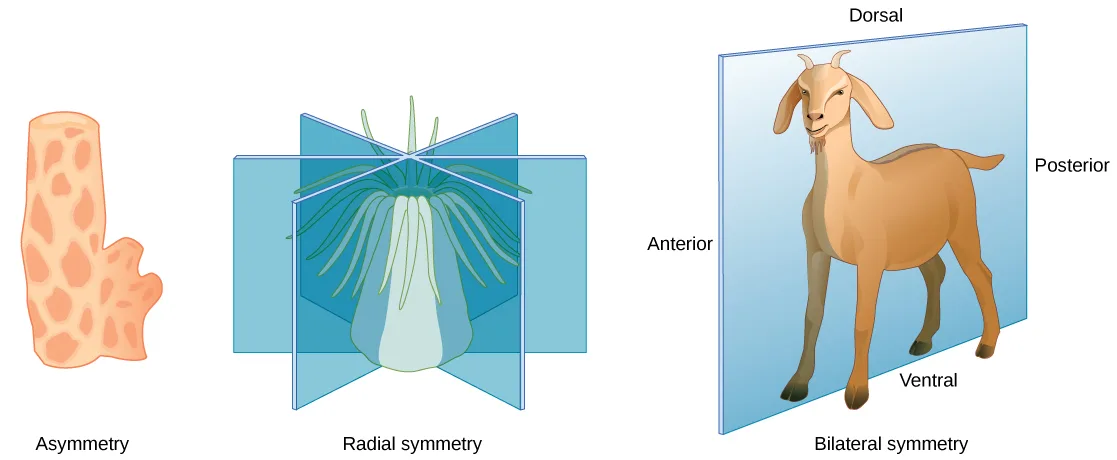
Extended description
Three panels left to right, each with its own caption beneath. The first, captioned ‘Asymmetry,’ shows an irregular, blob-like orange sponge with no plane or label. The second, captioned ‘Radial symmetry,’ shows a tube-bodied sea anemone with trailing tentacles, enclosed by three intersecting blue rectangular planes that meet along its central vertical axis. The third, captioned ‘Bilateral symmetry,’ shows a goat standing in profile inside a single blue plane running front to back through its body: ‘Dorsal’ labels the top edge of the plane, ‘Ventral’ the bottom edge near the legs, ‘Anterior’ the front (left) edge, and ‘Posterior’ the back (right) edge.
Animal body plans follow set patterns related to symmetry. They are asymmetrical, radial, or bilateral in form as illustrated above. Asymmetrical animals are animals with no pattern or symmetry; an example of an asymmetrical animal is a sponge. Radial symmetry, as illustrated above, describes when an animal has an up-and-down orientation: any plane cut along its longitudinal axis through the organism produces equal halves, but not a definite right or left side. This plan is found mostly in aquatic animals, especially organisms that attach themselves to a base, like a rock or a boat, and extract their food from the surrounding water as it flows around the organism. Bilateral symmetry is illustrated in the same figure by a goat. The goat also has an upper and lower component to it, but a plane cut from front to back separates the animal into definite right and left sides. Additional terms used when describing positions in the body are anterior (front), posterior (rear), dorsal (toward the back), and ventral (toward the stomach). Bilateral symmetry is found in both land-based and aquatic animals; it enables a high level of mobility.
Limits on Animal Size and Shape
Animals with bilateral symmetry that live in water tend to have a fusiform shape: this is a tubular shaped body that is tapered at both ends. This shape decreases the drag on the body as it moves through water and allows the animal to swim at high speeds. The table below lists the maximum speed of various animals. Certain types of sharks can swim at fifty kilometers per hour and some dolphins at 32 to 40 kilometers per hour. Land animals frequently travel faster, although the tortoise and snail are significantly slower than cheetahs. Another difference in the adaptations of aquatic and land-dwelling organisms is that aquatic organisms are constrained in shape by the forces of drag in the water since water has higher viscosity than air. On the other hand, land-dwelling organisms are constrained mainly by gravity, and drag is relatively unimportant. For example, most adaptations in birds are for gravity not for drag.
| Animal | Speed (kmh) | Speed (mph) |
|---|---|---|
| Cheetah | 113 | 70 |
| Quarter horse | 77 | 48 |
| Fox | 68 | 42 |
| Shortfin mako shark | 50 | 31 |
| Domestic house cat | 48 | 30 |
| Human | 45 | 28 |
| Dolphin | 32–40 | 20–25 |
| Mouse | 13 | 8 |
| Snail | 0.05 | 0.03 |
Maximum Speed of Assorted Land & Marine Animals
Most animals have an exoskeleton, including insects, spiders, scorpions, horseshoe crabs, centipedes, and crustaceans. Scientists estimate that, of insects alone, there are over 30 million species on our planet. The exoskeleton is a hard covering or shell that provides benefits to the animal, such as protection against damage from predators and from water loss (for land animals); it also provides for the attachments of muscles.
As the tough and resistant outer cover of an arthropod, the exoskeleton may be constructed of a tough polymer such as chitin and is often biomineralized with materials such as calcium carbonate. This is fused to the animal’s epidermis. Ingrowths of the exoskeleton, called apodemes, function as attachment sites for muscles, similar to tendons in more advanced animals (illustrated below). In order to grow, the animal must first synthesize a new exoskeleton underneath the old one and then shed or molt the original covering. This limits the animal’s ability to grow continually, and may limit the individual’s ability to mature if molting does not occur at the proper time. The thickness of the exoskeleton must be increased significantly to accommodate any increase in weight. It is estimated that a doubling of body size increases body weight by a factor of eight. The increasing thickness of the chitin necessary to support this weight limits most animals with an exoskeleton to a relatively small size. The same principles apply to endoskeletons, but they are more efficient because muscles are attached on the outside, making it easier to compensate for increased mass.
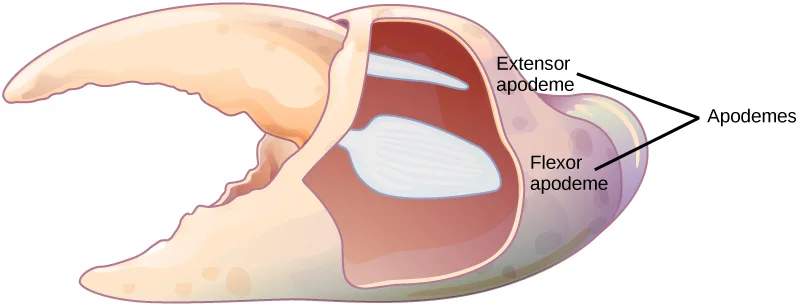
Extended description
A crab claw shown open, its shell cut away to reveal the muscle attachment sites inside the pincer’s base. Two labels point to pale ridged structures within the claw: ‘Extensor apodeme’ above the pivot point and ‘Flexor apodeme’ below it; a brace at the right groups both labels under the single heading ‘Apodemes.’
An animal with an endoskeleton has its size determined by the amount of skeletal system it needs in order to support the other tissues and the amount of muscle it needs for movement. As the body size increases, both bone and muscle mass increase. The speed achievable by the animal is a balance between its overall size and the bone and muscle that provide support and movement.
Limiting Effects of Diffusion on Size and Development
The exchange of nutrients and wastes between a cell and its watery environment occurs through the process of diffusion. All living cells are bathed in liquid, whether they are in a single-celled organism or a multicellular one. Diffusion is effective over a specific distance and limits the size that an individual cell can attain. If a cell is a single-celled microorganism, such as an amoeba, it can satisfy all of its nutrient and waste needs through diffusion. If the cell is too large, then diffusion is ineffective and the center of the cell does not receive adequate nutrients nor is it able to effectively dispel its waste.
An important concept in understanding how efficient diffusion is as a means of transport is the surface to volume ratio. Recall that any three-dimensional object has a surface area and volume; the ratio of these two quantities is the surface-to-volume ratio. Consider a cell shaped like a perfect sphere: it has a surface area of , and a volume of . The surface-to-volume ratio of a sphere is 3/r; as the cell gets bigger, its surface to volume ratio decreases, making diffusion less efficient. The larger the size of the sphere, or animal, the less surface area for diffusion it possesses.
The solution to producing larger organisms is for them to become multicellular. Specialization occurs in complex organisms, allowing cells to become more efficient at doing fewer tasks. For example, circulatory systems bring nutrients and remove waste, while respiratory systems provide oxygen for the cells and remove carbon dioxide from them. Other organ systems have developed further specialization of cells and tissues and efficiently control body functions. Moreover, surface-to-volume ratio applies to other areas of animal development, such as the relationship between muscle mass and cross-sectional surface area in supporting skeletons, and in the relationship between muscle mass and the generation and dissipation of heat.
Link to Learning
Animal Bioenergetics
All animals must obtain their energy from food they ingest or absorb. These nutrients are converted to adenosine triphosphate (ATP) for short-term storage and use by all cells. Some animals store energy for slightly longer times as glycogen, and others store energy for much longer times in the form of triglycerides housed in specialized adipose tissues. No energy system is one hundred percent efficient, and an animal’s metabolism produces waste energy in the form of heat. If an animal can conserve that heat and maintain a relatively constant body temperature, it is classified as a warm-blooded animal and called an endotherm. The insulation used to conserve the body heat comes in the forms of fur, fat, or feathers. The absence of insulation in ectothermic animals increases their dependence on the environment for body heat.
The amount of energy expended by an animal over a specific time is called its metabolic rate. The rate is measured variously in joules, calories, or kilocalories (1000 calories). Carbohydrates and proteins contain about 4.5 to 5 kcal/g, and fat contains about 9 kcal/g. Metabolic rate is estimated as the basal metabolic rate (BMR) in endothermic animals at rest and as the standard metabolic rate (SMR) in ectotherms. Human males have a BMR of 1600 to 1800 kcal/day, and human females have a BMR of 1300 to 1500 kcal/day. Even with insulation, endothermal animals require extensive amounts of energy to maintain a constant body temperature. An ectotherm such as an alligator has an SMR of 60 kcal/day.
Energy Requirements Related to Body Size
Smaller endothermic animals have a greater surface area for their mass than larger ones (illustrated below). Therefore, smaller animals lose heat at a faster rate than larger animals and require more energy to maintain a constant internal temperature. This results in a smaller endothermic animal having a higher BMR, per body weight, than a larger endothermic animal.
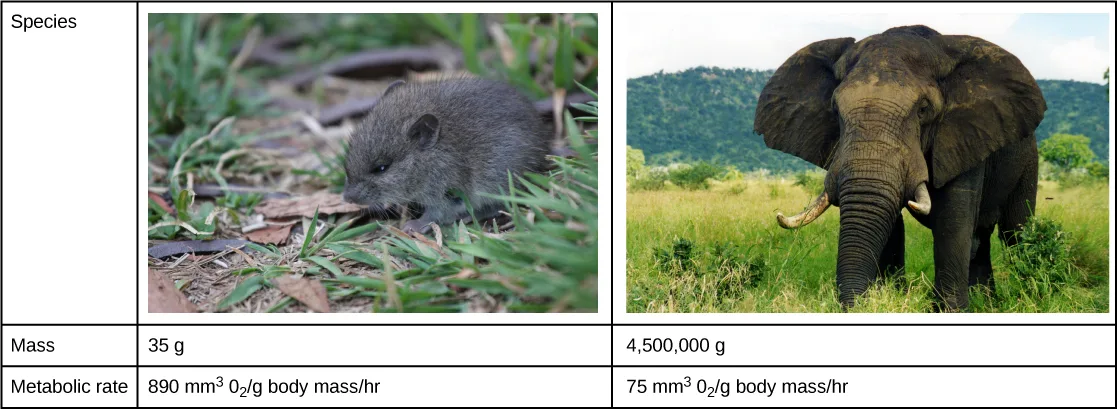
Energy Requirements Related to Levels of Activity
The more active an animal is, the more energy is needed to maintain that activity, and the higher its BMR or SMR. The average daily rate of energy consumption is about two to four times an animal’s BMR or SMR. Humans are more sedentary than most animals and have an average daily rate of only 1.5 times the BMR. The diet of an endothermic animal is determined by its BMR. For example: the type of grasses, leaves, or shrubs that an herbivore eats affects the number of calories that it takes in. The relative caloric content of herbivore foods, in descending order, is tall grasses > legumes > short grasses > forbs (any broad-leaved plant, not a grass) > subshrubs > annuals/biennials.
Energy Requirements Related to Environment
Animals adapt to extremes of temperature or food availability through torpor. Torpor is a process that leads to a decrease in activity and metabolism and allows animals to survive adverse conditions. Torpor can be used by animals for long periods, such as entering a state of hibernation during the winter months, in which case it enables them to maintain a reduced body temperature. During hibernation, ground squirrels can achieve an abdominal temperature of 0 °C (32 °F), while a bear’s internal temperature is maintained higher at about 37 °C (99 °F).
If torpor occurs during the summer months with high temperatures and little water, it is called estivation. Some desert animals use this to survive the harshest months of the year. Torpor can occur on a daily basis; this is seen in bats and hummingbirds. While endothermy is limited in smaller animals by surface to volume ratio, some organisms can be smaller and still be endotherms because they employ daily torpor during the part of the day that is coldest. This allows them to conserve energy during the colder parts of the day, when they consume more energy to maintain their body temperature.
Animal Body Planes and Cavities
A standing vertebrate animal can be divided by several planes. A sagittal plane divides the body into right and left portions. A midsagittal plane divides the body exactly in the middle, making two equal right and left halves. A frontal plane (also called a coronal plane) separates the front from the back. A transverse plane (or, horizontal plane) divides the animal into upper and lower portions. This is sometimes called a cross section, and, if the transverse cut is at an angle, it is called an oblique plane. The figure below illustrates these planes on a goat (a four-legged animal) and a human being.
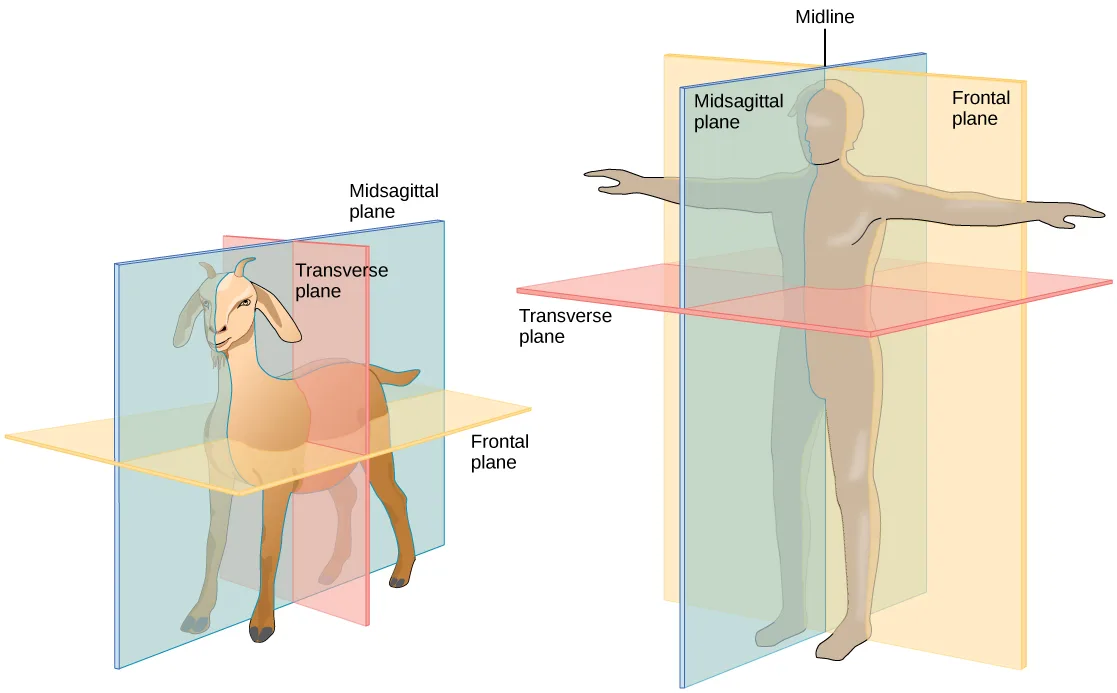
Extended description
Two panels side by side. On the left, a goat stands in profile, sliced by three intersecting planes: a blue vertical plane running the length of its body, labeled ‘Midsagittal plane’; a red vertical plane crossing its torso partway along that length, labeled ‘Transverse plane’; and a yellow horizontal plane at leg height beneath its body, labeled ‘Frontal plane.’ On the right, a human stands facing forward with arms outstretched, sliced by the same three planes, plus a ‘Midline’ label at the top marking the body’s central vertical line: a teal vertical plane running front to back through the body’s center, labeled ‘Midsagittal plane’; a yellow vertical plane running side to side through the shoulders, labeled ‘Frontal plane’; and a red horizontal plane at waist height, labeled ‘Transverse plane.’
Vertebrate animals have a number of defined body cavities, as illustrated below. Two of these are major cavities that contain smaller cavities within them. The dorsal cavity contains the cranial and the vertebral (or spinal) cavities. The ventral cavity contains the thoracic cavity, which in turn contains the pleural cavity around the lungs and the pericardial cavity, which surrounds the heart. The ventral cavity also contains the abdominopelvic cavity, which can be separated into the abdominal and the pelvic cavities.
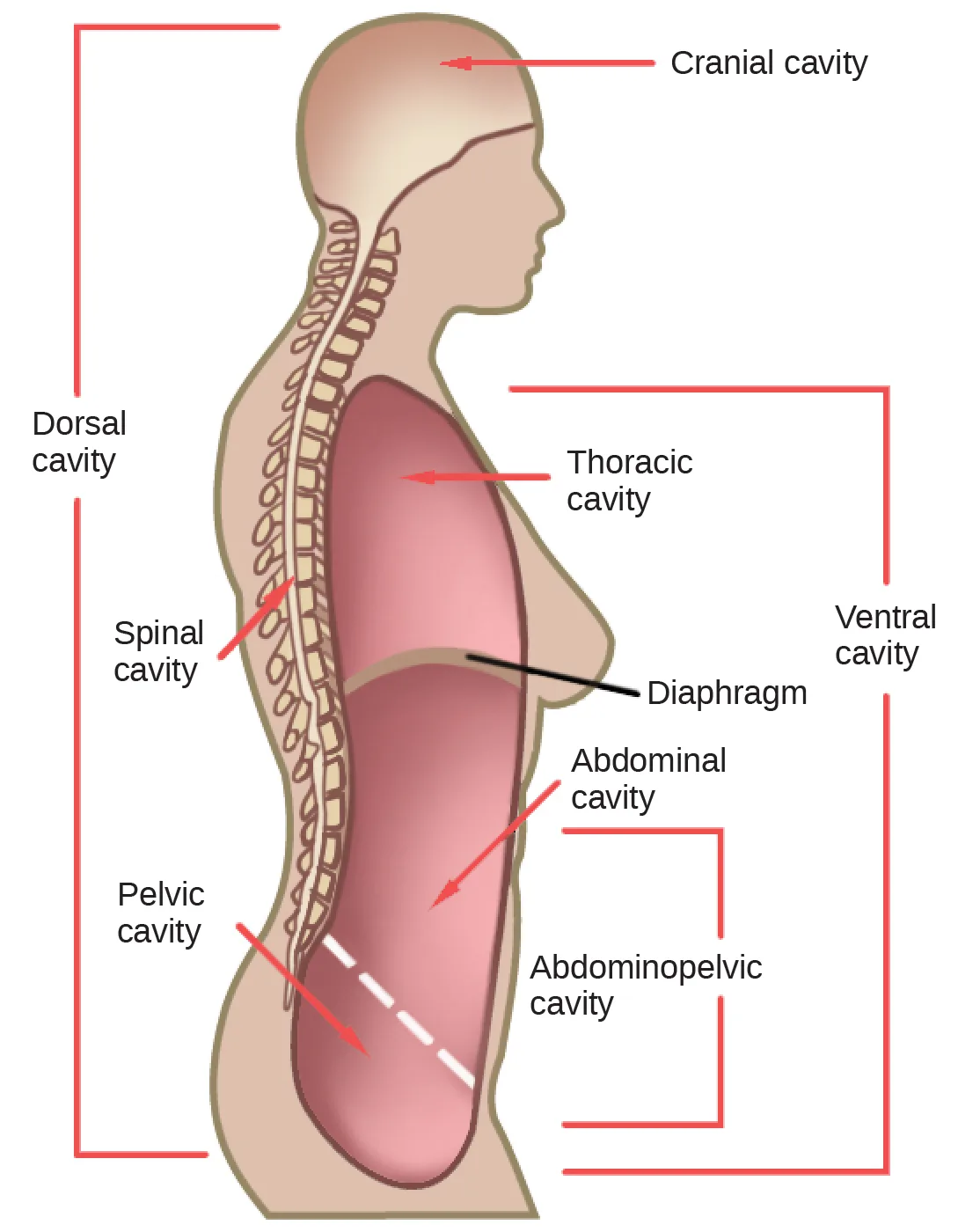
Extended description
A side profile of a human upper body, from head to hips, with cavities shaded and bracketed. At the top, ‘Cranial cavity’ labels the head. A long thin shaded strip down the back of the neck and spine is labeled ‘Spinal cavity,’ and together with the cranial cavity is bracketed at the left as the ‘Dorsal cavity.’ A large shaded region filling the front of the torso is labeled from top to bottom: ‘Thoracic cavity,’ then a boundary line labeled ‘Diaphragm,’ then ‘Abdominal cavity,’ with a white dashed line further down separating it from the ‘Pelvic cavity’ beneath. This entire front region is bracketed at the right as the ‘Ventral cavity,’ with the abdominal-and-pelvic portion beneath the diaphragm additionally bracketed and labeled ‘Abdominopelvic cavity.’
Career Connection. Physical Anthropologist. Physical anthropologists study the adaptation, variability, and evolution of human beings, plus their living and fossil relatives. They can work in a variety of settings, although most will have an academic appointment at a university, usually in an anthropology department or a biology, genetics, or zoology department.
Nonacademic positions are available in the automotive and aerospace industries where the focus is on human size, shape, and anatomy. Research by these professionals might range from studies of how the human body reacts to car crashes to exploring how to make seats more comfortable. Other nonacademic positions can be obtained in museums of natural history, anthropology, archaeology, or science and technology. These positions involve educating students from grade school through graduate school. Physical anthropologists serve as education coordinators, collection managers, writers for museum publications, and as administrators. Zoos employ these professionals, especially if they have an expertise in primate biology; they work in collection management and captive breeding programs for endangered species. Forensic science utilizes physical anthropology expertise in identifying human and animal remains, assisting in determining the cause of death, and for expert testimony in trials.
Summary
Animal bodies come in a variety of sizes and shapes. Limits on animal size and shape include impacts to their movement. Diffusion affects their size and development. Bioenergetics describes how animals use and obtain energy in relation to their body size, activity level, and environment.
Key terms
- apodeme — ingrowth of an animal’s exoskeleton that functions as an attachment site for muscles.
- asymmetrical — describes animals with no axis of symmetry in their body pattern.
- basal metabolic rate (BMR) — metabolic rate at rest in endothermic animals.
- dorsal cavity — body cavity on the posterior or back portion of an animal; includes the cranial and vertebral cavities.
- ectotherm — animal incapable of maintaining a relatively constant internal body temperature.
- endotherm — animal capable of maintaining a relatively constant internal body temperature.
- estivation — torpor in response to extremely high temperatures and low water availability.
- frontal (coronal) plane — plane cutting through an animal separating the individual into front and back portions.
- fusiform — animal body shape that is tubular and tapered at both ends.
- hibernation — torpor over a long period of time, such as a winter.
- midsagittal plane — plane cutting through an animal separating the individual into even right and left sides.
- sagittal plane — plane cutting through an animal separating the individual into right and left sides.
- standard metabolic rate (SMR) — metabolic rate at rest in ectothermic animals.
- torpor — decrease in activity and metabolism that allows an animal to survive adverse conditions.
- transverse (horizontal) plane — plane cutting through an animal separating the individual into upper and lower portions.
- ventral cavity — body cavity on the anterior or front portion of an animal that includes the thoracic cavities and the abdominopelvic cavities.
Practice
Describe the various types of body plans that occur in animals
The symmetry found in animals that move swiftly is ________.
This is the symmetry of a goat or a fish, with a plane cut front to back that yields definite right and left sides.Although most animals are bilaterally symmetrical, a few exhibit radial symmetry. What is an advantage of radial symmetry?
Think about the sea anemones and similar animals that attach to a rock or boat and extract food from the water flowing around them.A plane that divides an animal into equal right and left portions is ________.
A plain sagittal plane also divides right from left, but only this plane guarantees the two halves are equal.A plane that divides an animal into dorsal and ventral portions is ________.
This is the plane that produces a cross section, dividing the body into upper and lower portions.The pleural cavity is a part of which cavity?
This cavity, which also holds the pericardial cavity around the heart, sits inside the larger ventral cavity.The plane cutting through an animal that separates it into front and back portions is called the ________.
The section also calls this plane by a second name, the one used for the similarly angled plane in dental and skull anatomy.The plane cutting through an animal that separates it into right and left sides, without requiring the two sides to be equal, is called the ________.
A more exact version of this plane, one that splits the body into precisely equal right and left halves, adds the prefix ‘mid-’ to the same term.Describe limits on animal size and shape
How does diffusion limit the size of an organism? How is this counteracted?
Show model answer
Did your answer mention:
Explain how using an open circulatory system constrains the size of animals.
Show model answer
Did your answer mention:
An animal body shape that is tubular and tapered at both ends is called ________.
This shape decreases drag as an animal with bilateral symmetry swims through water, letting it reach higher speeds.An ingrowth of an animal’s exoskeleton that functions as an attachment site for muscles is called an ________.
On a crab’s claw, this structure sits above and below the fulcrum, similar in role to a tendon in an animal with an endoskeleton.Relate bioenergetics to body size, levels of activity, and the environment
Which type of animal maintains a constant internal body temperature?
This animal conserves the heat its metabolism produces using insulation such as fur, fat, or feathers.What term describes the condition of a desert mouse that lowers its metabolic rate and “sleeps” during the hot day?
This is torpor brought on by high temperatures and scarce water, rather than by a long cold season.How could the increasing global temperature associated with climate change impact ectotherms?
Think about a region that used to be too cold for a given ectotherm year-round, and what warming does to that limit.What is the relationship between BMR and body size? Why?
Show model answer
Did your answer mention:
Describe one key environmental constraint for ectotherms and one for endotherms. Why are they limited by different factors?
Show model answer
Did your answer mention:
Torpor in response to extremely high temperatures and low water availability is called ________.
Some desert animals use this to survive the driest, hottest months of the year.Torpor over a long period of time, such as a winter, is called ________.
A ground squirrel entering this state can let its abdominal temperature drop to 0 °C.This section is adapted from Biology 2e, Section 33.1: Animal Form and Function by Mary Ann Clark, Jung Choi, Matthew Douglas, and OpenStax, © OpenStax, licensed under CC BY-NC-SA 4.0. Access the original for free at openstax.org. Changes: figures re-encoded as WebP; three figures re-kinded from the media manifest’s file-extension “photo” guess to “diagram” — Figure_33_01_01 (body-symmetry illustration), Figure_B33_01_06-crab (apodeme illustration), and Figure_33_01_04 (body-planes illustration) are all drawings, not photographs; a longdesc added to the body-symmetry, apodeme, body-planes, and body-cavities figures (Figure_33_01_01, Figure_B33_01_06-crab, Figure_33_01_04, Figure_B33_01_05), each walking its labels in reading order; the body-metabolic-rate figure’s (Figure_33_01_03) source alt, a data walk-through with a spacing artifact (“4,500 k g”), rewritten to describe the two photographs and their data-table layout using the figure’s own printed value (“4,500,000 g”); the Link to Learning’s “this site” replaced with descriptive link text naming the destination, its URL kept; the Career Connection feature box rendered as a callout with its bold name and italicized title; the maximum-speed table kept as a Markdown table (a table of example animals and their speeds, not a category comparison, so it is not also rendered as a sortbins exercise); the two genuine numeric exponents in the surface-to-volume-ratio sentence (, ) set in KaTeX; the end-of-section Review Questions and Critical Thinking Questions adapted into the closing interactive Practice block (multiple choice and self-check respectively), using every keyed exercise; rubric checkpoints added to each self-check, decomposing its model answer (the source solution) into check-off clauses with no new claims; and six key-term recall items (frontal plane, sagittal plane, fusiform, apodeme, estivation, hibernation) added from the glossary to round out each objective’s group.