Homeostasis
By the end of this section, you will be able to:
- Define homeostasis
- Describe the factors affecting homeostasis
- Discuss positive and negative feedback mechanisms used in homeostasis
- Describe thermoregulation of endothermic and ectothermic animals
Animal organs and organ systems constantly adjust to internal and external changes through a process called homeostasis (“steady state”). These changes might be in the level of glucose or calcium in blood or in external temperatures. Homeostasis means to maintain dynamic equilibrium in the body. It is dynamic because it is constantly adjusting to the changes that the body’s systems encounter. It is equilibrium because body functions are kept within specific ranges. Even an animal that is apparently inactive is maintaining this homeostatic equilibrium.
Homeostatic Process
The goal of homeostasis is the maintenance of equilibrium around a point or value called a set point. While there are normal fluctuations from the set point, the body’s systems will usually attempt to go back to this point. A change in the internal or external environment is called a stimulus and is detected by a receptor; the response of the system is to adjust the deviation parameter toward the set point. For instance, if the body becomes too warm, adjustments are made to cool the animal. If the blood’s glucose rises after a meal, adjustments are made to lower the blood glucose level by getting the nutrient into tissues that need it or to store it for later use.
Control of Homeostasis
When a change occurs in an animal’s environment, an adjustment must be made. The receptor senses the change in the environment, then sends a signal to the control center (in most cases, the brain) which in turn generates a response that is signaled to an effector. The effector is a muscle (that contracts or relaxes) or a gland that secretes. Homeostasis is maintained by negative feedback loops. Positive feedback loops actually push the organism further out of homeostasis, but may be necessary for life to occur. Homeostasis is controlled by the nervous and endocrine system of mammals.
Negative Feedback Mechanisms
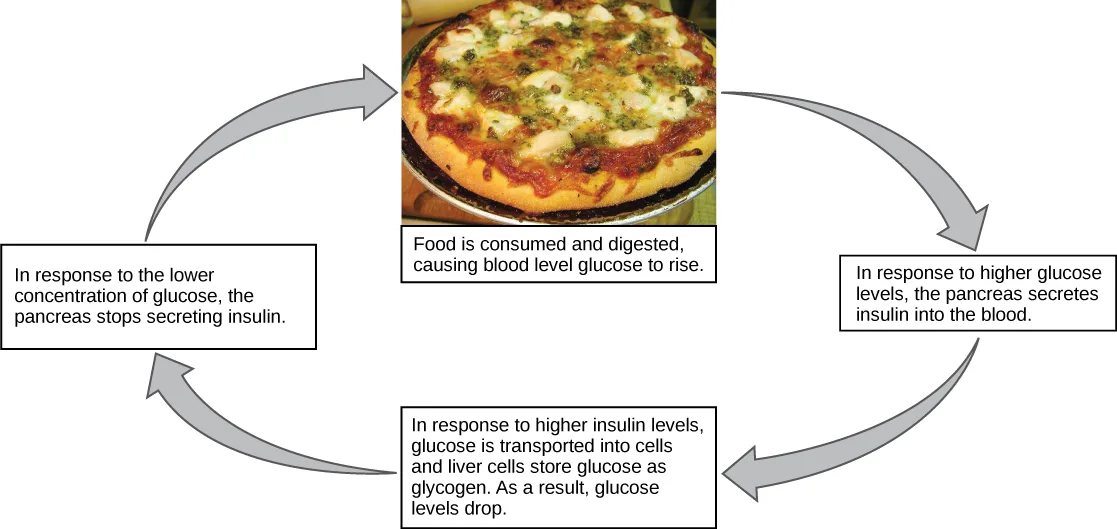
Any homeostatic process that changes the direction of the stimulus is a negative feedback loop. It may either increase or decrease the stimulus, but the stimulus is not allowed to continue as it did before the receptor sensed it. In other words, if a level is too high, the body does something to bring it down, and conversely, if a level is too low, the body does something to make it go up. Hence the term negative feedback. An example is animal maintenance of blood glucose levels. When an animal has eaten, blood glucose levels rise. This is sensed by the nervous system. Specialized cells in the pancreas sense this, and the hormone insulin is released by the endocrine system. Insulin causes blood glucose levels to decrease, as would be expected in a negative feedback system, as illustrated below. However, if an animal has not eaten and blood glucose levels decrease, this is sensed in another group of cells in the pancreas, and the hormone glucagon is released causing glucose levels to increase. This is still a negative feedback loop, but not in the direction expected by the use of the term “negative.” Another example of an increase as a result of the feedback loop is the control of blood calcium. If calcium levels decrease, specialized cells in the parathyroid gland sense this and release parathyroid hormone (PTH), causing an increased absorption of calcium through the intestines and kidneys and, possibly, the breakdown of bone in order to liberate calcium. The effects of PTH are to raise blood levels of the element. Negative feedback loops are the predominant mechanism used in homeostasis.
Extended description
Reading clockwise from the top: a box over a photo of a pizza reads ‘Food is consumed and digested, causing blood level glucose to rise.’ A gray arrow curves down to a box at the right, ‘In response to higher glucose levels, the pancreas secretes insulin into the blood.’ A second arrow curves down to a box at the bottom, ‘In response to higher insulin levels, glucose is transported into cells and liver cells store glucose as glycogen. As a result, glucose levels drop.’ A third arrow curves up to a box at the left, ‘In response to the lower concentration of glucose, the pancreas stops secreting insulin.’ A fourth arrow curves back up to the top box, closing the loop.
Positive Feedback Loop
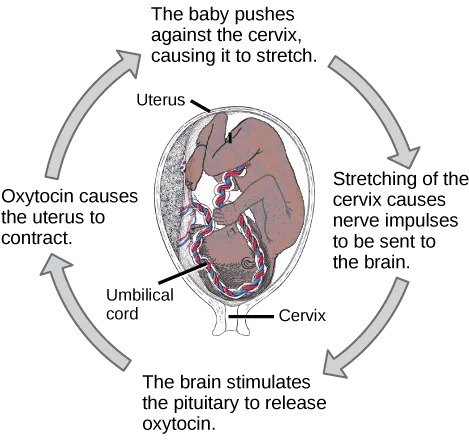
A positive feedback loop maintains the direction of the stimulus, possibly accelerating it. Few examples of positive feedback loops exist in animal bodies, but one is found in the cascade of chemical reactions that result in blood clotting, or coagulation. As one clotting factor is activated, it activates the next factor in sequence until a fibrin clot is achieved. The final factor, a protein called thrombin, converts inactive fibrinogen to fibrin. Thrombin also activates additional clotting factor molecules earlier in the cascade, resulting in the activation of even more thrombin. This positive feedback loop amplifies the cascade for faster, more effective formation of a blood clot. Another example of positive feedback is uterine contractions during childbirth, as illustrated below. The hormone oxytocin, made by the endocrine system, stimulates the contraction of the uterus. This stimulation is sensed by the nervous system. Instead of lowering the oxytocin, more oxytocin is produced until the contractions are powerful enough to produce childbirth.
Extended description
Reading clockwise from the top: a box reads ‘The baby pushes against the cervix, causing it to stretch.’ A gray arrow curves down to a box at the right, ‘Stretching of the cervix causes nerve impulses to be sent to the brain.’ A second arrow curves down to a box at the bottom, ‘The brain stimulates the pituitary to release oxytocin.’ A third arrow curves up to a box at the left, ‘Oxytocin causes the uterus to contract.’ A fourth arrow curves back up to the top box, closing the loop. At the center, a cutaway illustration of a fetus curled inside the uterus is labeled Uterus at upper left, Umbilical cord at lower left, and Cervix at lower right.
State whether each of the following processes are regulated by a positive feedback loop or a negative feedback loop: (a) a person feels satiated after eating a large meal; (b) the blood has plenty of red blood cells, so erythropoietin — a hormone that stimulates the production of new red blood cells — is no longer released from the kidney.
Show model answer
Did your answer mention:
Set Point
It is possible to adjust a system’s set point. When this happens, the feedback loop works to maintain the new setting. An example of this is blood pressure: over time, the normal or set point for blood pressure can increase as a result of continued increases in blood pressure. The body no longer recognizes the elevation as abnormal and no attempt is made to return to the lower set point. The result is the maintenance of an elevated blood pressure that can have harmful effects on the body. Medication can lower blood pressure and lower the set point in the system to a more healthy level. This is called a process of alteration of the set point in a feedback loop.
Changes can be made in a group of body organ systems in order to maintain a set point in another system. This is called acclimatization. This occurs, for instance, when an animal migrates to a higher altitude than that to which it is accustomed. In order to adjust to the lower oxygen levels at the new altitude, the body increases the number of red blood cells circulating in the blood to ensure adequate oxygen delivery to the tissues. Another example of acclimatization is animals that have seasonal changes in their coats: a heavier coat in the winter ensures adequate heat retention, and a light coat in summer assists in keeping body temperature from rising to harmful levels.
Homeostasis: Thermoregulation
Body temperature affects body activities. Generally, as body temperature rises, enzyme activity rises as well. For every ten degree centigrade rise in temperature, enzyme activity doubles, up to a point. Body proteins, including enzymes, begin to denature and lose their function with high heat (around 50 °C for mammals). Enzyme activity will decrease by half for every ten degree centigrade drop in temperature, to the point of freezing, with a few exceptions. Some fish can withstand freezing solid and return to normal with thawing.
Endotherms and Ectotherms
Animals can be divided into two groups: some maintain a constant body temperature in the face of differing environmental temperatures, while others have a body temperature that is the same as their environment and thus varies with the environment. Animals that rely on external temperatures to set their body temperature are ectotherms. This group has been called cold-blooded, but the term may not apply to an animal in the desert with a very warm body temperature. In contrast to ectotherms, poikilotherms are animals with constantly varying internal temperatures. An animal that maintains a constant body temperature in the face of environmental changes is called a homeotherm. Endotherms are animals that rely on internal sources for maintenance of relatively constant body temperature in varying environmental temperatures. These animals are able to maintain a level of metabolic activity in cooler external temperatures, which an ectotherm cannot due to differing enzyme levels of activity. It is worth mentioning that some ectotherms and poikilotherms have relatively constant body temperatures due to the constant environmental temperatures in their habitats. These animals are so-called ectothermic homeotherms, like some deep sea fish species.
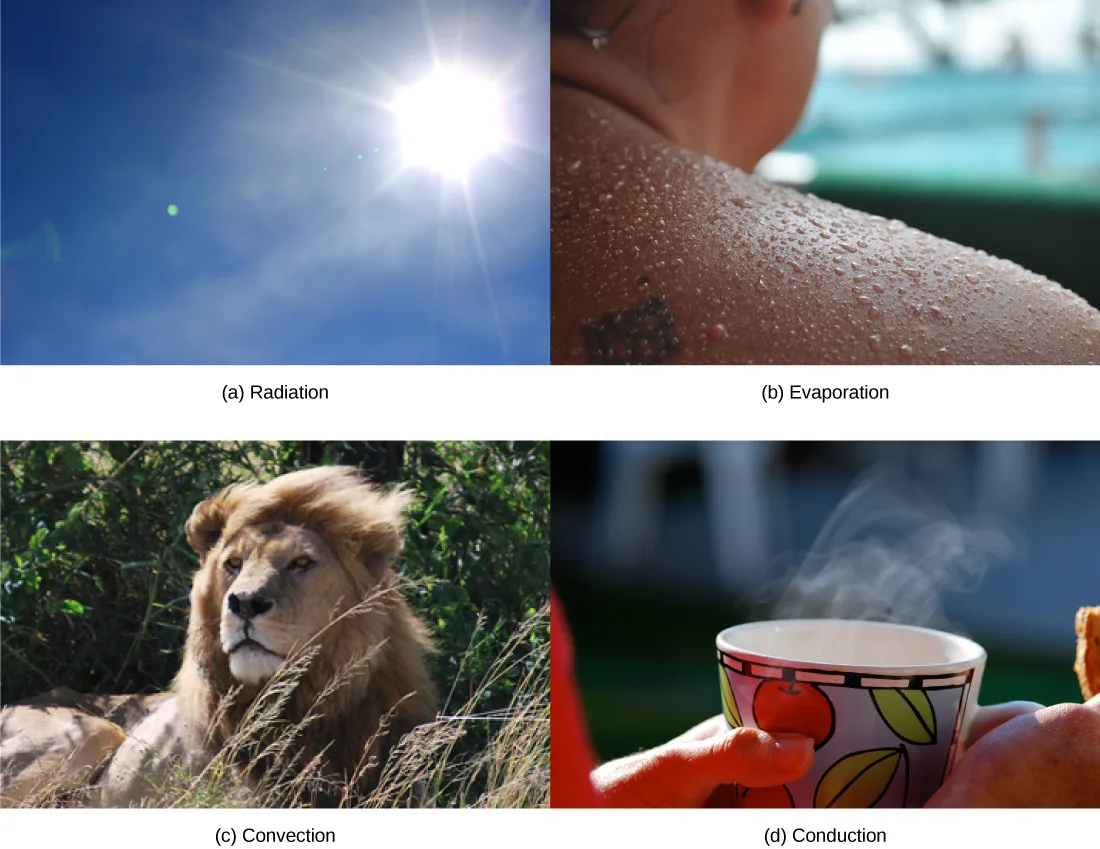
Heat can be exchanged between an animal and its environment through four mechanisms: radiation, evaporation, convection, and conduction (pictured below). Radiation is the emission of electromagnetic “heat” waves. Heat comes from the sun in this manner and radiates from dry skin the same way. Heat can be removed with liquid from a surface during evaporation. This occurs when a mammal sweats. Convection currents of air remove heat from the surface of dry skin as the air passes over it. Heat will be conducted from one surface to another during direct contact with the surfaces, such as an animal resting on a warm rock.
Heat Conservation and Dissipation
Animals conserve or dissipate heat in a variety of ways. In certain climates, endothermic animals have some form of insulation, such as fur, fat, feathers, or some combination thereof. Thick fur and feathers trap a layer of air that helps to provide thermal insulation. Polar bears and seals live and swim in a subfreezing environment and yet maintain a constant, warm, body temperature. The arctic fox, for example, uses its fluffy tail as extra insulation when it curls up to sleep in cold weather. Mammals have a residual effect from shivering and increased muscle activity: arrector pili muscles cause “goose bumps,” causing small hairs to stand up when the individual is cold; this has the intended effect of increasing body temperature. Mammals use layers of fat to achieve the same end. Loss of significant amounts of body fat will compromise an individual’s ability to conserve heat.
Endotherms use their circulatory systems to help maintain body temperature. Vasodilation brings more blood and heat to the body surface, facilitating radiation and evaporative heat loss, which helps to cool the body. Vasoconstriction reduces blood flow in peripheral blood vessels, forcing blood toward the core and the vital organs found there, and conserving heat. Some animals have adaptations to their circulatory system that enable them to transfer heat from arteries to veins, warming blood returning to the heart. This is called a countercurrent heat exchange; it prevents the cold venous blood from cooling the heart and other internal organs. This adaptation can be shut down in some animals to prevent overheating the internal organs. The countercurrent adaptation is found in many animals, including dolphins, sharks, bony fish, bees, and hummingbirds. In contrast, similar adaptations can help cool endotherms when needed, such as dolphin flukes and elephant ears.
Some ectothermic animals use changes in their behavior to help regulate body temperature. For example, a desert ectothermic animal may simply seek cooler areas during the hottest part of the day in the desert to keep from getting too warm. The same animals may climb onto rocks to capture heat during a cold desert night. Some animals seek water to aid evaporation in cooling them, as seen with reptiles. Other ectotherms use group activity such as the activity of bees to warm a hive to survive winter.
Many animals, especially mammals, use metabolic waste heat as a heat source. When muscles are contracted, most of the energy from the ATP used in muscle actions is wasted energy that translates into heat. Severe cold elicits a shivering reflex that generates heat for the body. Many species also have a type of adipose tissue called brown fat that specializes in generating heat.
Neural Control of Thermoregulation
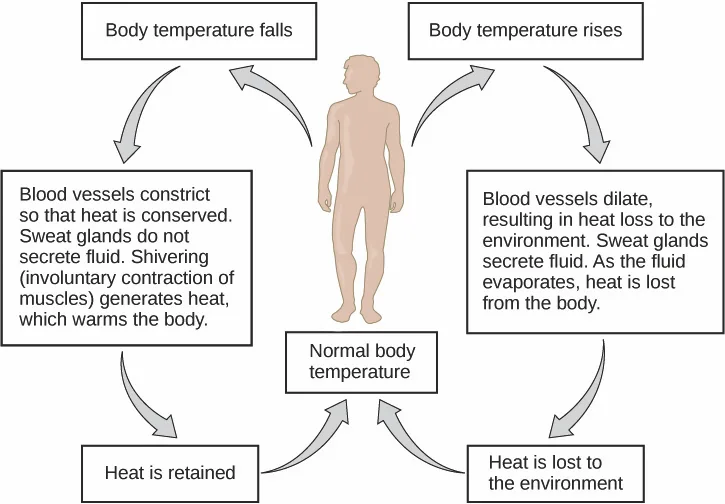
The nervous system is important to thermoregulation, as illustrated below. The processes of homeostasis and temperature control are centered in the hypothalamus of the advanced animal brain.
Extended description
A human silhouette sits at the center. Below it, a box reads ‘Normal body temperature.’ Two arrows lead up from that box: one to a box at upper left, ‘Body temperature falls,’ and one to a box at upper right, ‘Body temperature rises.’ From ‘Body temperature falls,’ an arrow leads down to a box at the left, ‘Blood vessels constrict so that heat is conserved. Sweat glands do not secrete fluid. Shivering (involuntary contraction of muscles) generates heat, which warms the body.’ An arrow from that box leads down to a box at lower left, ‘Heat is retained,’ and an arrow from that box leads back up to the ‘Normal body temperature’ box, closing the cold-response loop. Mirroring this at right, an arrow from ‘Body temperature rises’ leads down to a box at the right, ‘Blood vessels dilate, resulting in heat loss to the environment. Sweat glands secrete fluid. As the fluid evaporates, heat is lost from the body.’ An arrow from that box leads down to a box at lower right, ‘Heat is lost to the environment,’ and an arrow from that box leads back up to the ‘Normal body temperature’ box, closing the warm-response loop.
When bacteria are destroyed by leukocytes, pyrogens are released into the blood. Pyrogens reset the body’s thermostat to a higher temperature, resulting in fever. How might pyrogens cause the body temperature to rise?
Show model answer
Did your answer mention:
The hypothalamus maintains the set point for body temperature through reflexes that cause vasodilation and sweating when the body is too warm, or vasoconstriction and shivering when the body is too cold. It responds to chemicals from the body. When a bacterium is destroyed by phagocytic leukocytes, chemicals called endogenous pyrogens are released into the blood. These pyrogens circulate to the hypothalamus and reset the thermostat. This allows the body’s temperature to increase in what is commonly called a fever. An increase in body temperature causes iron to be conserved, which reduces a nutrient needed by bacteria. An increase in body heat also increases the activity of the animal’s enzymes and protective cells while inhibiting the enzymes and activity of the invading microorganisms. Finally, heat itself may also kill the pathogen. A fever that was once thought to be a complication of an infection is now understood to be a normal defense mechanism.
Summary
Homeostasis is a dynamic equilibrium that is maintained in body tissues and organs. It is dynamic because it is constantly adjusting to the changes that the systems encounter. It is in equilibrium because body functions are kept within a normal range, with some fluctuations around a set point for the processes.
Key terms
- acclimatization — alteration in a body system in response to environmental change
- alteration — change of the set point in a homeostatic system
- homeostasis — dynamic equilibrium maintaining appropriate body functions
- negative feedback loop — feedback to a control mechanism that increases or decreases a stimulus instead of maintaining it
- positive feedback loop — feedback to a control mechanism that continues the direction of a stimulus
- set point — midpoint or target point in homeostasis
- thermoregulation — regulation of body temperature
Practice
Define homeostasis
The dynamic equilibrium that maintains appropriate body functions is called ________.
This process keeps body functions within specific ranges even in an animal that appears inactive.Homeostasis is a ________ that is maintained in body tissues and organs.
This section’s opening paragraph pairs two words for this idea: one meaning the body is constantly adjusting, the other meaning its functions are kept within a range.It is in equilibrium because body functions are kept within a ________, with some fluctuations around a set point for the processes.
The section’s opening paragraph calls this the specific ranges body functions are kept within.Describe the factors affecting homeostasis
Which of the following is not true about acclimatization?
Acclimatization is a change an individual animal’s own body systems make in its lifetime, not a change to its genes.How is a condition such as diabetes a good example of the failure of a set point in humans?
Show model answer
Did your answer mention:
The midpoint or target point in homeostasis is called the ________.
The body’s systems usually attempt to return to this point after normal fluctuations away from it.A change of the set point in a homeostatic system is called an ________.
Medication that lowers an elevated blood pressure set point to a healthier level is an example of this kind of change.Alteration in a body system in response to environmental change is called ________.
An animal migrating to a higher altitude increasing its circulating red blood cells is an example.Discuss positive and negative feedback mechanisms used in homeostasis
Which is an example of negative feedback?
This is the option where the body’s response moves a level back toward normal rather than pushing it further away.Why are negative feedback loops used to control body homeostasis?
Show model answer
Did your answer mention:
Feedback to a control mechanism that increases or decreases a stimulus instead of maintaining it is called a ________.
Blood glucose rising after a meal, then falling again as insulin is released, is an example of this kind of loop.Feedback to a control mechanism that continues the direction of a stimulus is called a ________.
Uterine contractions that keep growing stronger as more oxytocin is released during childbirth are an example of this kind of loop.Describe thermoregulation of endothermic and ectothermic animals
When faced with a sudden drop in environmental temperature, an endothermic animal will:
An endotherm’s fastest response is a physiological reflex, not a change to its coat, which takes much longer to grow in.Which method of heat exchange occurs during direct contact between the source and animal?
Think about an animal resting directly on a warm rock.The body’s thermostat is located in the ________.
This structure is part of the advanced animal brain and centers the processes of homeostasis and temperature control.Which of the following is not a way that ectotherms can change their body temperatures?
The section describes ectotherms changing where and when they are active — seeking shade, basking on rocks, seeking water, huddling — rather than this mammalian physiological response.Why is a fever a “good thing” during a bacterial infection?
Show model answer
Did your answer mention:
On a molecular level, how can endotherms produce their own heat by adjusting processes associated with cellular respiration?
Show model answer
Did your answer mention:
Regulation of body temperature is called ________.
This process is centered in the hypothalamus of the advanced animal brain.This section is adapted from Biology 2e, Section 33.3: Homeostasis by Mary Ann Clark, Jung Choi, Matthew Douglas, and OpenStax, © OpenStax, licensed under CC BY-NC-SA 4.0. Access the original for free at openstax.org. Changes: figures re-encoded as WebP; Figure_33_03_01 and Figure_B33_04_03 re-kinded from the manifest’s file-extension guess of “photo” to “diagram” after inspection (both are drawn flow charts, not photographs — Figure_33_03_01 embeds one small photo of a pizza inside its top box, and Figure_B33_04_03 is a fully drawn diagram); a longdesc added to Figure_33_03_01, Figure_33_03_02, and Figure_B33_04_03, the three cyclic flow-chart figures whose box text and arrow structure are not carried by their one-line captions; a custom alt written for Figure_33_03_03 describing what each of the four photo panels shows rather than reusing the source’s bare “Photo A/B/C/D” alt; inline figure references (“as illustrated in”, parenthetical figure links) changed to descriptive phrases (“illustrated below,” “pictured below”) since figures are not numbered here; both feature boxes rendered as Link to Learning callouts, keeping the source’s own openstax.org/l/ redirect URLs; the two visual-connection notes (Positive Feedback Loop’s feedback-loop classification and Neural Control of Thermoregulation’s pyrogen question) kept in the body immediately after their figures and rendered as self-checks, since the source keys both to prose solutions rather than lettered options, using the separately printed Visual Connection Question copy for each (fs-idp20380880, fs-idp77964000) rather than the note copy; the first visual connection’s note copy prints “State whether each of the following processes is regulated…” while its matching exercise copy prints “…processes are regulated…” — a grammatical mismatch between the two printings of the same item — reported as a source defect; the six end-of-section Review Questions and four Critical Thinking Questions adapted into the closing interactive Practice block (multiple choice and self-check respectively), sorted under the objective each supports; rubric checkpoints added to each self-check (the two body self-checks and the four in Practice), decomposing its model answer (the source solution) into check-off clauses with no new claims; seven key-term recall items (homeostasis, set point, alteration, acclimatization, negative feedback loop, positive feedback loop, thermoregulation) added from the glossary; and two summary-derived cloze recall items (“dynamic equilibrium,” “normal range”) added under the first objective, which the source’s own exercise sets do not otherwise test.