Types of Hormones
By the end of this section, you will be able to:
- List the different types of hormones
- Explain their role in maintaining homeostasis
Maintaining homeostasis within the body requires the coordination of many different systems and organs. Communication between neighboring cells, and between cells and tissues in distant parts of the body, occurs through the release of chemicals called hormones. Hormones are released into body fluids (usually blood) that carry these chemicals to their target cells. At the target cells, which are cells that have a receptor for a signal or ligand from a signal cell, the hormones elicit a response. The cells, tissues, and organs that secrete hormones make up the endocrine system. Examples of glands of the endocrine system include the adrenal glands, which produce hormones such as epinephrine and norepinephrine that regulate responses to stress, and the thyroid gland, which produces thyroid hormones that regulate metabolic rates.
Although there are many different hormones in the human body, they can be divided into three classes based on their chemical structure: lipid-derived, amino acid-derived, and peptide (peptide and proteins) hormones. One of the key distinguishing features of lipid-derived hormones is that they can diffuse across plasma membranes whereas the amino acid-derived and peptide hormones cannot.
Lipid-Derived Hormones (or Lipid-soluble Hormones)
Most lipid hormones are derived from cholesterol and thus are structurally similar to it, as illustrated below. The primary class of lipid hormones in humans is the steroid hormones. Chemically, these hormones are usually ketones or alcohols; their chemical names will end in “-ol” for alcohols or “-one” for ketones. Examples of steroid hormones include estrogens (such as estradiol) and androgens (such as testosterone), both of which regulate bone and tissue development in all humans.
Gonadal hormones, produced by the gonads, include both steroid and peptide hormones. Androgens and estrogens resemble one another in chemical structure and originate from the same molecule. Estrogens are chief drivers of sexual development in an ovarian reproductive system, while androgens drive development in a testicular reproductive system. The ovaries produce steroid hormones such as estradiol and progesterone. When androgens are produced, some of them are later converted to estrogens. Minute amounts of estrogen occur through aromatase actions in adipose, brain, skin, and bone, which convert testosterone to estrogen. The testes and the adrenal cortex both secrete testosterone.
Other steroid hormones include aldosterone and cortisol, which are released by the adrenal glands along with some other types of androgens. Steroid hormones are insoluble in water, and they are transported by transport proteins in blood. As a result, they remain in circulation longer than peptide hormones. For example, cortisol has a half-life of 60 to 90 minutes, while epinephrine, an amino acid derived-hormone, has a half-life of approximately one minute.
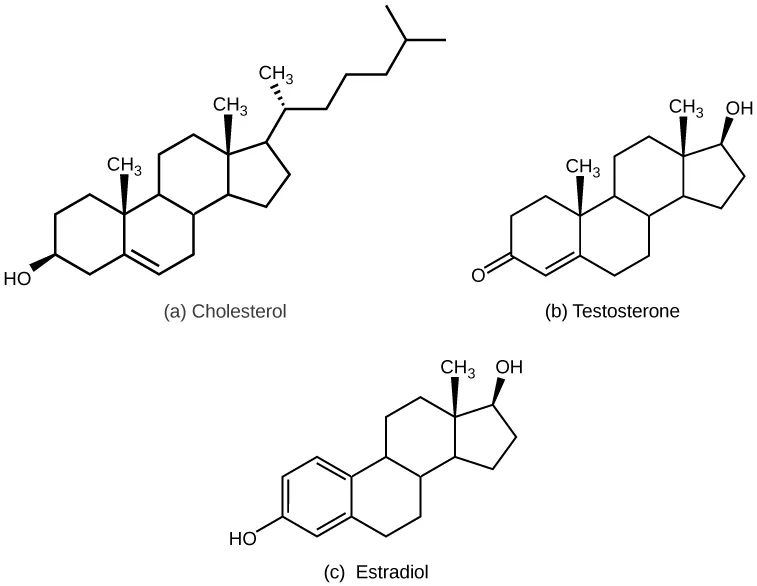
Extended description
(a) Cholesterol: a hydroxyl group (HO) sits on the first six-membered ring at lower left; two methyl (CH₃) groups each attach to a ring-fusion carbon partway up the skeleton; a branched hydrocarbon side chain, itself carrying a methyl branch, extends from the five-membered ring at upper right. (b) Testosterone: the same four-ring skeleton with both ring-fusion methyl (CH₃) groups still drawn; the branched side chain is replaced by a hydroxyl group (OH) on the five-membered ring, and a ketone (=O) replaces the hydroxyl on the first ring, next to a double bond in that ring. (c) Estradiol: the same four-ring skeleton as testosterone, with a hydroxyl group on the five-membered ring, but the first ring is drawn with alternating double bonds rather than fully saturated, and its hydroxyl group sits directly on that ring; only one ring-fusion methyl group is present.
Amino Acid-Derived Hormones
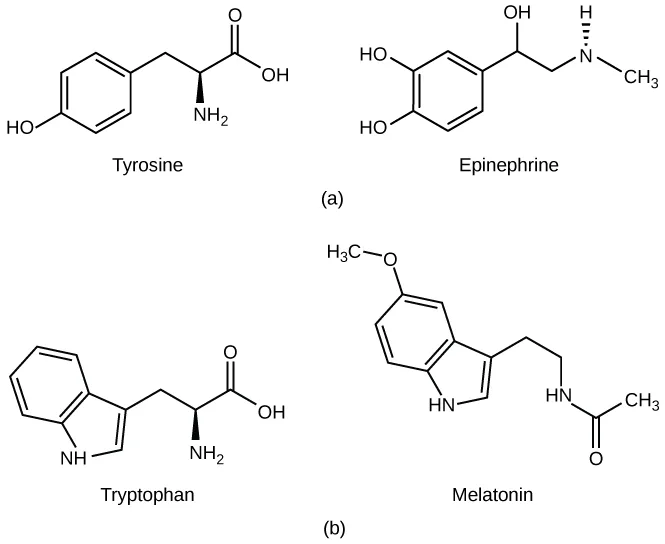
The amino acid-derived hormones are relatively small molecules that are derived from the amino acids tyrosine and tryptophan, shown below. If a hormone is amino acid-derived, its chemical name will end in “-ine”. Examples of amino acid-derived hormones include epinephrine and norepinephrine, which are synthesized in the medulla of the adrenal glands, and thyroxine, which is produced by the thyroid gland. The pineal gland in the brain makes and secretes melatonin which regulates sleep cycles.
Peptide Hormones
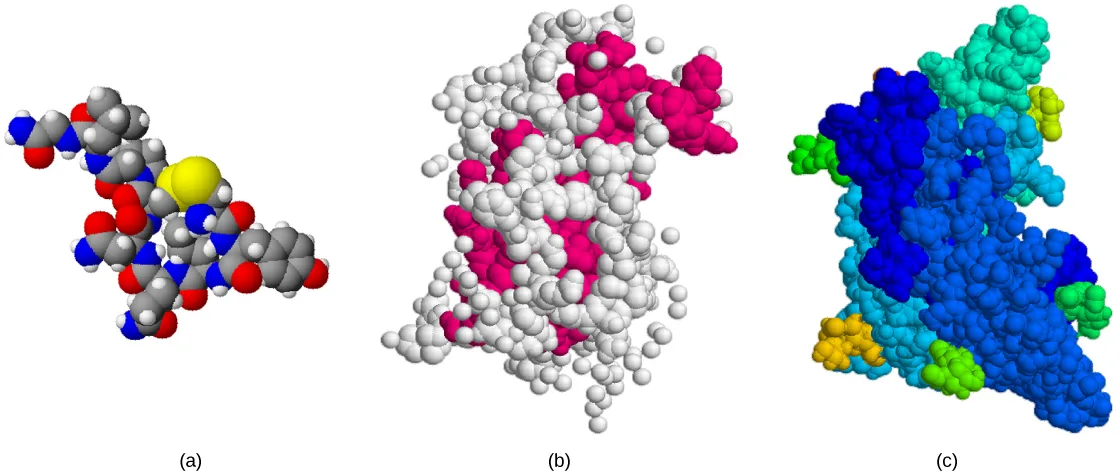
The structure of peptide hormones is that of a polypeptide chain (chain of amino acids). The peptide hormones include molecules that are short polypeptide chains, such as antidiuretic hormone and oxytocin produced in the brain and released into the blood in the posterior pituitary gland. This class also includes small proteins, like growth hormones produced by the pituitary, and large glycoproteins such as follicle-stimulating hormone produced by the pituitary. These peptide hormones are illustrated below.
Secreted peptides like insulin are stored within vesicles in the cells that synthesize them. They are then released in response to stimuli such as high blood glucose levels in the case of insulin. Amino acid-derived and polypeptide hormones are water-soluble and insoluble in lipids. These hormones cannot pass through plasma membranes of cells; therefore, their receptors are found on the surface of the target cells.
Career Connection. Endocrinologist
An endocrinologist is a medical doctor who specializes in treating disorders of the endocrine glands, hormone systems, and glucose and lipid metabolic pathways. An endocrine surgeon specializes in the surgical treatment of endocrine diseases and glands. Some of the diseases that are managed by endocrinologists: disorders of the pancreas (diabetes mellitus), disorders of the pituitary (gigantism, acromegaly, and pituitary dwarfism), disorders of the thyroid gland (goiter and Graves’ disease), and disorders of the adrenal glands (Cushing’s disease and Addison’s disease).
Endocrinologists are required to assess patients and diagnose endocrine disorders through extensive use of laboratory tests. Many endocrine diseases are diagnosed using tests that stimulate or suppress endocrine organ functioning. Blood samples are then drawn to determine the effect of stimulating or suppressing an endocrine organ on the production of hormones. For example, to diagnose diabetes mellitus, patients are required to fast for 12 to 24 hours. They are then given a sugary drink, which stimulates the pancreas to produce insulin to decrease blood glucose levels. A blood sample is taken one to two hours after the sugar drink is consumed. If the pancreas is functioning properly, the blood glucose level will be within a normal range. Another example is the A1C test, which can be performed during blood screening. The A1C test measures average blood glucose levels over the past two to three months by examining how well the blood glucose is being managed over a long time.
Once a disease has been diagnosed, endocrinologists can prescribe lifestyle changes and/or medications to treat the disease. Some cases of diabetes mellitus can be managed by exercise, weight loss, and a healthy diet; in other cases, medications may be required to enhance insulin release. If the disease cannot be controlled by these means, the endocrinologist may prescribe insulin injections.
In addition to clinical practice, endocrinologists may also be involved in primary research and development activities. For example, ongoing islet transplant research is investigating how healthy pancreas islet cells may be transplanted into diabetic patients. Successful islet transplants may allow patients to stop taking insulin injections.
Summary
There are three basic types of hormones: lipid-derived, amino acid-derived, and peptide. Lipid-derived hormones are structurally similar to cholesterol and include steroid hormones such as estradiol and testosterone. Amino acid-derived hormones are relatively small molecules and include the adrenal hormones epinephrine and norepinephrine. Peptide hormones are polypeptide chains or proteins and include the pituitary hormones, antidiuretic hormone (vasopressin), and oxytocin.
Key terms
- amino acid-derived hormone — hormone derived from amino acids.
- lipid-derived hormone — hormone derived mostly from cholesterol.
- peptide hormone — hormone composed of a polypeptide chain.
Practice
List the different types of hormones
A newly discovered hormone contains four amino acids linked together. Under which chemical class would this hormone be classified?
This section defines one hormone class as chains of amino acids linked together — match the number of amino acids in the new hormone to that class’s basic structure.Which class of hormones can diffuse through plasma membranes?
The section’s second paragraph names exactly one class whose members can cross the membrane on their own, contrasting it with the other two.Why are steroids able to diffuse across the plasma membrane?
Steroid hormones are structurally similar to cholesterol, a fat — think about what kind of molecules can move easily through the fatty interior of a membrane.Although there are many different hormones in the human body, they can be divided into three classes based on their chemical structure. What are these classes and what is one factor that distinguishes them?
Show model answer
Did your answer mention:
A hormone derived from amino acids is called a(n) ________.
This chemical name typically ends in ‘-ine,’ and includes epinephrine, norepinephrine, thyroxine, and melatonin.A hormone derived mostly from cholesterol is called a(n) ________.
This class can diffuse straight across the plasma membrane, unlike the other two classes, and its chemical names typically end in ‘-ol’ or ‘-one.’A hormone composed of a polypeptide chain is called a ________.
This class ranges from short chains such as antidiuretic hormone and oxytocin to large glycoproteins such as follicle-stimulating hormone.Explain their role in maintaining homeostasis
Where is insulin stored, and why would it be released?
Show model answer
Did your answer mention:
Glucagon is the peptide hormone that signals for the body to release glucose into the bloodstream. How does glucagon contribute to maintaining homeostasis throughout the body? What other hormones are involved in regulating the blood glucose cycle?
Show model answer
Did your answer mention:
The cells, tissues, and organs that secrete hormones make up the ________.
This is the collective name for every hormone-secreting gland and organ in the body, not the name of any one gland.According to this section, what makes a cell a hormone’s target cell?
The section defines this kind of cell by something it possesses, not by its distance from the gland that released the hormone or how quickly it moves through the blood.This section is adapted from Biology 2e, Section 37.1: Types of Hormones by Mary Ann Clark, Jung Choi, Matthew Douglas, and OpenStax, © OpenStax, licensed under CC BY-NC-SA 4.0. Access the original for free at openstax.org. Changes: figures re-encoded as WebP; all three figures re-kinded from the manifest’s file-extension “photo” guess to “diagram” (Figure_37_01_01abc, Figure_37_01_02ab, and Figure_37_01_03abc are molecular structure drawings and space-filling models, not captured photographs); the cholesterol/testosterone/estradiol figure’s alt shortened from the manifest’s 755-character source alt (over the 600-character limit) to a description under the limit, with the full per-panel structural detail — including the aromatic ring visible in estradiol’s structure, which the source alt omits — moved into a longdesc; in-text pointers to figures (“Figure 37.2” through “Figure 37.4”) replaced with “shown below” or “illustrated below,” since Hugo does not number figures; the Career Connection note rendered as a callout with its bold feature name and the note’s own title in italics; the end-of-section Review Questions and Critical Thinking Questions adapted into the closing interactive Practice block (multiple choice and self-check respectively); rubric checkpoints added to each self-check, decomposing its model answer (the source solution) into check-off clauses with no new claims; three key-term recall items added from the section’s complete three-term glossary; the “Explain their role in maintaining homeostasis” objective’s group, left thin by the source’s two Critical Thinking items alone, filled with two locally written items built strictly from the page’s own opening paragraph — a text-recall item on “endocrine system” and a multiple choice on what defines a hormone’s target cell — disclosed here and in the source ledger.