Regulation of Hormone Production
By the end of this section, you will be able to:
- Explain how hormone production is regulated
- Discuss the different stimuli that control hormone levels in the body
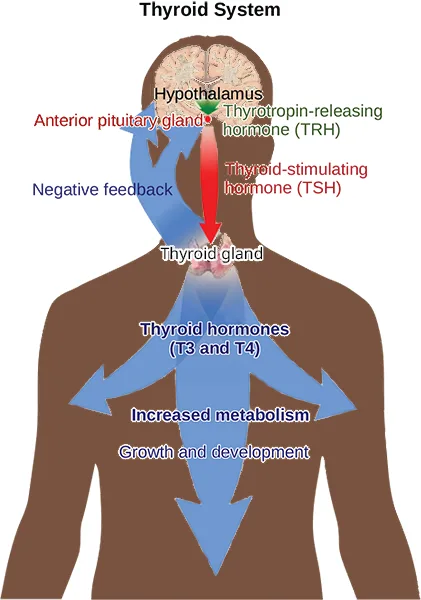
Hormone production and release are primarily controlled by negative feedback. In negative feedback systems, a stimulus elicits the release of a substance; once the substance reaches a certain level, it sends a signal that stops further release of the substance. In this way, the concentration of hormones in blood is maintained within a narrow range. For example, the anterior pituitary signals the thyroid to release thyroid hormones. Increasing levels of these hormones in the blood then give feedback to the hypothalamus and anterior pituitary to inhibit further signaling to the thyroid gland, as illustrated below. There are three mechanisms by which endocrine glands are stimulated to synthesize and release hormones: humoral stimuli, hormonal stimuli, and neural stimuli.
Extended description
A human head, neck, and torso silhouette carries the diagram’s stages top to bottom. ‘Hypothalamus’ labels the brain at the top of the head. A short green arrow points down from the hypothalamus to ‘Anterior pituitary gland’ (labeled in red, at the base of the skull), labeled with the green text ‘Thyrotropin-releasing hormone (TRH).’ A thick red arrow continues down through the neck to ‘Thyroid gland’ at its base, labeled ‘Thyroid-stimulating hormone (TSH).’ A separate blue arrow rises along the left side of the neck from lower down back up to the anterior pituitary gland, labeled ‘Negative feedback.’ From the thyroid gland, a wide blue arrow widens as it descends into the chest and ends in three arrowheads pointing down-left, straight down, and down-right; it carries the labels ‘Thyroid hormones (T₃ and T₄)’ and ‘Increased metabolism’ inside the arrow, with ‘Growth and development’ below them. The upward blue arrow completes the loop: rising T₃ and T₄ signal the pituitary and hypothalamus to stop releasing TRH and TSH.
Hyperthyroidism is a condition in which the thyroid gland is overactive. Hypothyroidism is a condition in which the thyroid gland is underactive. Which of the conditions are the following two patients most likely to have? Patient A has symptoms including weight gain, cold sensitivity, low heart rate, and fatigue. Patient B has symptoms including weight loss, profuse sweating, increased heart rate, and difficulty sleeping.
Show model answer
Did your answer mention:
Humoral Stimuli
The term “humoral” is derived from the term “humor,” which refers to bodily fluids such as blood. A humoral stimulus refers to the control of hormone release in response to changes in extracellular fluids such as blood or the ion concentration in the blood. For example, a rise in blood glucose levels triggers the pancreatic release of insulin. Insulin causes blood glucose levels to drop, which signals the pancreas to stop producing insulin in a negative feedback loop.
Hormonal Stimuli
Hormonal stimuli refers to the release of a hormone in response to another hormone. A number of endocrine glands release hormones when stimulated by hormones released by other endocrine glands. For example, the hypothalamus produces hormones that stimulate the anterior portion of the pituitary gland. The anterior pituitary in turn releases hormones that regulate hormone production by other endocrine glands. The anterior pituitary releases the thyroid-stimulating hormone, which then stimulates the thyroid gland to produce the hormones T₃ and T₄. As blood concentrations of T₃ and T₄ rise, they inhibit both the pituitary and the hypothalamus in a negative feedback loop.
Neural Stimuli
In some cases, the nervous system directly stimulates endocrine glands to release hormones, which is referred to as neural stimuli. Recall that in a short-term stress response, the hormones epinephrine and norepinephrine are important for providing the bursts of energy required for the body to respond. Here, neuronal signaling from the sympathetic nervous system directly stimulates the adrenal medulla to release the hormones epinephrine and norepinephrine in response to stress.
Summary
Hormone levels are primarily controlled through negative feedback, in which rising levels of a hormone inhibit its further release. The three mechanisms of hormonal release are humoral stimuli, hormonal stimuli, and neural stimuli. Humoral stimuli refers to the control of hormonal release in response to changes in extracellular fluid levels or ion levels. Hormonal stimuli refers to the release of hormones in response to hormones released by other endocrine glands. Neural stimuli refers to the release of hormones in response to neural stimulation.
Key terms
- hormonal stimuli — release of a hormone in response to another hormone.
- humoral stimuli — control of hormone release in response to changes in extracellular fluids such as blood or the ion concentration in the blood.
- neural stimuli — stimulation of endocrine glands by the nervous system.
Practice
Explain how hormone production is regulated
Which mechanism of hormonal stimulation would be affected if signaling and hormone release from the hypothalamus was blocked?
The hypothalamus sits at the start of the hormone cascade this section traces to the thyroid, and it also has a direct line to the nervous system — think about which two of the three mechanisms run through the hypothalamus, as opposed to the one triggered purely by a change in blood chemistry.How is hormone production and release primarily controlled?
Show model answer
Did your answer mention:
Oral contraceptive pills work by delivering daily synthetic progestins to an ovary-based reproductive system. Describe why this is an effective method of birth control.
Show model answer
Did your answer mention:
Discuss the different stimuli that control hormone levels in the body
A rise in blood glucose levels triggers release of insulin from the pancreas. This mechanism of hormone production is stimulated by:
This mechanism responds directly to a change in blood chemistry itself, rather than to an incoming hormone or a nerve signal.A scientist hypothesizes that the pancreas’s hormone production is controlled by neural stimuli. Which observation would support this hypothesis?
Neural stimuli work through direct nervous-system signaling, not through a change in blood chemistry — look for the option where insulin release happens with no chemical trigger in the blood at all.Compare and contrast hormonal and humoral stimuli.
Show model answer
The term humoral is derived from the term humor, which refers to bodily fluids such as blood. Humoral stimuli refer to the control of hormone release in response to changes in extracellular fluids such as blood or the ion concentration in the blood. For example, a rise in blood glucose levels triggers the pancreatic release of insulin. Insulin causes blood glucose levels to drop, which signals the pancreas to stop producing insulin in a negative feedback loop.
Hormonal stimuli refer to the release of a hormone in response to another hormone. A number of endocrine glands release hormones when stimulated by hormones released by other endocrine organs. For example, the hypothalamus produces hormones that stimulate the anterior pituitary. The anterior pituitary in turn releases hormones that regulate hormone production by other endocrine glands. For example, the anterior pituitary releases thyroid-stimulating hormone, which stimulates the thyroid gland to produce the hormones T₃ and T₄. As blood concentrations of T₃ and T₄ rise they inhibit both the pituitary and the hypothalamus in a negative feedback loop.
Did your answer mention:
The control of hormone release in response to changes in extracellular fluids such as blood or the ion concentration in the blood is called ________.
This mechanism takes its name from a term meaning bodily fluids, and it is the one directly triggered by a rise in blood glucose that stimulates insulin release.The release of a hormone in response to another hormone is called ________.
This is the mechanism behind the hypothalamus-to-pituitary-to-thyroid cascade described in this section, where each gland’s hormone triggers the next gland’s release.Stimulation of endocrine glands by the nervous system is called ________.
This is the mechanism the sympathetic nervous system uses to trigger the adrenal medulla’s release of epinephrine and norepinephrine during a short-term stress response.This section is adapted from Biology 2e, Section 37.4: Regulation of Hormone Production by Mary Ann Clark, Jung Choi, Matthew Douglas, and OpenStax, © OpenStax, licensed under CC BY-NC-SA 4.0. Access the original for free at openstax.org. Changes: the figure re-encoded as WebP; its manifest alt text — a letter-spaced screen-reader spelling (“T S H,” “T 3 and T 4”) — rewritten as a plain description of what the diagram shows, with the full step-by-step walkthrough of its arrows and labels moved into a longdesc; its kind confirmed “diagram” against the manifest’s guess (a hand-drawn line illustration, not a photograph — not re-kinded); T₃ and T₄ set with Unicode subscripts throughout, replacing the CNXML’s <sub> markup; the note wrapping the thyroid Visual Connection rendered as its figure followed immediately by a self-check in the body — the note copy and the <exercise> copy of the question print identical wording for both patients, so no adjudication was needed; the in-text pointer to the figure (“Figure 37.14”) replaced with “as illustrated below,” since Hugo does not number figures; the end-of-section Review Questions and Critical Thinking Questions adapted into the closing interactive Practice block (multiple choice and self-check respectively), using every keyed exercise in the module; rubric checkpoints added to each self-check, decomposing its model answer (the source solution) into check-off clauses with no new claims; three key-term recall items added covering the section’s complete three-term glossary, each with an added singular-form accept (“humoral stimulus” as printed in the section; “hormonal stimulus” and “neural stimulus” as the natural singular of the glossary’s plural headword).