Osmoregulation and Osmotic Balance
By the end of this section, you will be able to:
- Define osmosis and explain its role within the body
- Explain why osmoregulation and osmotic balance are important body functions
- Describe active transport mechanisms
- Explain osmolarity and the way in which it is measured
- Describe osmoregulators or osmoconformers and how these tools allow animals to adapt to different environments
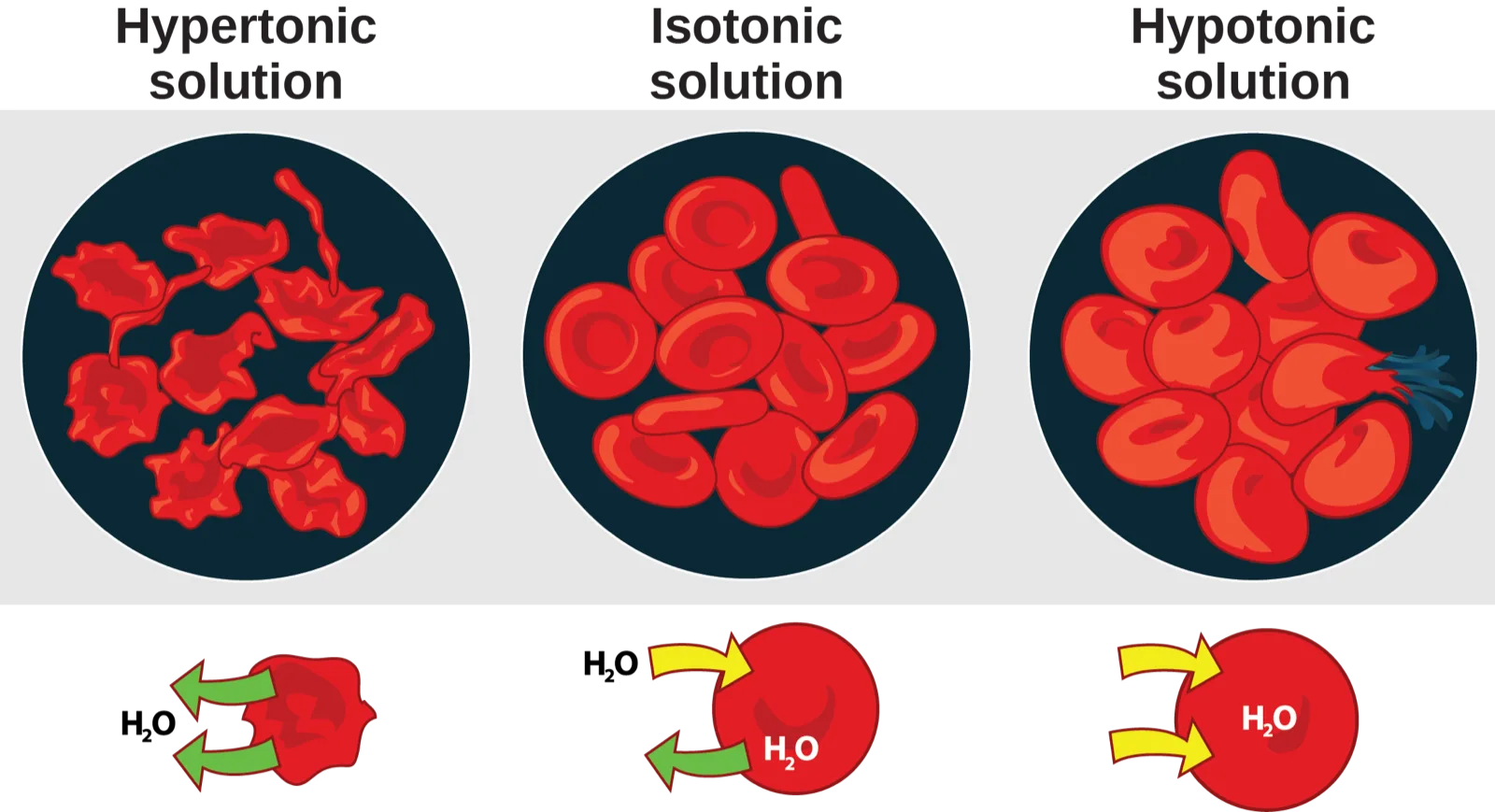
Osmosis is the diffusion of water across a membrane in response to osmotic pressure caused by an imbalance of molecules on either side of the membrane. Osmoregulation is the process of maintenance of salt and water balance (osmotic balance) across membranes within the body’s fluids, which are composed of water, plus electrolytes and non-electrolytes. An electrolyte is a solute that dissociates into ions when dissolved in water. A non-electrolyte, in contrast, doesn’t dissociate into ions during water dissolution. Both electrolytes and non-electrolytes contribute to the osmotic balance. The body’s fluids include blood plasma, the cytosol within cells, and interstitial fluid, the fluid that exists in the spaces between cells and tissues of the body. The membranes of the body (such as the pleural, serous, and cell membranes) are semi-permeable membranes. Semi-permeable membranes are permeable (or permissive) to certain types of solutes and water. Solutions on two sides of a semi-permeable membrane tend to equalize in solute concentration by movement of solutes and/or water across the membrane. As shown below, a cell placed in water tends to swell due to gain of water from the hypotonic or “low salt” environment. A cell placed in a solution with higher salt concentration, on the other hand, tends to make the membrane shrivel up due to loss of water into the hypertonic or “high salt” environment. Isotonic cells have an equal concentration of solutes inside and outside the cell; this equalizes the osmotic pressure on either side of the cell membrane which is a semi-permeable membrane.
Extended description
Three panels, left to right. Hypertonic solution: the circle holds a cluster of shriveled, spiky-edged red blood cells; below it, a single shriveled cell has two green arrows, both labeled H₂O, pointing away from the cell on either side — water leaving the cell. Isotonic solution: the circle holds a cluster of normally disc-shaped red blood cells; below it, a single round cell has a yellow arrow labeled H₂O entering from the top and a green arrow labeled H₂O leaving from the bottom — water entering and leaving in equal amounts. Hypotonic solution: the circle holds a cluster of swollen, rounded red blood cells, one of them bursting with dark fragments spraying from its edge; below it, a single swollen cell has two yellow arrows, both labeled H₂O, pointing into the cell on either side — water entering the cell.
The body does not exist in isolation. There is a constant input of water and electrolytes into the system. While osmoregulation is achieved across membranes within the body, excess electrolytes and wastes are transported to the kidneys and excreted, helping to maintain osmotic balance.
Need for Osmoregulation
Biological systems constantly interact and exchange water and nutrients with the environment by way of consumption of food and water and through excretion in the form of sweat, urine, and feces. Without a mechanism to regulate osmotic pressure, or when a disease damages this mechanism, there is a tendency to accumulate toxic waste and water, which can have dire consequences.
Mammalian systems have evolved to regulate not only the overall osmotic pressure across membranes, but also specific concentrations of important electrolytes in the three major fluid compartments: blood plasma, extracellular fluid, and intracellular fluid. Since osmotic pressure is regulated by the movement of water across membranes, the volume of the fluid compartments can also change temporarily. Because blood plasma is one of the fluid components, osmotic pressures have a direct bearing on blood pressure.
Transport of Electrolytes across Cell Membranes
Electrolytes, such as sodium chloride, ionize in water, meaning that they dissociate into their component ions. In water, sodium chloride (NaCl), dissociates into the sodium ion (Na⁺) and the chloride ion (Cl⁻). The most important ions, whose concentrations are very closely regulated in body fluids, are the cations sodium (Na⁺), potassium (K⁺), calcium (Ca²⁺), magnesium (Mg²⁺), and the anions chloride (Cl⁻), carbonate (CO₃²⁻), bicarbonate (HCO₃⁻), and phosphate (PO₄³⁻). Electrolytes are lost from the body during urination and perspiration. For this reason, athletes are encouraged to replace electrolytes and fluids during periods of increased activity and perspiration.
Osmotic pressure is influenced by the concentration of solutes in a solution. It is directly proportional to the number of solute atoms or molecules and not dependent on the size of the solute molecules. Because electrolytes dissociate into their component ions, they, in essence, add more solute particles into the solution and have a greater effect on osmotic pressure, per mass than compounds that do not dissociate in water, such as glucose.
Water can pass through membranes by passive diffusion. If electrolyte ions could passively diffuse across membranes, it would be impossible to maintain specific concentrations of ions in each fluid compartment; therefore they require special mechanisms to cross the semi-permeable membranes in the body. This movement can be accomplished by facilitated diffusion and active transport. Facilitated diffusion requires protein-based channels for moving the solute. Active transport requires energy in the form of ATP conversion, carrier proteins, or pumps in order to move ions against the concentration gradient.
Concept of Osmolality and Milliequivalent
In order to calculate osmotic pressure, it is necessary to understand how solute concentrations are measured. The unit for measuring solutes is the mole. One mole is defined as the gram molecular weight of the solute. For example, the molecular weight of sodium chloride is 58.44. Thus, one mole of sodium chloride weighs 58.44 grams. The molarity of a solution is the number of moles of solute per liter of solution. The molality of a solution is the number of moles of solute per kilogram of solvent. If the solvent is water, one kilogram of water is equal to one liter of water. While molarity and molality are used to express the concentration of solutions, electrolyte concentrations are usually expressed in terms of milliequivalents per liter (mEq/L): the mEq/L is equal to the ion concentration (in millimoles) multiplied by the number of electrical charges on the ion. The unit of milliequivalent takes into consideration the ions present in the solution (since electrolytes form ions in aqueous solutions) and the charge on the ions.
Thus, for ions that have a charge of one, one milliequivalent is equal to one millimole. For ions that have a charge of two (like calcium), one milliequivalent is equal to 0.5 millimoles. Another unit for the expression of electrolyte concentration is the milliosmole (mOsm), which is the number of millimoles of osmotically active solute particles per kilogram of solvent. (Source note: the source says “the number of milliequivalents of solute”; milliequivalents count charge, whereas osmoles count dissolved particles regardless of charge, as the paragraph’s own calcium example implies.) Body fluids are usually maintained within the range of 280 to 300 mOsm.
Osmoregulators and Osmoconformers
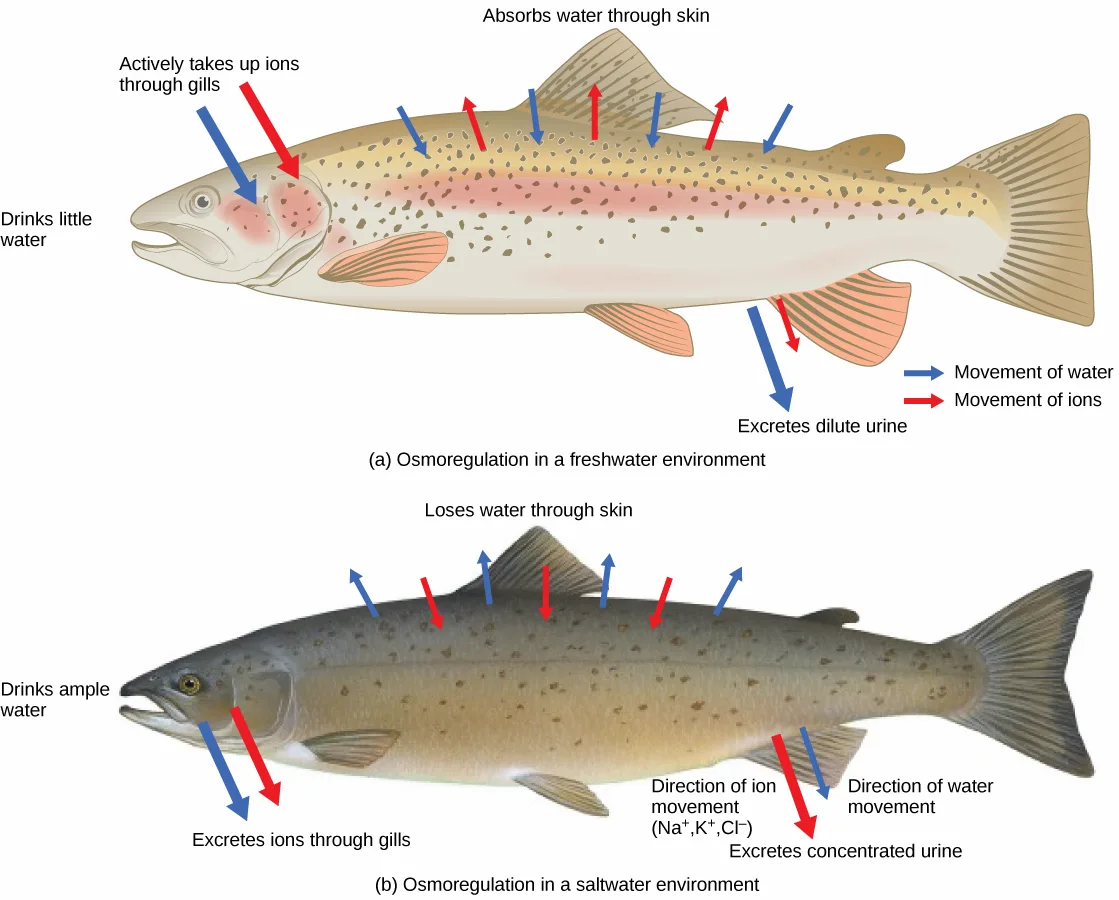
Persons lost at sea without any freshwater to drink are at risk of severe dehydration because the human body cannot adapt to drinking seawater, which is hypertonic in comparison to body fluids. Organisms such as goldfish that can tolerate only a relatively narrow range of salinity are referred to as stenohaline. About 90 percent of all bony fish are restricted to either freshwater or seawater. They are incapable of osmotic regulation in the opposite environment. It is possible, however, for a few fishes like salmon to spend part of their life in freshwater and part in seawater. Organisms like the salmon and molly that can tolerate a relatively wide range of salinity are referred to as euryhaline organisms. This is possible because some fish have evolved osmoregulatory mechanisms to survive in all kinds of aquatic environments. When they live in freshwater, their bodies tend to take up water because the environment is relatively hypotonic, as shown below (a). In such hypotonic environments, these fish do not drink much water. Instead, they pass a lot of very dilute urine, and they achieve electrolyte balance by active transport of salts through the gills. When they move to a hypertonic marine environment, these fish start drinking seawater; they excrete the excess salts through their gills and their urine, as shown below (b). Most marine invertebrates, on the other hand, may be isotonic with seawater (osmoconformers). Their body fluid concentrations conform to changes in seawater concentration. Cartilaginous fishes’ salt composition of the blood is similar to bony fishes; however, the blood of sharks contains the organic compounds urea and trimethylamine oxide (TMAO). This does not mean that their electrolyte composition is similar to that of seawater. They achieve isotonicity with the sea by storing large concentrations of urea. These animals that secrete urea are called ureotelic animals. TMAO stabilizes proteins in the presence of high urea levels, preventing the disruption of peptide bonds that would occur in other animals exposed to similar levels of urea. Sharks are cartilaginous fish with a rectal gland to secrete salt and assist in osmoregulation.
Extended description
Two illustrations of a trout-like fish stacked one above the other, each carrying printed labels; panel (a) draws a boxed legend at its lower right (blue arrow = movement of water, red arrow = movement of ions), and panel (b) instead labels its arrow colours in place near the tail (Direction of ion movement (Na⁺, K⁺, Cl⁻); Direction of water movement). Panel (a), captioned ‘Osmoregulation in a freshwater environment’: near the head, labeled ‘Drinks little water’ and ‘Actively takes up ions through gills,’ a blue arrow and a red arrow both point into the gill region. Along the back, under the label ‘Absorbs water through skin,’ four blue arrows point into the body, alternating with three red arrows pointing away from it. Near the tail, under the label ‘Excretes dilute urine,’ a large blue arrow and a smaller red arrow both point away from the body. Panel (b), captioned ‘Osmoregulation in a saltwater environment’: near the head, labeled ‘Drinks ample water’ and ‘Excretes ions through gills,’ a blue arrow and a red arrow point down from the gill region. Along the back, under the label ‘Loses water through skin,’ four blue arrows point away from the body, alternating with three red arrows pointing into it. Near the tail, labeled ‘Direction of water movement’ and ‘Direction of ion movement (Na⁺,K⁺,Cl⁻),’ a blue arrow and a larger red arrow (captioned ‘Excretes concentrated urine’) both point away from the body.
Career Connection. Dialysis Technician
Dialysis is a medical process of removing wastes and excess water from the blood by diffusion and ultrafiltration. When kidney function fails, dialysis must be done to artificially rid the body of wastes. This is a vital process to keep patients alive. In some cases, the patients undergo artificial dialysis until they are eligible for a kidney transplant. In others who are not candidates for kidney transplants, dialysis is a life-long necessity.
Dialysis technicians typically work in hospitals and clinics. While some roles in this field include equipment development and maintenance, most dialysis technicians work in direct patient care. Their on-the-job duties, which typically occur under the direct supervision of a registered nurse, focus on providing dialysis treatments. This can include reviewing patient history and current condition, assessing and responding to patient needs before and during treatment, and monitoring the dialysis process. Treatment may include taking and reporting a patient’s vital signs and preparing solutions and equipment to ensure accurate and sterile procedures.
Summary
Solute concentrations across semi-permeable membranes influence the movement of water and solutes across the membrane. It is the number of solute molecules and not the molecular size that is important in osmosis. Osmoregulation and osmotic balance are important bodily functions, resulting in water and salt balance. Not all solutes can pass through a semi-permeable membrane. Osmosis is the movement of water across the membrane. Osmosis occurs to equalize the number of solute molecules across a semi-permeable membrane by the movement of water to the side of higher solute concentration. Facilitated diffusion utilizes protein channels to move solute molecules from areas of higher to lower concentration while active transport mechanisms are required to move solutes against concentration gradients. Osmolarity is measured in units of milliequivalents or milliosmoles, both of which take into consideration the number of solute particles and the charge on them. Fish that live in freshwater or saltwater adapt by being osmoregulators or osmoconformers.
Key terms
- electrolyte — solute that breaks down into ions when dissolved in water.
- molality — number of moles of solute per kilogram of solvent.
- molarity — number of moles of solute per liter of solution.
- mole — gram equivalent of the molecular weight of a substance.
- non-electrolyte — solute that does not break down into ions when dissolved in water.
- osmoconformer — organism that changes its tonicity based on its environment.
- osmoregulation — mechanism by which water and solute concentrations are maintained at desired levels.
- osmoregulator — organism that maintains its tonicity irrespective of its environment.
- osmotic balance — balance of the amount of water and salt input and output to and from a biological system without disturbing the desired osmotic pressure and solute concentration in every compartment.
- osmotic pressure — pressure exerted on a membrane to equalize solute concentration on either side.
- semi-permeable membrane — membrane that allows only certain solutes to pass through.
Practice
Define osmosis and explain its role within the body
Cells in a hypertonic solution tend to:
A hypertonic solution has a higher solute concentration outside the cell than inside it — think about which way water moves to equalize that difference.The pressure exerted on a membrane to equalize solute concentration on either side is called ________.
It’s the pressure osmosis itself creates — named for the process, not the membrane.A membrane that allows only certain solutes to pass through is called a ________.
The pleural, serous, and cell membranes of the body are all examples of this kind of barrier.Explain why osmoregulation and osmotic balance are important body functions
When dehydrated human patients need to be given fluids intravenously, they are given:
The safest IV fluid keeps the tonicity outside the blood cells equal to the tonicity inside them — check which option describes exactly that relationship.Why is excretion important in order to achieve osmotic balance?
Show model answer
Did your answer mention:
The mechanism by which water and solute concentrations are maintained at desired levels is called ________.
This is the process the whole section is named for — maintaining balance, not the balance itself.The balance of water and salt input and output that keeps a biological system’s osmotic pressure and solute concentration steady is called ________.
Osmoregulation is the process; this is the state that process achieves and maintains.Describe active transport mechanisms
The sodium ion is at the highest concentration in:
The module names three fluid compartments in that same paragraph — pick the one that is not inside a cell and not confined to the vessels carrying blood.Why do electrolyte ions move across membranes by active transport?
Show model answer
Did your answer mention:
A solute that breaks down into ions when dissolved in water is called a(n) ________.
Athletes are told to replace these, along with fluids, after heavy sweating.A solute that does not break down into ions when dissolved in water is called a(n) ________.
Glucose is the module’s own example of this kind of solute.Explain osmolarity and the way in which it is measured
The gram equivalent of the molecular weight of a substance is called a ________.
Sodium chloride’s molecular weight is 58.44, so one of these weighs 58.44 grams.The number of moles of solute per liter of solution is called a solution’s ________.
This measure divides by the solution’s total liquid volume, not its solvent’s mass.The number of moles of solute per kilogram of solvent is called a solution’s ________.
This measure divides by the solvent’s mass, not the solution’s total volume — the opposite of the other similarly named unit.Describe osmoregulators or osmoconformers and how these tools allow animals to adapt to different environments
Organisms like the salmon and molly, which can tolerate a relatively wide range of salinity, are called ________.
Look at how the module describes salmon and molly’s tolerance for a wide range of salinity, versus organisms restricted to one narrow range.An organism that changes its tonicity based on its environment is called a(n) ________.
Most marine invertebrates fit this pattern, matching their body fluids to the surrounding seawater.An organism that maintains its tonicity irrespective of its environment is called a(n) ________.
Euryhaline fish like the salmon use this strategy to survive in both freshwater and seawater.This section is adapted from Biology 2e, Section 41.1: Osmoregulation and Osmotic Balance by Mary Ann Clark, Jung Choi, Matthew Douglas, and OpenStax, © OpenStax, licensed under CC BY-NC-SA 4.0. Access the original for free at openstax.org. Changes: figures re-encoded as WebP; Figure_41_01_02ab re-kinded from the manifest’s file-extension “photo” guess to “diagram” (it is a labeled illustration with arrows and printed captions, not a captured photograph); Figure_B41_01_01’s alt rewritten from the manifest’s letter-spaced, screen-reader-spelled source text (“upper case H subscript 2 baseline upper case O”) to a plain visual description, with the walk-through moved into a longdesc; Figure_41_01_02ab’s alt lightly cleaned from the source (which read “chlorine ions”) to “chloride ions,” matching the section’s own prose and the figure’s own printed “Na⁺,K⁺,Cl⁻” label; a longdesc added to both figures, transcribing each drawing’s own printed labels, arrow colors, and arrow directions in reading order, since neither figure’s one-line caption carries that content; ion charges (Na⁺, K⁺, Ca²⁺, Mg²⁺, Cl⁻, CO₃²⁻, HCO₃⁻, PO₄³⁻) set in Unicode in place of the source’s plain-text superscripts and subscripts; in-text pointers to figures (“as seen in [Figure],” “as illustrated in [Figure]”) replaced with “as shown below,” since Hugo does not number figures; the Career Connection note rendered as a callout with its bold name and italic title; the end-of-section Review Questions and Critical Thinking Questions adapted into the closing interactive Practice block (multiple choice and self-check respectively); rubric checkpoints added to each self-check, decomposing its model answer (the source solution) into check-off clauses with no new claims; eleven key-term recall items added from the glossary, covering all eleven glossary terms — electrolyte, non-electrolyte, mole, molarity, molality, osmoregulation, osmotic balance, osmotic pressure, semi-permeable membrane, osmoconformer, and osmoregulator; one locally written multiple choice (“euryhaline organisms” vs. the module’s own “stenohaline,” “osmoconformers,” and “ureotelic animals”) added to the fifth objective’s group, which the source’s three Review Questions and two Critical Thinking Questions do not otherwise reach, built strictly from the section’s own sentence about salmon and molly. The sodium-ion Review Question (fs-idm2578240) is kept keyed to the source’s answer B, extracellular fluid, on source authority alone: the module never states which compartment holds the highest sodium concentration, and it does not contradict B, so general knowledge cannot overturn it — reported for the parent’s adjudication. One definition is corrected with a visible Source note: a milliosmole counts dissolved particles, not milliequivalents of charge (erratum 450).