Nitrogenous Wastes
By the end of this section, you will be able to:
- Compare and contrast the way in which aquatic animals and terrestrial animals can eliminate toxic ammonia from their systems
- Compare the major byproduct of ammonia metabolism in vertebrate animals to that of birds, insects, and reptiles
Of the four major macromolecules in biological systems, both proteins and nucleic acids contain nitrogen. During the catabolism, or breakdown, of nitrogen-containing macromolecules, carbon, hydrogen, and oxygen are extracted and stored in the form of carbohydrates and fats. Excess nitrogen is excreted from the body. Nitrogenous wastes tend to form toxic ammonia, which raises the pH of body fluids. The formation of ammonia itself requires energy in the form of ATP and large quantities of water to dilute it out of a biological system. Animals that live in aquatic environments tend to release ammonia into the water. Animals that excrete ammonia are said to be ammonotelic. Terrestrial organisms have evolved other mechanisms to excrete nitrogenous wastes. The animals must detoxify ammonia by converting it into a relatively nontoxic form such as urea or uric acid. Mammals, including humans, produce urea, whereas reptiles and many terrestrial invertebrates produce uric acid. Animals that secrete urea as the primary nitrogenous waste material are called ureotelic animals.
Nitrogenous Waste in Terrestrial Animals: The Urea Cycle
The urea cycle is the primary mechanism by which mammals convert ammonia to urea. Urea is made in the liver and excreted in urine. The overall chemical reaction by which ammonia is converted to urea is 2 NH₃ (ammonia) + CO₂ + 3 ATP + H₂O → H₂N-CO-NH₂ (urea) + 2 ADP + 4 Pi + AMP.
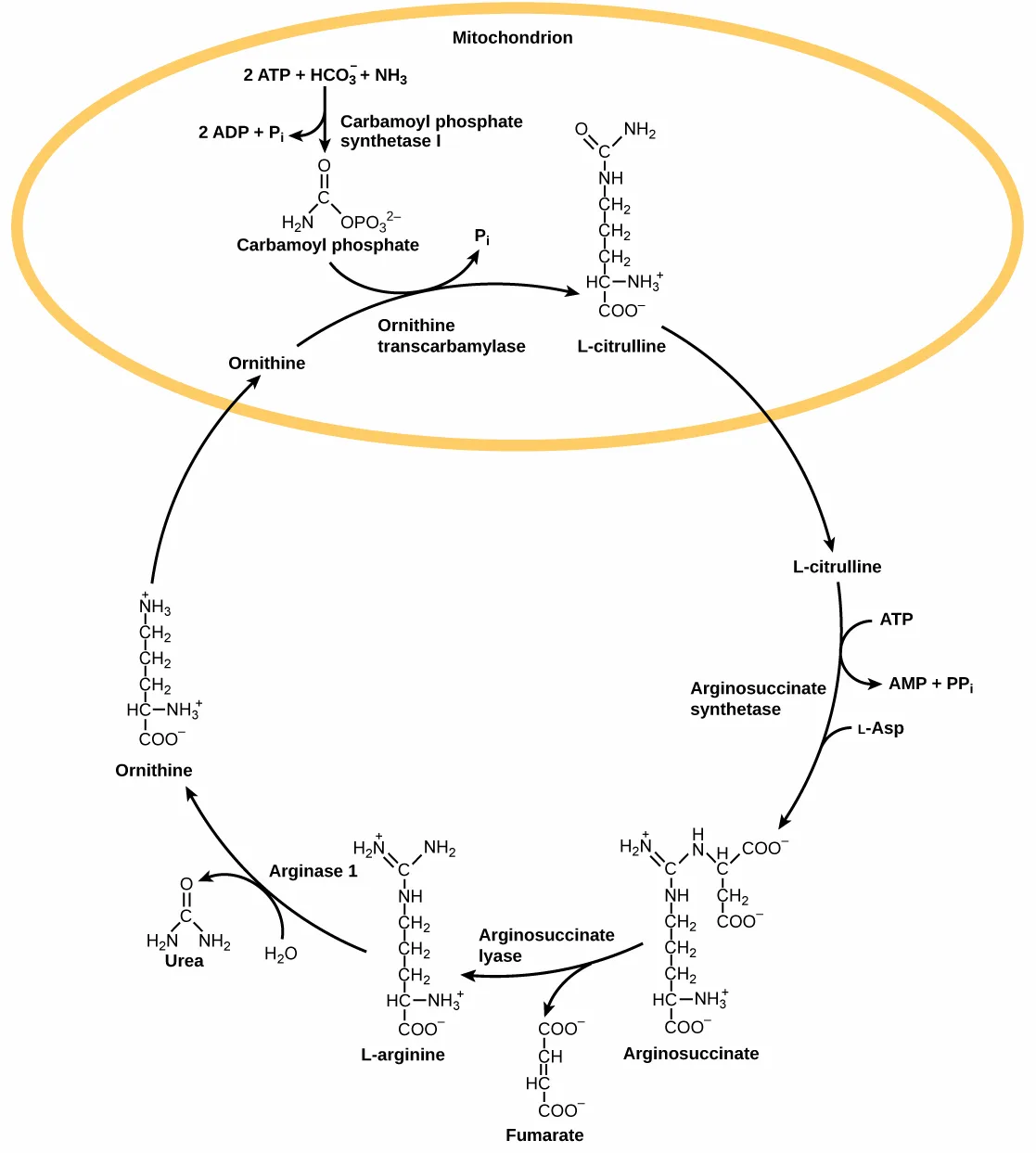
The urea cycle utilizes five intermediate steps, catalyzed by five different enzymes, to convert ammonia to urea, shown below. The amino acid L-ornithine gets converted into different intermediates before being regenerated at the end of the urea cycle. Hence, the urea cycle is also referred to as the ornithine cycle. The enzyme ornithine transcarbamylase catalyzes a key step in the urea cycle and its deficiency can lead to accumulation of toxic levels of ammonia in the body. The first two reactions occur in the mitochondria and the last three reactions occur in the cytosol. Urea concentration in the blood, called blood urea nitrogen or BUN, is used as an indicator of kidney function.
Extended description
Reading clockwise from the top, a gold oval labeled Mitochondrion holds the cycle’s first two of five enzyme-catalyzed steps. (1) At the upper left, two ATP plus bicarbonate (HCO₃⁻) and ammonia (NH₃) are converted by carbamoyl phosphate synthetase I into carbamoyl phosphate, releasing two ADP and phosphate (Pᵢ). (2) Moving right across the oval, ornithine transcarbamylase combines carbamoyl phosphate with ornithine to form L-citrulline at the oval’s right edge, releasing phosphate (Pᵢ); L-citrulline then exits the mitochondrion. (3) Outside the oval, arginosuccinate synthetase combines L-citrulline with ATP and L-aspartate to form arginosuccinate, releasing AMP and pyrophosphate (PPᵢ). (4) Moving left along the bottom, arginosuccinate lyase splits arginosuccinate into fumarate, released as a side product, and L-arginine. (5) Continuing left, arginase 1 combines L-arginine with water to release urea and regenerate ornithine. An arrow then carries this regenerated ornithine up the oval’s left side and back into the mitochondrion, closing the cycle at step 2.
Evolution Connection. Excretion of Nitrogenous Waste
The theory of evolution proposes that life started in an aquatic environment. It is not surprising to see that biochemical pathways like the urea cycle evolved to adapt to a changing environment when terrestrial life forms evolved. Arid conditions probably led to the evolution of the uric acid pathway as a means of conserving water.
Nitrogenous Waste in Birds and Reptiles: Uric Acid
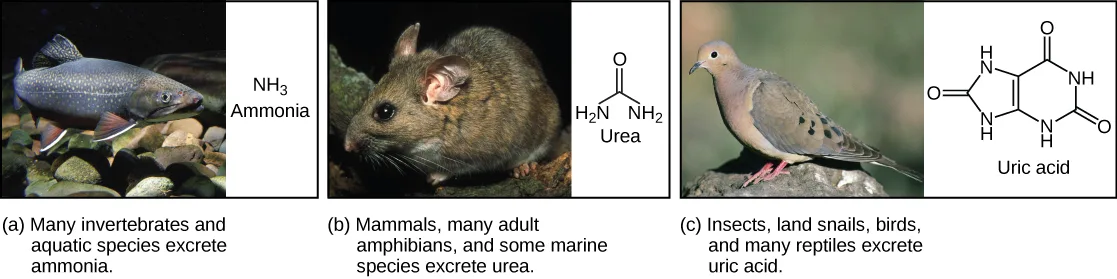
Birds, reptiles, and most terrestrial arthropods convert toxic ammonia to uric acid or the closely related compound guanine (guano) instead of urea. Mammals also form some uric acid during breakdown of nucleic acids. Uric acid is a compound similar to purines found in nucleic acids. It is water insoluble and tends to form a white paste or powder; it is excreted by birds, insects, and reptiles. Conversion of ammonia to uric acid requires more energy and is much more complex than conversion of ammonia to urea, shown below.
Extended description
Three panels, left to right. Panel (a): a photograph of a fish beside the structure of ammonia (NH₃) and the caption ‘Many invertebrates and aquatic species excrete ammonia.’ Panel (b): a photograph of a wood rat beside the structure of urea — a central carbon double-bonded to an oxygen and single-bonded to two NH₂ groups — and the caption ‘Mammals, many adult amphibians, and some marine species excrete urea.’ Panel (c): a photograph of a pigeon beside the structure of uric acid — a six-membered carbon ring fused to a five-membered ring; each ring carries two NH groups; the six-membered ring has two oxygens double-bonded to it (one at the top, one at the lower right) and the five-membered ring one, at its left — and the caption ‘Insects, land snails, birds, and many reptiles excrete uric acid.’
Everyday Connection. Gout
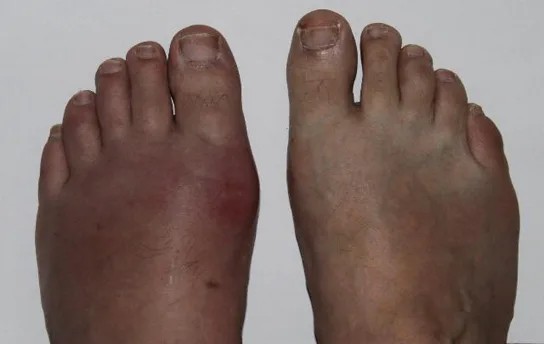
Mammals use uric acid crystals as an antioxidant in their cells. However, too much uric acid tends to form kidney stones and may also cause a painful condition called gout, where uric acid crystals accumulate in the joints, as illustrated below. Food choices that reduce the amount of nitrogenous bases in the diet help reduce the risk of gout. For example, tea, coffee, and chocolate have purine-like compounds, called xanthines, and should be avoided by people with gout and kidney stones.
Summary
Ammonia is the waste produced by metabolism of nitrogen-containing compounds like proteins and nucleic acids. While aquatic animals can easily excrete ammonia into their watery surroundings, terrestrial animals have evolved special mechanisms to eliminate the toxic ammonia from their systems. Urea is the major byproduct of ammonia metabolism in vertebrate animals. Uric acid is the major byproduct of ammonia metabolism in birds, terrestrial arthropods, and reptiles.
Key terms
- ammonia — compound made of one nitrogen atom and three hydrogen atoms.
- ammonotelic — describes an animal that excretes ammonia as the primary waste material.
- antioxidant — agent that prevents cell destruction by reactive oxygen species.
- blood urea nitrogen (BUN) — estimate of urea in the blood and an indicator of kidney function.
- urea cycle — pathway by which ammonia is converted to urea.
- ureotelic — describes animals that secrete urea as the primary nitrogenous waste material.
- uric acid — byproduct of ammonia metabolism in birds, insects, and reptiles.
Practice
Compare and contrast the way in which aquatic animals and terrestrial animals can eliminate toxic ammonia from their systems
A compound made of one nitrogen atom and three hydrogen atoms is called ________.
This is the toxic compound formed when nitrogen-containing molecules like proteins and nucleic acids are broken down.Animals that excrete ammonia as their primary waste material are said to be ________.
The term uses the same root as the word for animals that instead secrete urea, attached to the name of the compound these animals release directly into water.Animals that secrete urea as their primary nitrogenous waste material are called ________ animals.
This term pairs the same ending as the word for ammonia-excreting animals with the name of the nitrogenous compound mammals make instead.In terms of evolution, why might the urea cycle have evolved in organisms?
Show model answer
Did your answer mention:
Compare the major byproduct of ammonia metabolism in vertebrate animals to that of birds, insects, and reptiles
BUN is ________.
This term appears in the sentence about a lab measurement doctors use to judge how well the kidneys are filtering waste — work out what its four letters spell, not what it measures.Human beings accumulate ________ before excreting nitrogenous waste.
Reread the section describing the cycle mammals use to detoxify ammonia in the liver — it names the one molecule made there and passed out in urine, distinct from the toxic gas of simple ammonia release and from the compound birds and reptiles use instead.Compare and contrast the formation of urea and uric acid.
Show model answer
Did your answer mention:
The pathway by which ammonia is converted to urea is called the ________.
This pathway is named after the intermediate amino acid that gets regenerated at its end — the module says it goes by two names, one for that molecule and one for what the whole pathway converts ammonia into.The byproduct of ammonia metabolism in birds, insects, and reptiles is called ________.
This nitrogen-containing waste is so insoluble in water that it forms a paste or powder rather than dissolving into urine the way the vertebrate byproduct does.An estimate of urea in the blood used as an indicator of kidney function is called ________.
This is the same measurement introduced by its four-letter abbreviation earlier in this practice group — spell out what each letter stands for.This section is adapted from Biology 2e, Section 41.4: Nitrogenous Wastes by Mary Ann Clark, Jung Choi, Matthew Douglas, and OpenStax, © OpenStax, licensed under CC BY-NC-SA 4.0. Access the original for free at openstax.org. Changes: figures re-encoded as WebP; two figures re-kinded from the manifest’s file-extension “photo” guess to “diagram” (Figure_41_04_01, a hand-drawn flow chart of the urea cycle, and Figure_41_04_02abc, a composite of animal photographs paired with molecular-structure drawings — neither is a captured photograph on its own), while Figure_41_04_03 (the gout photograph) keeps the manifest’s “photo” guess; alts rewritten from the manifest’s letter-spaced, narrated source text (or, for the gout photo, its generic “Photo shows” phrasing) into plain visual descriptions, with the step-by-step walk-through for the first two figures moved into a longdesc; a longdesc added to the urea-cycle flow chart, counting its five enzyme-catalyzed steps and tracing the cycle’s clockwise direction (top → right → bottom → left → top), and to the three-panel ammonia/urea/uric-acid comparison figure, naming each panel’s animal and molecular structure; the display reaction converting ammonia to urea set as Unicode text with Pi, kept inline as printed rather than as KaTeX, per house chemical-equation notation; the Evolution Connection and Everyday Connection notes rendered as callouts with their bold names and italic titles, the Everyday Connection’s figure and paragraph kept inside its box as printed; in-text figure pointers (“Figure 41.12” and “Figure 41.13”) replaced with “shown below” and the Figure 41.14 pointer with “illustrated below,” since Hugo does not number figures; the end-of-section Review Questions and Critical Thinking Questions adapted into the closing interactive Practice block (multiple choice and self-check respectively), using both keyed exercises of each set; rubric checkpoints added to each self-check, decomposing its model answer (the source solution, kept verbatim) into check-off clauses with no new claims; six key-term recall items added from the glossary (ammonia, ammonotelic, ureotelic, urea cycle, uric acid, blood urea nitrogen); the seventh glossary term (antioxidant) appears only in the Key terms list and the Everyday Connection prose.