Disruptions in the Immune System
By the end of this section, you will be able to:
- Describe hypersensitivity
- Define autoimmunity
A functioning immune system is essential for survival, but even the sophisticated cellular and molecular defenses of the mammalian immune response can be defeated by pathogens at virtually every step. In the competition between immune protection and pathogen evasion, pathogens have the advantage of more rapid evolution because of their shorter generation time and other characteristics. For instance, Streptococcus pneumoniae (bacterium that cause pneumonia and meningitis) surrounds itself with a capsule that inhibits phagocytes from engulfing it and displaying antigens to the adaptive immune system. Staphylococcus aureus (bacterium that can cause skin infections, abscesses, and meningitis) synthesizes a toxin called leukocidin that kills phagocytes after they engulf the bacterium. Other pathogens can also hinder the adaptive immune system. HIV infects TH cells via their CD4 surface molecules, gradually depleting the number of TH cells in the body; this inhibits the adaptive immune system’s capacity to generate sufficient responses to infection or tumors. As a result, HIV-infected individuals often suffer from infections that would not cause illness in people with healthy immune systems but which can cause devastating illness to immune-compromised individuals. Maladaptive responses of immune cells and molecules themselves can also disrupt the proper functioning of the entire system, leading to host cell damage that could become fatal.
Immunodeficiency
Failures, insufficiencies, or delays at any level of the immune response can allow pathogens or tumor cells to gain a foothold and replicate or proliferate to high enough levels that the immune system becomes overwhelmed. Immunodeficiency is the failure, insufficiency, or delay in the response of the immune system, which may be acquired or inherited. Immunodeficiency can be acquired as a result of infection with certain pathogens (such as HIV), chemical exposure (including certain medical treatments), malnutrition, or possibly by extreme stress. For instance, radiation exposure can destroy populations of lymphocytes and elevate an individual’s susceptibility to infections and cancer. Dozens of genetic disorders result in immunodeficiencies, including Severe Combined Immunodeficiency (SCID), Bare lymphocyte syndrome, and MHC II deficiencies. Rarely, primary immunodeficiencies that are present from birth may occur. Neutropenia is one form in which the immune system produces a below-average number of neutrophils, the body’s most abundant phagocytes. As a result, bacterial infections may go unrestricted in the blood, causing serious complications.
Hypersensitivities
Maladaptive immune responses toward harmless foreign substances or self antigens that occur after tissue sensitization are termed hypersensitivities. The types of hypersensitivities include immediate, delayed, and autoimmunity. A large proportion of the population is affected by one or more types of hypersensitivity.
Allergies
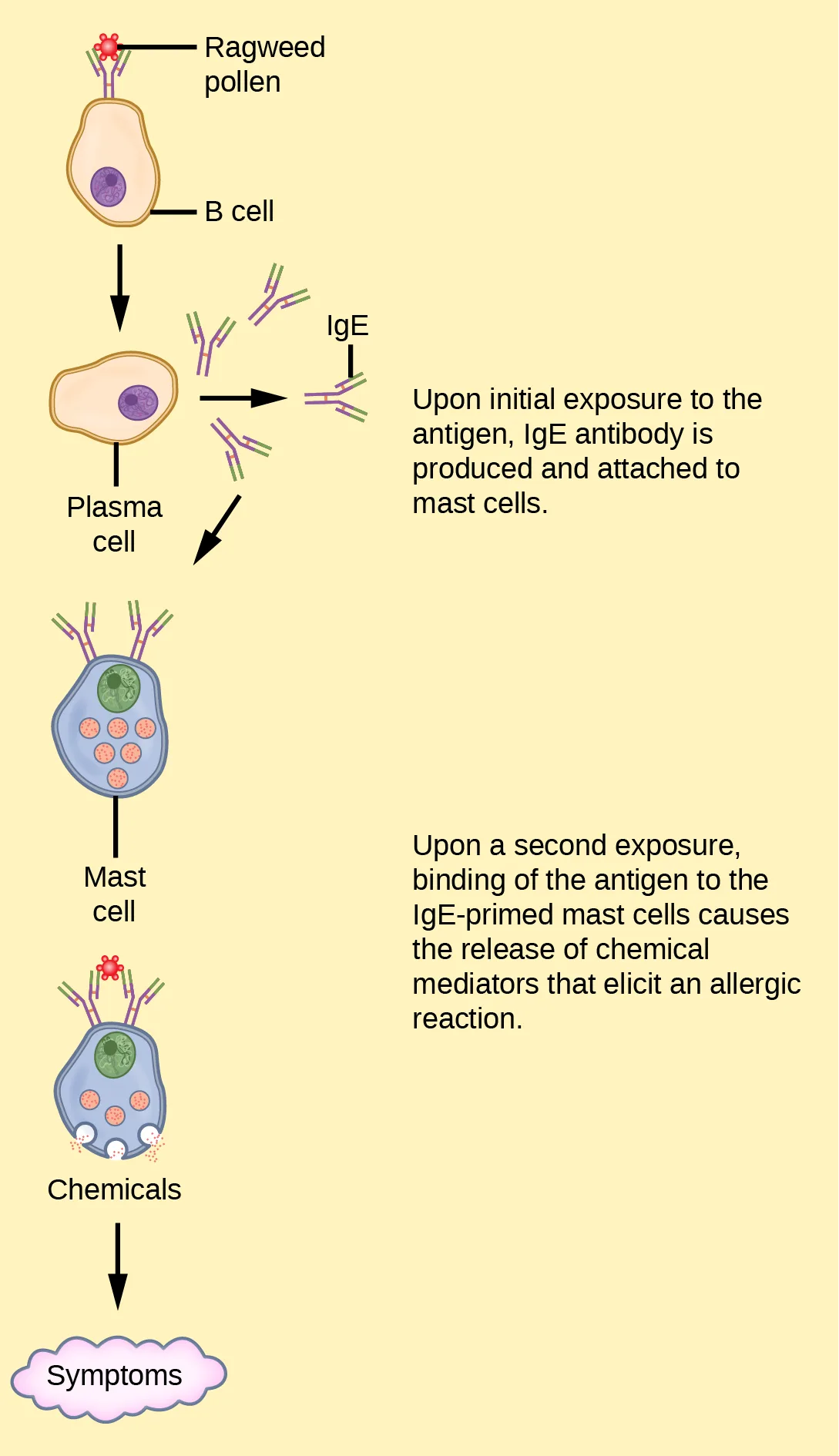
The immune reaction that results from immediate hypersensitivities in which an antibody-mediated immune response occurs within minutes of exposure to a harmless antigen is called an allergy. In the United States, 20 percent of the population exhibits symptoms of allergy or asthma, whereas 55 percent test positive against one or more allergens. Upon initial exposure to a potential allergen, an allergic individual synthesizes antibodies of the IgE class via the typical process of APCs presenting processed antigen to TH cells that stimulate B cells to produce IgE. This class of antibodies also mediates the immune response to parasitic worms. The constant domain of the IgE molecules interact with mast cells embedded in connective tissues. This process primes, or sensitizes, the tissue. Upon subsequent exposure to the same allergen, IgE molecules on mast cells bind the antigen via their variable domains and stimulate the mast cell to release the modified amino acids histamine and serotonin; these chemical mediators then recruit eosinophils which mediate allergic responses. The illustration below shows an example of an allergic response to ragweed pollen. The effects of an allergic reaction range from mild symptoms like sneezing and itchy, watery eyes to more severe or even life-threatening reactions involving intensely itchy welts or hives, airway contraction with severe respiratory distress, and plummeting blood pressure. This extreme reaction is known as anaphylactic shock. If not treated with epinephrine to counter the blood pressure and breathing effects, this condition can be fatal.
Extended description
The chart reads top to bottom in seven labeled elements joined by five arrows. A red pollen particle labeled ‘Ragweed pollen’ sits bound to a receptor on a tan cell labeled ‘B cell.’ An arrow points down to a second tan cell labeled ‘Plasma cell.’ From the plasma cell, one arrow points right to a cluster of Y-shaped antibodies labeled ‘IgE,’ and a second, diagonal arrow points down and to the left to a blue-gray granular cell labeled ‘Mast cell,’ already coated with Y-shaped IgE antibodies on its surface; beside these three elements, text reads ‘Upon initial exposure to the antigen, IgE antibody is produced and attached to mast cells.’ A third arrow points straight down to a second blue-gray granular cell labeled ‘Chemicals,’ drawn with a red pollen particle now bound to the IgE on its surface and small orange flecks released from its base; beside it, text reads ‘Upon a second exposure, binding of the antigen to the IgE-primed mast cells causes the release of chemical mediators that elicit an allergic reaction.’ A final arrow points down to a pink cloud labeled ‘Symptoms.’
Delayed hypersensitivity is a cell-mediated immune response that takes approximately one to two days after secondary exposure for a maximal reaction to be observed. This type of hypersensitivity involves the TH1 cytokine-mediated inflammatory response and may manifest as local tissue lesions or contact dermatitis (rash or skin irritation). Delayed hypersensitivity occurs in some individuals in response to contact with certain types of jewelry or cosmetics. Delayed hypersensitivity facilitates the immune response to poison ivy and is also the reason why the skin test for tuberculosis results in a small region of inflammation on individuals who were previously exposed to Mycobacterium tuberculosis. That is also why cortisone is used to treat such responses: it will inhibit cytokine production.
Autoimmunity
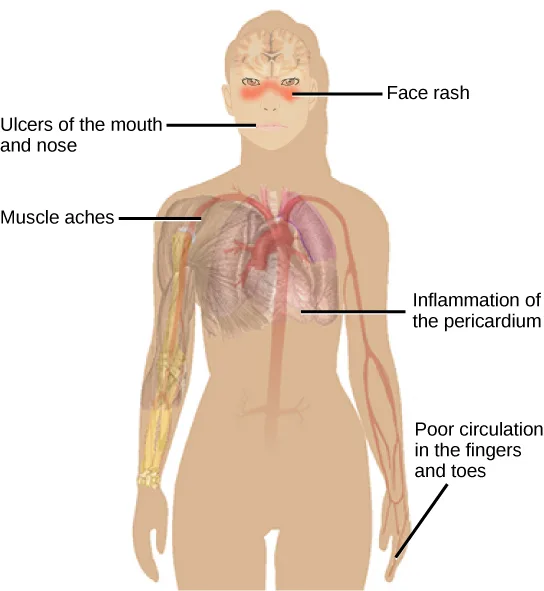
Autoimmunity is a type of hypersensitivity to self antigens that affects approximately five percent of the population. Most types of autoimmunity involve the humoral immune response. Antibodies that inappropriately mark self components as foreign are termed autoantibodies. In patients with the autoimmune disease myasthenia gravis, muscle cell receptors that induce contraction in response to acetylcholine are targeted by antibodies. The result is muscle weakness that may include marked difficulty with fine and/or gross motor functions. In systemic lupus erythematosus, a diffuse autoantibody response to the individual’s own DNA and proteins results in various systemic diseases. As illustrated below, systemic lupus erythematosus may affect the heart, joints, lungs, skin, kidneys, central nervous system, or other tissues, causing tissue damage via antibody binding, complement recruitment, lysis, and inflammation.
Extended description
Five leader lines run to the body illustration. Reading roughly top to bottom: ‘Face rash’ points to a red, mask-like rash drawn across the bridge of the nose and both cheeks, beneath a transparent skull that shows the brain. ‘Ulcers of the mouth and nose’ points to the mouth. ‘Muscle aches’ points to the muscle and bone of the arm on the image’s left, shown without skin in tan and yellow. ‘Inflammation of the pericardium’ points to a pink area over the heart and lungs, visible beneath the ribs on the image’s right. ‘Poor circulation in the fingers and toes’ points up and to the left to the red blood-vessel line that runs down the right arm and ends at the drawn hand; no foot is drawn in the figure.
Autoimmunity can develop with time, and its causes may be rooted in molecular mimicry. Antibodies and TCRs may bind self antigens that are structurally similar to pathogen antigens, which the immune receptors first raised. As an example, infection with Streptococcus pyogenes (bacterium that causes strep throat) may generate antibodies or T cells that react with heart muscle, which has a similar structure to the surface of S. pyogenes. These antibodies can damage heart muscle with autoimmune attacks, leading to rheumatic fever. Insulin-dependent (Type 1) diabetes mellitus arises from a destructive inflammatory TH1 response against insulin-producing cells of the pancreas. Patients with this autoimmunity must be injected with insulin that originates from other sources.
Summary
Immune disruptions may involve insufficient immune responses or inappropriate immune targets. Immunodeficiency increases an individual’s susceptibility to infections and cancers. Hypersensitivities are misdirected responses either to harmless foreign particles, as in the case of allergies, or to host factors, as in the case of autoimmunity. Reactions to self components may be the result of molecular mimicry.
Key terms
- allergy — immune reaction that results from immediate hypersensitivities in which an antibody-mediated immune response occurs within minutes of exposure to a harmless antigen
- autoantibody — antibody that incorrectly marks “self” components as foreign and stimulates the immune response
- autoimmunity — type of hypersensitivity to self antigens
- hypersensitivities — spectrum of maladaptive immune responses toward harmless foreign particles or self antigens; occurs after tissue sensitization and includes immediate-type (allergy), delayed-type, and autoimmunity
- immunodeficiency — failure, insufficiency, or delay at any level of the immune system, which may be acquired or inherited
Practice
Describe hypersensitivity
Allergy to pollen is classified as:
This response begins minutes after contact with the allergen, not days later — which type of hypersensitivity involves that fast a timeline?________ are misdirected responses either to harmless foreign particles, as in the case of allergies, or to host factors, as in the case of autoimmunity.
This is the section’s own heading for the broad category spanning both allergic and autoimmune reactions.The immune reaction that results from immediate hypersensitivities in which an antibody-mediated immune response occurs within minutes of exposure to a harmless antigen is called a(n) ________.
Not autoimmunity or immunodeficiency — this is the everyday word for a reaction to pollen, dust, or pet dander.Immune disruptions may involve insufficient immune responses or ________.
Hypersensitivity is not a weak response — it is a response aimed at the wrong thing.Define autoimmunity
A potential cause of acquired autoimmunity is ________.
The section explains how an antibody raised against a pathogen’s surface molecules can end up recognizing the body’s own similarly shaped proteins — what is that phenomenon called?Autoantibodies are probably involved in:
Look for the disease described as a diffuse antibody response against the person’s own DNA and proteins.Which of the following diseases is not due to autoimmunity?
Three of these four are explicitly described in this section as autoimmune diseases — the fourth is caused directly by a virus destroying immune cells, not by the body attacking itself.The type of hypersensitivity to self antigens is called ________.
This is one of the three subtypes of hypersensitivity introduced earlier — the one where the immune system attacks the body’s own tissue instead of a foreign invader.An antibody that incorrectly marks ‘self’ components as foreign and stimulates the immune response is called a(n) ________.
This is simply an antibody-class protein — the same kind the body normally makes against pathogens — misdirected against its own molecules.This section is adapted from Biology 2e, Section 42.4: Disruptions in the Immune System by Mary Ann Clark, Jung Choi, Matthew Douglas, and OpenStax, © OpenStax, licensed under CC BY-NC-SA 4.0. Access the original for free at openstax.org. Changes: figures re-encoded as WebP; the module’s two figures are printed in reverse stem order from their in-text numbering (the allergy/IgE flow chart discussed first in the Allergies subsection is vendored as Figure_B42_04_02, and the systemic-lupus-erythematosus illustration discussed second in Autoimmunity is vendored as Figure_42_04_02) — selected by the media manifest’s module field rather than by guessing from the figure number; the lupus illustration re-kinded from the manifest’s file-extension “photo” guess to “diagram” (it is a hand-drawn, flat-color body illustration with leader-line labels, not a photograph); the flow chart’s source alt, which used letter-spaced text-to-speech spelling (“I g E”), rewritten from the image, with the step-by-step walkthrough moved into a longdesc; a longdesc also added to the lupus illustration, since its caption does not carry the five printed labels; in-text pointers to the figures (“shows an example of,” “As illustrated in Figure 42.27”) replaced with “shown below” / “illustrated below,” since Hugo does not number figures; the one Review Question testing hypersensitivity/allergy concepts and the three testing autoimmunity concepts adapted into the closing interactive Practice block, one per objective’s group; a select-the-term multiple choice built from the section’s own Summary sentence (distractors drawn from the module’s own terms “immunodeficiencies,” “autoantibodies,” and “allergies”) and a cloze text recall from another Summary sentence added under “Describe hypersensitivity,” which the end-of-section exercise set alone left short of the book’s three-item floor; four key-term recall items (allergy, inappropriate immune targets as a Summary cloze, autoimmunity, autoantibody) added from the glossary and Summary, covering three of the section’s five glossary terms as textins (hypersensitivities is tested by the select-the-term multiple choice) — “immunodeficiency” appears only in the Key terms list and the prose, since neither of the section’s two objectives (hypersensitivity, autoimmunity) tests it and the module has no exercise on immunodeficiency; this module carries no Critical Thinking Questions and no Visual Connection.