Reproduction Methods
By the end of this section, you will be able to:
- Describe advantages and disadvantages of asexual and sexual reproduction
- Discuss asexual reproduction methods
- Discuss sexual reproduction methods
Animals produce offspring through asexual and/or sexual reproduction. Both methods have advantages and disadvantages. Asexual reproduction produces offspring that are genetically identical to the parent because the offspring are all clones of the original parent. A single individual can produce offspring asexually and large numbers of offspring can be produced quickly. In a stable or predictable environment, asexual reproduction is an effective means of reproduction because all the offspring will be adapted to that environment. In an unstable or unpredictable environment asexually-reproducing species may be at a disadvantage because all the offspring are genetically identical and may not have the genetic variation to survive in new or different conditions. On the other hand, the rapid rates of asexual reproduction may allow for a speedy response to environmental changes if individuals have mutations. An additional advantage of asexual reproduction is that colonization of new habitats may be easier when an individual does not need to find a mate to reproduce.
During sexual reproduction the genetic material of two individuals is combined to produce genetically diverse offspring that differ from their parents. The genetic diversity of sexually produced offspring is thought to give species a better chance of surviving in an unpredictable or changing environment. Species that reproduce sexually must maintain two different types of individuals, males and females, which can limit the ability to colonize new habitats as both sexes must be present.
Asexual Reproduction
Asexual reproduction occurs in prokaryotic microorganisms (bacteria) and in some eukaryotic single-celled and multi-celled organisms. There are a number of ways that animals reproduce asexually.
Fission
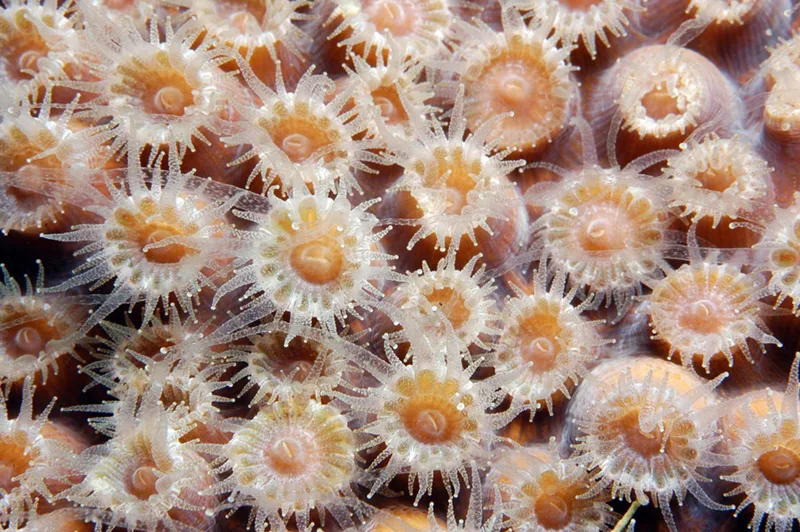
Fission, also called binary fission, occurs in prokaryotic microorganisms and in some invertebrate, multi-celled organisms. After a period of growth, an organism splits into two separate organisms. Some unicellular eukaryotic organisms undergo binary fission by mitosis. In other organisms, part of the individual separates and forms a second individual. This process occurs, for example, in many asteroid echinoderms through splitting of the central disk. Some sea anemones and some coral polyps (shown below) also reproduce through fission.
Budding
Budding is a form of asexual reproduction that results from the outgrowth of a part of a cell or body region leading to a separation from the original organism into two individuals. Budding occurs commonly in some invertebrate animals such as corals and hydras. In hydras, a bud forms that develops into an adult and breaks away from the main body, as illustrated below, whereas in coral budding, the bud does not detach and multiplies as part of a new colony.
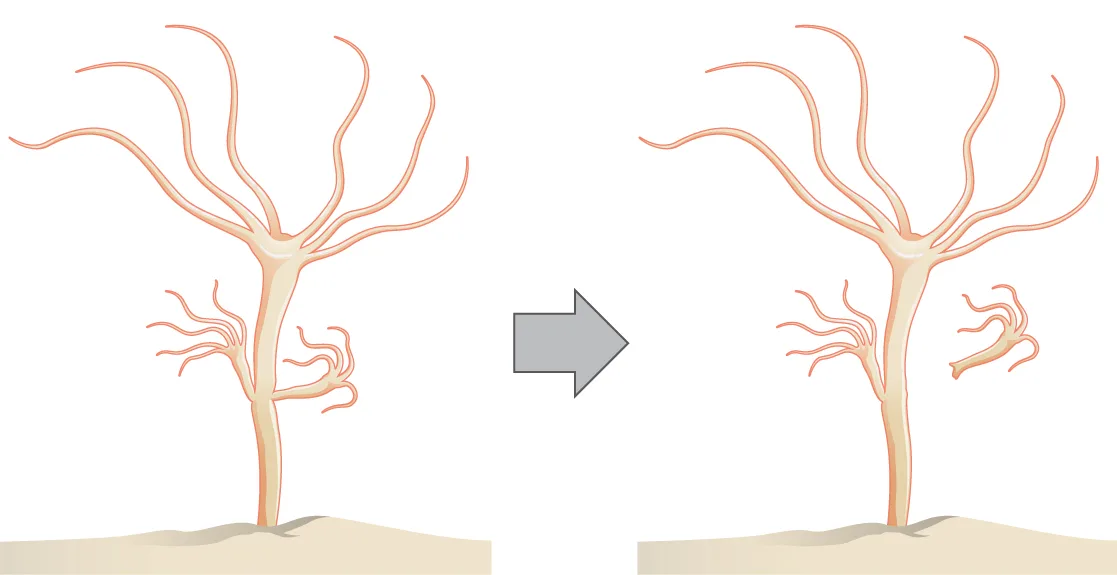
Extended description
The left illustration shows a main hydra with a fanning crown of tentacles at the top of its stalk and a smaller, similarly tentacled bud attached partway down the stalk’s left side. A single gray arrow points from the left illustration to the right one. The right illustration repeats the same main hydra, but the bud’s own stalk has narrowed to a thin pinch point and a gap has opened between the bud and the main stalk, showing it separating to become an independent hydra.
Link to Learning
Watch a video of a hydra budding.
Fragmentation
Fragmentation is the breaking of the body into two parts with subsequent regeneration. If the animal is capable of fragmentation, and the part is big enough, a separate individual will regrow.
For example, in many sea stars, asexual reproduction is accomplished by fragmentation. The illustration below shows a sea star for which an arm of the individual is broken off and regenerates a new sea star. Fisheries workers have been known to try to kill the sea stars eating their clam or oyster beds by cutting them in half and throwing them back into the ocean. Unfortunately for the workers, the two parts can each regenerate a new half, resulting in twice as many sea stars to prey upon the oysters and clams. Fragmentation also occurs in annelid worms, turbellarians, and poriferans.
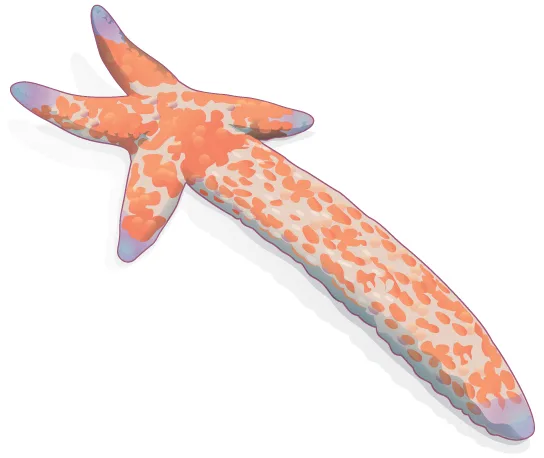
Note that in fragmentation, there is generally a noticeable difference in the size of the individuals, whereas in fission, two individuals of approximately the same size are formed.
Parthenogenesis
Parthenogenesis is a form of asexual reproduction where an egg develops into a complete individual without being fertilized. The resulting offspring can be either haploid or diploid, depending on the process and the species. Parthenogenesis occurs in invertebrates such as water fleas, rotifers, aphids, stick insects, some ants, wasps, and bees. Bees use parthenogenesis to produce haploid males (drones). If eggs are fertilized, diploid females develop, and if the fertilized eggs are fed a special diet (so called royal jelly), a queen is produced.
Some vertebrate animals—such as certain reptiles, amphibians, and fish—also reproduce through parthenogenesis. Although more common in plants, parthenogenesis has been observed in animal species that were segregated by sex in terrestrial or marine zoos. Two female Komodo dragons, a hammerhead shark, and a blacktip shark (Source note: the source prints “blacktop”; the documented case is a blacktip shark, Carcharhinus limbatus (Chapman et al., Journal of Fish Biology 73 [2008]: 1473).) have produced parthenogenic young when the females have been isolated from males.
Sexual Reproduction
Sexual reproduction is the combination of (usually haploid) reproductive cells from two individuals to form a third (usually diploid) unique offspring. Sexual reproduction produces offspring with novel combinations of genes. This can be an adaptive advantage in unstable or unpredictable environments. As humans, we are used to thinking of animals as having two separate sexes—male and female—determined at conception. However, in the animal kingdom, there are many variations on this theme.
Hermaphroditism
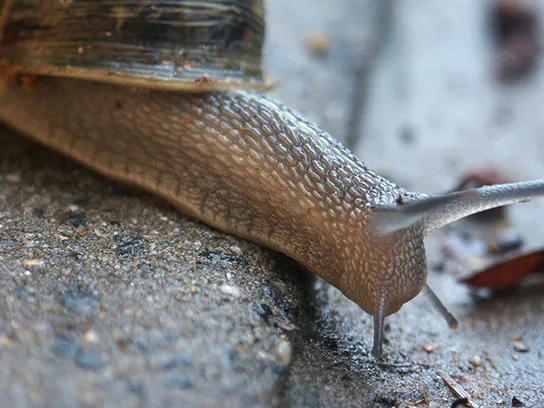
Hermaphroditism occurs in animals where one individual has both male and female reproductive parts. Invertebrates such as earthworms, slugs, tapeworms and snails, shown below, are often hermaphroditic. Hermaphrodites may self-fertilize or may mate with another of their species, fertilizing each other and both producing offspring. Self fertilization is common in animals that have limited mobility or are not motile, such as barnacles and clams.
Sex Determination
Mammalian sex determination is determined genetically by the presence of X and Y chromosomes. Individuals homozygous for X (XX) are female and heterozygous individuals (XY) are male. The presence of a Y chromosome causes the development of male characteristics and its absence results in female characteristics. The XY system is also found in some insects and plants.
Avian sex determination is dependent on the presence of Z and W chromosomes. Homozygous for Z (ZZ) results in a male and heterozygous (ZW) results in a female. The W appears to be essential in determining the sex of the individual, similar to the Y chromosome in mammals. Some fish, crustaceans, insects (such as butterflies and moths), and reptiles use this system.
The sex of some species is not determined by genetics but by some aspect of the environment. Sex determination in some crocodiles and turtles, for example, is often dependent on the temperature during critical periods of egg development. This is referred to as environmental sex determination, or more specifically as temperature-dependent sex determination. In many turtles, cooler temperatures during egg incubation produce males and warm temperatures produce females. In some crocodiles, moderate temperatures produce males and both warm and cool temperatures produce females. In some species, sex is both genetic- and temperature-dependent. Note that in this discussion and throughout the chapter, we are speaking only about sex, not gender, when referring to males and females. (Gender is a more complex construct; beyond having social aspects, it is not universal in the animal kingdom.)
Individuals of some species change their sex during their lives, alternating between male and female. If the individual is female first, it is termed protogyny or “first female,” if it is male first, it’s termed protandry or “first male.” Oysters, for example, are born male, grow, and become female and lay eggs; some oyster species change sex multiple times.
Summary
Reproduction may be asexual when one individual produces genetically identical offspring, or sexual when the genetic material from two individuals is combined to produce genetically diverse offspring. Asexual reproduction occurs through fission, budding, and fragmentation. Sexual reproduction may mean the joining of sperm and eggs within animals’ bodies or it may mean the release of sperm and eggs into the environment. An individual may be one sex, or both; it may start out as one sex and switch during its life, or it may stay male or female.
Key terms
- asexual reproduction — form of reproduction that produces offspring that are genetically identical to the parent
- budding — form of asexual reproduction that results from the outgrowth of a part of a cell leading to a separation from the original animal into two individuals
- fission — (also, binary fission) method by which multicellular organisms increase in size or asexual reproduction in which a unicellular organism splits into two separate organisms by mitosis
- fragmentation — cutting or fragmenting of the original animal into parts and the growth of a separate animal from each part
- hermaphroditism — state of having both male and female reproductive parts within the same individual organism; refers only to nonhuman animals
- parthenogenesis — form of asexual reproduction where an egg develops into a complete individual without being fertilized
- sexual reproduction — mixing of genetic material from two individuals to produce genetically unique offspring
Practice
Describe advantages and disadvantages of asexual and sexual reproduction
Which form of reproduction is thought to be best in a stable environment?
Compare what each option’s offspring look like genetically, then decide which strategy pays off when the surrounding conditions are not changing.Genetically unique individuals are produced through ________.
Which of these processes combines genetic material from two individuals rather than copying one parent’s genes exactly?Why is sexual reproduction useful if only half the animals can produce offspring and two separate cells must be combined to form a third?
Show model answer
Did your answer mention:
A form of reproduction that produces offspring genetically identical to the parent is called ________.
Think about what a clone shares with the single parent that produced it.The mixing of genetic material from two individuals to produce genetically unique offspring is called ________.
Think about what combining two individuals’ genetic material, rather than copying one, does to the offspring’s genes.Discuss asexual reproduction methods
Which form of reproduction can result from damage to the original animal?
Which of these processes specifically begins when part of the animal’s body is broken off, rather than growing a new part or developing from an unfertilized egg?The form of asexual reproduction in which a unicellular organism splits into two separate organisms by mitosis is called ________.
One organism splits into two individuals of about the same size, most often by ordinary cell division.The form of asexual reproduction that results from an outgrowth of part of a cell or body region separating into a new individual is called ________.
Picture a small offshoot growing on the side of the parent and eventually pinching free, the way the pictured animal on this page does it.The form of asexual reproduction in which an egg develops into a complete individual without being fertilized is called ________.
No mating is involved here — think about what happens when an unfertilized egg still develops on its own.Discuss sexual reproduction methods
Which form of reproduction is useful to an animal with little mobility that reproduces sexually?
The animal still needs another individual’s genetic material, but its low mobility makes travelling to find a mate hard — what trait would let one individual supply both roles, or self-fertilize?What determines which sex will result in offspring of birds and mammals?
Show model answer
Did your answer mention:
The state of having both male and female reproductive parts within the same individual organism is called ________.
Think about an organism carrying reproductive organs of both sexes at once, a trait useful when a mate is hard to reach.Sexual reproduction may mean the joining of sperm and eggs within animals’ bodies or it may mean the release of sperm and eggs into the ________.
Think about where fertilization happens when it takes place outside the body, rather than inside it.This section is adapted from Biology 2e, Section 43.1: Reproduction Methods by Mary Ann Clark, Jung Choi, Matthew Douglas, and OpenStax, © OpenStax, licensed under CC BY-NC-SA 4.0. Access the original for free at openstax.org. Changes: figures re-encoded as WebP with the source alt text edited to describe rather than caption-repeat; two figures re-kinded from the manifest’s file-extension “photo” guess to “diagram” (Figure_43_01_02 and Figure_43_01_03 are hand-drawn or computer-rendered illustrations, not captured photographs — the module’s own alt text calls both “Illustration shows…” while the two kept as photo are called “Image shows…” and “Photo shows…”); a longdesc added to the budding hydra illustration, the only figure on the page whose two panels and connecting arrow are not otherwise carried by its one-line caption, transcribing the illustration’s own before/after layout without stating which of the two clusters is the bud; in-text pointers to figures (“Figure 43.2” through “Figure 43.5”) replaced with “shown below,” “illustrated below,” or “the illustration below shows,” since Hugo does not number figures; the interactive note rendered as a Link to Learning callout, keeping the module’s own openstax.org/l/budding_hydra redirect URL; the end-of-section Review Questions and Critical Thinking Questions adapted into the closing interactive Practice block (multiple choice and self-check respectively) — all four Review Questions and both Critical Thinking Questions are used, and neither the source options nor its keys were altered; rubric checkpoints added to each self-check, decomposing its model answer (the source solution) into check-off clauses with no new claims; six key-term recall items added from the glossary (asexual reproduction, sexual reproduction, fission, budding, parthenogenesis, hermaphroditism), covering six of the section’s seven glossary terms (fragmentation is tested instead as the keyed answer of a multiple choice); one cloze recall item added from the section’s own summary sentence ("…it may mean the release of sperm and eggs into the ________," answered “environment”), reaching for a summary item ahead of writing a local one, disclosed as summary-sourced rather than a source exercise; the source’s “its termed protandry” corrected to “it’s termed protandry” — reported as a source defect. One name is corrected with a visible Source note: the parthenogenetic shark is a blacktip shark, where the source prints “blacktop” (erratum 454).