Fertilization
By the end of this section, you will be able to:
- Discuss internal and external methods of fertilization
- Describe the methods used by animals for development of offspring during gestation
- Describe the anatomical adaptations that occurred in animals to facilitate reproduction
Sexual reproduction starts with the combination of a sperm and an egg in a process called fertilization. This can occur either inside (internal fertilization) or outside (external fertilization) the body of the female. Humans provide an example of the former whereas seahorse reproduction is an example of the latter.
External Fertilization
External fertilization usually occurs in aquatic environments where both eggs and sperm are released into the water. After the sperm reaches the egg, fertilization takes place. Most external fertilization happens during the process of spawning where one or several females release their eggs and the male(s) release sperm in the same area, at the same time. The release of the reproductive material may be triggered by water temperature or the length of daylight. Nearly all fish spawn, as do crustaceans (such as crabs and shrimp), mollusks (such as oysters), squid, and echinoderms (such as sea urchins and sea cucumbers). Salmon spawning in a shallow stream are shown below. Toads, like those shown below, also spawn.
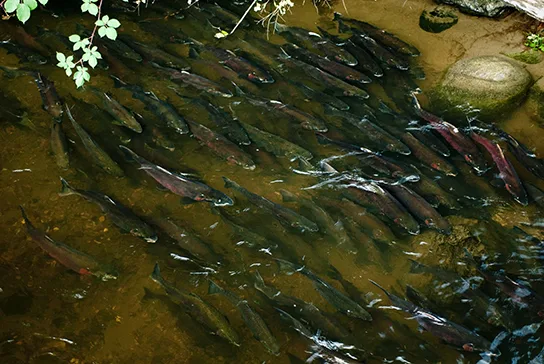
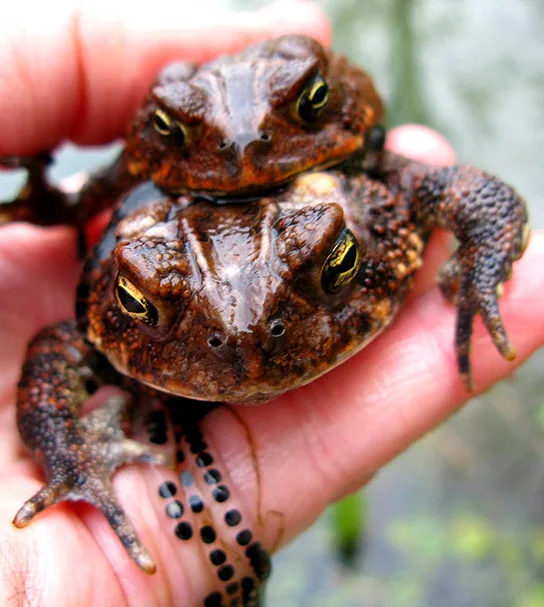
Pairs of fish that are not broadcast spawners may exhibit courtship behavior. This allows the female to select a particular male. The trigger for egg and sperm release (spawning) causes the egg and sperm to be placed in a small area, enhancing the possibility of fertilization.
External fertilization in an aquatic environment protects the eggs from drying out. Broadcast spawning can result in a greater mixture of the genes within a group, leading to higher genetic diversity and a greater chance of species survival in a hostile environment. For sessile aquatic organisms like sponges, broadcast spawning is the only mechanism for fertilization and colonization of new environments. The presence of the fertilized eggs and developing young in the water provides opportunities for predation resulting in a loss of offspring. Therefore, millions of eggs must be produced by individuals, and the offspring produced through this method must mature rapidly. The survival rate of eggs produced through broadcast spawning is low.
Internal Fertilization
Internal fertilization occurs most often in land-based animals, although some aquatic animals also use this method. There are three ways that offspring are produced following internal fertilization. In oviparity, fertilized eggs are laid outside the parent’s body and develop there, receiving nourishment from the yolk that is a part of the egg. This occurs in most bony fish, many reptiles, some cartilaginous fish, most amphibians, two mammals, and all birds. Reptiles and insects produce leathery eggs, while birds and turtles produce eggs with high concentrations of calcium carbonate in the shell, making them hard. Chicken eggs are an example of this second type.
In ovoviviparity, fertilized eggs are retained in the parent (usually the female), but the embryo obtains its nourishment from the egg’s yolk and the young are fully developed when they are hatched. This occurs in some bony fish (like the guppy Lebistes reticulatus), some sharks, some lizards, some snakes (such as the garter snake Thamnophis sirtalis), some vipers, and some invertebrate animals (like the Madagascar hissing cockroach Gromphadorhina portentosa).
In viviparity the young develop within the female, receiving nourishment from the parent’s blood through a placenta. The offspring develops in the female and is born alive. This occurs in most mammals, some cartilaginous fish, and a few reptiles.
Internal fertilization has the advantage of protecting the fertilized egg from dehydration on land. The embryo is isolated within the female, which limits predation on the young. Internal fertilization enhances the fertilization of eggs by a specific male. Fewer offspring are produced through this method, but their survival rate is higher than that for external fertilization.
The Evolution of Reproduction
Once multicellular organisms evolved and developed specialized cells, some also developed tissues and organs with specialized functions. An early development in reproduction occurred in the Annelids. These organisms produce sperm and eggs from undifferentiated cells in their coelom and store them in that cavity. When the coelom becomes filled, the cells are released through an excretory opening or by the body splitting open. Reproductive organs evolved with the development of gonads that produce sperm and eggs. These cells went through meiosis, an adaptation of mitosis, which reduced the number of chromosomes in each reproductive cell by half, while increasing the number of cells through cell division.
Complete reproductive systems were developed in insects, with separate sexes. Sperm are made in testes and then travel through coiled tubes to the epididymis for storage. Eggs mature in the ovary. When they are released from the ovary, they travel to the uterine tubes for fertilization. Some insects have a specialized sac, called a spermatheca, which stores sperm for later use, sometimes up to a year. Fertilization can be timed with environmental or food conditions that are optimal for offspring survival.
Vertebrates have similar structures, with a few differences. Non-mammals, such as birds and reptiles, have a common body opening, called a cloaca, for the digestive, excretory and reproductive systems. Coupling between birds usually involves positioning the cloaca openings opposite each other for transfer of sperm. Mammals have separate openings for the systems in the female and a uterus for support of developing offspring. The uterus has two chambers in species that produce large numbers of offspring at a time, while species that produce one offspring, such as primates, have a single uterus.
Sperm transfer from the male to the female during reproduction ranges from releasing the sperm into the watery environment for external fertilization, to the joining of cloaca in birds, to the development of a penis for direct delivery into the female’s vagina in mammals.
Summary
Sexual reproduction starts with the combination of a sperm and an egg in a process called fertilization. This can occur either outside the bodies or inside the female. Both methods have advantages and disadvantages. Once fertilized, the eggs can develop inside the female or outside. If the egg develops outside the body, it usually has a protective covering over it. Animal anatomy evolved various ways to fertilize, hold, or expel the egg. The method of fertilization varies among animals. Some species release the egg and sperm into the environment, some species retain the egg and receive the sperm into the female body and then expel the developing embryo covered with shell, while still other species retain the developing offspring through the gestation period.
Key terms
- cloaca — common body opening for the digestive, excretory, and reproductive systems found in non-mammals, such as birds
- external fertilization — fertilization of egg by sperm outside animal body, often during spawning
- internal fertilization — fertilization of egg by sperm inside the body of the female
- oviparity — process by which fertilized eggs are laid outside the female’s body and develop there, receiving nourishment from the yolk that is a part of the egg
- ovoviviparity — process by which fertilized eggs are retained within the female; the embryo obtains its nourishment from the egg’s yolk and the young are fully developed when they are hatched
- spermatheca — specialized sac that stores sperm for later use
- viviparity — process in which the young develop within the female, receiving nourishment from the mother’s blood through a placenta
Practice
Discuss internal and external methods of fertilization
External fertilization occurs in which type of environment?
Think about where both eggs and sperm need to be released into the same medium at the same time for sperm to reach the egg — spawning depends on it.What are the advantages and disadvantages of external and internal forms of fertilization?
Show model answer
Did your answer mention:
Why would paired external fertilization be preferable to group spawning?
Show model answer
Did your answer mention:
Fertilization of an egg by sperm outside the animal’s body, often during spawning, is called ________.
This is the method most fish and aquatic invertebrates use, releasing gametes into the water rather than inside a body.Fertilization of an egg by sperm inside the body of the female is called ________.
This is the method humans use, in contrast to the one seahorses use.Describe the methods used by animals for development of offspring during gestation
Which term applies to egg development within the female with nourishment derived from a yolk?
This term keeps the egg inside the parent’s body but still relies on the egg’s own yolk for nourishment, rather than a placental blood supply — that combination is what separates it from the other two terms.Which term applies to egg development outside the female with nourishment derived from a yolk?
This is the option where the egg leaves the body before it hatches, unlike the other two terms, which both keep the developing egg inside the parent.The process in which young develop within the female, receiving nourishment from the mother’s blood through a placenta, is called ________.
This is the reproductive strategy used by most mammals, where a placenta — not a yolk — is the nutrient source.Describe the anatomical adaptations that occurred in animals to facilitate reproduction
The common body opening for the digestive, excretory, and reproductive systems found in non-mammals, such as birds, is called the ________.
Birds line up this single shared opening with their mate’s matching opening during coupling, instead of using separate organs.The specialized sac in some insects that stores sperm for later use, sometimes up to a year, is called a(n) ________.
It lets the female time fertilization to when environmental or food conditions are best for the offspring, well after mating actually happens.Which anatomical adaptation allows mammals to deliver sperm directly into the female’s vagina, in contrast to the cloacal joining birds use for sperm transfer?
The sentence describing sperm transfer names three different structures for three different groups — one for external fertilizers, one for birds, and one for the group being asked about here.This section is adapted from Biology 2e, Section 43.2: Fertilization by Mary Ann Clark, Jung Choi, Matthew Douglas, and OpenStax, © OpenStax, licensed under CC BY-NC-SA 4.0. Access the original for free at openstax.org. Changes: figures re-encoded as WebP with the source alts (bare “Photo shows many salmon swimming up a shallow creek.” and “Photo shows mating toads.”) rewritten to describe what each photograph shows, since neither named a point the caption did not already carry; both figures are kept as kind="photo", matching the manifest’s guess; the prose’s cross-reference “Frogs, like those shown in Figure 43.7, also spawn” is corrected to “Toads, like those shown below, also spawn” — reported as a source defect below; in-text pointers to figures (“Figure 43.6”, “Figure 43.7”) replaced with “shown below,” since Hugo does not number figures; the end-of-section Review Questions and Critical Thinking Questions adapted into the closing interactive Practice block (multiple choice and self-check respectively); rubric checkpoints added to each self-check, decomposing its model answer (the source solution) into check-off clauses with no new claims; five key-term recall items added from the glossary (external fertilization, internal fertilization, viviparity, cloaca, spermatheca), covering five of the section’s seven glossary terms (oviparity and ovoviviparity are instead tested by their own source multiple-choice items rather than duplicated as recall); one local multiple-choice item added under the third objective, built strictly from the section’s own sentence on sperm-transfer structures (“the development of a penis for direct delivery into the female’s vagina in mammals”), because no source exercise or glossary term tests that objective on its own. Source defects: module m66671 — the prose says “Frogs, like those shown in Figure 43.7, also spawn,” but Figure 43.7’s own caption and alt both describe toads (“During sexual reproduction in toads, the male grasps the female from behind…”; “Photo shows mating toads.”), and the same photo appears captioned as toads in the printed PDF (page 1262). The figure shows toads, not frogs; “Frogs” is a wrong cross-reference, corrected to “Toads” above.