Ecology and the Biosphere
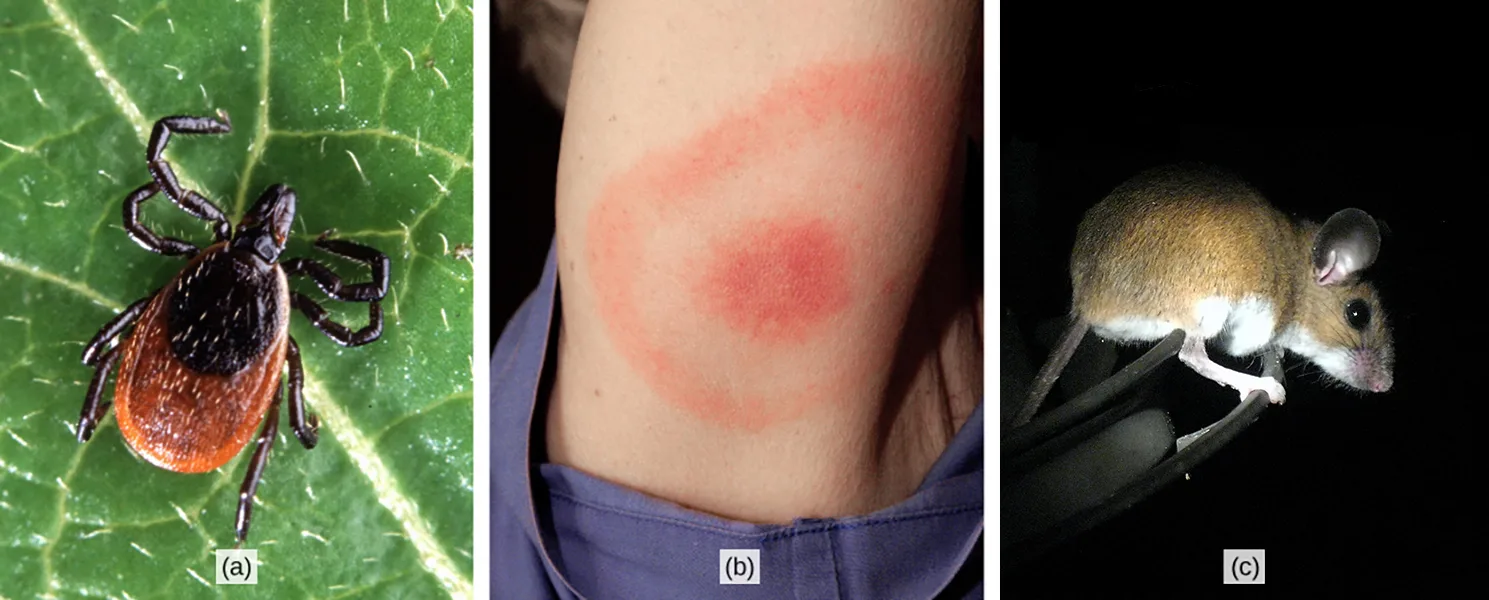
Why study ecology? Perhaps you are interested in learning about the natural world and how living things have adapted to the physical conditions of their environment. Or, perhaps you’re a future physician seeking to understand the connection between your patients’ health and their environment.
Humans are a part of the ecological landscape, and human health is one important part of human interaction with our physical and living environment. Lyme disease, for instance, serves as one modern-day example of the connection between our health and the natural world (shown above). More formally known as Lyme borreliosis, Lyme disease is a bacterial infection that can be transmitted to humans when they are bitten by the deer tick (Ixodes scapularis in the eastern U.S., and Ixodes pacificus along the Pacific coast). Deer ticks are the primary vectors (a vector is an organism that transmits a pathogen) for this disease. However, not all ticks carry the pathogen, and not all deer ticks carry the bacteria that will cause Lyme disease in humans. Also, the ticks I. scapularis and pacificus can have other hosts besides deer. In fact, it turns out that the probability of infection depends on the type of host upon which the tick develops: a higher proportion of ticks that live on white-footed mice carry the bacterium than do ticks that live on deer. Knowledge about the environments and population densities in which the host species is abundant would help a physician or an epidemiologist better understand how Lyme disease is transmitted and how its incidence could be reduced.
Sections
- The Scope of Ecology — ecology and its four levels of research, how ecology draws on other scientific disciplines, and the abiotic and biotic components of the environment and how they relate.
- Biogeography — biogeography and the abiotic factors that shape the global distribution of species, how those forces differ between aquatic and terrestrial environments, and their effects on net primary productivity.
- Terrestrial Biomes — the two major abiotic factors that determine terrestrial biomes and the distinguishing characteristics of each of the eight major biomes.
- Aquatic Biomes — how abiotic factors shape plant and animal communities in aquatic biomes, the ocean zones, and standing- and flowing-water freshwater biomes.
- Climate and the Effects of Global Climate Change — global climate change, how the Industrial Revolution has affected atmospheric carbon dioxide, natural factors that affect long-term climate, and the greenhouse gases that drive the greenhouse effect.
This chapter is adapted from Biology 2e, Chapter 44: Ecology and the Biosphere by Mary Ann Clark, Jung Choi, Matthew Douglas, and OpenStax, © OpenStax, licensed under CC BY-NC-SA 4.0. Access the original for free at openstax.org. Each section page records its own changes from the source. Changes: the chapter-opening image is the source’s, re-encoded for the web, with its source alt kept since it already names each lettered panel and says what each photo shows; the source’s in-text parenthetical figure reference ("(Figure 44.1)") is rendered as “(shown above)” since this site does not number figures.