The Scope of Ecology
By the end of this section, you will be able to:
- Define ecology and the four basic levels of ecological research
- Describe examples of the ways in which ecology requires the integration of different scientific disciplines
- Distinguish between abiotic and biotic components of the environment
- Recognize the relationship between abiotic and biotic components of the environment
Ecology is the study of the interactions of living organisms with their environment. One core goal of ecology is to understand the distribution and abundance of living things in the physical environment. Attainment of this goal requires the integration of scientific disciplines inside and outside of biology, such as mathematics, statistics, biochemistry, molecular biology, physiology, evolution, biodiversity, geology, and climatology.
Link to Learning
Climate change can alter where organisms live, which can sometimes directly affect human health. Watch the PBS video “Feeling the Effects of Climate Change”, in which researchers discover a pathogenic organism living far outside of its normal range.
Levels of Ecological Study
When a discipline such as biology is studied, it is often helpful to subdivide it into smaller, related areas. For instance, cell biologists interested in cell signaling need to understand the chemistry of the signal molecules (which are usually proteins) as well as the result of cell signaling. Ecologists interested in the factors that influence the survival of an endangered species might use mathematical models to predict how current conservation efforts affect endangered organisms.
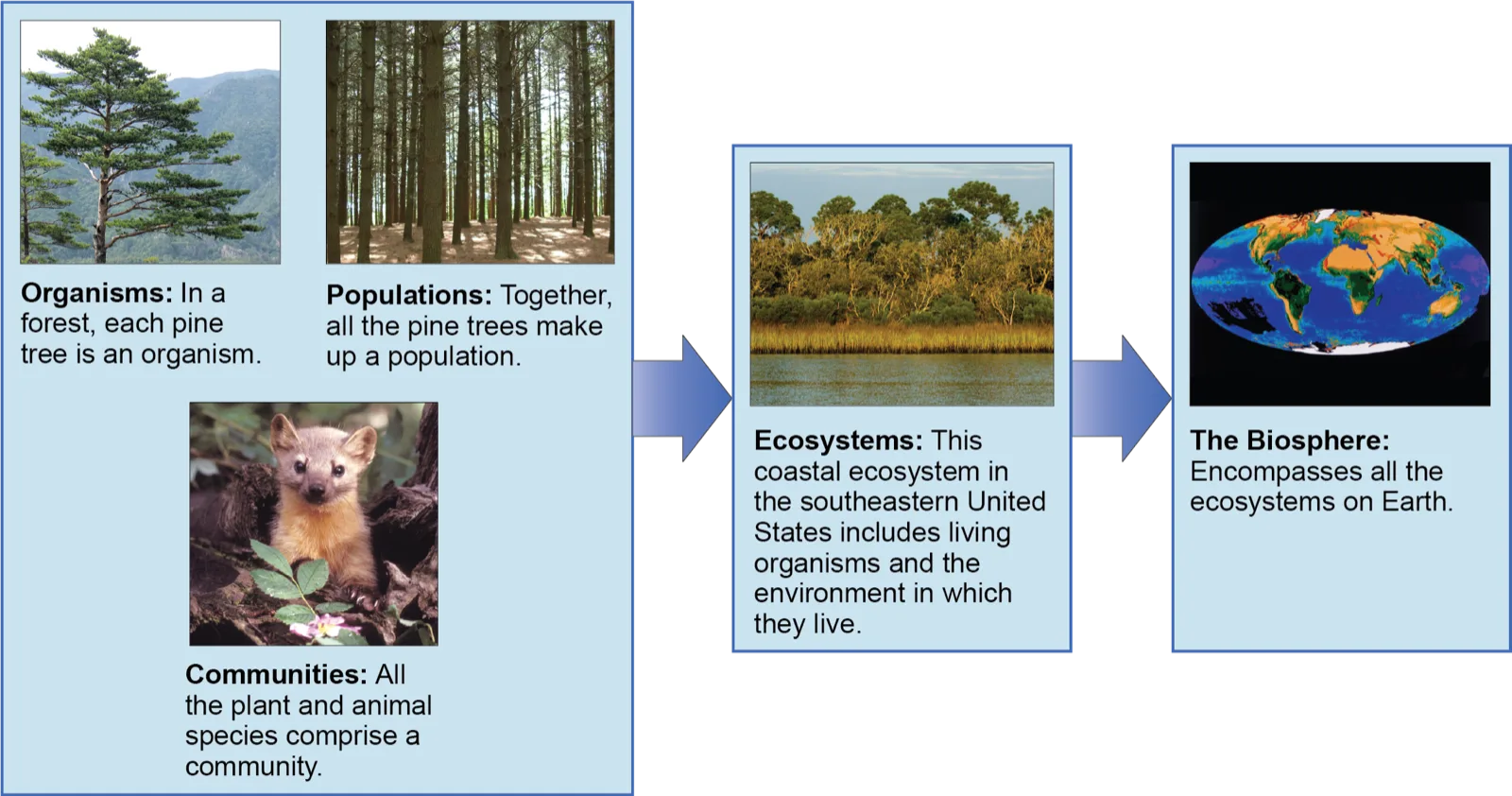
To produce a sound set of management options, a conservation biologist needs to collect accurate data, including current population size, factors affecting reproduction (like physiology and behavior), habitat requirements (such as plants and soils), and potential human influences on the endangered population and its habitat (which might be derived through studies in sociology and urban ecology). Within the discipline of ecology, researchers work at four general levels, which sometimes overlap. These levels are organism, population, community, and ecosystem, shown below.
Extended description
A large box at left holds three photographs. Top left, a single pine tree on a hillside, captioned ‘Organisms: In a forest, each pine tree is an organism.’ Top right, a dense pine forest, captioned ‘Populations: Together, all the pine trees make up a population.’ Below both, spanning the box’s width, a small tan-and-brown animal peering out from among tree roots and leaves, captioned ‘Communities: All the plant and animal species comprise a community.’ A blue arrow leads right from this box to a second box: a photograph of marsh grasses and low trees along a shoreline, captioned ‘Ecosystems: This coastal ecosystem in the southeastern United States includes living organisms and the environment in which they live.’ A second blue arrow leads right from the Ecosystems box to a third box: a colorized satellite image of Earth’s landmasses and oceans, captioned ‘The Biosphere: Encompasses all the ecosystems on Earth.’
Organismal Ecology
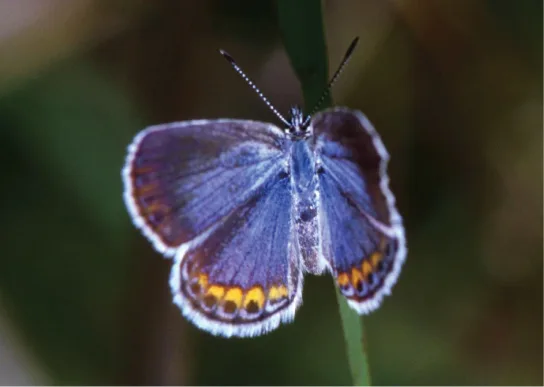
Researchers studying ecology at the organismal level are interested in the adaptations that enable individuals to live in specific habitats. These adaptations can be morphological, physiological, and behavioral. For instance, the Karner blue butterfly (Lycaeides melissa samuelis), shown below, is considered a specialist because the females only oviposit (that is, lay eggs) on wild lupine (Lupinus perennis). This specific requirement and adaptation means that the Karner blue butterfly is completely dependent on the presence of wild lupine plants for its survival.
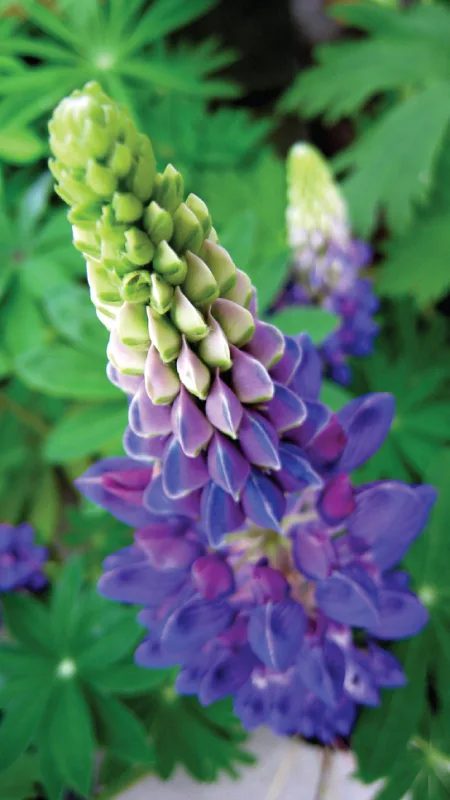
After hatching, the (first instar) caterpillars emerge and spend four to six weeks feeding solely on wild lupine, shown below. The caterpillars pupate as a chrysalis to undergo the final stage of metamorphosis and emerge as butterflies after about four weeks. The adult butterflies feed on the nectar of flowers of wild lupine and other plant species, such as milkweeds. Generally there are two broods of the Karner blue each year.
A researcher interested in studying Karner blue butterflies at the organismal level might, in addition to asking questions about egg laying requirements, ask questions about the butterflies’ preferred thoracic flight temperature (a physiological question), or the behavior of the caterpillars when they are at different larval stages (a behavioral question).
Population Ecology
A population is a group of interbreeding organisms that are members of the same species living in the same area at the same time. (Organisms that are all members of the same species are called conspecifics.) A population is identified, in part, by where it lives, and its area of population may have natural or artificial boundaries. Natural boundaries might be rivers, mountains, or deserts, while artificial boundaries may be mowed grass, manmade structures, or roads. The study of population ecology focuses on the number of individuals in an area and how and why population size changes over time.
For example, population ecologists are particularly interested in counting the Karner blue butterfly because it is classified as a federally endangered species. However, the distribution and density of this species is highly influenced by the distribution and abundance of wild lupine, and the biophysical environment around it. Researchers might ask questions about the factors leading to the decline of wild lupine and how these affect Karner blue butterflies. For example, ecologists know that wild lupine thrives in open areas where trees and shrubs are largely absent. In natural settings, intermittent wildfires regularly remove trees and shrubs, helping to maintain the open areas that wild lupine requires. Mathematical models can be used to understand how wildfire suppression by humans has led to the decline of this important plant for the Karner blue butterfly.
Community Ecology
A biological community consists of the different species within an area, typically a three-dimensional space, and the interactions within and among these species. Community ecologists are interested in the processes driving these interactions and their consequences. Questions about conspecific interactions often focus on competition among members of the same species for a limited resource. Ecologists also study interactions between various species; members of different species are called heterospecifics. Examples of heterospecific interactions include predation, parasitism, herbivory, competition, and pollination. These interactions can have regulating effects on population sizes and can impact ecological and evolutionary processes affecting diversity.
For example, Karner blue butterfly larvae form mutualistic relationships with ants (especially Formica spp). Mutualism is a form of long-term relationship that has coevolved between two species and from which each species benefits. For mutualism to exist between individual organisms, each species must receive some benefit from the other as a consequence of the relationship. Researchers have shown that there is an increase in survival when ants protect Karner blue butterfly larvae (caterpillars) from predaceous insects and spiders, an act known as “tending.” This might be because the larvae spend less time in each life stage when tended by ants, which provides an advantage for the larvae. Meanwhile, to attract the ants, the Karner blue butterfly larvae secrete ant-like pheromones and a carbohydrate-rich substance that is an important energy source for the ants. Both the Karner blue larvae and the ants benefit from their interaction, although the species of attendant ants may be partially opportunistic and vary over the range of the butterfly.
Ecosystem Ecology
Ecosystem ecology is an extension of organismal, population, and community ecology. The ecosystem is composed of all the biotic components (living things) in an area along with the abiotic components (nonliving things) of that area. Some of the abiotic components include air, water, and soil. Ecosystem biologists ask questions about how nutrients and energy are stored and how they move among organisms and through the surrounding atmosphere, soil, and water.
The Karner blue butterflies and the wild lupine live in an oak-pine barren habitat. This habitat is characterized by natural disturbance and nutrient-poor soils that are low in nitrogen. The availability of nutrients is an important factor in the distribution of the plants that live in this habitat. Researchers interested in ecosystem ecology could ask questions about the importance of limited resources and the movement of resources, such as nutrients, through the biotic and abiotic portions of the ecosystem.
Link to Learning
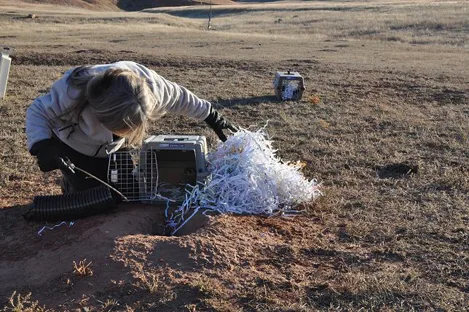
See an interview with Stephen Wing, a marine ecologist from the University of Otago, discussing the role of an ecologist and the types of issues ecologists explore.
Summary
Ecology is the study of the interactions of living things with their environment. Ecologists ask questions that comprise four levels of general biological organization—organismal, population, community, and ecosystem. At the organismal level, ecologists study individual organisms and how they interact with their environments. At the population and community levels, ecologists explore, respectively, how a population of organisms changes over time and the ways in which that population interacts with other species in the community. Ecologists studying an ecosystem examine the living species (the biotic components) of the ecosystem as well as the nonliving portions (the abiotic components), such as air, water, and soil, of the environment.
Key terms
- abiotic — nonliving components of the environment
- biotic — living components of the environment
- conspecifics — individuals that are members of the same species
- ecology — study of interaction between living things and their environment
- heterospecifics — individuals that are members of different species
Practice
Define ecology and the four basic levels of ecological research
The scientific study of the interactions of living things with their environment is called ________.
This is the name of the whole scientific discipline the section introduces, not any one of its four narrower levels.The section’s summary states that ecologists ask questions comprising four levels of general biological organization: organismal, population, community, and ________.
This is the level ecologists study when they examine both the living and the nonliving components of an area together, discussed later in this same section.Individuals that are members of the same species are called ________.
The Community Ecology section uses this term for members sharing one species, distinguishing them from its term for members of different species.Individuals that are members of different species are called ________.
This term pairs with the one for same-species individuals; its prefix marks ‘different’ rather than ‘same.’Ecologists often collaborate with other researchers interested in ecological questions. Describe the levels of ecology that would be easier for collaboration because of the similarities of questions asked. What levels of ecology might be more difficult for collaboration?
Show model answer
Did your answer mention:
The population is an important unit in ecology as well as other biological sciences. How is a population defined, and what are the strengths and weaknesses of this definition? Are there some species that at certain times or places are not in populations?
Show model answer
Did your answer mention:
Describe examples of the ways in which ecology requires the integration of different scientific disciplines
To produce a sound set of management options for an endangered species, a conservation biologist needs data on population size, reproduction, and habitat requirements, plus potential human influences that might be derived through studies in ________ and urban ecology.
This field studies human society and behavior — the section pairs it with ‘urban ecology’ as a source of data about people’s effects on a species’ habitat.Which of the following disciplines does this section name as one that ecology integrates with, alongside mathematics, statistics, biochemistry, molecular biology, physiology, evolution, and biodiversity?
This section’s first paragraph lists nine fields ecology integrates with, ending with the science of weather and long-term atmospheric patterns — find the option that matches a field named there.What kinds of information does a conservation biologist need to collect to produce a sound set of management options for an endangered species, and what other academic fields can supply some of that information?
Show model answer
Did your answer mention:
Distinguish between abiotic and biotic components of the environment
Which of the following is a biotic factor?
Three of these four options are physical or chemical conditions of the environment; only one of them is a living thing.In an ecosystem, the living things are known as the ________ components.
This word shares its root with ‘biology’ — the study of living things.In an ecosystem, the nonliving things — such as air, water, and soil — are known as the ________ components.
The prefix here means ‘without’ or ’not,’ attached to the same root as the term for the living components.Recognize the relationship between abiotic and biotic components of the environment
The study of nutrient cycling through the environment is an example of which of the following?
This branch of ecology studies how nutrients and energy move among organisms and through the surrounding atmosphere, soil, and water — a scope broader than any single population or community.Explain how ecosystem ecology studies the relationship between the biotic and abiotic components of an area.
Show model answer
Did your answer mention:
The summary explains that ecologists studying an ecosystem examine the living species, called the ________, as well as the nonliving portions (the abiotic components), such as air, water, and soil, of the environment.
The summary names this pair right beside ’nonliving portions (the abiotic components)’ — it is the sibling term for the living species just named.This section is adapted from Biology 2e, Section 44.1: The Scope of Ecology by Mary Ann Clark, Jung Choi, Matthew Douglas, and OpenStax, © OpenStax, licensed under CC BY-NC-SA 4.0. Access the original for free at openstax.org. Changes: figures re-encoded as WebP; the levels-of-organization figure (Figure_B44_01_04, module-keyed to the first, unlettered figure in “Levels of Ecological Study” despite its own file name) kept its manifest “diagram” kind and got a new alt and a longdesc, since its source alt named the small animal in the “Communities” panel a “marmot” — inspection of the image shows a pointed-muzzle, large-eared animal that does not read as a marmot, so the rewritten alt and longdesc describe it only by its visible features (tan-furred, peering from tree roots) rather than repeat an uncertain species guess; the two “Photo depicts …”/“This photo shows …” source alts on Figure_44_01_02 and Figure_44_01_04 replaced with plain descriptive alts, and Figure_44_01_03’s alt reworded the same way, dropping the “clam-shaped petals” description in favor of the flower spike’s actual bud-to-bloom color progression; in-text pointers to figures (“Figure 44.2,” “Figure 44.3,” “Figure 44.4,” “Figure 44.5”) replaced with “shown below” or “shown above,” since Hugo does not number figures; the module’s own “though”/“through” typo, which appears twice — “nutrient cycling though the environment” (exercise fs-idp212979968) and “the movement of resources, such as nutrients, though the biotic and abiotic portions of the ecosystem” (Ecosystem Ecology paragraph 2) — corrected to “through” in both places on the page; reported as a source defect below; the two interactive-class notes rendered as Link to Learning callouts, each keeping the module’s own openstax.org/l/ redirect URL (climate_health, ecologist_role) with descriptive link text (the ecologist_role note’s bare “site” replaced; the climate_health note already carried its title); the career-class note rendered as a callout with its bold name and italicized title, its own figure (Figure_44_01_04) kept immediately after the callout rather than nested inside it, matching this book’s existing pattern for a note-wrapped figure; the end-of-section Review Questions and Critical Thinking Questions adapted into the closing interactive Practice block (multiple choice and self-check respectively) — both Critical Thinking Questions used, together under the first objective group; rubric checkpoints added to each self-check, decomposing its model answer (the source solution, or for two locally built self-checks, a paraphrase of one paragraph with no new claim) into check-off clauses; five key-term recall items added from the glossary (ecology, conspecifics, heterospecifics, biotic, abiotic), covering the section’s entire five-term glossary; two additional cloze recall items built from the section’s own Summary sentence (blanking “ecosystem” and “biotic components”) since the section has no Visual Connection or comparison table to draw Practice items from; because the second objective (integration of scientific disciplines) has no Review Question, Critical Thinking Question, or glossary term of its own, its three-item group is built entirely from the section’s own sentences — a cloze recall item blanking “sociology,” a multiple choice naming a discipline from the section’s own nine-field list with three disciplines never named in the section as distractors, and a self-check paraphrasing the conservation-biologist paragraph — all disclosed here and in the source ledger. Source defects: module m66410 prints “though” for “through” twice — exercise fs-idp212979968, “The study of nutrient cycling though the environment is an example of which of the following?”, and body paragraph fs-idp199797600, “…the movement of resources, such as nutrients, though the biotic and abiotic portions of the ecosystem”; both confirmed against the raw CNXML and corrected on the page as noted above.