Terrestrial Biomes
By the end of this section, you will be able to:
- Identify the two major abiotic factors that determine terrestrial biomes
- Recognize distinguishing characteristics of each of the eight major terrestrial biomes
The Earth’s biomes are categorized into two major groups: terrestrial and aquatic. Terrestrial biomes are based on land, while aquatic biomes include both ocean and freshwater biomes. The eight major terrestrial biomes on Earth are each distinguished by characteristic temperatures and amount of precipitation. Comparing the annual totals of precipitation and fluctuations in precipitation from one biome to another provides clues as to the importance of abiotic factors in the distribution of biomes. Temperature variation on a daily and seasonal basis is also important for predicting the geographic distribution of the biome and the vegetation type in the biome. The distribution of these biomes shows that the same biome can occur in geographically distinct areas with similar climates, shown below.
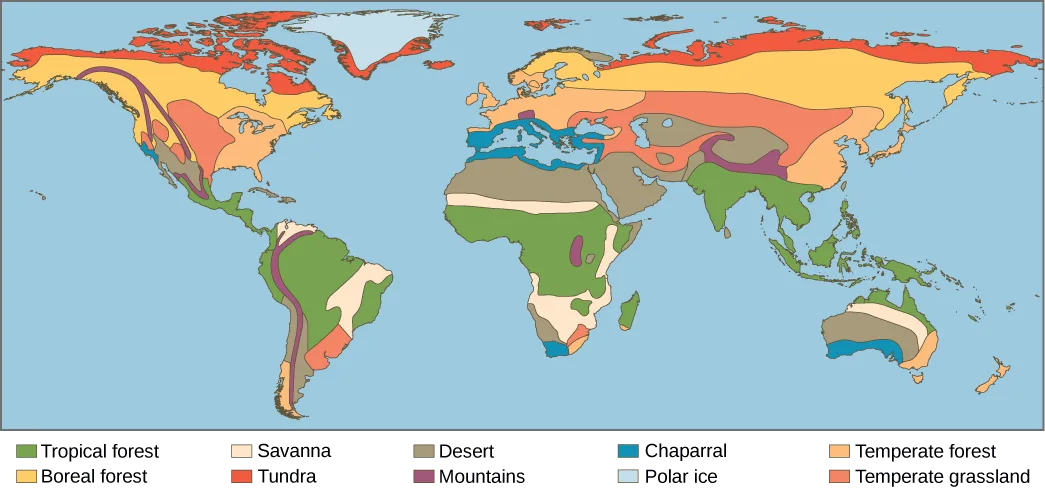
Extended description
The legend lists ten colors in two rows of five: tropical forest, savanna, desert, chaparral, and temperate forest in the first row; boreal forest, tundra, mountains, polar ice, and temperate grassland in the second. On the map, tropical forest covers large parts of South America, central Africa, and Southeast Asia. Savanna borders it in South America, Africa, and northern Australia. Desert covers the Middle East, parts of central Australia, southwestern North America, and northern and southern Africa. Chaparral appears in small patches around the Mediterranean Sea, the southern tip of Africa, southern Australia, and California. Temperate forest covers the eastern United States, Europe, and eastern Asia. Temperate grassland covers the midwestern United States, parts of Asia, and parts of South America. Boreal forest forms a band across northern Canada, northern Europe, and northern Asia, with tundra lying north of it in each of those regions. Mountains run the length of North and South America and also appear in northern India, parts of Africa, and parts of Europe. Polar ice covers Greenland.
Which of the following statements about biomes is false?
Read each biome’s own paragraph in this section for what kind of leaves its dominant trees carry — one option names a leaf-dropping habit that this section’s own paragraph on that biome contradicts.Tropical Wet Forest
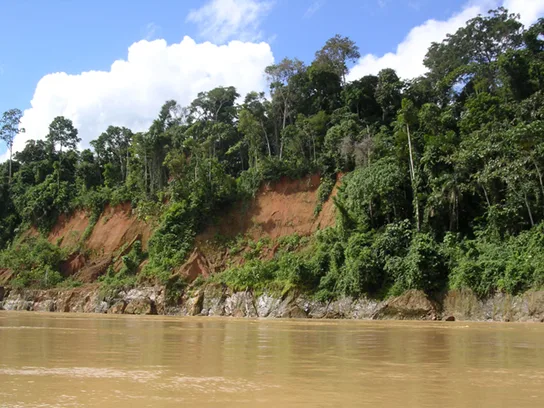
Tropical wet forests are also referred to as tropical rainforests. This biome is found in equatorial regions, shown in the map above. The vegetation is characterized by plants with broad leaves that fall and are replaced throughout the year. Unlike the trees of deciduous forests, the trees in this biome do not have a seasonal loss of leaves associated with variations in temperature and sunlight; these forests are “evergreen” year-round.
The temperature and sunlight profiles of tropical wet forests are very stable in comparison to that of other terrestrial biomes, with the temperatures ranging from 20 °C to 34 °C (68 °F to 93 °F). When one compares the annual temperature variation of tropical wet forests with that of other forest biomes, the lack of seasonal temperature variation in the tropical wet forest becomes apparent. This lack of seasonality leads to year-round plant growth, rather than the seasonal (spring, summer, and fall) growth seen in other more temperate biomes. In contrast to other ecosystems, tropical ecosystems do not have long days and short days during the yearly cycle. Instead, a constant daily amount of direct overhead sunlight (11–12 hrs per day) provides more solar radiation, thereby, increased plant growth.
The annual rainfall in tropical wet forests ranges from 125 cm to 660 cm (50–200 in) with some monthly variation. While sunlight and temperature remain fairly consistent, annual rainfall is highly variable. Tropical wet forests typically have wet months in which there can be more than 30 cm (11–12 in) of precipitation, as well as dry months in which there are fewer than 10 cm (3.5 in) of rainfall. However, the driest month of a tropical wet forest still exceeds the annual rainfall of some other biomes, such as deserts.
Tropical wet forests have high net primary productivity because the annual temperatures and precipitation values in these areas are ideal for plant growth. Therefore, the extensive biomass present in the tropical wet forest leads to plant communities with very high species diversities, shown below. Tropical wet forests have more species of trees than any other biome; on average between 100 and 300 species of trees are present in a single hectare (2.5 acres) of South American Amazonian rain forest. One way to visualize this is to compare the distinctive horizontal layers within the tropical wet forest biome. On the forest floor is a sparse layer of plants and decaying plant matter. Above that is an understory of short shrubby foliage. A layer of trees rises above this understory and is topped by a closed upper canopy—the uppermost overhead layer of branches and leaves. Some additional trees emerge through this closed upper canopy. These layers provide diverse and complex habitats for the variety of plants, fungi, animals, and other organisms within the tropical wet forests.
For example, epiphytes are plants that grow on other plants, which typically are not harmed. Epiphytes are found throughout tropical wet forest biomes. Many species of animals use the variety of plants and the complex structure of the tropical wet forests for food and shelter. Some organisms live several meters above ground and have adapted to this arboreal lifestyle.
Savannas
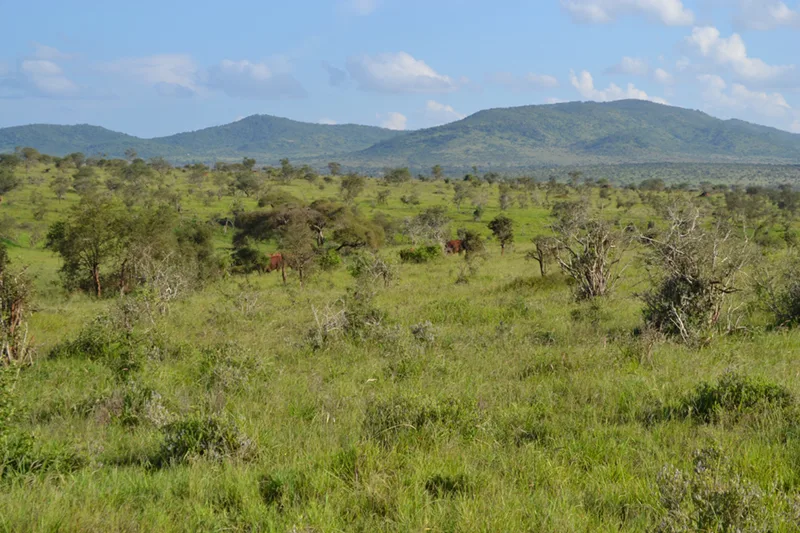
Savannas are grasslands with scattered trees, and they are located in Africa, South America, and northern Australia, shown in the map above. Savannas are usually hot, tropical areas with temperatures averaging from 24 °C to 29 °C (75 °F to 84 °F) and an annual rainfall of 10–40 cm (3.9–15.7 in). Savannas have an extensive dry season; for this reason, forest trees do not grow as well as they do in the tropical wet forest (or other forest biomes). As a result, within the grasses and forbs (herbaceous flowering plants) that dominate the savanna, there are relatively few trees, shown below. Since fire is an important source of disturbance in this biome, plants have evolved well-developed root systems that allow them to quickly resprout after a fire.
Subtropical Deserts
Subtropical deserts exist between 15° and 30° north and south latitude and are centered on the Tropics of Cancer and Capricorn, shown in the map above. This biome is very dry; in some years, evaporation exceeds precipitation. Subtropical hot deserts can have daytime soil surface temperatures above 60 °C (140 °F) and nighttime temperatures approaching 0 °C (32 °F). This is largely due to the lack of atmospheric water. In cold deserts, temperatures can be as high as 25 °C and can drop below -30 °C (-22 °F). Subtropical deserts are characterized by low annual precipitation of fewer than 30 cm (12 in) with little monthly variation and lack of predictability in rainfall. In some cases, the annual rainfall can be as low as 2 cm (0.8 in) in subtropical deserts located in central Australia (“the Outback”) and northern Africa.
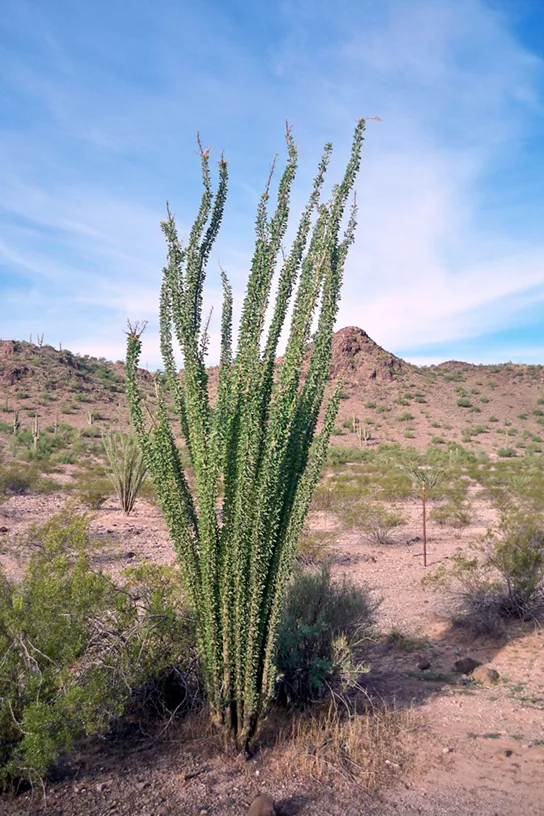
The vegetation and low animal diversity of this biome is closely related to low and unpredictable precipitation. Very dry deserts lack perennial vegetation that lives from one year to the next; instead, many plants are annuals that grow quickly and reproduce when rainfall does occur, and then die. Many other plants in these areas are characterized by having a number of adaptations that conserve water, such as deep roots, reduced foliage, and water-storing stems, shown below. Seed plants in the desert produce seeds that can be in dormancy for extended periods between rains. Adaptations in desert animals include nocturnal behavior and burrowing.
Chaparral
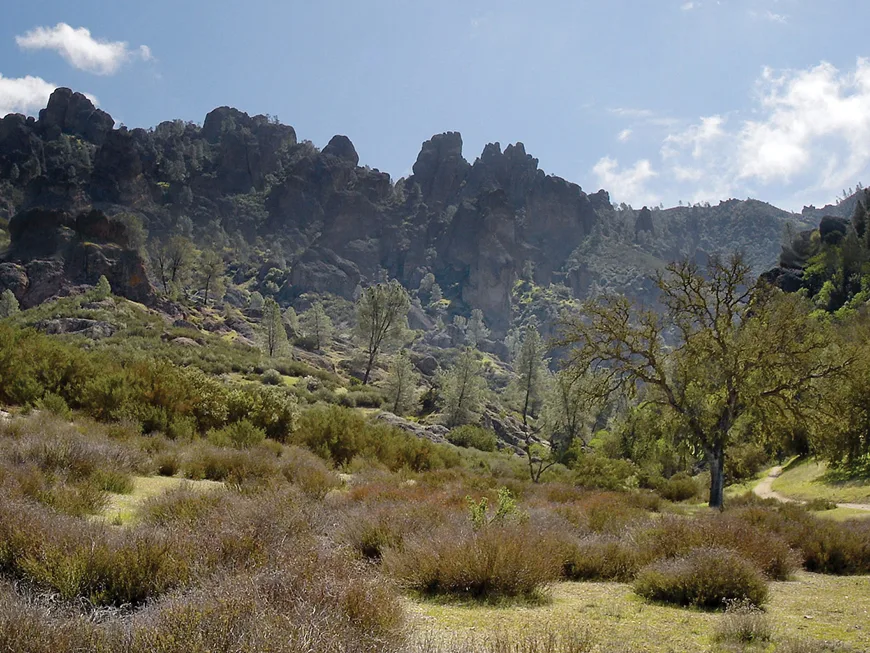
The chaparral is also called the scrub forest and is found in California, along the Mediterranean Sea, and along the southern coast of Australia, shown in the map above. The annual rainfall in this biome ranges from 65 cm to 75 cm (25.6–29.5 in), and the majority of the rain falls in the winter. Summers are very dry and many chaparral plants are dormant during the summertime. The chaparral vegetation, shown below, is dominated by shrubs adapted to periodic fires, with some plants producing seeds that only germinate after a hot fire. The ashes left behind after a fire are rich in nutrients like nitrogen that fertilize the soil and promote plant regrowth.
Temperate Grasslands
Temperate grasslands are found throughout central North America, where they are also known as prairies; they are also in Eurasia, where they are known as steppes, shown in the map above. Temperate grasslands have pronounced annual fluctuations in temperature with hot summers and cold winters. The annual temperature variation produces specific growing seasons for plants. Plant growth is possible when temperatures are warm enough to sustain plant growth and when ample water is available, which occurs in the spring, summer, and fall. During much of the winter, temperatures are low, and water, which is stored in the form of ice, is not available for plant growth.
Annual precipitation ranges from 25 cm to 75 cm (9.8–29.5 in). Because of relatively lower annual precipitation in temperate grasslands, there are few trees except for those found growing along rivers or streams. The dominant vegetation tends to consist of grasses dense enough to sustain populations of grazing animals, shown below. The vegetation is very dense and the soils are fertile because the subsurface of the soil is packed with the roots and rhizomes (underground stems) of these grasses. The roots and rhizomes act to anchor plants into the ground and replenish the organic material (humus) in the soil when they die and decay.
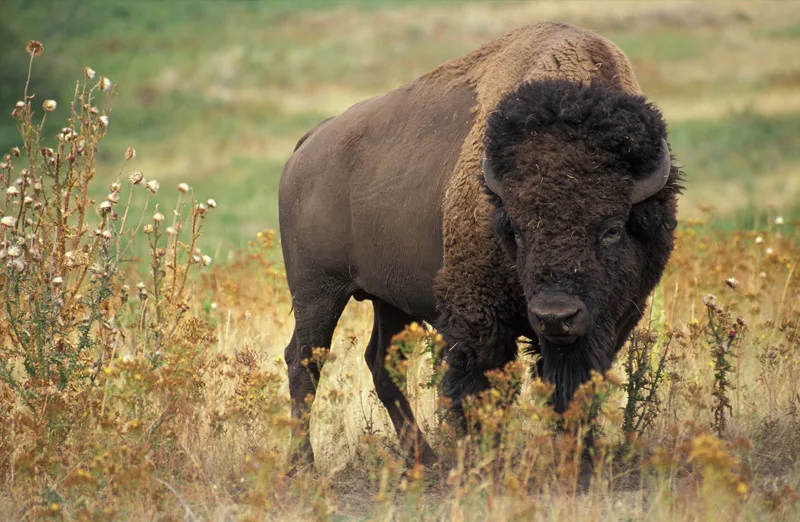
Fires, mainly caused by lightning, are a natural disturbance in temperate grasslands. When fire is suppressed in temperate grasslands, the vegetation eventually converts to scrub and sometimes dense forests with drought-tolerant tree species. Often, the restoration or management of temperate grasslands requires the use of controlled burns to suppress the growth of trees and maintain the grasses.
Temperate Forests
Temperate forests are the most common biome in eastern North America, Western Europe, Eastern Asia, Chile, and New Zealand, shown in the map above. This biome is found throughout mid-latitude regions. Temperatures range between -30 °C and 30 °C (-22 °F to 86 °F) and drop to below freezing periodically during cold winters. These temperatures mean that temperate forests have defined growing seasons during the spring, summer, and early fall. Precipitation is relatively constant throughout the year and ranges between 75 cm and 150 cm (29.5–59 in).
Because of the moderate annual rainfall and temperatures, deciduous trees are the dominant plant in this biome, shown below. Deciduous trees lose their leaves each fall and remain leafless in the winter. Thus, no photosynthesis occurs in the deciduous trees during the dormant winter period. Each spring, new leaves appear as the temperature increases. Because of the dormant period, the net primary productivity of temperate forests is less than that of tropical wet forests. In addition, temperate forests show less diversity of tree species than tropical wet forest biomes.
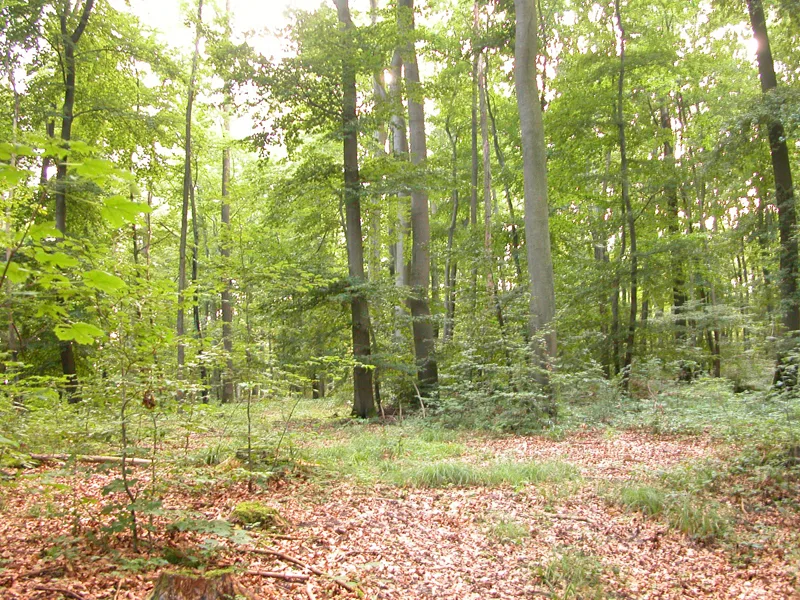
The trees of the temperate forests leaf out and shade much of the ground; however, this biome is more open than tropical wet forests because most trees in the temperate forests do not grow as tall as the trees in tropical wet forests. The soils of the temperate forests are rich in inorganic and organic nutrients. This is due to the thick layer of leaf litter on forest floors, which does not develop in tropical rainforests. As this leaf litter decays, nutrients are returned to the soil. The leaf litter also protects soil from erosion, insulates the ground, and provides habitats for invertebrates (such as the pill bug or roly-poly, Armadillidium vulgare) and their predators, such as the red-backed salamander (Plethodon cinereus).
Boreal Forests
The boreal forest, also known as taiga or coniferous forest, is found south of the Arctic Circle and across most of Canada, Alaska, Russia, and northern Europe, shown in the map above. This biome has cold, dry winters and short, cool, wet summers. The annual precipitation is from 40 cm to 100 cm (15.7–39 in) and usually takes the form of snow. Little evaporation occurs because of the cold temperatures.
The long and cold winters in the boreal forest have led to the predominance of cold-tolerant cone-bearing (coniferous) plants. These are evergreen coniferous trees like pines, spruce, and fir, which retain their needle-shaped leaves year-round. Evergreen trees can photosynthesize earlier in the spring than deciduous trees because less energy from the sun is required to warm a needle-like leaf than a broad leaf. This benefits evergreen trees, which grow faster than deciduous trees in the boreal forest. In addition, soils in boreal forest regions tend to be acidic with little available nitrogen. Leaves are a nitrogen-rich structure and deciduous trees must produce a new set of these nitrogen-rich structures each year. Therefore, coniferous trees that retain nitrogen-rich needles may have a competitive advantage over the broad-leafed deciduous trees.
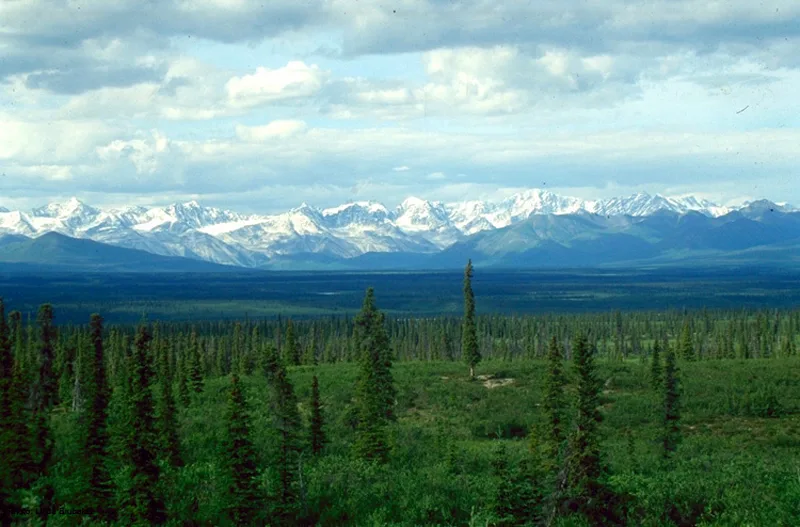
The net primary productivity of boreal forests is lower than that of temperate forests and tropical wet forests. The above-ground biomass of boreal forests is high because these slow-growing tree species are long-lived and accumulate a large standing biomass over time. Plant species diversity is less than that seen in temperate forests and tropical wet forests. Boreal forests lack the pronounced elements of the layered forest structure seen in tropical wet forests. The structure of a boreal forest is often only a tree layer and a ground layer, shown below. When conifer needles are dropped, they decompose more slowly than broad leaves; therefore, fewer nutrients are returned to the soil to fuel plant growth.
Arctic Tundra
The Arctic tundra lies north of the subarctic boreal forest and is located throughout the Arctic regions of the northern hemisphere, shown in the map above. The average winter temperature is –34 °C (–29.2 °F) and the average summer temperature is from 3 °C to 12 °C (37 °F–52 °F). Plants in the arctic tundra have a very short growing season of approximately 10–12 weeks.
However, during this time, there are almost 24 hours of daylight and plant growth is rapid. The annual precipitation of the Arctic tundra is very low with little annual variation in precipitation. And, as in the boreal forests, there is little evaporation due to the cold temperatures.
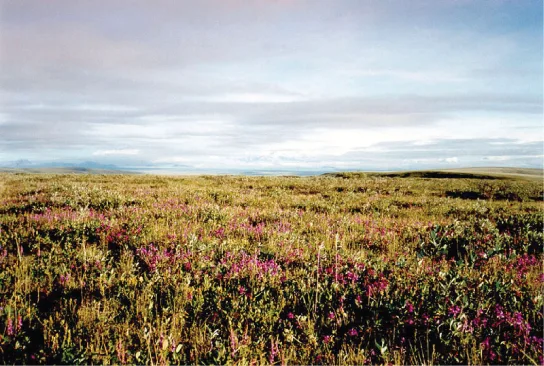
Plants in the Arctic tundra are generally low to the ground, shown below. There is little species diversity, low net primary productivity, and low above-ground biomass. The soils of the Arctic tundra may remain in a perennially frozen state referred to as permafrost. The permafrost makes it impossible for roots to penetrate deep into the soil and slows the decay of organic matter, which inhibits the release of nutrients from organic matter. During the growing season, the ground of the Arctic tundra can be completely covered with plants or lichens.
Link to Learning
Watch this video about biomes for an overview of biomes. To explore further, select one of the biomes on the extended playlist: desert, savanna, temperate forest, temperate grassland, tropic, tundra.
Summary
The Earth has terrestrial biomes and aquatic biomes. Aquatic biomes include both freshwater and marine environments. There are eight major terrestrial biomes: tropical wet forests, savannas, subtropical deserts, chaparral, temperate grasslands, temperate forests, boreal forests, and Arctic tundra. The same biome can occur in different geographic locations with similar climates. Temperature and precipitation, and variations in both, are key abiotic factors that shape the composition of animal and plant communities in terrestrial biomes. Some biomes, such as temperate grasslands and temperate forests, have distinct seasons, with cold weather and hot weather alternating throughout the year. In warm, moist biomes, such as the tropical wet forest, net primary productivity is high, as warm temperatures, abundant water, and a year-round growing season fuel plant growth and supply energy for high diversity throughout the food web. Other biomes, such as deserts and tundras, have low primary productivity due to extreme temperatures and a shortage of available water.
Key terms
- canopy — branches and foliage of trees that form a layer of overhead coverage in a forest
- permafrost — perennially frozen portion of the Arctic tundra soil
Practice
Identify the two major abiotic factors that determine terrestrial biomes
Which two abiotic factors does this section use to distinguish the eight major terrestrial biomes from one another?
Look at what number range each biome’s paragraph opens with, before it ever describes the plants that live there — the same two kinds of measurements appear for every biome in this section.The distribution of these biomes shows that the same biome can occur in geographically distinct areas with similar ________.
Not the location itself, but the overall long-term weather pattern of a region — the combination of the two abiotic factors this section measures for every biome.The extremely low precipitation of subtropical desert biomes might lead one to expect fire to be a major disturbance factor; however, fire is more common in the temperate grassland biome than in the subtropical desert biome. Why is this?
Show model answer
Did your answer mention:
In what ways are the subtropical desert and the arctic tundra similar?
Show model answer
Did your answer mention:
Recognize distinguishing characteristics of each of the eight major terrestrial biomes
Which of the following biomes is characterized by abundant water resources?
Compare the annual rainfall ranges printed in each biome’s own paragraph — one range climbs several times higher than the rest, up to 660 cm a year.Which of the following biomes is characterized by short growing seasons?
One biome’s paragraph gives a growing season measured in weeks rather than months — look for the shortest number printed in this section.The branches and foliage of trees that form a layer of overhead coverage in a forest are called the ________.
This structure caps the tallest layer of a tropical wet forest, above the understory and the forest floor.The perennially frozen portion of the Arctic tundra soil is called ________.
This frozen layer keeps plant roots from penetrating deep into the ground and slows the decay of organic matter.Sort each distinguishing feature into the biome it describes.
Tropical Wet Forest
Savanna
Chaparral
Arctic Tundra
This section is adapted from Biology 2e, Section 44.3: Terrestrial Biomes by Mary Ann Clark, Jung Choi, Matthew Douglas, and OpenStax, © OpenStax, licensed under CC BY-NC-SA 4.0. Access the original for free at openstax.org. Changes: nine figures re-encoded as WebP, with kind set explicitly on every one after looking at the image (the manifest’s own file-extension guess — diagram for the one PNG world map, photo for the eight JPEG biome photographs — was correct in every case, so no re-kinding was needed); a longdesc added to the world-map figure only, transcribing its ten-item, two-row legend and the continents each color covers, since that content is not carried by its one-line caption — the eight biome photographs need no longdesc, since each one’s caption already names what it shows; in-text pointers to the figure (“Figure 44.12” through “Figure 44.20”) replaced with “shown above”/“shown below,” since Hugo does not number figures; the note wrapping the section’s one Visual Connection rendered as its figure followed by a multiple choice, kept in the body — the note copy and the <exercise> copy (fs-idp44965632) print identical question and option wording, so no adjudication was needed, and the item is keyed C, matching the module’s own printed solution; the interactive note rendered as a Link to Learning callout, keeping the module’s own openstax.org/l/biomes redirect URL; both Review Questions and both Critical Thinking Questions adapted into the closing interactive Practice block (multiple choice and self-check respectively); rubric checkpoints added to each self-check, decomposing its model answer (the source solution) into check-off clauses with no new claims; both of the section’s glossary terms (canopy, permafrost) added as key-term recall items, giving this section complete glossary coverage; because the module carries only two glossary terms and five keyed exercises against this book’s floor of three items per objective group and eight per section, three items were written locally, strictly from the section’s own sentences, and disclosed here: a multiple choice (“Which two abiotic factors…”) built from the section’s own repeated temperature/precipitation framing, a cloze text-recall built from the section’s own sentence on why the same biome recurs in distinct places, and a sort-into-bins exercise assigning eight of the section’s own descriptive phrases (two per biome, drawn from the Tropical Wet Forest, Savannas, Chaparral, and Arctic Tundra sections) to the biome each phrase describes.