Population and Community Ecology
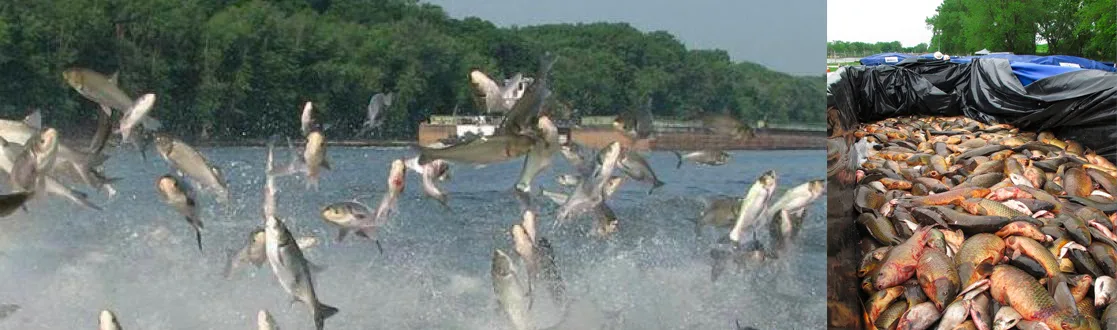
Imagine sailing down a river in a small motorboat on a weekend afternoon; the water is smooth and you are enjoying the warm sunshine and cool breeze when suddenly you are hit in the head by a 20-pound silver carp. This is now a risk on many rivers and canal systems in Illinois and Missouri because of the presence of Asian carp.
This fish—actually a group of species including the silver, black, grass, and big head carp—has been farmed and eaten in China for over 1000 years. It is one of the most important aquaculture food resources worldwide. In the United States, however, Asian carp is considered a dangerous invasive species that disrupts community structure and composition to the point of threatening native species.
Sections
- Population Demography — how ecologists measure population size and density, the three patterns of population distribution, life tables and mortality rates, and the three types of survivorship curves.
- Life Histories and Natural Selection — how natural selection shapes life history patterns and how different reproductive strategies affect a species’ survival.
- Environmental Limits to Population Growth — exponential and logistic population growth, examples of each in natural populations, and how natural selection and environmental adaptation shape life history patterns.
- Population Dynamics and Regulation — how a habitat’s carrying capacity can change, density-dependent and density-independent population regulation, and examples of exponential and logistic growth in wild populations.
- Human Population Growth — exponential human population growth, how humans have expanded their habitat’s carrying capacity, the relationship between population growth, age structure, and economic development, and the long-term implications of unchecked growth.
- Community Ecology — the predator-prey cycle, defenses against predation and herbivory, the competitive exclusion principle, symbiotic relationships between species, and community structure and succession.
- Behavioral Biology: Proximate and Ultimate Causes of Behavior — innate and learned behavior, movement and migration as products of natural selection, how populations communicate, mating displays and courtship behavior, the different mating systems, and how species learn.
This chapter is adapted from Biology 2e, Chapter 45: Population and Community Ecology by Mary Ann Clark, Jung Choi, Matthew Douglas, and OpenStax, © OpenStax, licensed under CC BY-NC-SA 4.0. Access the original for free at openstax.org. Each section page records its own changes from the source. Changes: the chapter-opening image is the source’s, re-encoded for the web, with its source alt kept since it already says what each photo shows.