Population Dynamics and Regulation
By the end of this section, you will be able to:
- Give examples of how the carrying capacity of a habitat may change
- Compare and contrast density-dependent growth regulation and density-independent growth regulation, giving examples
- Give examples of exponential and logistic growth in wild animal populations
- Describe how natural selection and environmental adaptation leads to the evolution of particular life-history patterns
The logistic model of population growth, while valid in many natural populations and a useful model, is a simplification of real-world population dynamics. Implicit in the model is that the carrying capacity of the environment does not change, which is not the case. The carrying capacity varies annually: for example, some summers are hot and dry whereas others are cold and wet. In many areas, the carrying capacity during the winter is much lower than it is during the summer. Also, natural events such as earthquakes, volcanoes, and fires can alter an environment and hence its carrying capacity. Additionally, populations do not usually exist in isolation. They engage in interspecific competition: that is, they share the environment with other species competing for the same resources. These factors are also important to understanding how a specific population will grow.
Nature regulates population growth in a variety of ways. These are grouped into density-dependent factors, in which the density of the population at a given time affects growth rate and mortality, and density-independent factors, which influence mortality in a population regardless of population density. Note that in the former, the effect of the factor on the population depends on the density of the population at onset. Conservation biologists want to understand both types because this helps them manage populations and prevent extinction or overpopulation.
Density-Dependent Regulation
Most density-dependent factors are biological in nature (biotic), and include predation, inter- and intraspecific competition, accumulation of waste, and diseases such as those caused by parasites. Usually, the denser a population is, the greater its mortality rate. For example, during intra- and interspecific competition, the reproductive rates of the individuals will usually be lower, reducing their population’s rate of growth. In addition, low prey density increases the mortality of its predator because it has more difficulty locating its food source.
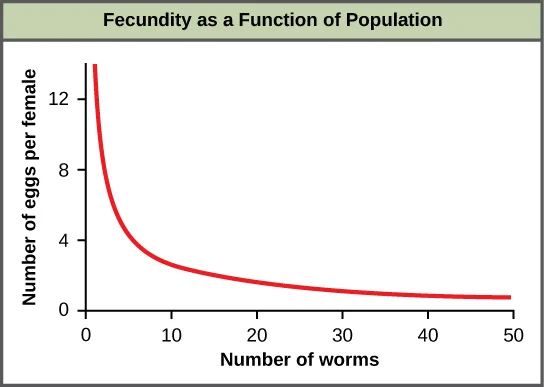
An example of density-dependent regulation is shown below with results from a study focusing on the giant intestinal roundworm (Ascaris lumbricoides), a parasite of humans and other mammals (N.A. Croll et al., “The Population Biology and Control of Ascaris lumbricoides in a Rural Community in Iran.” Transactions of the Royal Society of Tropical Medicine and Hygiene 76, no. 2 (1982): 187-197, doi:10.1016/0035-9203(82)90272-3). Denser populations of the parasite exhibited lower fecundity: they contained fewer eggs. One possible explanation for this is that females would be smaller in more dense populations (due to limited resources) and that smaller females would have fewer eggs. This hypothesis was tested and disproved in a 2009 study which showed that female weight had no influence (Martin Walker et al., “Density-Dependent Effects on the Weight of Female Ascaris lumbricoides Infections of Humans and its Impact on Patterns of Egg Production.” Parasites & Vectors 2, no. 11 (February 2009), doi:10.1186/1756-3305-2-11). The actual cause of the density-dependence of fecundity in this organism is still unclear and awaiting further investigation.
Extended description
The x-axis, labeled Number of worms, runs from 0 to 50 in increments of 10. The y-axis, labeled Number of eggs per female, runs from 0 to 12 in increments of 4, with the curve entering the frame above the top gridline near the y-axis. A single red curve falls steeply from about 13 eggs per female at 1 worm to about 4 eggs per female by 10 worms, then declines more gradually, leveling off at just under 1 egg per female by 30 to 50 worms.
Density-Independent Regulation and Interaction with Density-Dependent Factors
Many factors, typically physical or chemical in nature (abiotic), influence the mortality of a population regardless of its density, including weather, natural disasters, and pollution. An individual deer may be killed in a forest fire regardless of how many deer happen to be in that area. Its chances of survival are the same whether the population density is high or low. The same holds true for cold winter weather.
In real-life situations, population regulation is very complicated and density-dependent and independent factors can interact. A dense population that is reduced in a density-independent manner by some environmental factor(s) will be able to recover differently than a sparse population. For example, a population of deer affected by a harsh winter will recover faster if there are more deer remaining to reproduce.
Evolution Connection. Why Did the Woolly Mammoth Go Extinct?
It’s easy to get lost in the discussion about why dinosaurs went extinct 65 million years ago. Was it due to a meteor slamming into Earth near the coast of modern-day Mexico, or was it from some long-term weather cycle that is not yet understood? Scientists are continually exploring these and other theories.
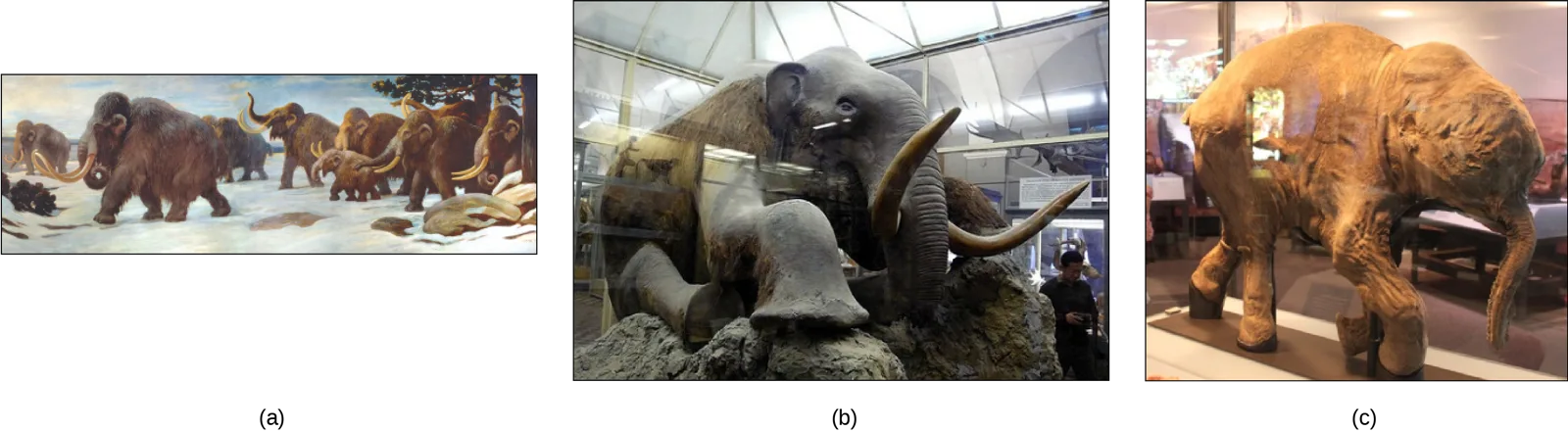
Woolly mammoths began to go extinct much more recently, when they shared the Earth with humans who were no different anatomically than humans today (shown above). Mammoths survived in isolated island populations as recently as 1700 BC. We know a lot about these animals from carcasses found frozen in the ice of Siberia and other regions of the north. Scientists have sequenced at least 50 percent of its genome and believe mammoths are between 98 and 99 percent identical to modern elephants.
It is commonly thought that climate change and human hunting led to their extinction. A 2008 study estimated that climate change reduced the mammoth’s range from 3,000,000 square miles 42,000 years ago to 310,000 square miles 6,000 years ago (David Nogués-Bravo et al., “Climate Change, Humans, and the Extinction of the Woolly Mammoth.” PLoS Biol 6 (April 2008): e79, doi:10.1371/journal.pbio.0060079). It is also well documented that humans hunted these animals. A 2012 study showed that no single factor was exclusively responsible for the extinction of these magnificent creatures (G.M. MacDonald et al., “Pattern of Extinction of the Woolly Mammoth in Beringia.” Nature Communications 3, no. 893 (June 2012), doi:10.1038/ncomms1881). In addition to human hunting, climate change, and reduction of habitat, these scientists demonstrated another important factor in the mammoth’s extinction was the migration of humans across the Bering Strait to North America during the last ice age 20,000 years ago.
The maintenance of stable populations was and is very complex, with many interacting factors determining the outcome. It is important to remember that humans are also part of nature. We once contributed to a species’ decline using only primitive hunting technology.
Life Histories of K-selected and r-selected Species
While reproductive strategies play a key role in life histories, they do not account for important factors like limited resources and competition. The regulation of population growth by these factors can be used to introduce a classical concept in population biology, that of K-selected versus r-selected species.
The concept relates to a species’ reproductive strategies, habitat, and behavior, especially in the way that they obtain resources and care for their young. It includes length of life and survivorship factors as well. Population biologists have grouped species into the two large categories—K-selected and r-selected—although the categories are really two ends of a continuum.
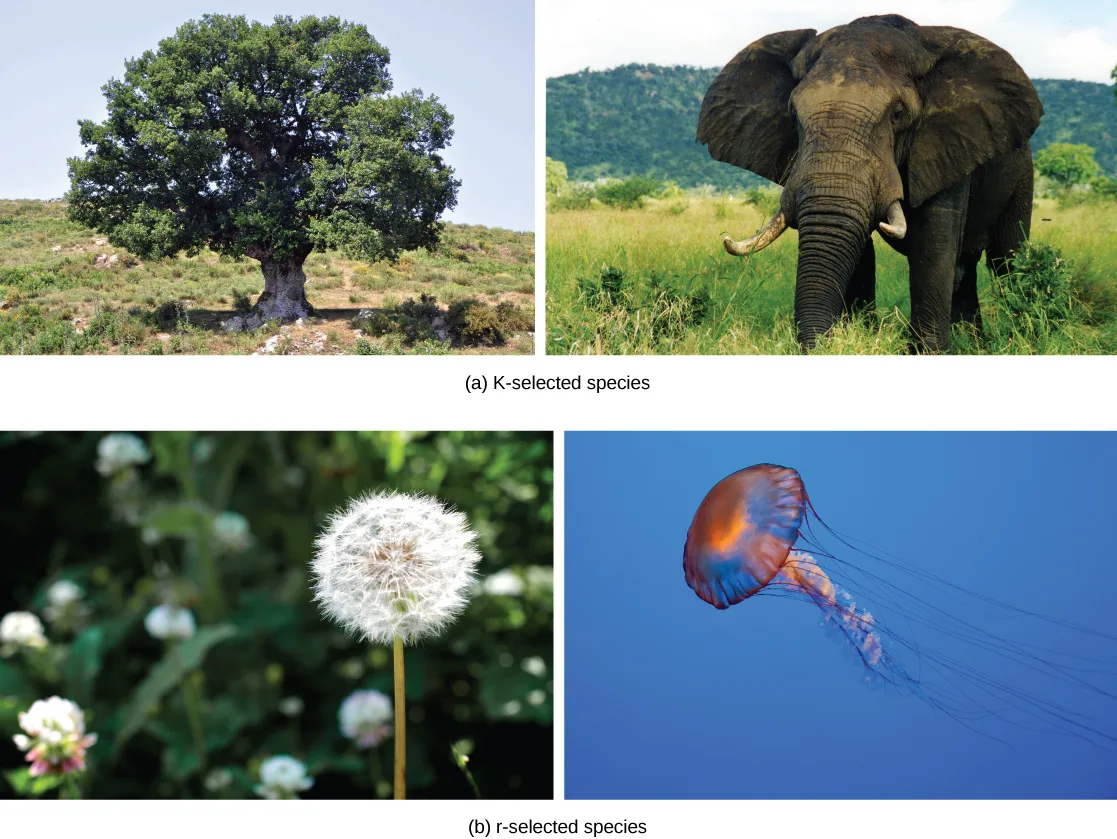
K-selected species are species selected by stable, predictable environments. Populations of K-selected species tend to exist close to their carrying capacity (hence the term K-selected) where intraspecific competition is high. These species have few, large offspring, a long gestation period, and often give long-term care to their offspring (see the table below). While larger in size when born, the offspring are relatively helpless and immature at birth. By the time they reach adulthood, they must develop skills to compete for natural resources. In plants, scientists think of parental care more broadly: how long fruit takes to develop or how long it remains on the plant are determining factors in the time to the next reproductive event. Examples of K-selected species are primates (including humans), elephants, and plants such as oak trees (shown below).
Oak trees grow very slowly and take, on average, 20 years to produce their first seeds, known as acorns. As many as 50,000 acorns can be produced by an individual tree, but the germination rate is low as many of these rot or are eaten by animals such as squirrels. In some years, oaks may produce an exceptionally large number of acorns, and these years may be on a two- or three-year cycle depending on the species of oak (r-selection).
As oak trees grow to a large size and for many years before they begin to produce acorns, they devote a large percentage of their energy budget to growth and maintenance. The tree’s height and size allow it to dominate other plants in the competition for sunlight, the oak’s primary energy resource. Furthermore, when it does reproduce, the oak produces large, energy-rich seeds that use their energy reserve to become quickly established (K-selection).
In contrast, r-selected species have a large number of small offspring (hence their r designation, shown in the table below). This strategy is often employed in unpredictable or changing environments. Animals that are r-selected do not give long-term parental care and the offspring are relatively mature and self-sufficient at birth. Examples of r-selected species are marine invertebrates, such as jellyfish, and plants, such as the dandelion (shown below). Dandelions have small seeds that are wind dispersed long distances. Many seeds are produced simultaneously to ensure that at least some of them reach a hospitable environment. Seeds that land in inhospitable environments have little chance for survival since their seeds are low in energy content. Note that survival is not necessarily a function of energy stored in the seed itself.
Characteristics of K-selected and r-selected species
| Characteristics of K-selected species | Characteristics of r-selected species |
|---|---|
| Mature late | Mature early |
| Greater longevity | Lower longevity |
| Increased parental care | Decreased parental care |
| Increased competition | Decreased competition |
| Fewer offspring | More offspring |
| Larger offspring | Smaller offspring |
Modern Theories of Life History
By the second half of the twentieth century, the concept of K- and r-selected species was used extensively and successfully to study populations. The r- and K-selection theory, although accepted for decades and used for much groundbreaking research, has now been reconsidered, and many population biologists have abandoned or modified it. Over the years, several studies attempted to confirm the theory, but these attempts have largely failed. Many species were identified that did not follow the theory’s predictions. Furthermore, the theory ignored the age-specific mortality of the populations which scientists now know is very important. New demographic-based models of life history evolution have been developed which incorporate many ecological concepts included in r- and K-selection theory as well as population age structure and mortality factors.
Summary
Populations are regulated by a variety of density-dependent and density-independent factors. Species are divided into two categories based on a variety of features of their life history patterns: r-selected species, which have large numbers of offspring, and K-selected species, which have few offspring. The r- and K-selection theory has fallen out of use; however, many of its key features are still used in newer, demographically-based models of population dynamics.
Key terms
- demographic-based population model — modern model of population dynamics incorporating many features of the r- and K-selection theory
- density-dependent regulation — regulation of population that is influenced by population density, such as crowding effects; usually involves biotic factors
- density-independent regulation — regulation of populations by factors that operate independent of population density, such as forest fires and volcanic eruptions; usually involves abiotic factors
- interspecific competition — competition between species for resources in a shared habitat or environment
- K-selected species — species suited to stable environments that produce a few, relatively large offspring and provide parental care
- r-selected species — species suited to changing environments that produce many offspring and provide little or no parental care
Practice
Give examples of how the carrying capacity of a habitat may change
Which of the following events would not negatively impact Yellowstone’s grey wolf carrying capacity?
Three of these options remove or damage the wolves’ food source or habitat outright; one of them is simply a normal seasonal condition the ecosystem already experiences every year.According to this section, in many areas the carrying capacity of a habitat is lowest during which season?
The section directly contrasts two seasons, one where resources are scarcer and one where they are more abundant — find the sentence naming both and pick the scarcer one.According to this section’s Evolution Connection, how did a 2008 study say climate change affected the geographic range available to woolly mammoths between 42,000 and 6,000 years ago?
Show model answer
Did your answer mention:
Compare and contrast density-dependent growth regulation and density-independent growth regulation, giving examples
A forest fire is an example of ________ regulation.
A forest fire kills without regard to how many deer or other animals are packed into an area — that’s the defining feature of one of these two regulation types, not the other.Give an example of how density-dependent and density-independent factors might interact.
Show model answer
Did your answer mention:
Competition between different species for resources in a shared habitat or environment is called ________.
This term’s prefix means ‘between,’ distinguishing it from competition among members of the same species.Regulation of a population that is influenced by the population’s own density, such as crowding effects, and that usually involves biotic factors, is called ________.
This kind of regulation gets stronger as a population gets more crowded — its name pairs with a second kind that acts the same regardless of crowding.Give examples of exponential and logistic growth in wild animal populations
According to this section, the logistic model of population growth is valid in many natural populations, but it is also:
The section’s opening sentence calls the model useful and valid, then immediately qualifies that praise with a word meaning it leaves out real-world complexity.According to this section, implicit in the logistic model of population growth is that the carrying capacity of the environment does not ________.
The next sentence explains that in reality, carrying capacity does do this from year to year — summers and winters differ, and disasters can strike.According to this section, why is the logistic model of population growth described as a simplification of real-world population dynamics?
Show model answer
Did your answer mention:
Describe how natural selection and environmental adaptation leads to the evolution of particular life-history patterns
Species that have many offspring at one time are usually:
A species that produces many offspring at once needs no long-term parental investment in any single one — which of the two life-history categories does that describe?Which of the following statements does not support the conclusion that giraffes are k-selected species?
Three of these facts point toward late maturity, few offspring, or a long time to independence — one of them describes a newborn that needs almost no time at all to become capable on its own.Primates are examples of:
The section names primates directly, alongside elephants and oak trees, as an example of one specific life-history category — the one whose offspring are few, large, and long cared for.A species suited to a stable, predictable environment that produces a few, relatively large offspring and provides parental care is called a(n) ________.
This is the category whose name comes from the variable population biologists use for carrying capacity — a population near that ceiling faces high intraspecific competition.A modern model of population dynamics that incorporates many features of the r- and K-selection theory is called a(n) ________.
Population biologists built this newer kind of model after finding that r- and K-selection theory ignored one important thing: how mortality changes with age.Assign each characteristic to the species type it describes.
K-selected species
r-selected species
This section is adapted from Biology 2e, Section 45.4: Population Dynamics and Regulation by Mary Ann Clark, Jung Choi, Matthew Douglas, and OpenStax, © OpenStax, licensed under CC BY-NC-SA 4.0. Access the original for free at openstax.org. Changes: figures re-encoded as WebP; two figures re-kinded from the manifest’s file-extension guess — Figure_45_04_01 (the fecundity-vs-population line graph) from “photo” to “diagram,” and Figure_45_04_02 (the three woolly-mammoth photographs) from “diagram” to “photo”; Figure_45_04_03ab’s “photo” guess confirmed after inspection. A longdesc added to Figure_45_04_01, the only figure whose axes and curve are not carried by its one-line caption, transcribing its axis labels, ranges, and the curve’s trend from steep to leveling off; Figure_45_04_02’s and Figure_45_04_03ab’s alts lightly copyedited from the manifest’s source alt (tense and phrasing only, no content added or removed). The four footnoted citations in the body prose and the one repeated in the roundworm figure’s caption folded into parenthetical text following the sentences they support, as elsewhere in the corpus. The Woolly Mammoth Evolution Connection note rendered as a callout with its bold name and italicized title, its own figure kept inside the callout as the note prints it. In-text pointers (“Figure 45.11” through “Figure 45.13,” “Table 45.2”) replaced with “shown above,” “shown below,” or “the table above/below,” since Hugo does not number figures or tables. The Characteristics of K-selected and r-selected species table kept as a Markdown table in the body (with its spanning title row folded into a bold lead-in sentence above the table, following the corpus convention for a top-titled CALS table) and also rendered as a sortbins exercise in the life-history Practice group, its twelve rows interleaved rather than grouped by species type. The end-of-section Review Questions and Critical Thinking Question adapted into the closing interactive Practice block (multiple choice and self-check respectively), using every keyed exercise (fs-idm74770800, fs-idm96228320, fs-idm88520640, eip-132, eip-720, fs-idm59103088); rubric checkpoints added to the two self-checks, decomposing each model answer (the source solution) into check-off clauses with no new claims. Four key-term recall items added from the glossary (interspecific competition, density-dependent regulation, K-selected species, demographic-based population model — the latter accepting the body’s own shorter phrasing “demographic-based models”), covering four of the section’s six glossary terms; density-independent regulation and r-selected species appear only in the Key terms list, the prose, and (for r-selected species) a multiple choice and the sortbins bins. The “Give examples of exponential and logistic growth in wild animal populations” objective has no dedicated Review, Critical Thinking, or Visual Connection item and no glossary term of its own in this module (its growth-curve examples are developed in Section 45.3); its three Practice items are built strictly from the section’s own opening sentences; likewise the first objective group carries two locally written items (a multiple choice on the season of lowest carrying capacity and a self-check on the woolly mammoth’s shrinking range), each built strictly from the section’s own sentence or its Evolution Connection, and both disclosed here and in the source ledger; the remaining local items there are built strictly from the section’s own opening sentences describing the logistic model as “a simplification of real-world population dynamics” that assumes a constant carrying capacity, disclosed here and in the source ledger. Exercise eip-720 is kept at the module’s own printed key, A, “snow in winter” — winter is a recurring seasonal condition the Yellowstone ecosystem already experiences every year, unlike the other three options, which each remove or damage the wolves’ food source or habitat; no other option reads cleanly as the “not negatively impact” case either, so the strategy hint above steers the learner toward that seasonal/event distinction rather than toward the word “snow.” Exercise eip-132 is kept at the module’s own printed key, C, “newborn giraffes … walking within an hour … running within 24 hours” — the module’s own text ties K-selection to few, large, long-cared-for offspring and late maturity, which options A, B, and D each illustrate; only C describes precocial, rapid independence at birth, which the section does not present as a K-selected trait.