What Our Ancestors Knew
By the end of this section, you will be able to:
- Describe how our ancestors improved food with the use of invisible microbes
- Describe how the causes of sickness and disease were explained in ancient times, prior to the invention of the microscope
- Describe key historical events associated with the birth of microbiology
Clinical Focus. Part 1
Cora, a 41-year-old lawyer and mother of two, has recently been experiencing severe headaches, a high fever, and a stiff neck. Her husband, who has accompanied Cora to see a doctor, reports that Cora also seems confused at times and unusually drowsy. Based on these symptoms, the doctor suspects that Cora may have meningitis, a potentially life-threatening infection of the tissue that surrounds the brain and spinal cord.
Meningitis has several potential causes. It can be brought on by bacteria, fungi, viruses, or even a reaction to medication or exposure to heavy metals. Although people with viral meningitis usually heal on their own, bacterial and fungal meningitis are quite serious and require treatment.
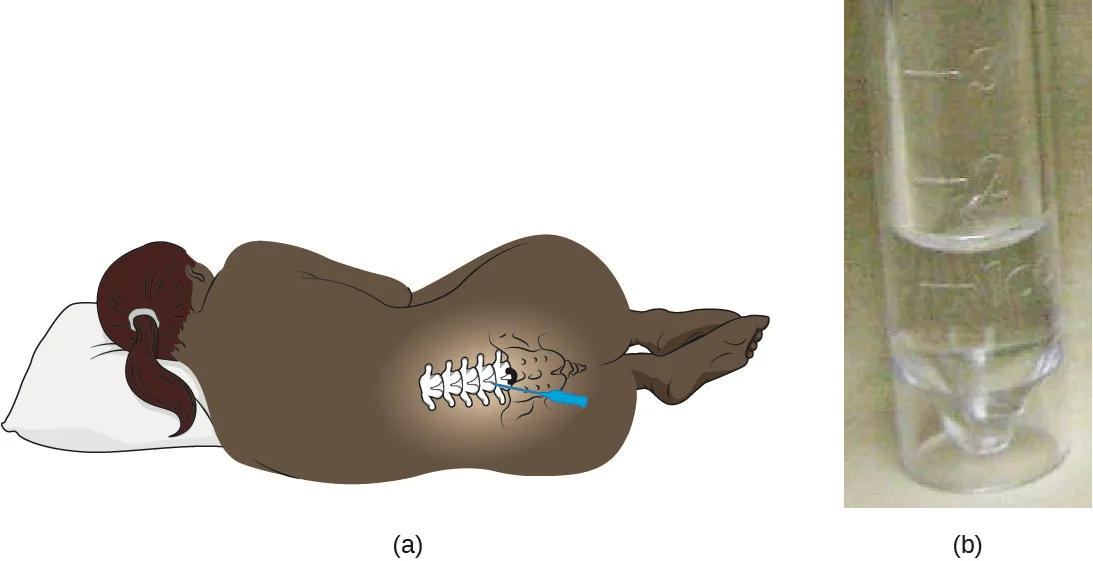
Cora’s doctor orders a lumbar puncture (spinal tap) to take three samples of cerebrospinal fluid (CSF) from around the spinal cord (see the illustration below). The samples will be sent to laboratories in three different departments for testing: clinical chemistry, microbiology, and hematology. The samples will first be visually examined to determine whether the CSF is abnormally colored or cloudy; then the CSF will be examined under a microscope to see if it contains a normal number of red and white blood cells and to check for any abnormal cell types. In the microbiology lab, the specimen will be centrifuged to concentrate any cells in a sediment; this sediment will be smeared on a slide and stained with a Gram stain. Gram staining is a procedure used to differentiate between two different types of bacteria (gram-positive and gram-negative).
About 80% of patients with bacterial meningitis will show bacteria in their CSF with a Gram stain (Rebecca Buxton, “Examination of Gram Stains of Spinal Fluid—Bacterial Meningitis,” American Society for Microbiology, 2007). Cora’s Gram stain did not show any bacteria, but her doctor decides to prescribe her antibiotics just in case. Part of the CSF sample will be cultured—put in special dishes to see if bacteria or fungi will grow. It takes some time for most microorganisms to reproduce in sufficient quantities to be detected and analyzed.
- What types of microorganisms would be killed by antibiotic treatment?
The case continues in A Systematic Approach.
Most people today, even those who know very little about microbiology, are familiar with the concept of microbes, or “germs,” and their role in human health. Schoolchildren learn about bacteria, viruses, and other microorganisms, and many even view specimens under a microscope. But a few hundred years ago, before the invention of the microscope, the existence of many types of microbes was impossible to prove. By definition, microorganisms, or microbes, are very small organisms; many types of microbes are too small to see without a microscope, although some parasites and fungi are visible to the naked eye.
Humans have been living with—and using—microorganisms for much longer than they have been able to see them. Historical evidence suggests that humans have had some notion of microbial life since prehistoric times and have used that knowledge to develop foods as well as prevent and treat disease. In this section, we will explore some of the historical applications of microbiology as well as the early beginnings of microbiology as a science.
Fermented Foods and Beverages
People across the world have enjoyed fermented foods and beverages like beer, wine, bread, yogurt, cheese, and pickled vegetables for all of recorded history. Discoveries from several archeological sites suggest that even prehistoric people took advantage of fermentation to preserve and enhance the taste of food. Archaeologists studying pottery jars from a Neolithic village in China found that people were making a fermented beverage from rice, honey, and fruit as early as 7000 BC (P.E. McGovern et al., “Fermented Beverages of Pre- and Proto-Historic China,” Proceedings of the National Academy of Sciences of the United States of America 1, no. 51 (2004): 17593–17598, doi:10.1073/pnas.0407921102).
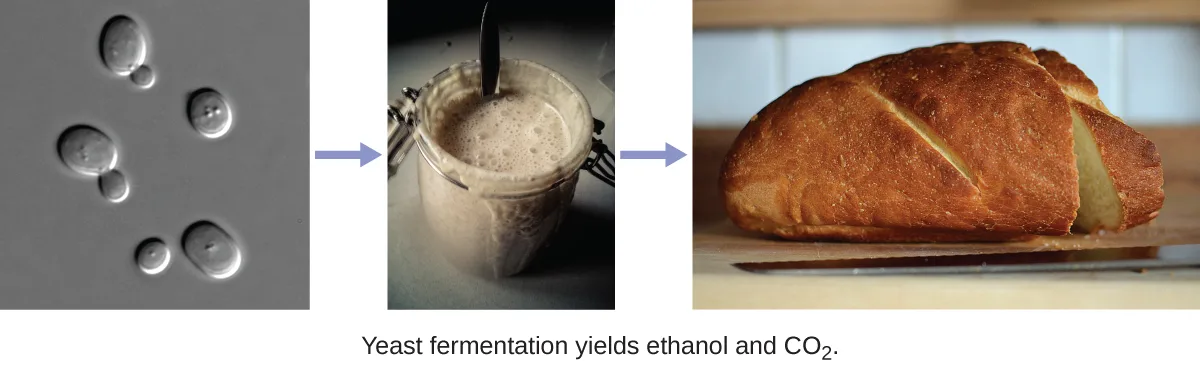
Production of these foods and beverages requires microbial fermentation, a process that uses bacteria, mold, or yeast to convert sugars (carbohydrates) to alcohol, gases, and organic acids (see the illustration below). While it is likely that people first learned about fermentation by accident—perhaps by drinking old milk that had curdled or old grape juice that had fermented—they later learned to harness the power of fermentation to make products like bread, cheese, and wine.
The Iceman and Evidence of Early Treatments
Prehistoric humans had a very limited understanding of the causes of disease, and various cultures developed different beliefs and explanations. While many believed that illness was punishment for angering the gods or was simply the result of fate, archaeological evidence suggests that prehistoric people attempted to treat illnesses and infections. One example of this is Ötzi the Iceman, a 5300-year-old mummy found frozen in the ice of the Ötzal Alps on the Austrian-Italian border in 1991. Because Ötzi was so well preserved by the ice, researchers discovered that he was infected with the eggs of the parasite Trichuris trichiura, which may have caused him to have abdominal pain and anemia. Researchers also found evidence of Borrelia burgdorferi, a bacterium that causes Lyme disease (A. Keller et al., “New Insights into the Tyrolean Iceman’s Origin and Phenotype as Inferred by Whole-Genome Sequencing,” Nature Communications 3 (2012): 698, doi:10.1038/ncomms1701). Some researchers think Ötzi may have been trying to treat his infections with the woody fruit of the Fomitopsis betulinus fungus, which was discovered tied to his belongings. This fungus has both laxative and antibiotic properties. Ötzi was also covered in tattoos that were made by cutting incisions into his skin, filling them with herbs, and then burning the herbs (Capasso, L., “5300 Years Ago, the Ice Man Used Natural Laxatives and Antibiotics,” Lancet (London, England) vol. 352, 9143 (1998): 1864, doi:10.1016/S0140-6736(05)79939-6). There is speculation that this may have been another attempt to treat his health ailments.
Early Notions of Disease, Contagion, and Containment
Several ancient civilizations appear to have had some understanding that disease could be transmitted by things they could not see. This is especially evident in historical attempts to contain the spread of disease. For example, the Bible refers to the practice of quarantining people with leprosy and other diseases, suggesting that people understood that diseases could be communicable. Ironically, while leprosy is communicable, it is also a disease that progresses slowly. This means that people were likely quarantined after they had already spread the disease to others.
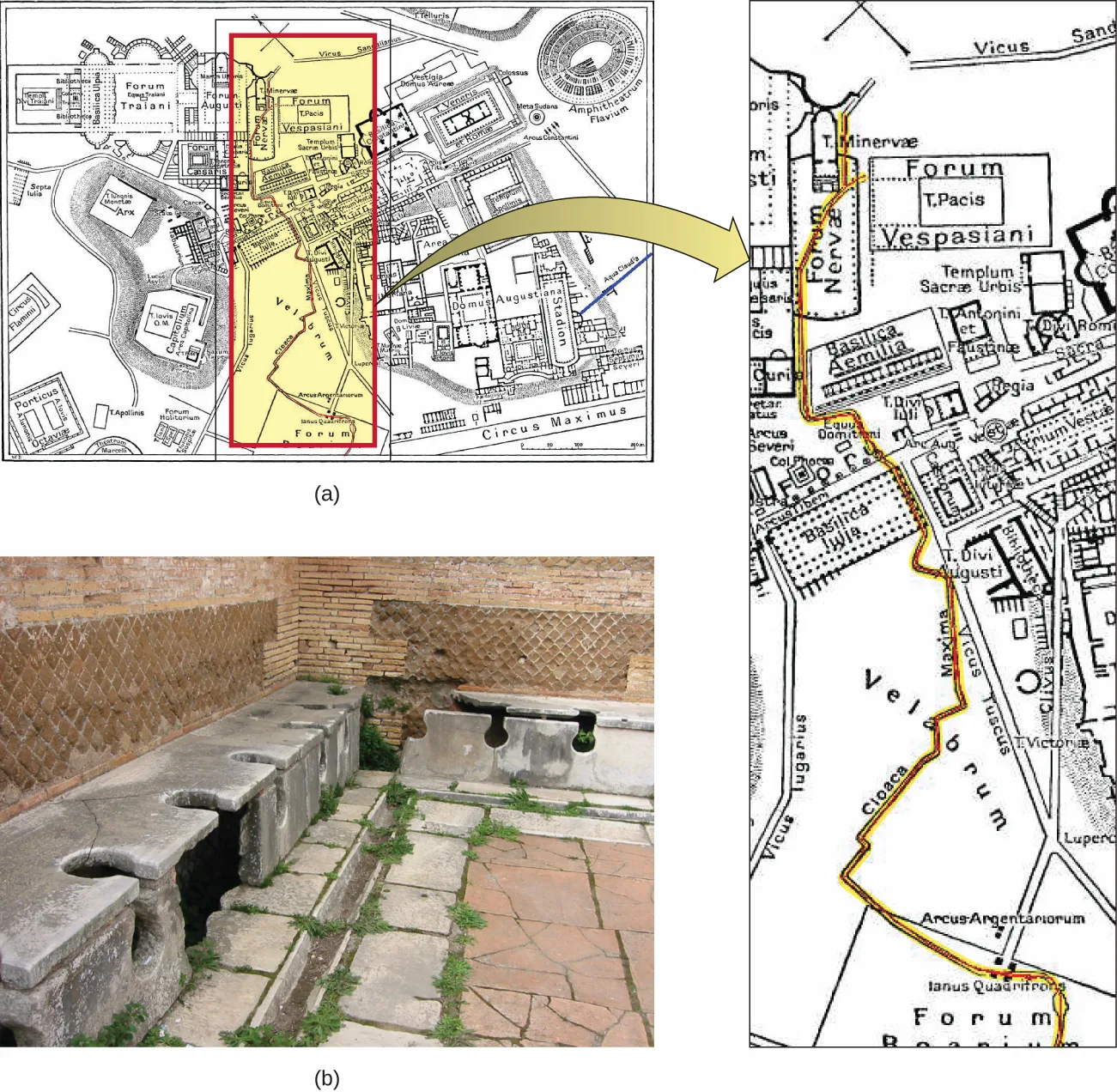
Clean water and sanitation are among the most important elements of healthy societies. The earliest examples of urban sanitation systems are from the ancient Indus Valley Civilization cities of Mohenjo-daro and Harappa, located in current-day Pakistan. Constructed in 2500 BCE (about 4,500 years ago), the cities had complex networks of wells, baths, and drainage systems that stored fresh water and carried waste away. About two thousand years later, people in the ancient Greek civilization attributed disease to bad air, mal’aria, which they called “miasmatic odors.” They developed hygiene practices that built on this idea. In Rome, they built aqueducts, which brought fresh water into the city, and a giant sewer, the Cloaca Maxima, which carried waste away and into the river Tiber (see the map below). Some researchers believe that this infrastructure helped protect the Romans from epidemics of waterborne illnesses.
Even before the invention of the microscope, some doctors, philosophers, and scientists made great strides in understanding the invisible forces—what we now know as microbes—that can cause infection, disease, and death.
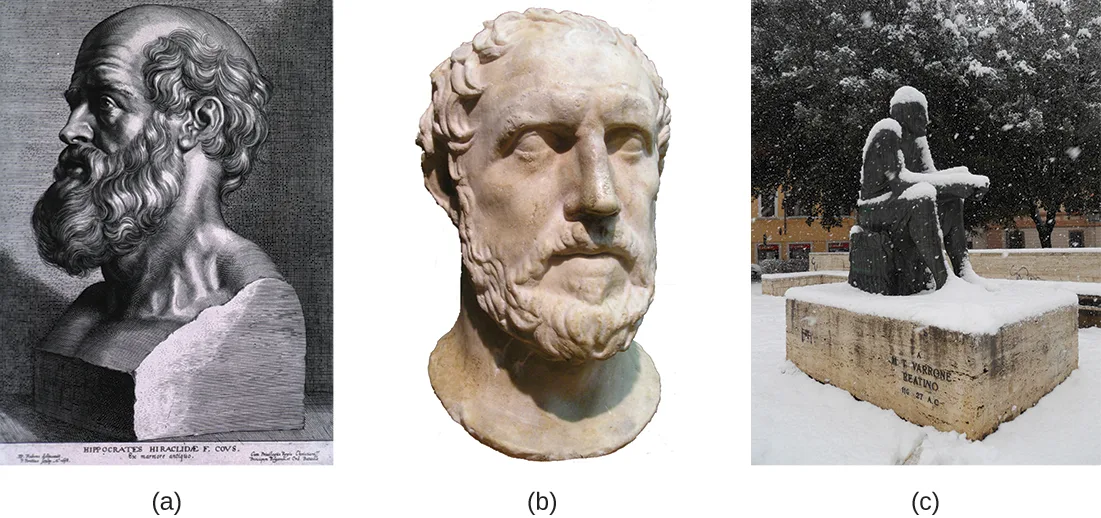
The Greek physician Hippocrates (460–370 BC) is considered the “father of Western medicine” (see the portraits below). Unlike many of his ancestors and contemporaries, he dismissed the idea that disease was caused by supernatural forces. Instead, he posited that diseases had natural causes from within patients or their environments. Hippocrates and his heirs are believed to have written the Hippocratic Corpus, a collection of texts that make up some of the oldest surviving medical books (G. Pappas et al., “Insights Into Infectious Disease in the Era of Hippocrates,” International Journal of Infectious Diseases 12 (2008) 4: 347–350, doi:10.1016/j.ijid.2007.11.003). Hippocrates is also often credited as the author of the Hippocratic Oath, taken by new physicians to pledge their dedication to diagnosing and treating patients without causing harm.
While Hippocrates is considered the father of Western medicine, the Greek philosopher and historian Thucydides (460–395 BC) is considered the father of scientific history because he advocated for evidence-based analysis of cause-and-effect reasoning (also shown below). Among his most important contributions are his observations regarding the Athenian plague that killed one-third of the population of Athens between 430 and 426 BC. (Source note: the source’s end date is 410 BC. Thucydides’ account and the modern epidemiological literature place the outbreak and its recurrence between 430 and 426 BC.) Having survived the epidemic himself, Thucydides made the important observation that survivors did not get re-infected with the disease, even when taking care of actively sick people (Thucydides, The History of the Peloponnesian War, The Second Book, 431 BC, translated by Richard Crawley). This observation shows an early understanding of the concept of immunity.
Marcus Terentius Varro (116–27 BC) was a prolific Roman writer who was one of the first people to propose the concept that things we cannot see (what we now call microorganisms) can cause disease (pictured below). In Res Rusticae (On Farming), published in 36 BC, he said that “precautions must also be taken in neighborhood swamps . . . because certain minute creatures [animalia minuta] grow there which cannot be seen by the eye, which float in the air and enter the body through the mouth and nose and there cause serious diseases” (Plinio Prioreschi, A History of Medicine: Roman Medicine, Lewiston, NY: Edwin Mellen Press, 1998, p. 215).
Centuries later, Islamic scholars, mainly in Persia, built on the knowledge from Hippocrates as well as from Chinese and Indian medicine. Foremost among them was Abū Bakr al-Rāzī, usually referred to as al-Razi or by his Latinized name, Rhazes. He developed a range of experimental methods to test various aspects of medicine. For example, to select a location for a hospital, al-Razi hung raw meat around the city, and located the facility in the place where the meat took the longest to rot. He also was the first to distinguish measles and smallpox, and undertook experiments to determine which available treatments were most effective for each. While al-Razi did not have the technology to understand the role of microbes, his efforts to identify the causes of illnesses, rather than solely focusing on the symptoms, were highly influential.
Islamic physicians created one of the most important medical texts in history, the Canon of Medicine (Arabic: al-Qānūn fī al-Ṭibb). Compiled in 1025 by physician and philosopher Ibn Sina (often referred to as Avicenna), the encyclopedia included detailed descriptions of the parts of the body, a detailed account of over 800 medicinal substances, and pathologies of several illnesses organized by body part or health event. In the work, Ibn Sina described mechanisms of contagion, indicated that organisms could be infected by foreign substances, and that illness could be transmitted by breath. He is also credited with advancing the practice of isolating people who are sick, laying the foundation for historical and contemporary quarantine methods. The Canon was translated into many languages, and was a primary resource for teaching medicine around the world, through the Renaissance and beyond.
Check Your Understanding
Give two examples of foods that have historically been produced by humans with the aid of microbes.
Show model answer
Did your answer mention:
Explain how historical understandings of disease contributed to attempts to treat and contain disease.
Show model answer
Did your answer mention:
The Birth of Microbiology
While the ancients may have suspected the existence of invisible “minute creatures,” it wasn’t until the invention of the microscope that their existence was definitively confirmed. While it is unclear who exactly invented the microscope, a Dutch cloth merchant named Antonie van Leeuwenhoek (1632–1723) was the first to develop a lens powerful enough to view microbes. In 1675, using a simple but powerful microscope, Leeuwenhoek was able to observe single-celled organisms, which he described as “animalcules” or “wee little beasties,” swimming in a drop of rain water. From his drawings of these little organisms, we now know he was looking at bacteria and protists. (We will explore Leeuwenhoek’s contributions to microscopy further in How We See the Invisible World.)
Nearly 200 years after van Leeuwenhoek got his first glimpse of microbes, the “Golden Age of Microbiology” spawned a host of new discoveries between 1857 and 1914. Two famous microbiologists, Louis Pasteur and Robert Koch, were especially active in advancing our understanding of the unseen world of microbes (pictured below). Pasteur, a French chemist, showed that individual microbial strains had unique properties and demonstrated that fermentation is caused by microorganisms. He also invented pasteurization, a process used to kill microorganisms responsible for spoilage, and developed vaccines for the treatment of diseases, including rabies, in animals and humans. Koch, a German physician, was the first to demonstrate the connection between a single, isolated microbe and a known human disease. For example, he discovered the bacteria that cause anthrax (Bacillus anthracis), cholera (Vibrio cholerae), and tuberculosis (Mycobacterium tuberculosis) (S.M. Blevins and M.S. Bronze, “Robert Koch and the ‘Golden Age’ of Bacteriology,” International Journal of Infectious Diseases 14, no. 9 (2010): e744–e751, doi:10.1016/j.ijid.2009.12.003). We will discuss these famous microbiologists, and others, in later chapters.
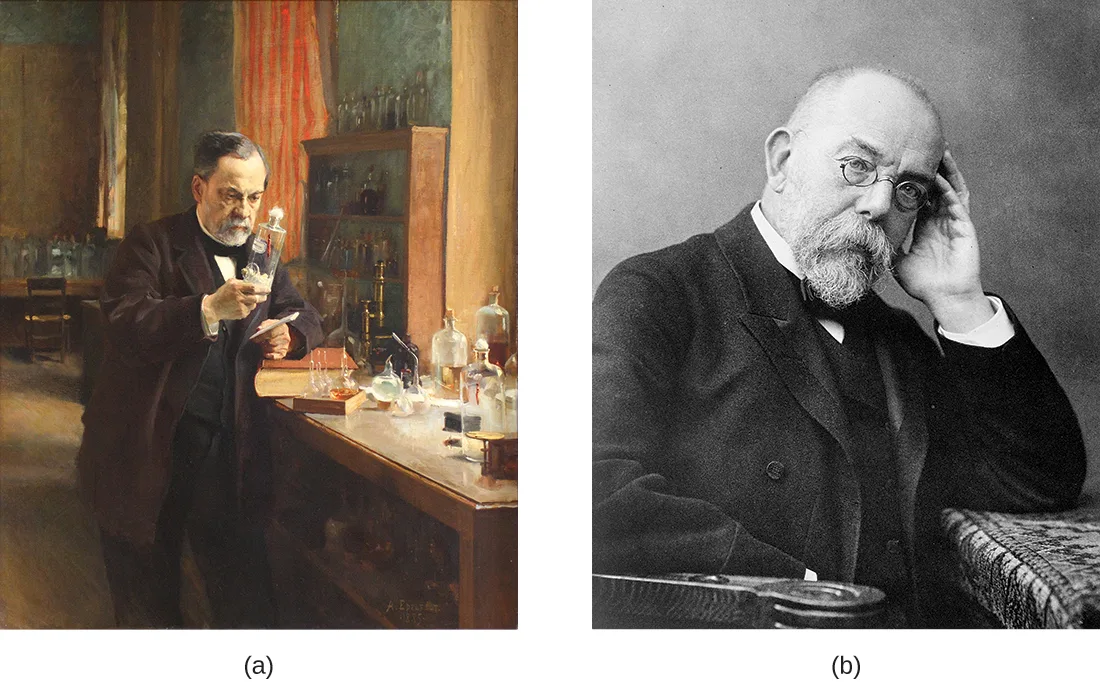
As microbiology has developed, it has allowed the broader discipline of biology to grow and flourish in previously unimagined ways. Much of what we know about human cells comes from our understanding of microbes, and many of the tools we use today to study cells and their genetics derive from work with microbes.
Check Your Understanding
How did the discovery of microbes change human understanding of disease?
Show model answer
Did your answer mention:
Micro Connection. Microbiology Toolbox
Because individual microbes are generally too small to be seen with the naked eye, the science of microbiology is dependent on technology that can artificially enhance the capacity of our natural senses of perception. Early microbiologists like Pasteur and Koch had fewer tools at their disposal than are found in modern laboratories, making their discoveries and innovations that much more impressive. Later chapters of this text will explore many applications of technology in depth, but for now, here is a brief overview of some of the fundamental tools of the microbiology lab.
- Microscopes produce magnified images of microorganisms, human cells and tissues, and many other types of specimens too small to be observed with the naked eye.
- Stains and dyes are used to add color to microbes so they can be better observed under a microscope. Some dyes can be used on living microbes, whereas others require that the specimens be fixed with chemicals or heat before staining. Some stains only work on certain types of microbes because of differences in their cellular chemical composition.
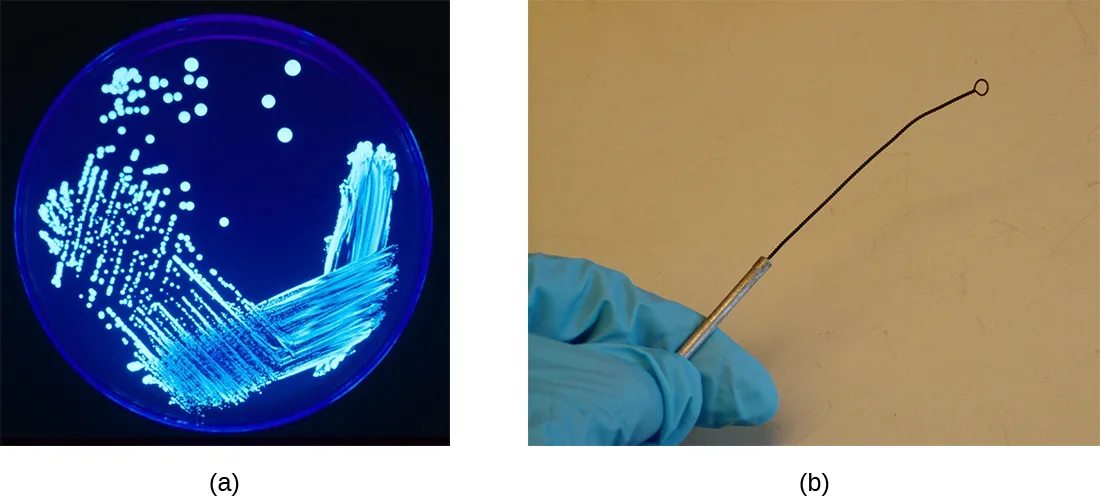
- Growth media are used to grow microorganisms in a lab setting. Some media are liquids; others are more solid or gel-like. A growth medium provides nutrients, including water, various salts, a source of carbon (like glucose), and a source of nitrogen and amino acids (like yeast extract) so microorganisms can grow and reproduce. Ingredients in a growth medium can be modified to grow unique types of microorganisms.
- A Petri dish is a flat-lidded dish that is typically 10–11 centimeters (cm) in diameter and 1–1.5 cm high. Petri dishes made out of either plastic or glass are used to hold growth media (shown below).
- Test tubes are cylindrical plastic or glass tubes with rounded bottoms and open tops. They can be used to grow microbes in broth, or semisolid or solid growth media.
- A Bunsen burner is a metal apparatus that creates a flame that can be used to sterilize pieces of equipment. A rubber tube carries gas (fuel) to the burner. In many labs, Bunsen burners are being phased out in favor of infrared microincinerators, which serve a similar purpose without the safety risks of an open flame.
- An inoculation loop is a handheld tool that ends in a small wire loop (also shown below). The loop can be used to streak microorganisms on agar in a Petri dish or to transfer them from one test tube to another. Before each use, the inoculation loop must be sterilized so cultures do not become contaminated.
Summary
- Microorganisms (or microbes) are living organisms that are generally too small to be seen without a microscope.
- Throughout history, humans have used microbes to make fermented foods such as beer, bread, cheese, and wine.
- Long before the invention of the microscope, some people theorized that infection and disease were spread by living things that were too small to be seen. They also correctly intuited certain principles regarding the spread of disease and immunity.
- Antonie van Leeuwenhoek, using a microscope, was the first to actually describe observations of bacteria, in 1675.
- During the Golden Age of Microbiology (1857–1914), microbiologists, including Louis Pasteur and Robert Koch, discovered many new connections between the fields of microbiology and medicine.
Key terms
- microorganism — generally, an organism that is too small to be seen without a microscope; also known as a microbe.
- microbe — generally, an organism that is too small to be seen without a microscope; also known as a microorganism.
Practice
Describe how our ancestors improved food with the use of invisible microbes
Which of the following foods is NOT made by fermentation?
Three of these are made by microbes converting sugars into alcohol, gases, and acids; ask which one is simply squeezed from fruit, with no microbial step.The process by which microbes turn grape juice into wine is called ________.
This is the process that converts sugars into alcohol, gases, and organic acids using bacteria, mold, or yeast.What are some ways people use microbes?
Show model answer
Did your answer mention:
Explain how the discovery of fermented foods likely benefited our ancestors.
Show model answer
Did your answer mention:
Describe how the causes of sickness and disease were explained in ancient times, prior to the invention of the microscope
Who is considered the “father of Western medicine”?
This Greek physician rejected supernatural explanations for disease, posited natural causes instead, and is credited with the oath new physicians take to do no harm.Who proposed that swamps might harbor tiny, disease-causing animals too small to see?
This Roman writer described “certain minute creatures . . . which cannot be seen by the eye” living in swamps.Thucydides is known as the father of ________.
He is remembered for advocating evidence-based analysis of cause-and-effect reasoning, using the Athenian plague as his evidence.Researchers think that Ötzi the Iceman may have been infected with ________ disease.
Researchers found evidence of the bacterium Borrelia burgdorferi in his remains.What did Thucydides learn by observing the Athenian plague?
Think about what happened to people who survived the plague and then cared for the sick.What evidence would you use to support this statement: Ancient people thought that disease was transmitted by things they could not see.
Show model answer
Did your answer mention:
Describe key historical events associated with the birth of microbiology
Who was the first to observe “animalcules” under the microscope?
This Dutch cloth merchant built a lens powerful enough to observe single-celled organisms in a drop of rain water in 1675.During the ________ (1857–1914), microbiologists, including Louis Pasteur and Robert Koch, discovered many new connections between the fields of microbiology and medicine.
This 57-year period is named for a burst of major discoveries, roughly two centuries after microbes were first seen under a microscope.Why was the invention of the microscope important for microbiology?
Show model answer
Did your answer mention:
This section is adapted from Microbiology, Section 1.1: What Our Ancestors Knew by Nina Parker, Mark Schneegurt, Anh-Hue Thi Tu, Philip Lister, Brian M. Forster, and OpenStax, © OpenStax, licensed under CC BY-NC-SA 4.0. Access the original for free at openstax.org. Changes: figures re-encoded as WebP; two of the six re-kinded from the manifest’s file-extension guess of “photo” to “diagram” after inspection (the lumbar-puncture and Cloaca Maxima figures each carry a genuine drawn diagram — an anatomical overlay and a historical city map — alongside a photo panel), the other four confirmed as “photo”; every alt rewritten from the source’s alt text to describe only what is visible in the vendored image (dropping an unverifiable count of latrine openings the source alt gave and adding the “CO₂” caption text baked into the fermentation figure); the two Check Your Understanding boxes (three bullets total) rendered as three body self-checks, each with a model answer and rubric assembled from the sentences of this module’s preceding subsections, since the source prints no answer key for them; the Clinical Focus box rendered as a callout with its closing question kept as unanswered bulleted prose and its “Jump to the next Clinical Focus box” link replaced with a plain sentence linking to Section 1.2; the Micro Connection box rendered as a callout with its tool-name bolding kept; eight footnoted citations rendered as inline parenthetical citations after the sentences they support (their bare access URLs dropped, DOIs kept); the module’s cross-reference to “How We See the Invisible World” (m58784, the start of Chapter 2, not yet authored) kept as plain text with no link; the source’s misprint “Vibrio cholera” corrected to the valid binomial “Vibrio cholerae”, which the book itself prints in twelve other modules (reported as a source defect); the source’s misspelling “refered” in the al-Razi paragraph corrected to “referred” (also reported); the four Multiple Choice and three Fill in the Blank items keep the source’s own keys, options, and order and were sorted into the Practice block by objective; model answers for two Short Answer and two Critical Thinking questions are written from this section’s text, since the source prints no answer key for them (four, plus the three Check Your Understanding self-checks above — seven author-written model answers on this page in total); one cloze text-recall item (“Golden Age of Microbiology”) added from the module’s own summary sentence to round out the birth-of-microbiology objective group, which the source’s own exercise sets left thin; key terms compiled from the module’s two defined terms, both defined from the book’s Glossary appendix (no sentence-derived definitions on this page); 1 of the source’s unkeyed Short Answer questions is graded from the module’s own sentence rather than answered in prose — the source prints no key for it: the Thucydides Short Answer question is now a multiplechoice keyed by the module’s sentence that survivors did not get re-infected, with distractors drawn from the module’s other attributed ideas about the causes of disease (miasmatic odors, minute airborne creatures, quarantine of lepers). The Athenian plague’s end date is corrected from the source’s 410 BC to 426 BC with a visible Source note (erratum 377).