A Systematic Approach
By the end of this section, you will be able to:
- Describe how microorganisms are classified and distinguished as unique species
- Compare historical and current systems of taxonomy used to classify microorganisms
Once microbes became visible to humans with the help of microscopes, scientists began to realize their enormous diversity. Microorganisms vary in all sorts of ways, including their size, their appearance, and their rates of reproduction. To study this incredibly diverse new array of organisms, researchers needed a way to systematically organize them.
The Science of Taxonomy
Taxonomy is the classification, description, identification, and naming of living organisms. Classification is the practice of organizing organisms into different groups based on their shared characteristics. The most famous early taxonomist was a Swedish botanist, zoologist, and physician named Carolus Linnaeus (1701–1778). In 1735, Linnaeus published Systema Naturae, an 11-page booklet in which he proposed the Linnaean taxonomy, a system of categorizing and naming organisms using a standard format so scientists could discuss organisms using consistent terminology. He continued to revise and add to the book, which grew into multiple volumes (see the portrait below).
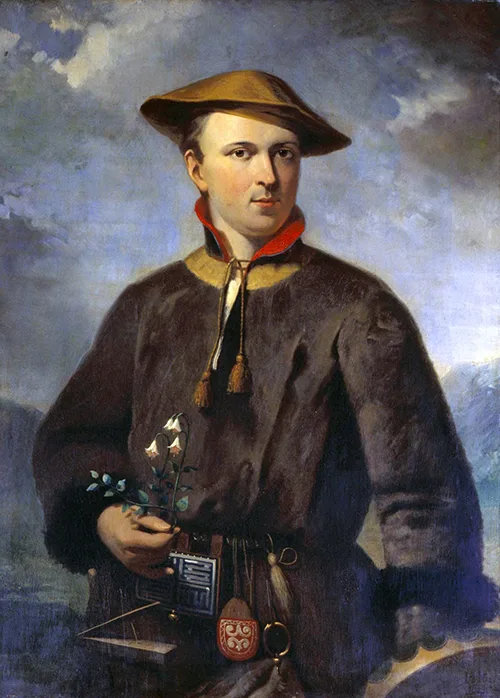
In his taxonomy, Linnaeus divided the natural world into three kingdoms: animal, plant, and mineral (the mineral kingdom was later abandoned). Within the animal and plant kingdoms, he grouped organisms using a hierarchy of increasingly specific levels and sublevels based on their similarities. The names of the levels in Linnaeus’s original taxonomy were kingdom, class, order, family, genus (plural: genera), and species. Species was, and continues to be, the most specific and basic taxonomic unit.
Evolving Trees of Life (Phylogenies)
With advances in technology, other scientists gradually made refinements to the Linnaean system and eventually created new systems for classifying organisms. In the 1800s, there was a growing interest in developing taxonomies that took into account the evolutionary relationships, or phylogenies, of all different species of organisms on earth. One way to depict these relationships is via a diagram called a phylogenetic tree (or tree of life). In these diagrams, groups of organisms are arranged by how closely related they are thought to be. In early phylogenetic trees, the relatedness of organisms was inferred by their visible similarities, such as the presence or absence of hair or the number of limbs. Now, the analysis is more complicated. Today, phylogenic analyses include genetic, biochemical, and embryological comparisons, as will be discussed later in this chapter.
Linnaeus’s tree of life contained just two main branches for all living things: the animal and plant kingdoms. In 1866, Ernst Haeckel, a German biologist, philosopher, and physician, proposed another kingdom, Protista, for unicellular organisms (see the drawing below). He later proposed a fourth kingdom, Monera, for unicellular organisms whose cells lack nuclei, like bacteria.
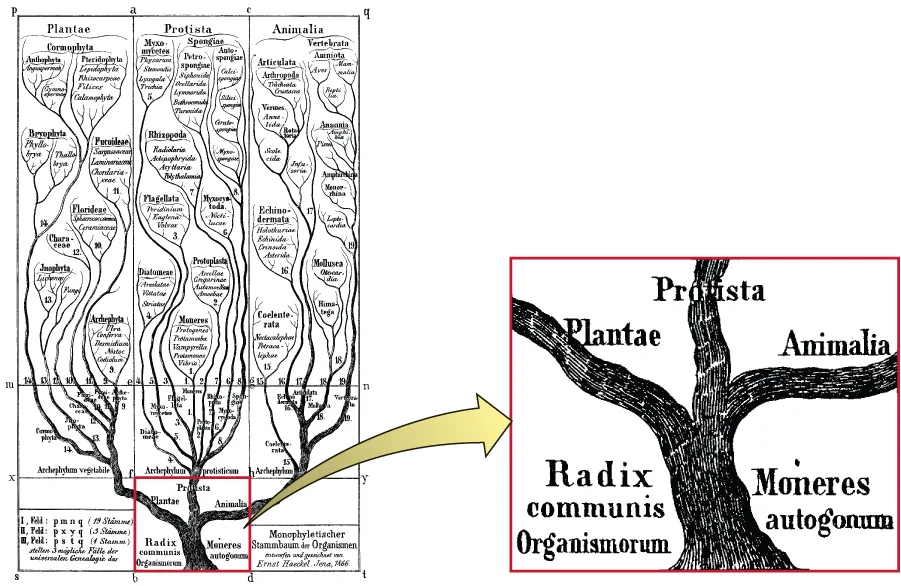
Extended description
The trunk carries two labels, Radix communis Organismorum on its left and Moneres autogonum on its right, and divides into Plantae on the left, Protista in the middle, and Animalia on the right. Each of the three branches subdivides repeatedly into narrower branches, each labeled in small type with a genus or group name.
Nearly 100 years later, in 1969, American ecologist Robert Whittaker (1920–1980) proposed adding another kingdom—Fungi—in his tree of life. Whittaker’s tree also contained a level of categorization above the kingdom level—the empire or superkingdom level—to distinguish between organisms that have membrane-bound nuclei in their cells (eukaryotes) and those that do not (prokaryotes). Empire Prokaryota contained just the Kingdom Monera. The Empire Eukaryota contained the other four kingdoms: Fungi, Protista, Plantae, and Animalia. Whittaker’s five-kingdom tree was considered the standard phylogeny for many years.
The timeline below shows how the tree of life has changed over time. Note that viruses are not found in any of these trees. That is because they are not made up of cells and thus it is difficult to determine where they would fit into a tree of life.
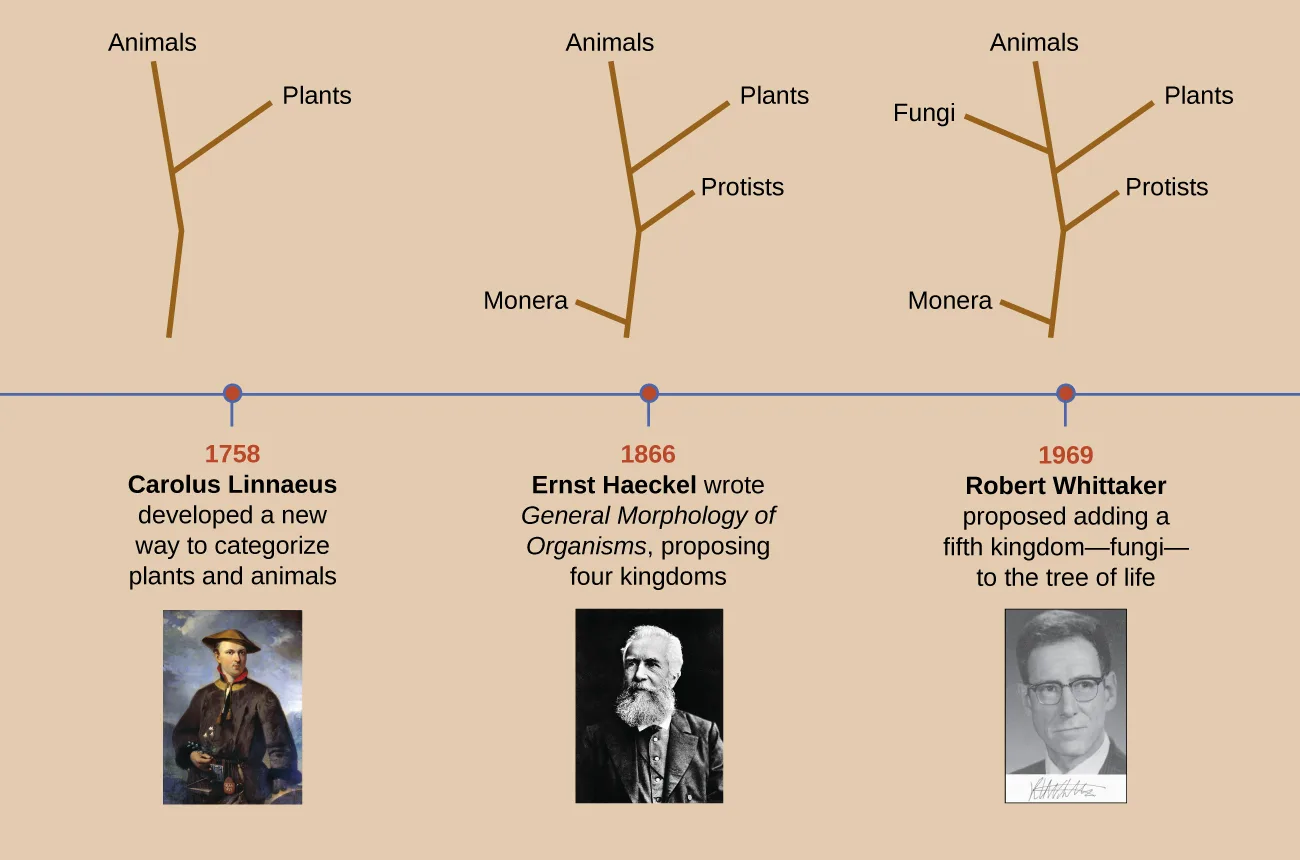
Extended description
Reading left to right: 1758, Linnaeus’s tree has two branches, animals and plants. 1866, Haeckel’s tree has a central line with Monera branching off the bottom, then protists, then plants and animals. 1969, Whittaker’s tree repeats Haeckel’s shape — Monera, then protists, then plants, then animals — and adds a fifth branch, fungi, on the left of the crown, opposite plants and outside animals.
Check Your Understanding
Briefly summarize how our evolving understanding of microorganisms has contributed to changes in the way that organisms are classified.
Show model answer
Did your answer mention:
Clinical Focus. Part 2
Antibiotic drugs are specifically designed to kill or inhibit the growth of bacteria. But after a couple of days on antibiotics, Cora shows no signs of improvement. Also, her CSF cultures came back from the lab negative. Since bacteria or fungi were not isolated from Cora’s CSF sample, her doctor rules out bacterial and fungal meningitis. Viral meningitis is still a possibility.
However, Cora now reports some troubling new symptoms. She is starting to have difficulty walking. Her muscle stiffness has spread from her neck to the rest of her body, and her limbs sometimes jerk involuntarily. In addition, Cora’s cognitive symptoms are worsening. At this point, Cora’s doctor becomes very concerned and orders more tests on the CSF samples.
- What types of microorganisms could be causing Cora’s symptoms?
The case continues in Types of Microorganisms. The case began in What Our Ancestors Knew.
The Role of Genetics in Modern Taxonomy
Haeckel’s and Whittaker’s trees presented hypotheses about the phylogeny of different organisms based on readily observable characteristics. But the advent of molecular genetics in the late 20th century revealed other ways to organize phylogenetic trees. Genetic methods allow for a standardized way to compare all living organisms without relying on observable characteristics that can often be subjective. Modern taxonomy relies heavily on comparing the nucleic acids (deoxyribonucleic acid [DNA] or ribonucleic acid [RNA]) or proteins from different organisms. The more similar the nucleic acids and proteins are between two organisms, the more closely related they are considered to be.
In the 1970s, American microbiologist Carl Woese discovered what appeared to be a “living record” of the evolution of organisms. He and his collaborator George Fox created a genetics-based tree of life based on similarities and differences they observed in the gene sequences coding for small subunit ribosomal RNA (rRNA) of different organisms. In the process, they discovered that a certain type of bacteria, called archaebacteria (now known simply as archaea), were significantly different from other bacteria and eukaryotes in terms of their small subunit rRNA gene sequences. To accommodate this difference, they created a tree with three Domains above the level of Kingdom: Archaea, Bacteria, and Eukarya (see the diagram below). Analysis of small subunit rRNA gene sequences suggests archaea, bacteria, and eukaryotes all evolved from a common ancestral cell type. The tree is skewed to show a closer evolutionary relationship between Archaea and Eukarya than they have to Bacteria.
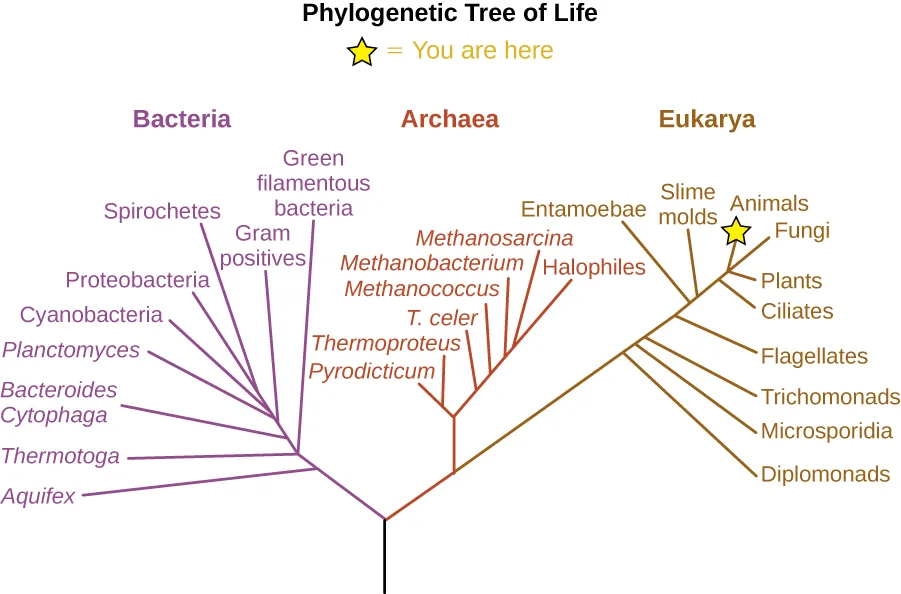
Extended description
Reading left to right: the Bacteria branch (purple) holds, from the trunk outward, Aquifex, Thermotoga, Bacteroides/Cytophaga, Planctomyces, Cyanobacteria, Proteobacteria, Spirochetes, Gram positives, and Green filamentous bacteria. The Archaea branch (red) holds Pyrodicticum, Thermoproteus, T. celer, Methanococcus, Methanobacterium, Methanosarcina, and Halophiles. The Eukarya branch (brown) holds, from the trunk outward, Diplomonads, Microsporidia, Trichomonads, Flagellates, Ciliates, Plants, and then a crown of Entamoebae, Slime molds, Animals, and Fungi, with Animals marked by a star labeled ‘you are here.’
Scientists continue to use analysis of RNA, DNA, and proteins to determine how organisms are related. One interesting, and complicating, discovery is that of horizontal gene transfer—when a gene of one species is absorbed into another organism’s genome. Horizontal gene transfer is especially common in microorganisms and can make it difficult to determine how organisms are evolutionarily related. Consequently, some scientists now think in terms of “webs of life” rather than “trees of life.”
Check Your Understanding
In modern taxonomy, how do scientists determine how closely two organisms are related?
Think about which molecules modern taxonomy compares between organisms, and what a closer match between them implies.Explain why the branches on the ’tree of life’ all originate from a single ’trunk.'
Show model answer
Did your answer mention:
Naming Microbes
In developing his taxonomy, Linnaeus used a system of binomial nomenclature, a two-word naming system for identifying organisms by genus and specific epithet. For example, modern humans are in the genus Homo and have the specific epithet name sapiens, so their scientific name in binomial nomenclature is Homo sapiens. In binomial nomenclature, the genus part of the name is always capitalized; it is followed by the specific epithet name, which is not capitalized. Both names are italicized. When referring to the species of humans, the binomial nomenclature would be Homo sapiens.
Taxonomic names in the 18th through 20th centuries were typically derived from Latin, since that was the common language used by scientists when taxonomic systems were first created. Today, newly discovered organisms can be given names derived from Latin, Greek, or English. Sometimes these names reflect some distinctive trait of the organism; in other cases, microorganisms are named after the scientists who discovered them. The archaeon Haloquadratum walsbyi is an example of both of these naming schemes. The genus, Haloquadratum, describes the microorganism’s saltwater habitat (halo is derived from the Greek word for “salt”) as well as the shape of its square, flat cells, which grow attached to one another in thin sheets (quadratum is Latin for “foursquare”). (Source note: the source says the cells are arranged in square clusters of four. The organism’s morphology literature describes flat square cells joined in fragile sheets, not fixed groups of four; the name refers to the square cell shape.) The species, walsbyi, is named after Anthony Edward Walsby, the microbiologist who discovered Haloquadratum walsbyi in 1980. While it might seem easier to give an organism a common descriptive name—like a red-headed woodpecker—we can imagine how that could become problematic. What happens when another species of woodpecker with red head coloring is discovered? The systematic nomenclature scientists use eliminates this potential problem by assigning each organism a single, unique two-word name that is recognized by scientists all over the world.
In this text, we will typically abbreviate an organism’s genus and species after its first mention. The abbreviated form is simply the first initial of the genus, followed by a period and the full name of the species. For example, the bacterium Escherichia coli is shortened to E. coli in its abbreviated form. You will encounter this same convention in other scientific texts as well.
Bergey’s Manuals
Whether in a tree or a web, microbes can be difficult to identify and classify. Without easily observable macroscopic features like feathers, feet, or fur, scientists must capture, grow, and devise ways to study their biochemical properties to differentiate and classify microbes. Despite these hurdles, a group of microbiologists created and updated a set of manuals for identifying and classifying microorganisms. First published in 1923 and since updated many times, Bergey’s Manual of Determinative Bacteriology and Bergey’s Manual of Systematic Bacteriology are the standard references for identifying and classifying different prokaryotes. (Appendix D of this textbook is partly based on Bergey’s manuals; it shows how the organisms that appear in this textbook are classified.) Because so many bacteria look identical, methods based on nonvisual characteristics must be used to identify them. For example, biochemical tests can be used to identify chemicals unique to certain species. Likewise, serological tests can be used to identify specific antibodies that will react against the proteins found in certain species. Ultimately, DNA and rRNA sequencing can be used both for identifying a particular bacterial species and for classifying newly discovered species.
Check Your Understanding
What is binomial nomenclature and why is it a useful tool for naming organisms?
Show model answer
Did your answer mention:
Explain why a resource like one of Bergey’s manuals would be helpful in identifying a microorganism in a sample.
Show model answer
Did your answer mention:
Micro Connection. Same Name, Different Strain
Within one species of microorganism, there can be several subtypes called strains. While different strains may be nearly identical genetically, they can have very different attributes. The bacterium Escherichia coli is infamous for causing food poisoning and traveler’s diarrhea. However, there are actually many different strains of E. coli, and they vary in their ability to cause disease.
One pathogenic (disease-causing) E. coli strain that you may have heard of is E. coli O157:H7. In humans, infection from E. coli O157:H7 can cause abdominal cramps and diarrhea. Infection usually originates from contaminated water or food, particularly raw vegetables and undercooked meat. In the 1990s, there were several large outbreaks of E. coli O157:H7 thought to have originated in undercooked hamburgers.
While E. coli O157:H7 and some other strains have given E. coli a bad name, most E. coli strains do not cause disease. In fact, some can be helpful. Different strains of E. coli found naturally in our gut help us digest our food, provide us with some needed chemicals, and fight against pathogenic microbes.
Link to Learning
Learn more about phylogenetic trees by exploring the Wellcome Trust’s interactive Tree of Life. The interactive tree of life website contains information, photos, and animations about many different organisms. Select two organisms to see how they are evolutionarily related.
Summary
- Carolus Linnaeus developed a taxonomic system for categorizing organisms into related groups.
- Binomial nomenclature assigns organisms Latinized scientific names with a genus and species designation.
- A phylogenetic tree is a way of showing how different organisms are thought to be related to one another from an evolutionary standpoint.
- The first phylogenetic tree contained kingdoms for plants and animals; Ernst Haeckel proposed adding kingdom for protists.
- Robert Whittaker’s tree contained five kingdoms: Animalia, Plantae, Protista, Fungi, and Monera.
- Carl Woese used small subunit ribosomal RNA to create a phylogenetic tree that groups organisms into three domains based on their genetic similarity.
- Bergey’s manuals of determinative and systemic bacteriology are the standard references for identifying and classifying bacteria, respectively.
- Bacteria can be identified through biochemical tests, DNA/RNA analysis, and serological testing methods.
Key terms
- taxonomy — the classification, description, identification, and naming of living organisms.
- phylogeny — the evolutionary history of a group of organisms.
- eukaryote — an organism made up of one or more cells that contain a membrane-bound nucleus and organelles.
- prokaryote — an organism whose cell structure does not include a membrane-bound nucleus.
- binomial nomenclature — a universal convention for the scientific naming of organisms using Latinized names for genus and species.
Practice
Describe how microorganisms are classified and distinguished as unique species
Which of the following is the standard resource for identifying bacteria?
This is a set of manuals first published in 1923 and updated many times since, not a phylogenetic tree or an 18th-century taxonomy book.In binomial nomenclature, an organism’s scientific name includes its ________.
These are the two most specific levels of Linnaeus’s taxonomic hierarchy — the ones combined to form a scientific name.Name some techniques that can be used to identify and differentiate species of bacteria.
Show model answer
Did your answer mention:
Why is using binomial nomenclature more useful than using common names?
Show model answer
Did your answer mention:
Compare historical and current systems of taxonomy used to classify microorganisms
Which of the following was NOT a kingdom in Linnaeus’s taxonomy?
Linnaeus divided the natural world into three kingdoms; one option here was added to the tree of life a century later, by a different scientist.Which scientist proposed adding a kingdom for protists?
This scientist wrote General Morphology of Organisms in 1866 and later added a fourth kingdom for organisms lacking nuclei.Which of the following is NOT a domain in Woese and Fox’s phylogenetic tree?
Woese and Fox’s tree groups all life into just three domains above the kingdom level — one of these options is a kingdom, not a domain.Haeckel proposed adding the kingdoms ________ and ________ to his phylogenetic tree.
One kingdom held unicellular organisms in general; the other held unicellular organisms whose cells lack nuclei.________ are organisms without membrane-bound nuclei.
This term names cells whose DNA is not enclosed within a nucleus — the opposite of the term for cells that do have one.________ are microorganisms that are not included in phylogenetic trees because they are acellular.
These infectious agents are not made up of cells at all, so they cannot be placed on a tree built from cellular relationships.What is a phylogenetic tree?
Think about what the diagram is meant to represent and how the groups within it are arranged.Which of the five kingdoms in Whittaker’s phylogenetic tree are prokaryotic, and which are eukaryotic?
Recall which empire held only one kingdom, and which empire held the other four.What molecule did Woese and Fox use to construct their phylogenetic tree?
This is the same kind of molecule involved in protein synthesis, compared across many different organisms’ genes.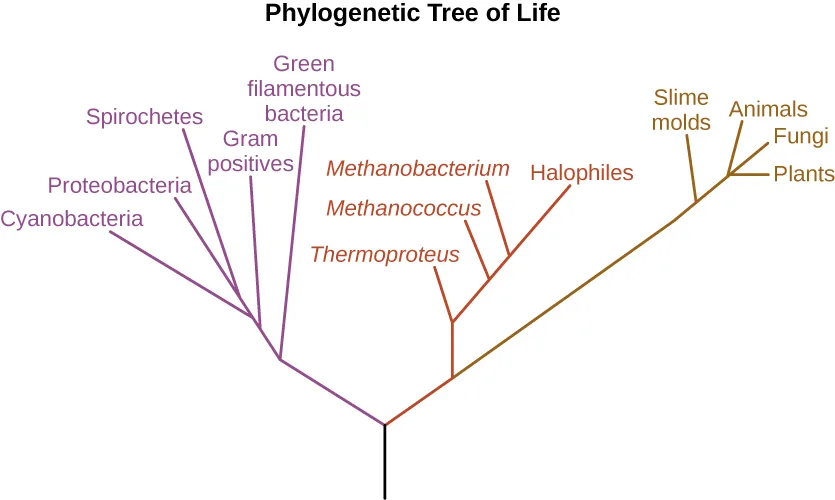
Label the three Domains found on modern phylogenetic trees, based on the branch groupings shown above.
Show model answer
Did your answer mention:
This section is adapted from Microbiology, Section 1.2: A Systematic Approach by Nina Parker, Mark Schneegurt, Anh-Hue Thi Tu, Philip Lister, Brian M. Forster, and OpenStax, © OpenStax, licensed under CC BY-NC-SA 4.0. Access the original for free at openstax.org. Changes: figures re-encoded as WebP, with the source alt text rewritten for all five figures to describe what is visibly drawn (the Linnaeus portrait, the Haeckel engraving, the timeline, the labeled Woese and Fox tree, and its unlabeled Art Connection counterpart) rather than restate the caption, and kind="diagram" set explicitly on the four drawn figures and kind="photo" on the portrait, overriding the media manifest’s JPEG-based guess; a longdesc added for the Haeckel engraving, the timeline, and the labeled Woese and Fox tree, walking each in reading order; two of the source alts corrected against the artwork in doing so — the Haeckel engraving’s trunk is labelled Radix communis Organismorum (with Moneres autogonum beside it), not “Radix Monera”, and Whittaker’s fungi branch sits on the opposite side of the crown from plants rather than “between plants and animals” — both reported as source defects; the “Spirocheres” and “Pyrodicticu” of the two tree alts spelled as the artwork spells them, Spirochetes and Pyrodicticum (also reported); feature boxes rendered as callouts; four of the five Check Your Understanding bullets rendered as body self-checks, with model answers and rubrics assembled from this section’s own preceding text; the Clinical Focus box’s “Jump to the next / Go back to the previous Clinical Focus box” links replaced with two plain sentences linking to Sections 1.1 and 1.3; the cross-reference to the book’s Appendix D left as plain text, since the appendices are not authored pages; the end-of-section Multiple Choice, Fill in the Blank, Short Answer, and Critical Thinking questions adapted into the closing interactive Practice block, sorted under the objective each supports; the Multiple Choice question “Which of the following is a correct usage of binomial nomenclature?” (options Homo Sapiens, homo sapiens, Homo sapiens, Homo Sapiens) omitted, because all three of its distractors differ from the keyed option only in capitalization, italicization, or both, so every option shares one spoken name and the item cannot be answered with a screen reader; the Fill in the Blank item “an organism’s scientific name includes its ________ and __________” (keyed “genus, species”) rebuilt as a multiple choice among genus-and-species and three other paired-rank distractors drawn from Linnaeus’s own hierarchy (kingdom/class/order/family/genus/species), because the ORDER of that pair is part of what the convention teaches and a single text field cannot mark a reversed pair wrong without also rejecting the punctuation a learner chooses; the section’s other two-blank item (“Haeckel proposed adding the kingdoms ________ and ________”), whose two answers are unordered, stays a text-recall item and accepts either order with or without a comma; the Critical Thinking item “Label the three Domains found on modern phylogenetic trees” adapted from a labeling task into a mediafigure followed by a self-check, since the site has no drag-to-label component; model answers for one Short Answer and two Critical Thinking questions are written from this section’s own text, because the source prints no answer key for either set; and key terms compiled from the module’s five defined terms and the book’s Glossary appendix (all five taken from the glossary; none from a defining sentence); 1 of the source’s body Check Your Understanding questions and 3 of its unkeyed Short Answer questions are graded from the module’s own sentences rather than answered in prose — the source prints no key for them: “how do scientists determine how closely two organisms are related” is now a multiplechoice keyed by the module’s comparative-genetics sentence, with distractors drawn from the module’s other, pre-genetic bases of classification (observable macroscopic features, visible similarities such as hair or limb count, common descriptive names); “what is a phylogenetic tree” is now a multiplechoice keyed by the module’s own definition, with distractors drawn from the module’s definitions of taxonomy, binomial nomenclature, and eukaryote; “which of the five kingdoms … are prokaryotic, and which are eukaryotic” is now a multiplechoice among the correct empire assignment and three other assignments of the same five kingdom names; “what molecule did Woese and Fox use” is now a multiplechoice among small subunit ribosomal RNA, DNA, and proteins, all named in the module’s own comparative-genetics sentence. The body Check Your Understanding question “Explain why the branches on the ’tree of life’ all originate from a single ’trunk’” stays a selfcheck: the module gives only one causal sentence (a common ancestral cell type) and no other printed explanation of the same kind to build honest wrong options from without either fabricating a claim the module does not make or offering a distractor (horizontal gene transfer, the rRNA sequencing method itself) that is itself defensible as an answer. The Haloquadratum sentence’s claim that its cells form square clusters of four is corrected to sheets of square cells with a visible Source note (erratum 378).