Spontaneous Generation
By the end of this section, you will be able to:
- Explain the theory of spontaneous generation and why people once accepted it as an explanation for the existence of certain types of organisms
- Explain how certain individuals (van Helmont, Redi, Needham, Spallanzani, and Pasteur) tried to prove or disprove spontaneous generation
Clinical Focus. Part 1
Barbara is a 19-year-old college student living in the dormitory. In January, she came down with a sore throat, headache, mild fever, chills, and a violent but unproductive (i.e., no mucus) cough. To treat these symptoms, Barbara began taking an over-the-counter cold medication, which did not seem to work. In fact, over the next few days, while some of Barbara’s symptoms began to resolve, her cough and fever persisted, and she felt very tired and weak.
- What types of respiratory disease may be responsible?
The case continues in Foundations of Modern Cell Theory.
Humans have been asking for millennia: Where does new life come from? Religion, philosophy, and science have all wrestled with this question. One of the oldest explanations was the theory of spontaneous generation, which can be traced back to the ancient Greeks and was widely accepted through the Middle Ages.
The Theory of Spontaneous Generation
The Greek philosopher Aristotle (384–322 BC) was one of the earliest recorded scholars to articulate the theory of spontaneous generation, the notion that life can arise from nonliving matter. Aristotle proposed that life arose from nonliving material if the material contained pneuma (“spirit” or “breath”). As evidence, he noted several instances of the appearance of animals from environments previously devoid of such animals, such as the seemingly sudden appearance of fish in a new puddle of water (K. Zwier, “Aristotle on Spontaneous Generation”).
This theory persisted into the 17th century, when scientists undertook additional experimentation to support or disprove it. By this time, the proponents of the theory cited how frogs simply seem to appear along the muddy banks of the Nile River in Egypt during the annual flooding. Others observed that mice simply appeared among grain stored in barns with thatched roofs. When the roof leaked and the grain molded, mice appeared. Jan Baptista van Helmont, a 17th century Flemish scientist, proposed that mice could arise from rags and wheat kernels left in an open container for 3 weeks. In reality, such habitats provided ideal food sources and shelter for mouse populations to flourish.
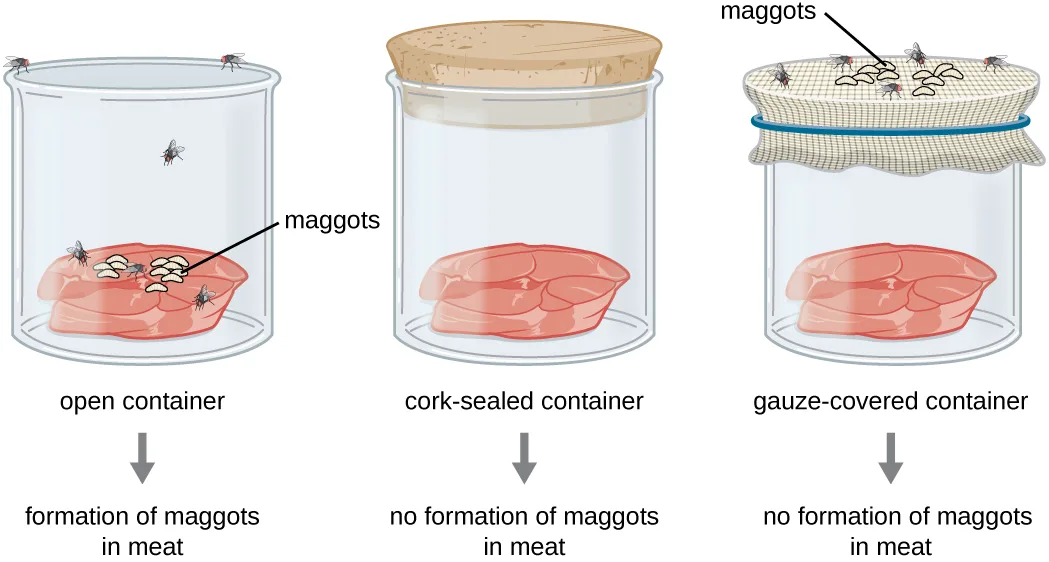
However, one of van Helmont’s contemporaries, Italian physician Francesco Redi (1626–1697), performed an experiment in 1668 that was one of the first to refute the idea that maggots (the larvae of flies) spontaneously generate on meat left out in the open air. He predicted that preventing flies from having direct contact with the meat would also prevent the appearance of maggots. Redi left meat in each of six containers (the diagram below). Two were open to the air, two were covered with gauze, and two were tightly sealed. His hypothesis was supported when maggots developed in the uncovered jars, but no maggots appeared in either the gauze-covered or the tightly sealed jars. He concluded that maggots could only form when flies were allowed to lay eggs in the meat, and that the maggots were the offspring of flies, not the product of spontaneous generation.
In 1745, John Needham (1713–1781) published a report of his own experiments, in which he briefly boiled broth infused with plant or animal matter, hoping to kill all preexisting microbes (E. Capanna, “Lazzaro Spallanzani: At the Roots of Modern Biology,” Journal of Experimental Zoology 285, no. 3 (1999): 178–196). He then sealed the flasks. After a few days, Needham observed that the broth had become cloudy and a single drop contained numerous microscopic creatures. He argued that the new microbes must have arisen spontaneously. In reality, however, he likely did not boil the broth enough to kill all preexisting microbes.
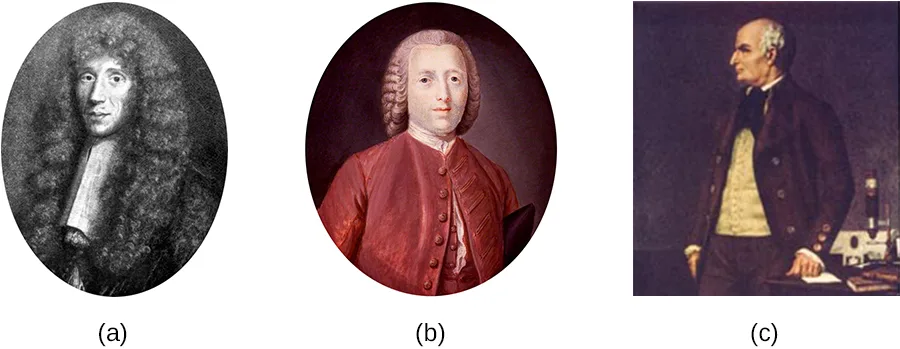
Lazzaro Spallanzani (1729–1799) did not agree with Needham’s conclusions, however, and performed hundreds of carefully executed experiments using heated broth (R. Mancini, M. Nigro, G. Ippolito, “Lazzaro Spallanzani and His Refutation of the Theory of Spontaneous Generation,” Le Infezioni in Medicina 15, no. 3 (2007): 199–206). As in Needham’s experiment, broth in sealed jars and unsealed jars was infused with plant and animal matter. Spallanzani’s results contradicted the findings of Needham: Heated but sealed flasks remained clear, without any signs of spontaneous growth, unless the flasks were subsequently opened to the air. This suggested that microbes were introduced into these flasks from the air. In response to Spallanzani’s findings, Needham argued that life originates from a “life force” that was destroyed during Spallanzani’s extended boiling. Any subsequent sealing of the flasks then prevented new life force from entering and causing spontaneous generation (the portraits below).
Check Your Understanding
Describe the theory of spontaneous generation and some of the arguments used to support it.
Show model answer
Did your answer mention:
Explain how the experiments of Redi and Spallanzani challenged the theory of spontaneous generation.
Show model answer
Did your answer mention:
Disproving Spontaneous Generation
The debate over spontaneous generation continued well into the 19th century, with scientists serving as proponents of both sides. To settle the debate, the Paris Academy of Sciences offered a prize for resolution of the problem. Louis Pasteur, a prominent French chemist who had been studying microbial fermentation and the causes of wine spoilage, accepted the challenge. In 1858, Pasteur filtered air through a gun-cotton filter and, upon microscopic examination of the cotton, found it full of microorganisms, suggesting that the exposure of a broth to air was not introducing a “life force” to the broth but rather airborne microorganisms.
Later, Pasteur made a series of flasks with long, twisted necks (“swan-neck” flasks), in which he boiled broth to sterilize it (the figure below). His design allowed air inside the flasks to be exchanged with air from the outside, but prevented the introduction of any airborne microorganisms, which would get caught in the twists and bends of the flasks’ necks. If a life force besides the airborne microorganisms were responsible for microbial growth within the sterilized flasks, it would have access to the broth, whereas the microorganisms would not. He correctly predicted that sterilized broth in his swan-neck flasks would remain sterile as long as the swan necks remained intact. However, should the necks be broken, microorganisms would be introduced, contaminating the flasks and allowing microbial growth within the broth.
Pasteur’s set of experiments irrefutably disproved the theory of spontaneous generation and earned him the prestigious Alhumbert Prize from the Paris Academy of Sciences in 1862. In a subsequent lecture in 1864, Pasteur articulated “Omne vivum ex vivo” (“Life only comes from life”). In this lecture, Pasteur recounted his famous swan-neck flask experiment, stating that “…life is a germ and a germ is life. Never will the doctrine of spontaneous generation recover from the mortal blow of this simple experiment.” (R. Vallery-Radot, The Life of Pasteur, trans. R.L. Devonshire (New York: McClure, Phillips and Co, 1902), 1:142). To Pasteur’s credit, it never has.
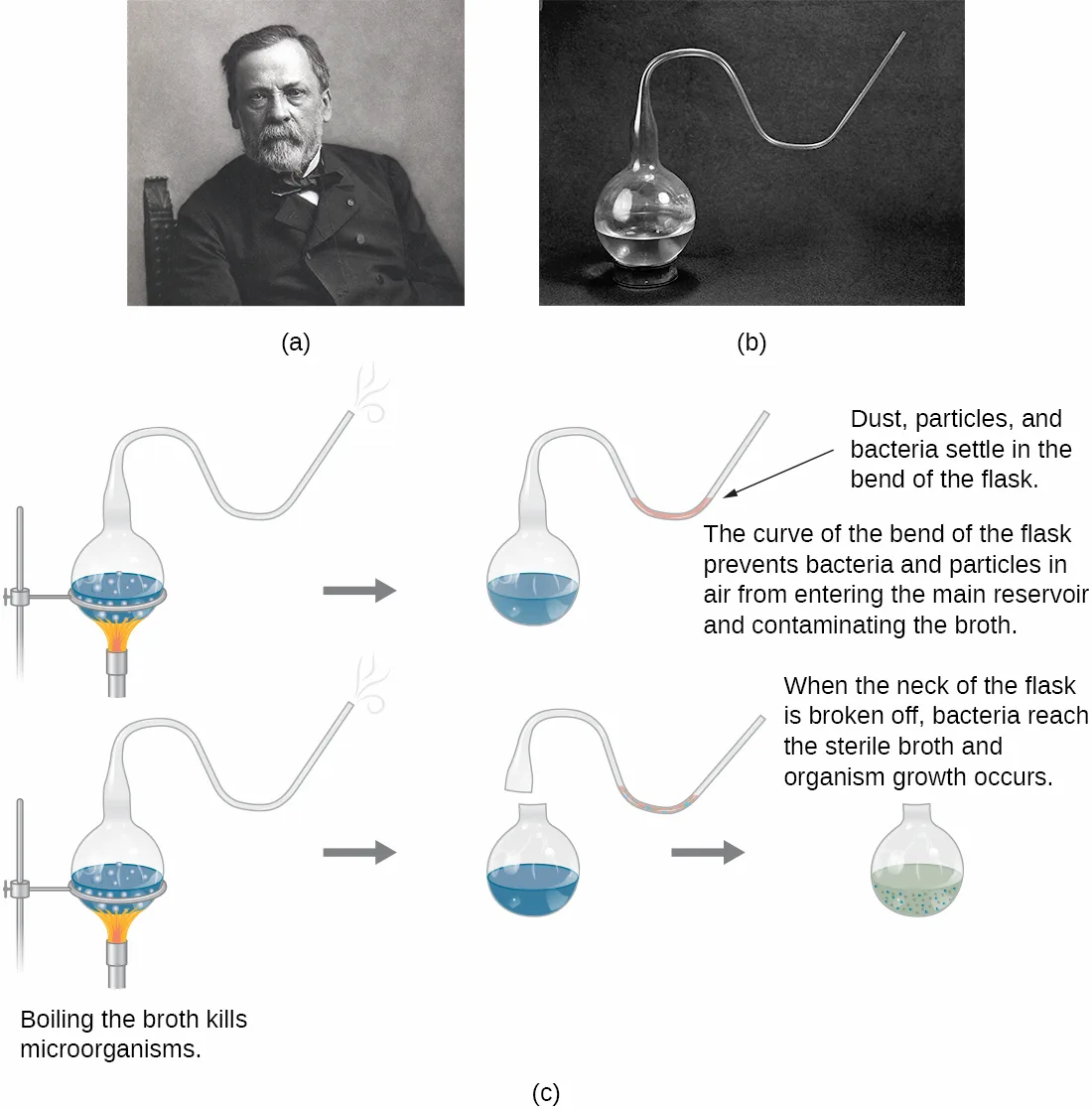
Extended description
Panel (c) shows two parallel sequences read left to right. In the top sequence, a swan-neck flask holding blue broth is heated over a flame; the next drawing shows the same flask afterward with a callout reading that dust, particles, and bacteria settle in the bend of the flask, and a second callout reading that the curve of the bend of the flask prevents bacteria and particles in air from entering the main reservoir and contaminating the broth, so no contamination occurs. In the bottom sequence, an identical flask is heated the same way; the next drawing shows the flask with its swan neck broken off, and an arrow leads to a final drawing of the flask with its broth turned cloudy and green and dotted with bacteria, with a callout reading that when the neck of the flask is broken off, bacteria reach the sterile broth and organism growth occurs.
Check Your Understanding
How did Pasteur’s experimental design allow air, but not microbes, to enter, and why was this important?
Show model answer
Did your answer mention:
What was the control group in Pasteur’s experiment and what did it show?
Show model answer
Did your answer mention:
Summary
- The theory of spontaneous generation states that life arose from nonliving matter. It was a long-held belief dating back to Aristotle and the ancient Greeks.
- Experimentation by Francesco Redi in the 17th century presented the first significant evidence refuting spontaneous generation by showing that flies must have access to meat for maggots to develop on the meat. Prominent scientists designed experiments and argued both in support of (John Needham) and against (Lazzaro Spallanzani) spontaneous generation.
- Louis Pasteur is credited with conclusively disproving the theory of spontaneous generation with his famous swan-neck flask experiment. He subsequently proposed that “life only comes from life.”
Key terms
- spontaneous generation — the now-disproven theory that life can arise from nonliving matter.
Practice
Explain the theory of spontaneous generation and why people once accepted it as an explanation for the existence of certain types of organisms
The assertion that “life only comes from life” was stated by Louis Pasteur in regard to his experiments that definitively refuted the theory of ________.
This is the same theory the section opens by tracing back to Aristotle and the ancient Greeks.Exposure to air is necessary for microbial growth.
Think about what happened to the sterile broth in Pasteur’s swan-neck flasks, which stayed exposed to air but not to airborne microorganisms.The theory of spontaneous generation states that life arose from ________ matter.
This theory claims that life could originate without a living parent organism, from matter of a different kind.Explain how certain individuals (van Helmont, Redi, Needham, Spallanzani, and Pasteur) tried to prove or disprove spontaneous generation
Which of the following individuals argued in favor of the theory of spontaneous generation?
Three of these four scientists designed experiments to disprove spontaneous generation; only one argued the opposite side of the debate.Which of the following individuals is credited for definitively refuting the theory of spontaneous generation using broth in a swan-neck flask?
This scientist’s flasks let air in but kept out airborne microorganisms, trapped in the twists and bends of the flask’s neck.Which of the following scientists experimented with raw meat, maggots, and flies in an attempt to disprove the theory of spontaneous generation?
This scientist left meat in six containers — some open, some covered with gauze, some sealed — to test whether flies were needed for maggots to appear.Explain in your own words Pasteur’s swan-neck flask experiment.
Show model answer
Did your answer mention:
Explain why the experiments of Needham and Spallanzani yielded different results even though they used similar methodologies.
Show model answer
Did your answer mention:
What would the results of Pasteur’s swan-neck flask experiment have looked like if they supported the theory of spontaneous generation?
Show model answer
Did your answer mention:
This section is adapted from Microbiology, Section 3.1: Spontaneous Generation by Nina Parker, Mark Schneegurt, Anh-Hue Thi Tu, Philip Lister, Brian M. Forster, and OpenStax, © OpenStax, licensed under CC BY-NC-SA 4.0. Access the original for free at openstax.org. Changes: figures re-encoded as WebP, with kind="diagram" set explicitly on all three figures, overriding the media manifest’s JPEG-based “photo” guess — the Redi-experiment jars are drawn icons, the three historical portraits are an engraving and two paintings rather than photographs, and the Pasteur figure is a composite whose third panel is a drawn schematic, so under the composite rule the whole figure is a diagram even though panels (a) and (b) are themselves photographs; the historical-portraits alt was rewritten from the source’s bare “a) drawing of…” labels to describe what each portrait actually shows, and a longdesc was added for the Pasteur figure’s schematic third panel, walking it in reading order; the four footnotes are rendered as inline parenthetical citations after the sentences they support, with the Zwier footnote’s bare access URL dropped; the Clinical Focus box is rendered as a callout, and its “Jump to the next Clinical Focus box” link is replaced by a plain sentence naming where the case continues (Section 3.2); the four Check Your Understanding bullets (two boxes of two) are rendered as body self-checks, with model answers and rubrics assembled from this section’s own preceding text; the three end-of-section Multiple Choice questions, the Fill in the Blank question, and the True/False question are adapted into the closing interactive Practice block under the objective each tests, with the True/False item rendered as a two-option multiple choice (True, then False); model answers for the two unkeyed Short Answer questions and the one unkeyed Critical Thinking question are written from this section’s own text, because the source prints no answer key for any of the three; one filler item (a cloze text-recall drawn from this section’s own Summary, “life arose from ________ matter”) fills out the first objective’s group to the book’s three-item floor, since the source’s own Multiple Choice, Fill in the Blank, and True/False items for that objective total only two; key terms are compiled from the module’s one defined term and the book’s Glossary appendix (one term, taken from the glossary); the cross-reference to Section 3.2 is rendered as an absolute link, since that page exists in this run; two Practice stems are corrected by one word each against the source — “using broth in a swan-neck flask” (the source omits the article) and “yielded different results” (the source prints “yielded in different results”) — both logged as errata.