Prokaryotic Diversity
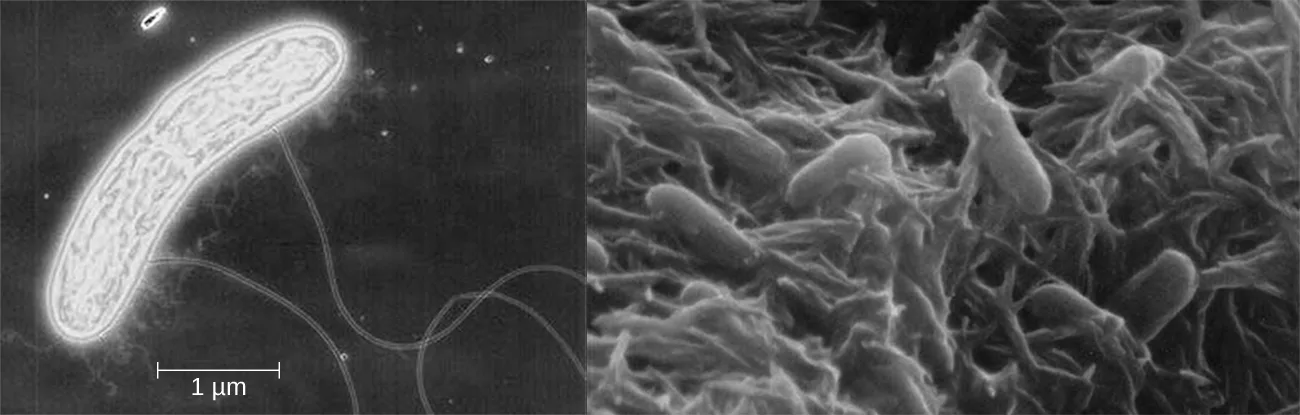
Scientists have studied prokaryotes for centuries, but it wasn’t until 1966 that scientist Thomas Brock (1926–2021) discovered that certain bacteria can live in boiling water. This led many to wonder whether prokaryotes may also live in other extreme environments, such as at the bottom of the ocean, at high altitudes, or inside volcanoes, or even on other planets.
Prokaryotes have an important role in changing, shaping, and sustaining the entire biosphere. They can produce proteins and other substances used by molecular biologists in basic research and in medicine and industry. For example, the bacterium Shewanella lives in the deep sea, where oxygen is scarce. It grows long appendages, which have special sensors used to seek the limited oxygen in its environment. It can also digest toxic waste and generate electricity. Other species of prokaryotes can produce more oxygen than the entire Amazon rainforest, while still others supply plants, animals, and humans with usable forms of nitrogen; and inhabit our body, protecting us from harmful microorganisms and producing some vitally important substances. This chapter will examine the diversity, structure, and function of prokaryotes.
Sections
- Prokaryote Habitats, Relationships, and Microbiomes — prokaryotes in diverse habitats, their symbiotic relationships, resident and transient microbiota, and the principles used to classify them.
- Proteobacteria — the distinguishing features and representative members of the alpha, beta, gamma, delta, and epsilon classes of Proteobacteria.
- Nonproteobacteria Gram-Negative Bacteria and Phototrophic Bacteria — the characteristics and representative organisms of nonproteobacterial gram-negative groups and bacteria that use light for energy.
- Gram-Positive Bacteria — the similarities, differences, and representative organisms of low G+C and high G+C gram-positive bacterial groups.
- Deeply Branching Bacteria — the distinctive traits and significant examples of bacteria near the deepest branches of the phylogenetic tree.
- Archaea — the major archaeal groups, the environments they inhabit, and their relationship to human microbiomes and disease.
This chapter is adapted from Microbiology, Chapter 4: Prokaryotic Diversity by Nina Parker, Mark Schneegurt, Anh-Hue Thi Tu, Philip Lister, Brian M. Forster, and OpenStax, © OpenStax, licensed under CC BY-NC-SA 4.0. Access the original for free at openstax.org. Each section page records its own changes from the source. Changes: the chapter-opening electron-micrograph panel is the source’s, re-encoded for the web; its alt text was rewritten from the source description to describe the two visible panels and their 1 µm scale bar without repeating the unsupported claim that the left cell is approximately 5 µm long; the source’s reference to the figure by number is replaced with a describing phrase.