Deeply Branching Bacteria
By the end of this section, you will be able to:
- Describe the unique features of deeply branching bacteria
- Give examples of significant deeply branching bacteria
On a phylogenetic tree (see A Systematic Approach), the trunk or root of the tree represents a common ancient evolutionary ancestor, often called the last universal common ancestor (LUCA), and the branches are its evolutionary descendants. Scientists consider the deeply branching bacteria, such as the genus Acetothermus, to be the first of these non-LUCA forms of life produced by evolution some 3.5 billion years ago. When placed on the phylogenetic tree, they stem from the common root of life, deep and close to the LUCA root—hence the name “deeply branching” (shown below).
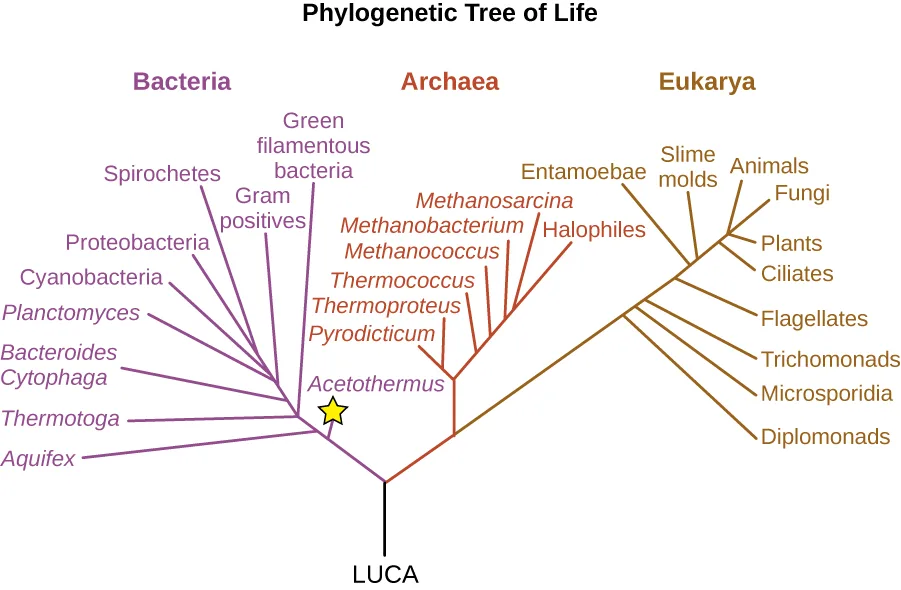
Extended description
The title is Phylogenetic Tree of Life. A black root labeled LUCA branches upward into three color-coded groups: Bacteria at left in purple, Archaea in the middle in orange, and Eukarya at right in brown. The bacterial branch labels, from the lowest upward, are Aquifex, Thermotoga, Bacteroides, Cytophaga, Planctomyces, Cyanobacteria, Proteobacteria, Spirochetes, Gram positives, and Green filamentous bacteria. A yellow star sits beside the label Acetothermus at the deep bacterial branch near Aquifex and Thermotoga. Archaeal labels, from the lower branch upward, are Pyrodicticum, Thermoproteus, Thermococcus, Methanococcus, Methanobacterium, Methanosarcina, and Halophiles. Eukaryal labels, from lower to upper branches, are Diplomonads, Microsporidia, Trichomonads, Flagellates, Ciliates, Plants, Fungi, Animals, Slime molds, and Entamoebae.
The deeply branching bacteria may provide clues regarding the structure and function of ancient and now extinct forms of life. We can hypothesize that ancient bacteria, like the deeply branching bacteria that still exist, were thermophiles or hyperthermophiles, meaning that they thrived at very high temperatures. Acetothermus paucivorans, a gram-negative anaerobic bacterium discovered in 1988 in sewage sludge, is a thermophile growing at an optimal temperature of 58 °C (G. Dietrich et al., “Acetothermus paucivorans, gen. nov., sp. Nov., a Strictly Anaerobic, Thermophilic Bacterium From Sewage Sludge, Fermenting Hexoses to Acetate, CO₂, and H₂,” Systematic and Applied Microbiology 10, no. 2 [1988]: 174–179). Scientists have determined it to be the deepest branching bacterium, or the closest evolutionary relative of the LUCA (shown above).
The class Aquificae includes deeply branching bacteria that are adapted to the harshest conditions on our planet, resembling the conditions thought to dominate the earth when life first appeared. Bacteria from the genus Aquifex are hyperthermophiles, living in hot springs at a temperature higher than 90 °C. The species A. pyrophilus thrives near underwater volcanoes and thermal ocean vents, where the temperature of water (under high pressure) can reach 138 °C. Aquifex bacteria use inorganic substances as nutrients. For example, A. pyrophilus can reduce oxygen, and it is able to reduce nitrogen in anaerobic conditions. They also show a remarkable resistance to ultraviolet light and ionizing radiation. Taken together, these observations support the hypothesis that the ancient ancestors of deeply branching bacteria began evolving more than 3 billion years ago, when the earth was hot and lacked an atmosphere, exposing the bacteria to nonionizing and ionizing radiation.
The class Thermotogae is represented mostly by hyperthermophilic, as well as some mesophilic (preferring moderate temperatures), anaerobic gram-negative bacteria whose cells are wrapped in a peculiar sheath-like outer membrane called a toga. The thin layer of peptidoglycan in their cell wall has an unusual structure; it contains diaminopimelic acid and D-lysine. These bacteria are able to use a variety of organic substrates and produce molecular hydrogen, which can be used in industry. The class contains several genera, of which the best known is the genus Thermotoga. One species of this genus, T. maritima, lives near the thermal ocean vents and thrives in temperatures of 90 °C; another species, T. subterranea, lives in underground oil reservoirs.
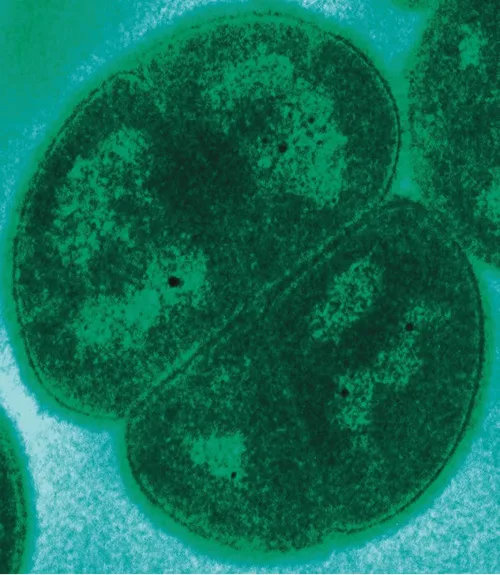
Finally, the deeply branching bacterium Deinococcus radiodurans belongs to a genus whose name is derived from a Greek word meaning terrible berry. Nicknamed “Conan the Bacterium,” D. radiodurans is considered a polyextremophile because of its ability to survive under the many different kinds of extreme conditions—extreme heat, drought, vacuum, acidity, and radiation. It owes its name to its ability to withstand doses of ionizing radiation that kill all other known bacteria; this special ability is attributed to some unique mechanisms of DNA repair.
Summary
- Deeply branching bacteria are phylogenetically the most ancient forms of life, being the closest to the last universal common ancestor.
- Deeply branching bacteria include many species that thrive in extreme environments that are thought to resemble conditions on earth billions of years ago.
- Deeply branching bacteria are important for our understanding of evolution; some of them are used in industry.
Key terms
- deeply branching bacteria — bacteria that occupy the lowest branches of the phylogenetic tree of life.
Practice
Describe the unique features of deeply branching bacteria
The term “deeply branching” refers to which of the following?
Use the location of the star on the phylogenetic tree rather than an organism’s habitat or shape.The length of the branches of the evolutionary tree characterizes the evolutionary ________ between organisms.
Think about the relationship that a phylogenetic tree expresses between two organisms.The deeply branching bacteria are thought to be the form of life closest to the last universal ________ ________.
Use the full phrase abbreviated by LUCA at the root of the tree.Briefly describe the significance of deeply branching bacteria for basic science and for industry.
Show model answer
Did your answer mention:
Give examples of significant deeply branching bacteria
Which of these deeply branching bacteria is considered a polyextremophile?
Find the organism nicknamed “Conan the Bacterium” in the final paragraph.Many of the deeply branching bacteria are aquatic and hyperthermophilic, found near underwater volcanoes and thermal ocean ________.
Use the environmental location given for Aquifex and Thermotoga species.The deeply branching bacterium Deinococcus radiodurans is able to survive exposure to high doses of ________.
Distinguish the radiation dose it withstands from the other environmental extremes in the final paragraph.What is thought to account for the unique radiation resistance of D. radiodurans?
Read the final clause of the paragraph about this bacterium’s resistance.This section is adapted from Microbiology, Section 4.5: Deeply Branching Bacteria by Nina Parker, Mark Schneegurt, Anh-Hue Thi Tu, Philip Lister, Brian M. Forster, and OpenStax, © OpenStax, licensed under CC BY-NC-SA 4.0. Access the original for free at openstax.org. Changes: figures are re-encoded as WebP and their source alt text is rewritten from the served images, correcting misspelled phylogenetic-tree labels and adding an extended description for the labeled tree; key terms are compiled from the module’s defined terms and the book’s Glossary appendix; selected end-of-section exercises are adapted into the interactive Practice block; the answer to one unkeyed Short Answer question is written from this section’s text because the source prints no answer key, and the other is graded from the module’s sentence on DNA repair.