The Eukaryotes of Microbiology
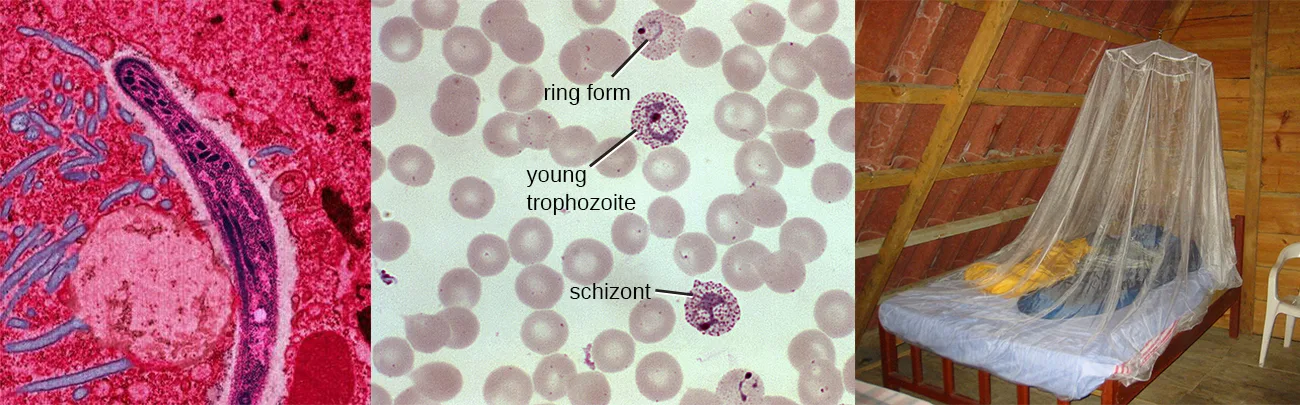
Although bacteria and viruses account for a large number of the infectious diseases that afflict humans, many serious illnesses are caused by eukaryotic organisms. One example is malaria, which is caused by Plasmodium, a eukaryotic organism transmitted through mosquito bites. Malaria is a major cause of morbidity (illness) and mortality (death) that threatens 3.4 billion people worldwide (Centers for Disease Control and Prevention, “Impact of Malaria,” September 22, 2015). In severe cases, organ failure and blood or metabolic abnormalities contribute to medical emergencies and sometimes death. Even after initial recovery, relapses may occur years later. In countries where malaria is endemic, the disease represents a major public health challenge that can place a tremendous strain on developing economies.
Worldwide, major efforts are underway to reduce malaria infections. Efforts include the distribution of insecticide-treated bed nets and the spraying of pesticides. Researchers are also making progress in their efforts to develop effective vaccines (RTS,S Clinical Trials Partnership, “Efficacy and safety of RTS,S/AS01 malaria vaccine with or without a booster dose in infants and children in Africa: final results of a phase 3, individually randomised, controlled trial,” The Lancet, April 23, 2015, DOI 10.1016/S0140-6736(15)60721-8). In late 2021, R21/Matrix-M became the first vaccine to be recommended for widespread use by the World Health Organization. At least ten other candidate vaccines are in development. The effort is a multinational one involving governments, universities, nonprofits, philanthropists, and pharmaceutical companies. Much of the recent progress can be credited to organizations within the most affected countries, such as the Malaria Research and Training Center in Mali. Founded by Ogobara Duombo and Yeya Touré in the 1990s, the center has emerged as a primary front-line research driver, including running many of the critical clinical trials that are so important to vaccine development and approval.
Sections
- Unicellular Eukaryotic Parasites — the characteristics of protists, their classification into supergroups, and the medically important protozoan parasites and their life cycles.
- Parasitic Helminths — the characteristics of parasitic nematodes, trematodes, and cestodes, with examples of the infections they cause.
- Fungi — fungal structure, reproduction, and diversity, the medically important fungal groups, and the mycoses they cause.
- Algae — the characteristics, groups, and ecological roles of algae, and their medical and economic importance.
- Lichens — the symbiotic partners of a lichen, its structure and growth forms, and its environmental importance.
This chapter is adapted from Microbiology, Chapter 5: The Eukaryotes of Microbiology by Nina Parker, Mark Schneegurt, Anh-Hue Thi Tu, Philip Lister, Brian M. Forster, and OpenStax, © OpenStax, licensed under CC BY-NC-SA 4.0. Access the original for free at openstax.org. Each section page records its own changes from the source. Changes: the chapter-opening three-panel figure is the source’s, re-encoded for the web, with its alt text rewritten to describe the three visible panels and their printed labels; the two source footnotes are rendered as inline parenthetical citations with the bare access URL dropped and the DOI kept; the source’s “an multinational” is printed as “a multinational”.