Algae
By the end of this section, you will be able to:
- Explain why algae are included within the discipline of microbiology
- Describe the unique characteristics of algae
- Identify examples of toxin-producing algae
- Compare the major groups of algae in this chapter, and give examples of each
- Classify algal organisms according to major groups
The algae are autotrophic protists that can be unicellular or multicellular. These organisms are found in the supergroups Chromalveolata (dinoflagellates, diatoms, golden algae, and brown algae) and Archaeplastida (red algae and green algae). They are important ecologically and environmentally because they are responsible for the production of approximately 70% of the oxygen and organic matter in aquatic environments. Some types of algae, even those that are microscopic, are regularly eaten by humans and other animals. Additionally, algae are the source for agar, agarose, and carrageenan, solidifying agents used in laboratories and in food production. Although algae are typically not pathogenic, some produce toxins. Harmful algal blooms, which occur when algae grow quickly and produce dense populations, can produce high concentrations of toxins that impair liver and nervous-system function in aquatic animals and humans.
Like protozoans, algae often have complex cell structures. For instance, algal cells can have one or more chloroplasts that contain structures called pyrenoids to synthesize and store starch. The chloroplasts themselves differ in their number of membranes, indicative of secondary or rare tertiary endosymbiotic events. Primary chloroplasts have two membranes—one from the original cyanobacteria that the ancestral eukaryotic cell engulfed, and one from the plasma membrane of the engulfing cell. Chloroplasts in some lineages appear to have resulted from secondary endosymbiosis, in which another cell engulfed a green or red algal cell that already had a primary chloroplast within it. The engulfing cell destroyed everything except the chloroplast and possibly the cell membrane of its original cell, leaving three or four membranes around the chloroplast. Different algal groups have different pigments, which are reflected in common names such as red algae, brown algae, and green algae.
Some algae, the seaweeds, are macroscopic and may be confused with plants. Seaweeds can be red, brown, or green, depending on their photosynthetic pigments. Green algae, in particular, share some important similarities with land plants; however, there are also important distinctions. For example, seaweeds do not have true tissues or organs like plants do. Additionally, seaweeds do not have a waxy cuticle to prevent desiccation. Algae can also be confused with cyanobacteria, photosynthetic bacteria that bear a resemblance to algae; however, cyanobacteria are prokaryotes (see Nonproteobacteria Gram-Negative Bacteria and Phototrophic Bacteria).
Algae have a variety of life cycles. Reproduction may be asexual by mitosis or sexual using gametes.
Algal Diversity
Although the algae and protozoa were formerly separated taxonomically, they are now mixed into supergroups. The algae are classified within the Chromalveolata and the Archaeplastida. Although the Euglenozoa (within the supergroup Excavata) include photosynthetic organisms, these are not considered algae because they feed and are motile.
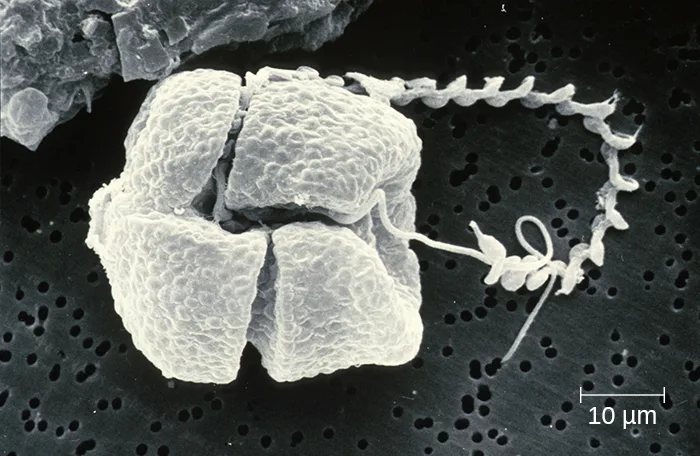
The dinoflagellates and stramenopiles fall within the Chromalveolata. The dinoflagellates are mostly marine organisms and are an important component of plankton. They have a variety of nutritional types and may be phototrophic, heterotrophic, or mixotrophic. Those that are photosynthetic use chlorophyll a, chlorophyll c₂, and other photosynthetic pigments, shown in the micrograph below. They generally have two flagella, causing them to whirl (in fact, the name dinoflagellate comes from the Greek word for “whirl”: dini). Some have cellulose plates forming a hard outer covering, or theca, as armor. Additionally, some dinoflagellates produce neurotoxins that can cause paralysis in humans or fish. Exposure can occur through contact with water containing the dinoflagellate toxins or by feeding on organisms that have eaten dinoflagellates.
When a population of dinoflagellates becomes particularly dense, a red tide (a type of harmful algal bloom) can occur. Red tides cause harm to marine life and to humans who consume contaminated marine life. Major toxin producers include Gonyaulax and Alexandrium, both of which cause paralytic shellfish poisoning. Another species, Pfiesteria piscicida, is known as a fish killer because, at certain parts of its life cycle, it can produce toxins harmful to fish and it appears to be responsible for a suite of symptoms, including memory loss and confusion, in humans exposed to water containing the species.
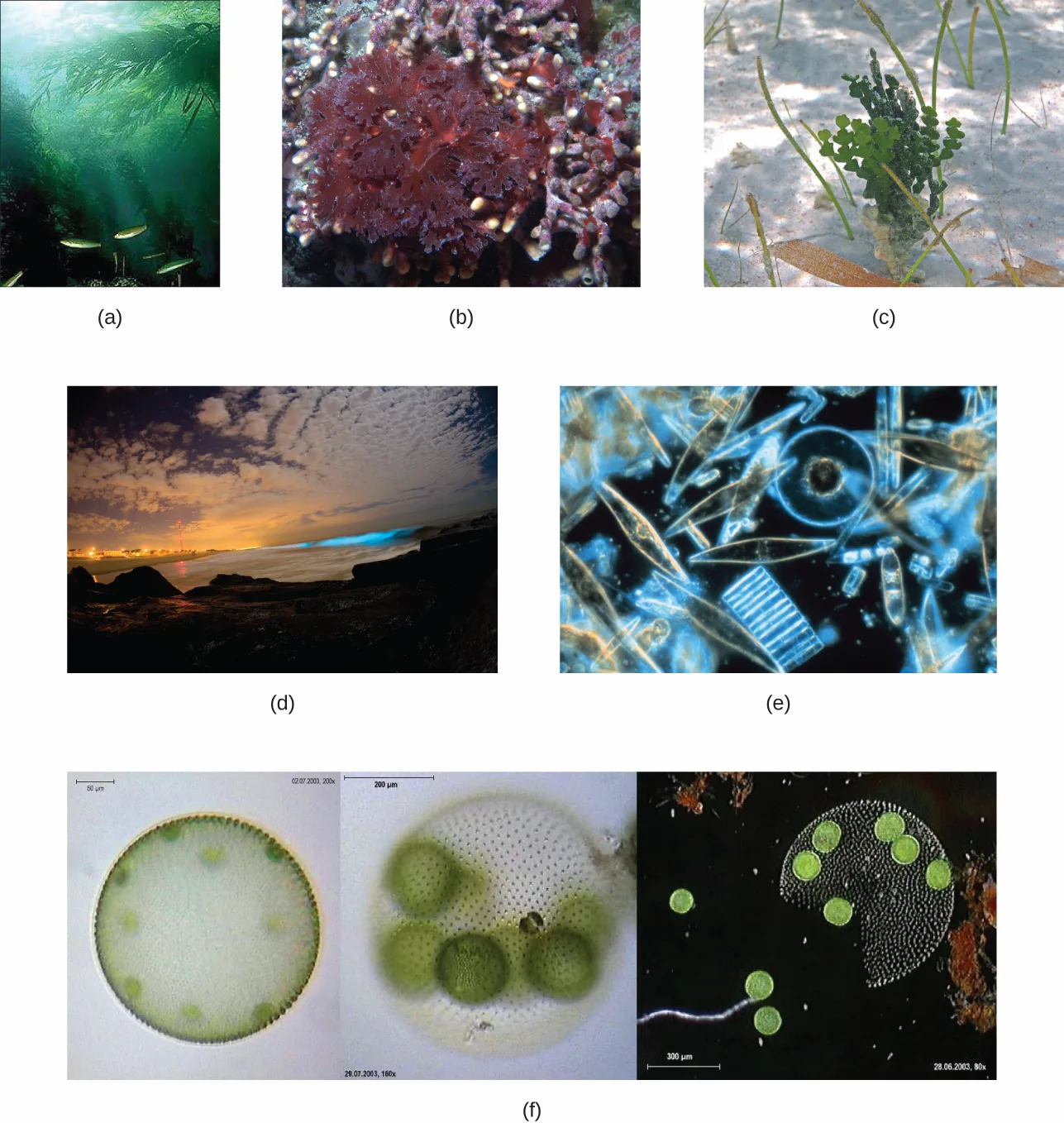
The stramenopiles include the golden algae (Chrysophyta), the brown algae (Phaeophyta), and the diatoms (Bacillariophyta). Stramenopiles have chlorophyll a, chlorophyll c₁/c₂, and fucoxanthin as photosynthetic pigments. Their storage carbohydrate is chrysolaminarin. While some lack cell walls, others have scales. Diatoms have frustules, which are outer cell walls of crystallized silica; their fossilized remains are used to produce diatomaceous earth, which has a range of uses such as filtration and insulation. Additionally, diatoms can reproduce sexually and asexually, and the male gametes of centric diatoms have flagella providing directed movement to seek female gametes for sexual reproduction.
Brown algae (Phaeophyta) are multicellular marine seaweeds. Some can be extremely large, such as the giant kelp (Laminaria). They have leaf-like blades, stalks, and structures called holdfasts that are used to attach to substrate. However, these are not true leaves, stems, or roots, shown in the composite figure below. Their photosynthetic pigments are chlorophyll a, chlorophyll c, β-carotene, and fucoxanthine. They use laminarin as a storage carbohydrate.
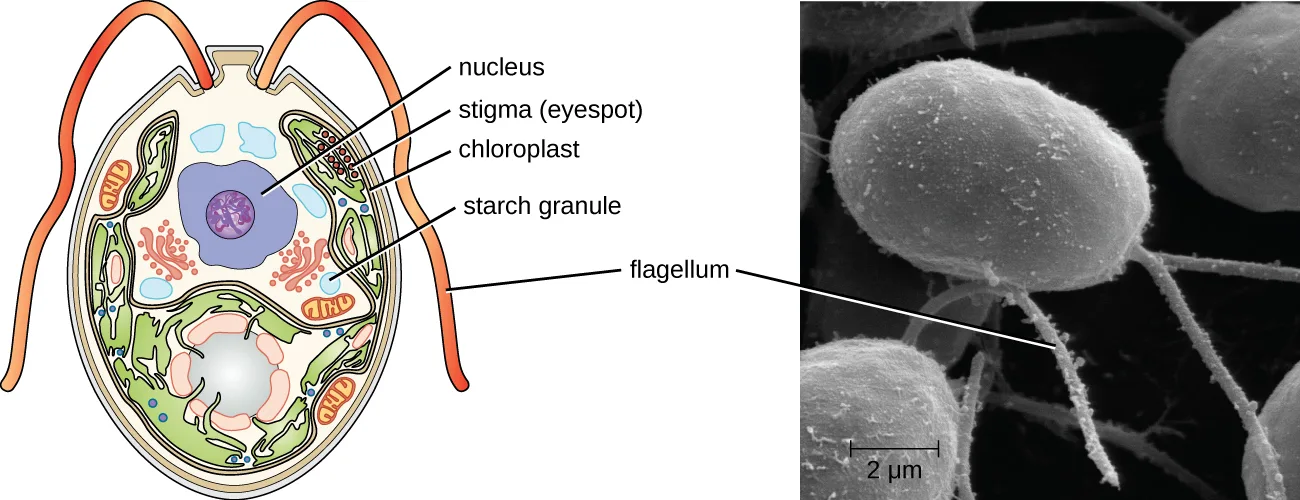
The Archaeplastids include the green algae (Chlorophyta), the red algae (Rhodophyta), another group of green algae (Charophyta), and the land plants. The Charophyta are the most similar to land plants because they share a mechanism of cell division and an important biochemical pathway, among other traits that the other groups do not have. Like land plants, the Charophyta and Chlorophyta have chlorophyll a and chlorophyll b as photosynthetic pigments, cellulose cell walls, and starch as a carbohydrate storage molecule. Chlamydomonas is a green alga that has a single large chloroplast, two flagella, and a stigma (eyespot); it is important in molecular biology research, illustrated in the figure below.
Extended description
Panel (a) looks up through a kelp forest: long green fronds rise toward sunlit water with a few small fish beneath them. Panel (b) is a close-up of a red, finely branched marine alga growing over rock. Panel (c) shows a single small green alga with flattened, segmented branches standing in pale sand among thin seagrass blades. Panel (d) is a night-time shoreline where a breaking wave glows blue against a dark sky and rocks. Panel (e) is a dark-field micrograph of many glass-like diatoms of different shapes, including needle-like, boat-shaped, ribbed, and a large round disc. Panel (f) is three light micrographs of Volvox colonies with scale bars: at left, a single hollow sphere whose wall is a mesh of tiny green cells, with several small green daughter colonies inside; in the middle, a sphere holding four large daughter colonies; at right, a ruptured sphere releasing daughter colonies, with free daughter colonies beside it.
Chlorella is a nonmotile, large, unicellular alga, and Acetabularia is an even larger unicellular green alga. The size of these organisms challenges the idea that all cells are small, and they have been used in genetics research since Joachim Hämmerling (1901–1980) began to work with them in 1943. Volvox is a colonial, unicellular alga, shown among the colonial green algae in the composite figure above. A larger, multicellular green alga is Ulva, also known as the sea lettuce because of its large, edible, green blades. The range of life forms within the Chlorophyta—from unicellular to various levels of coloniality to multicellular forms—has been a useful research model for understanding the evolution of multicellularity. The red algae are mainly multicellular but include some unicellular forms. They have rigid cell walls containing agar or carrageenan, which are useful as food solidifying agents and as a solidifier added to growth media for microbes.
Extended description
In the diagram, a large oval outline represents the cell, with two long flagella curving outward from a narrow neck at the top. Lines point from labels to structures inside the cell: ’nucleus’ to a rounded body near the center; ‘stigma (eyespot)’ to a cluster of small dots near the flagella base; ‘chloroplast’ to a large structure filling much of the cell; and ‘starch granule’ to small pale ovals within the chloroplast. A fifth label, ‘flagellum’, sits between the two panels, with one line running left to a flagellum of the diagram and another running right to a flagellum of a cell in the micrograph. In the micrograph beside it, several oval-bodied cells each trail two thin flagella from one end.
Check Your Understanding
Which groups of algae are associated with harmful algal blooms?
Show model answer
Did your answer mention:
Summary
- Algae are a diverse group of photosynthetic eukaryotic protists
- Algae may be unicellular or multicellular
- Large, multicellular algae are called seaweeds but are not plants and lack plant-like tissues and organs
- Although algae have little pathogenicity, they may be associated with toxic algal blooms that can harm aquatic wildlife and contaminate seafood with toxins that cause paralysis
- Algae are important for producing agar, which is used as a solidifying agent in microbiological media, and carrageenan, which is used as a solidifying agent
Key terms
- algae — (singular: alga) any of various unicellular and multicellular photosynthetic eukaryotic organisms; distinguished from plants by their lack of vascular tissues and organs.
- agar — a solidifying agent, along with carrageenan, used in laboratories and in food production, produced by algae such as red algae.
- carrageenan — a solidifying agent, along with agar, used in laboratories and in food production, produced by algae such as red algae.
- algal bloom — a dense, rapidly growing population of algae that, when harmful, can produce high concentrations of toxins that impair liver and nervous-system function in aquatic animals and humans.
- pyrenoids — structures within a chloroplast used to synthesize and store starch.
- dinoflagellates — mostly marine protists, an important component of plankton, that may be phototrophic, heterotrophic, or mixotrophic and generally have two flagella.
- theca — a hard outer covering of cellulose plates that some dinoflagellates have, serving as armor.
- red tide — a type of harmful algal bloom that can occur when a population of dinoflagellates becomes particularly dense.
- stramenopiles — a group of algae that includes the golden algae, the brown algae, and the diatoms.
- diatoms — algae with outer cell walls (frustules) of crystallized silica, belonging to the stramenopiles.
- frustules — the outer cell walls of crystallized silica found in diatoms.
Practice
Explain why algae are included within the discipline of microbiology
Why are algae not considered parasitic?
Show model answer
Did your answer mention:
Algae are a diverse group of photosynthetic ________ protists.
Contrast this cell type with the prokaryotic cyanobacteria the section distinguishes algae from.Some types of algae, even those that are microscopic, are regularly ________ by humans and other animals.
Algae serve as food, not only as a subject of study.Describe the unique characteristics of algae
Which polysaccharide found in red algal cell walls is a useful solidifying agent?
This wall component is also named as a laboratory and food-production solidifying agent earlier in the section.Structures in chloroplasts used to synthesize and store starch are called ________.
This is the same structure named early in the paragraph on algal cell complexity.Algae with chloroplasts with three or four membranes are a result of ________ ________.
Distinguish this two-membrane-adding event from the primary chloroplast’s original two membranes.Identify examples of toxin-producing algae
Which protists are associated with red tides?
This group is specifically tied to red tides when its population becomes dense.Major toxin producers responsible for paralytic shellfish poisoning include Gonyaulax and ________.
Name the second genus paired with Gonyaulax as a cause of this specific poisoning.Which toxin-producing organism named in this section is known as a fish killer, producing toxins during certain parts of its life cycle that have caused memory loss and confusion in exposed humans?
Look for the species named specifically for its effect on fish and for human memory loss and confusion, distinct from the paralytic-poisoning producers.Compare the major groups of algae in this chapter, and give examples of each
Which is the term for the hard outer covering of some dinoflagellates?
This is the armor-like structure some dinoflagellates form from cellulose plates.What is a distinctive feature of diatoms?
Name the outer cell wall structure diatoms have that is made of crystallized silica.Some brown algae can be extremely large, such as the giant kelp, ________.
This is the genus name printed in italics beside ‘giant kelp’ in the brown algae paragraph.Classify algal organisms according to major groups
Which groups contain the multicellular algae?
Show model answer
Did your answer mention:
Which supergroup includes the dinoflagellates, diatoms, golden algae, and brown algae discussed in this section?
This supergroup is named in the section’s opening paragraph, paired with a second supergroup that includes the red and green algae.Within the Archaeplastida, the group most similar to land plants — sharing a mechanism of cell division and an important biochemical pathway — is the ________.
This is the second green-algae group named in the Archaeplastida paragraph, distinct from the Chlorophyta.This section is adapted from Microbiology, Section 5.4: Algae by Nina Parker, Mark Schneegurt, Anh-Hue Thi Tu, Philip Lister, Brian M. Forster, and OpenStax, © OpenStax, licensed under CC BY-NC-SA 4.0. Access the original for free at openstax.org. Changes: all three source figures re-encoded as WebP and rendered as mediafigures after image and PDF inspection, with explicit kind; the dinoflagellate micrograph’s alt is rewritten to describe the two visible projections without naming them “theca” or “armor”; the six-panel algae composite gets a new alt summarizing all six photographs (the source alt covered them too, at length, so the wording is condensed and moved partly to longdesc) and its printed “Bioluminesence” is corrected to “Bioluminescence” (a one-word source typo, also logged as an erratum); the Chlamydomonas figure’s alt is rewritten because the source alt described only the labeled diagram panel and said nothing about the micrograph panel that is also part of the vendored image, and a longdesc walks the diagram’s labels (also logged as an erratum: an incomplete source alt); the first figure carries eager="true". The module’s own cross-reference for the sentence “Volvox is a colonial, unicellular alga” points (in both the CNXML and the print book, Figure 5.37) at the Chlamydomonas figure, which shows no Volvox; Volvox is actually shown in panel (f) of the composite figure (Figure 5.36), so the page’s descriptive phrase points there instead and the mistargeted cross-reference is logged as a suspected source defect. The Summary’s fourth bullet is missing a verb (“blooms that can and aquatic wildlife”); “harm” is inserted as the minimal correction, also logged. The module’s second spelling of the green-algal group, “Charaphyta,” is printed as “Charophyta,” matching its own defined term two sentences earlier (a one-word source typo, also logged). The Check Your Understanding box’s one bullet remains a body self-check: the honest answer (dinoflagellates, via the red-tide sentence) is the same fact the section’s own “which protists are associated with red tides?” Multiple Choice already tests as a graded item, so converting the CYU too would ask it twice. Two of the source’s three unkeyed Short Answer questions (“Why are algae not considered parasitic?” and “Which groups contain the multicellular algae?”) remain self-checks with model answers and rubrics assembled only from this module’s text, because their honest answers are not fixed by one sentence; the third (“What is a distinctive feature of diatoms?”) is graded as a textin keyed frustules from the module’s own defining sentence. No source exercise was omitted; the two source Multiple Choice and two Fill in the Blank items are used verbatim in Practice. The module’s own text supports the source’s Fill in the Blank key (“secondary endosymbiosis” for chloroplasts with three or four membranes) exactly, so it stands unchanged. Nine author-written items (five textin, two multiplechoice, two selfcheck-format prose already counted above) fill the remaining Practice slots to reach this book’s three-per-objective floor, since the module’s own exercise set (eight items plus one Check Your Understanding bullet) falls short of the fifteen a five-objective section needs: two cloze items from this section’s own summary and body sentences (“eukaryotic,” “eaten”); a textin naming the second red-tide genus (Alexandrium) and a multiplechoice on Pfiesteria piscicida, both from the toxin-producer paragraph; a textin naming the giant-kelp genus (Laminaria) from the brown-algae paragraph; and a multiplechoice on the Chromalveolata supergroup and a textin naming the Charophyta, both from the module’s own classification sentences — every filler’s source sentence is named above or in the source ledger. Key terms compiled from the module’s eleven defined terms; the module supplies a Glossary-appendix definition for only one of them (algae), so the other ten are sentence-derived, as the module’s own scan predicted. The cross-reference to Section 4.3 is rendered as an absolute site-root Markdown link to its published page.