Lichens
By the end of this section, you will be able to:
- Explain why lichens are included in the study of microbiology
- Describe the unique characteristics of a lichen and the role of each partner in the symbiotic relationship of a lichen
- Describe ways in which lichens are beneficial to the environment
No one has to worry about getting sick from a lichen infection, but lichens are interesting from a microbiological perspective and they are an important component of most terrestrial ecosystems. Lichens provide opportunities for study of close relationships between unrelated microorganisms. Lichens contribute to soil production by breaking down rock, and they are early colonizers in soilless environments such as lava flows. The cyanobacteria in some lichens can fix nitrogen and act as a nitrogen source in some environments. Lichens are also important soil stabilizers in some desert environments and they are an important winter food source for caribou. Finally, lichens produce compounds that have antibacterial effects, and further research may discover compounds that are medically useful to humans.
Characteristics
A lichen is a combination of two organisms, a green alga or cyanobacterium and fungus, living in a symbiotic relationship. Whereas algae normally grow only in aquatic or extremely moist environments, lichens can potentially be found on almost any surface (especially rocks) or as epiphytes (meaning that they grow on other plants).
In some ways, the symbiotic relationship between fungi and algae seems like a mutualism (a relationship in which both organisms benefit). The fungus can obtain photosynthates from the algae or cyanobacterium and the algae or cyanobacterium can grow in a drier environment than it could otherwise tolerate. However, most scientists consider this symbiotic relationship to be a controlled parasitism (a relationship in which one organism benefits and the other is harmed) because the photosynthetic organism grows less well than it would without the fungus. It is important to note that such symbiotic interactions fall along a continuum between conflict and cooperation.
Lichens are slow growing and can live for centuries. They have been used in foods and to extract chemicals as dyes or antimicrobial substances. Some are very sensitive to pollution and have been used as environmental indicators.
Lichens have a body called a thallus, an outer, tightly packed fungal layer called a cortex, and an inner, loosely packed fungal layer called a medulla (shown below). Lichens use hyphal bundles called rhizines to attach to the substrate.
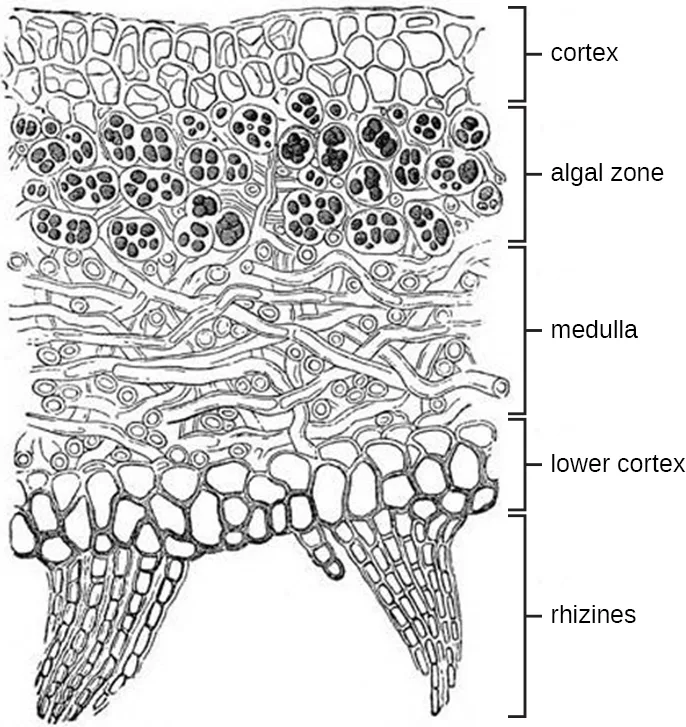
Extended description
Reading from top to bottom: the cortex is a band of tightly packed, angular, thin-walled cells. Below it, the algal zone contains clusters of round, darkly shaded cells scattered among thin filaments. Below that, the medulla is a thicker band of loosely interwoven, wavy filaments with occasional round cells. Below the medulla, a second, lower cortex repeats the tightly packed angular cells of the upper cortex. At the bottom, rhizines are bundles of thin, parallel filaments that taper to points, projecting downward from the lower cortex.
Lichen Diversity
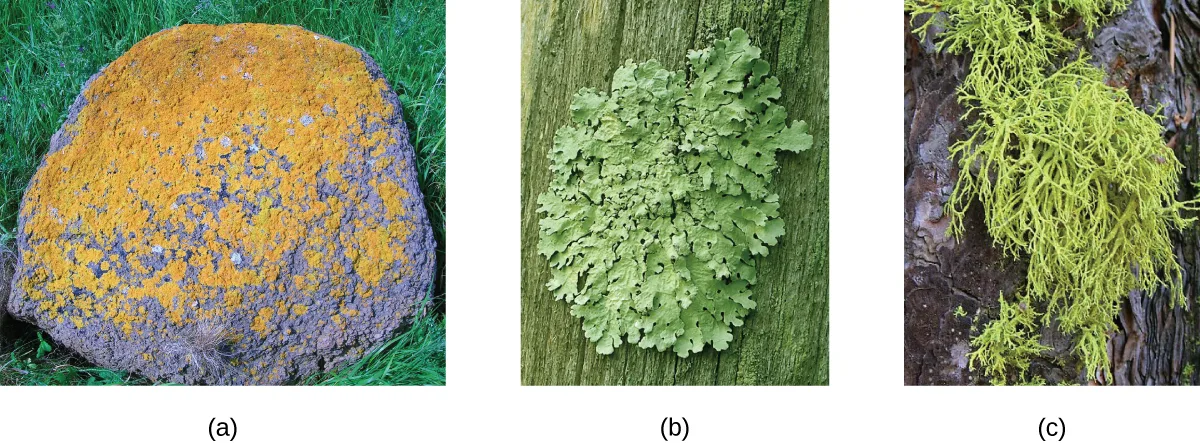
Lichens are classified as fungi and the fungal partners belong to the Ascomycota and Basidiomycota. Lichens can also be grouped into types based on their morphology. There are three major types of lichens, although other types exist as well. Lichens that are tightly attached to the substrate, giving them a crusty appearance, are called crustose lichens. Those that have leaf-like lobes are foliose lichens; they may only be attached at one point in the growth form, and they also have a second cortex below the medulla. Finally, fruticose lichens have rounded structures and an overall branched appearance. The photographs below show an example of each of the forms of lichens.
Check Your Understanding
What types of organisms are found in lichens?
Show model answer
Did your answer mention:
What are the three growth forms of lichens?
Show model answer
Did your answer mention:
Clinical Focus. Resolution
Sarah’s mother asks the doctor what she should do if the cream prescribed for Sarah’s ringworm does not work. The doctor explains that ringworm is a general term for a condition caused by multiple species. The first step is to take a scraping for examination under the microscope, which the doctor has already done. He explains that he has identified the infection as a fungus, and that the antifungal cream works against the most common fungi associated with ringworm. However, the cream may not work against some species of fungus. If the cream is not working after a couple of weeks, Sarah should come in for another visit, at which time the doctor will take steps to identify the species of the fungus.
Positive identification of dermatophytes requires culturing. For this purpose, Sabouraud’s agar may be used. In the case of Sarah’s infection, which cleared up within 2 weeks of treatment, the culture would have a granular texture and would appear pale pink on top and red underneath. These features suggest that the fungus is Trichophyton rubrum, a common cause of ringworm.
The case began in Unicellular Eukaryotic Parasites.
Summary
- Lichens are a symbiotic association between a fungus and an algae or a cyanobacterium
- The symbiotic association found in lichens is currently considered to be a controlled parasitism, in which the fungus benefits and the algae or cyanobacterium is harmed
- Lichens are slow growing and can live for centuries in a variety of habitats
- Lichens are environmentally important, helping to create soil, providing food, and acting as indicators of air pollution
Key terms
- lichen — symbiotic association of a fungus with an algae or cyanobacterium.
- epiphytes — a plant that grows on another plant.
- cortex — tightly packed layer of fungal filaments at the outer surface of a lichen; foliose lichens have a second cortex layer beneath the medulla.
- medulla — loosely packed layer of fungal filaments located underneath the cortex of a lichen.
- rhizines — structures made of hyphae found on some lichens; aid in attachment to a surface.
- crustose lichens — lichens that are tightly attached to the substrate, giving them a crusty appearance.
- foliose lichens — lichens that have lobes that may appear to resemble leaves.
- fruticose lichens — lichens that are generally branched with a rounded appearance.
Practice
Explain why lichens are included in the study of microbiology
The ________ in some lichens can fix nitrogen and act as a nitrogen source in some environments.
Look at the intro paragraph’s sentence about nitrogen fixation, not the sentence about soil stabilizers.Lichens are an important winter food source for which animal, according to this section?
Look at the intro paragraph’s sentence about winter food.According to this section, lichens are important soil stabilizers in which type of environment?
Distinguish this from the environments named for aquatic algae growth, lava-flow colonization, and marine rocks.Describe the unique characteristics of a lichen and the role of each partner in the symbiotic relationship of a lichen
You encounter a lichen with leafy structures. Which term describes this lichen?
Compare the leaf-like lobe description in the Lichen Diversity paragraph with each growth-form name.Which of the following is the term for the outer layer of a lichen?
The Characteristics paragraph names the lichen’s outer, tightly packed fungal layer.The fungus in a lichen is which of the following?
Decide which of the options is a fungus at all, using the Lichen Diversity paragraph’s sentence on what lichens are classified as.Describe ways in which lichens are beneficial to the environment
What are three ways that lichens are environmentally valuable?
Show model answer
Did your answer mention:
Lichens contribute to soil production by ________ rock.
Look at the intro paragraph’s sentence about soil production and lava flows.Lichens produce compounds that have ________ effects, and further research may discover compounds that are medically useful to humans.
Look at the last sentence of the intro paragraph.This section is adapted from Microbiology, Section 5.5: Lichens by Nina Parker, Mark Schneegurt, Anh-Hue Thi Tu, Philip Lister, Brian M. Forster, and OpenStax, © OpenStax, licensed under CC BY-NC-SA 4.0. Access the original for free at openstax.org. Changes: both source figures are re-encoded as WebP and rendered as mediafigures after image and PDF inspection; the lichen cross-section figure is set kind="diagram" (overriding the manifest’s photo guess, since the source JPEG is a labeled line drawing) with a longdesc walking its five labeled regions, and its alt is rewritten because the source alt misdescribed the algal-zone cells as “green” when the printed and vendored artwork is black-and-white line art with no color, and misspelled “next” as “enxt”; the three-lichen photograph’s alt is rewritten to describe each panel’s actual colors and texture rather than the source’s terser wording, matching the caption’s (a)/(b)/(c) labeling; the same-module figure cross-references are rendered as describing prose (“shown below”); the Clinical Focus box is rendered as a callout titled Resolution, and its closing “Go back to the previous Clinical Focus box” link (which pointed at Section 5.3, Fungi) is replaced with a sentence naming where the case began, Section 5.1, Unicellular Eukaryotic Parasites, per this book’s Clinical Focus chain convention; the two Check Your Understanding bullets are rendered as body self-checks; the three keyed Multiple Choice questions are adapted into Practice, and in “The fungus in a lichen is which of the following?” the source distractor “a basidiomycete” is replaced with “a cyanobacterium” (key unchanged), because this module’s own sentence says the fungal partners belong to the Ascomycota and Basidiomycota, which made that distractor a second correct option (see the errata log); the unkeyed Short Answer question (“What are three ways that lichens are environmentally valuable?”) remains a self-check, because its honest answer is a coordinate list rather than a single gradable fact, with a model answer and rubric built from the Summary’s own environmental-benefit sentence; two Practice groups are filled out with cloze textin items built strictly from this module’s own intro-paragraph sentences (nitrogen-fixing cyanobacteria, caribou as a winter food source, soil production by breaking down rock, antibacterial compounds) and one author-built multiple-choice item on desert soil stabilization, all keyed from this module’s own text with no invented claims; key terms are compiled from the module’s eight defined terms and the book’s Glossary appendix, all eight definitions taken directly from the Glossary.