Acellular Pathogens
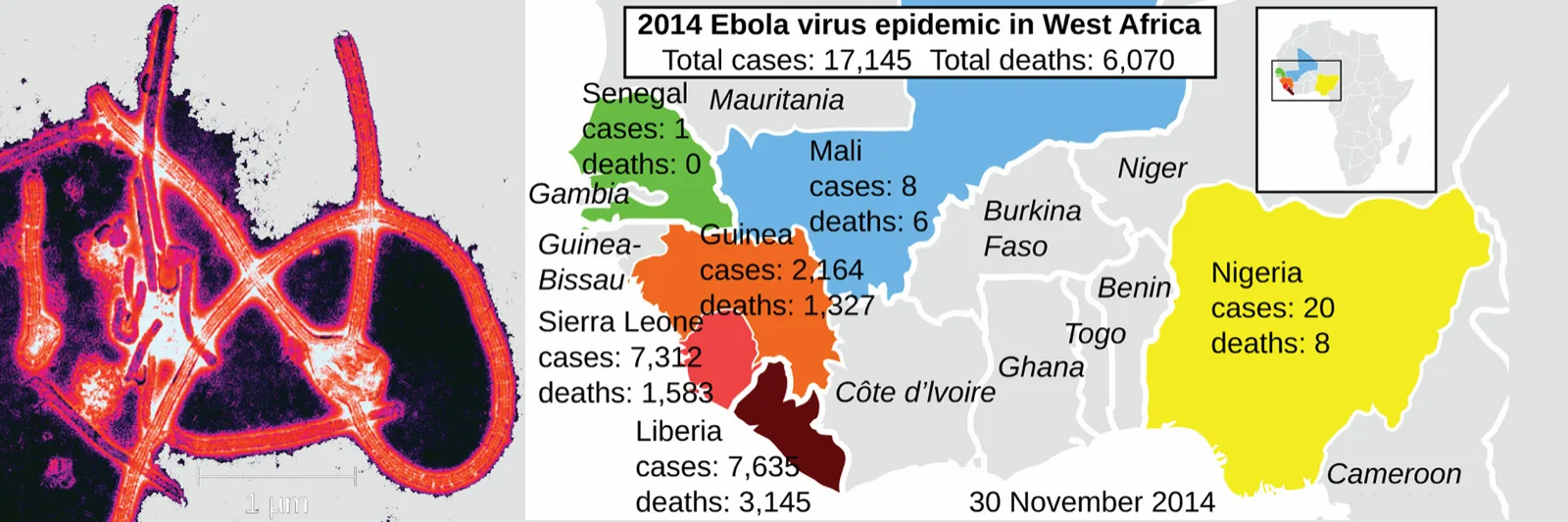
Public health measures in the developed world have dramatically reduced mortality from viral epidemics. But when epidemics do occur, they can spread quickly with global air travel. In 2009, an outbreak of H1N1 influenza spread across various continents. In early 2014, cases of Ebola in Guinea led to a massive epidemic in western Africa. This included the case of an infected man who traveled to the United States, sparking fears the epidemic might spread beyond Africa.
Until the late 1930s and the advent of the electron microscope, no one had seen a virus. Yet treatments for preventing or curing viral infections were used and developed long before that. Historical records suggest that by the 17th century, and perhaps earlier, inoculation (also known as variolation) was being used to prevent the viral disease smallpox in various parts of the world. By the late 18th century, Englishman Edward Jenner was inoculating patients with cowpox to prevent smallpox, a technique he coined vaccination (S. Riedel, “Edward Jenner and the History of Smallpox and Vaccination,” Baylor University Medical Center Proceedings 18, no. 1 [January 2005]: 21–25).
Today, the structure and genetics of viruses are well defined, yet new discoveries continue to reveal their complexities. In this chapter, we will learn about the structure, classification, and cultivation of viruses, and how they impact their hosts. In addition, we will learn about other infective particles such as viroids and prions.
Sections
- Viruses — the discovery, hosts, structure, and classification of viruses, and the shapes of virions.
- The Viral Life Cycle — the lytic and lysogenic cycles of bacteriophages, transduction, the life cycles of animal and plant viruses, and persistent infections.
- Isolation, Culture, and Identification of Viruses — filtration, in vivo and in vitro cultivation, and the serological and molecular methods used to detect viruses.
- Viroids, Virusoids, and Prions — the acellular infectious agents that are not viruses and the diseases they cause.
This chapter is adapted from Microbiology, Chapter 6: Acellular Pathogens by Nina Parker, Mark Schneegurt, Anh-Hue Thi Tu, Philip Lister, Brian M. Forster, and OpenStax, © OpenStax, licensed under CC BY-NC-SA 4.0. Access the original for free at openstax.org. Each section page records its own changes from the source. Changes: the chapter-opening micrograph-and-map figure is the source’s, re-encoded for the web, with its alt text rewritten to describe the two visible panels without repeating the source alt’s per-country figures, several of which do not match the map; the source footnote is rendered as an inline parenthetical citation.