Microbial Biochemistry
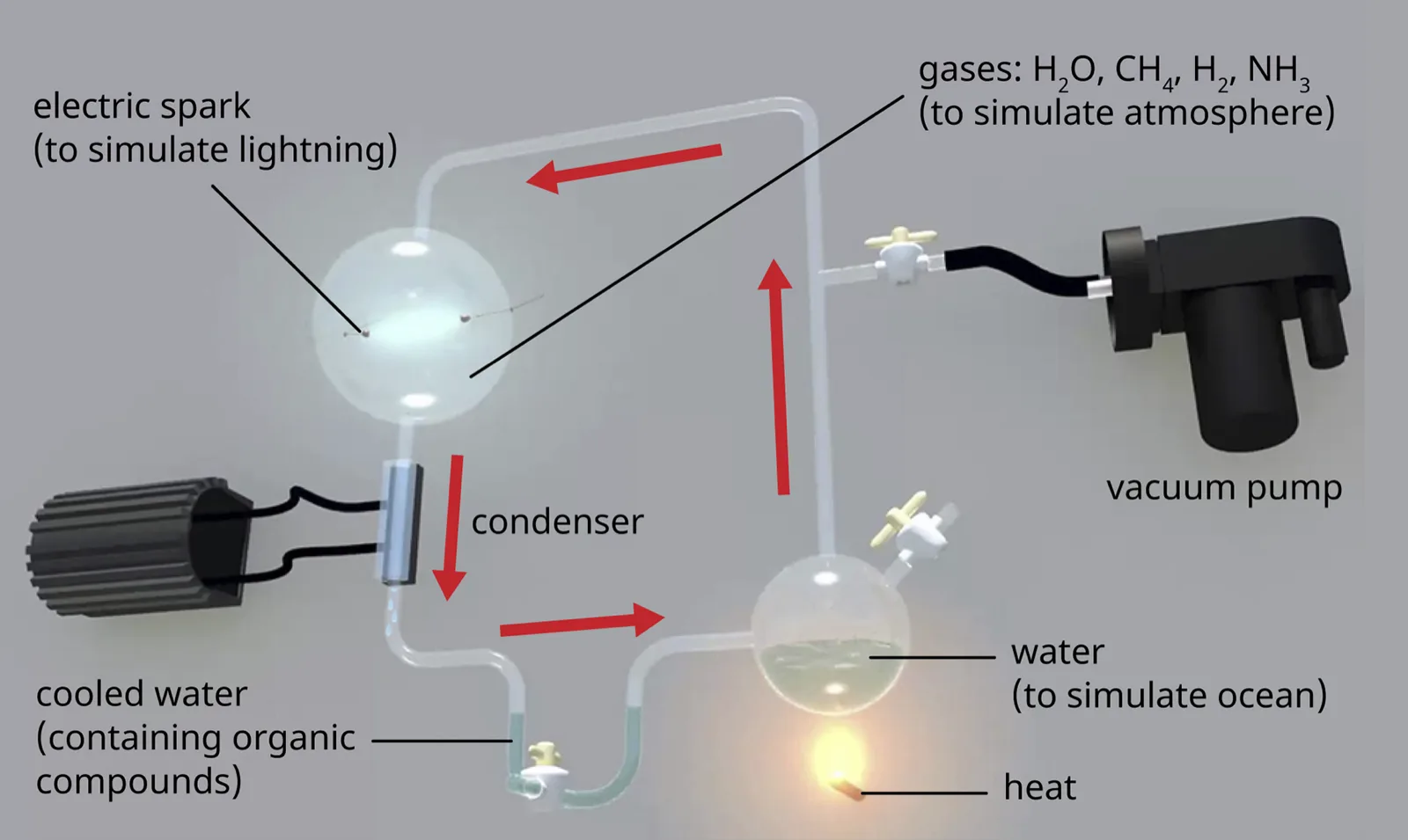
The earth is estimated to be 4.6 billion years old, but for the first 2 billion years, the atmosphere lacked oxygen, without which the earth could not support life as we know it. One hypothesis about how life emerged on earth involves the concept of a “primordial soup.” This idea proposes that life began in a body of water when metals and gases from the atmosphere combined with a source of energy, such as lightning or ultraviolet light, to form the carbon compounds that are the chemical building blocks of life. In 1952, Stanley Miller (1930–2007), a graduate student at the University of Chicago, and his professor Harold Urey (1893–1981), set out to confirm this hypothesis in a now-famous experiment. Miller and Urey combined what they believed to be the major components of the earth’s early atmosphere—water (H₂O), methane (CH₄), hydrogen (H₂), and ammonia (NH₃)—and sealed them in a sterile flask. Next, they heated the flask to produce water vapor and passed electric sparks through the mixture to mimic lightning in the atmosphere, as the diagram above shows. When they analyzed the contents of the flask a week later, they found amino acids, the structural units of proteins—molecules essential to the function of all organisms.
Sections
- Organic Molecules — the elements and bonding of carbon chemistry, functional groups, isomers and enantiomers, and the macromolecules built by dehydration synthesis.
- Carbohydrates — monosaccharides and their ring forms, disaccharides and the glycosidic bond, and the structural and storage polysaccharides.
- Lipids — fatty acids and triglycerides, phospholipids and the self-assembled structures they form, isoprenoids, steroids, and sterols.
- Proteins — amino acids and the peptide bond, the four levels of protein structure, denaturation, and the conjugated proteins.
- Using Biochemistry to Identify Microorganisms — MALDI-TOF mass spectrometry, fatty-acid and phospholipid-derived fatty-acid profiling, proteomic analysis, and glycoprotein serology.
This chapter is adapted from Microbiology, Chapter 7: Microbial Biochemistry by Nina Parker, Mark Schneegurt, Anh-Hue Thi Tu, Philip Lister, Brian M. Forster, and OpenStax, © OpenStax, licensed under CC BY-NC-SA 4.0. Access the original for free at openstax.org. Each section page records its own changes from the source. Changes: the chapter-opening Miller-Urey apparatus figure is the source’s, re-encoded for the web, with its alt text rewritten to walk the labelled apparatus in the order the arrows show; the source’s figure cross-reference is replaced by a describing phrase; chemical formulas are set in Unicode subscripts.