Organic Molecules
By the end of this section, you will be able to:
- Identify common elements and structures found in organic molecules
- Explain the concept of isomerism
- Identify examples of functional groups
- Describe the role of functional groups in synthesizing polymers
Clinical Focus. Part 1
Penny is a 16-year-old student who visited her doctor, complaining about an itchy skin rash. She had a history of allergic episodes. The doctor looked at her sun-tanned skin and asked her if she switched to a different sunscreen. She said she had, so the doctor diagnosed an allergic eczema. The symptoms were mild so the doctor told Penny to avoid using the sunscreen that caused the reaction and prescribed an over-the-counter moisturizing cream to keep her skin hydrated and to help with itching.
- What kinds of substances would you expect to find in a moisturizing cream?
- What physical or chemical properties of these substances would help alleviate itching and inflammation of the skin?
The case continues in Lipids.
Biochemistry is the discipline that studies the chemistry of life, and its objective is to explain form and function based on chemical principles. Organic chemistry is the discipline devoted to the study of carbon-based chemistry, which is the foundation for the study of biomolecules and the discipline of biochemistry. Both biochemistry and organic chemistry are based on the concepts of general chemistry, some of which are presented in Appendix A.
Elements in Living Cells
The most abundant element in cells is hydrogen (H), followed by carbon (C), oxygen (O), nitrogen (N), phosphorous (P), and sulfur (S). We call these elements macronutrients, and they account for about 99% of the dry weight of cells. Some elements, such as sodium (Na), potassium (K), magnesium (Mg), zinc (Zn), iron (Fe), calcium (Ca), molybdenum (Mo), copper (Cu), cobalt (Co), manganese (Mn), or vanadium (V), are required by some cells in very small amounts and are called micronutrients or trace elements. All of these elements are essential to the function of many biochemical reactions, and, therefore, are essential to life.
The four most abundant elements in living matter (C, N, O, and H) have low atomic numbers and are thus light elements capable of forming strong bonds with other atoms to produce molecules (shown below). Carbon forms four chemical bonds, whereas nitrogen forms three, oxygen forms two, and hydrogen forms one. When bonded together within molecules, oxygen, sulfur, and nitrogen often have one or more “lone pairs” of electrons that play important roles in determining many of the molecules’ physical and chemical properties (see Appendix A). These traits in combination permit the formation of a vast number of diverse molecular species necessary to form the structures and enable the functions of living organisms.
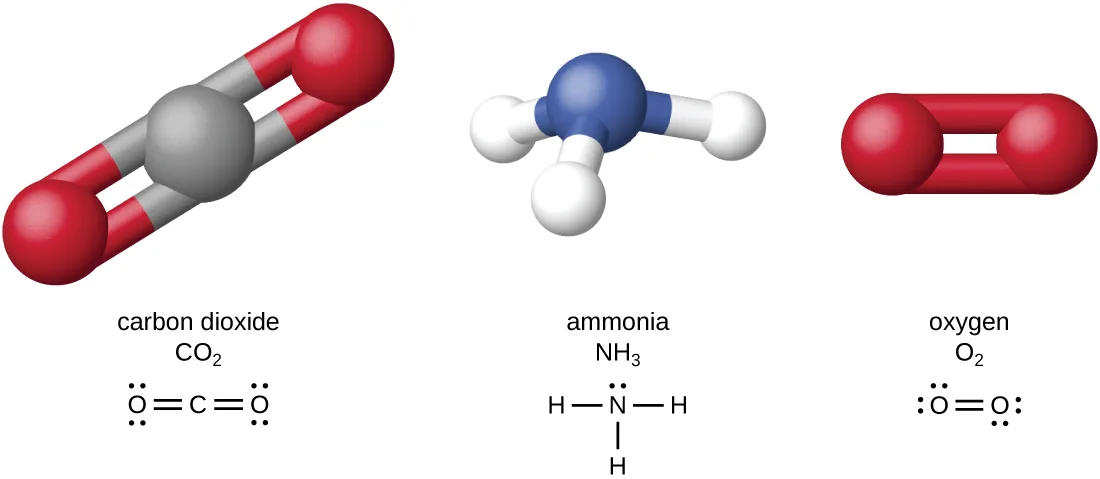
Living organisms contain inorganic compounds (mainly water and salts; see Appendix A) and organic molecules. Organic molecules contain carbon; inorganic compounds do not. Carbon oxides and carbonates are exceptions; they contain carbon but are considered inorganic because they do not contain hydrogen. The atoms of an organic molecule are typically organized around chains of carbon atoms.
Inorganic compounds make up 1%–1.5% of the dry weight of living cells. They are small, simple compounds that play important roles in the cell, although they do not form cell structures. Most of the carbon found in organic molecules originates from inorganic carbon sources such as carbon dioxide captured via carbon fixation by microorganisms.
Check Your Understanding
Describe the most abundant elements in nature.
Show model answer
Did your answer mention:
What are the differences between organic and inorganic molecules?
Show model answer
Did your answer mention:
Organic Molecules and Isomerism
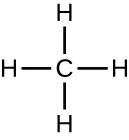
Organic molecules in organisms are generally larger and more complex than inorganic molecules. Their carbon skeletons are held together by covalent bonds. They form the cells of an organism and perform the chemical reactions that facilitate life. All of these molecules, called biomolecules because they are part of living matter, contain carbon, which is the building block of life. Carbon is a very unique element in that it has four valence electrons in its outer orbitals and can form four single covalent bonds with up to four other atoms at the same time (see Appendix A). These atoms are usually oxygen, hydrogen, nitrogen, sulfur, phosphorous, and carbon itself; the simplest organic compound is methane, in which carbon binds only to hydrogen (shown below).
As a result of carbon’s unique combination of size and bonding properties, carbon atoms can bind together in large numbers, thus producing a chain or carbon skeleton. The carbon skeleton of organic molecules can be straight, branched, or ring shaped (cyclic). Organic molecules are built on chains of carbon atoms of varying lengths; most are typically very long, which allows for a huge number and variety of compounds. No other element has the ability to form so many different molecules of so many different sizes and shapes.
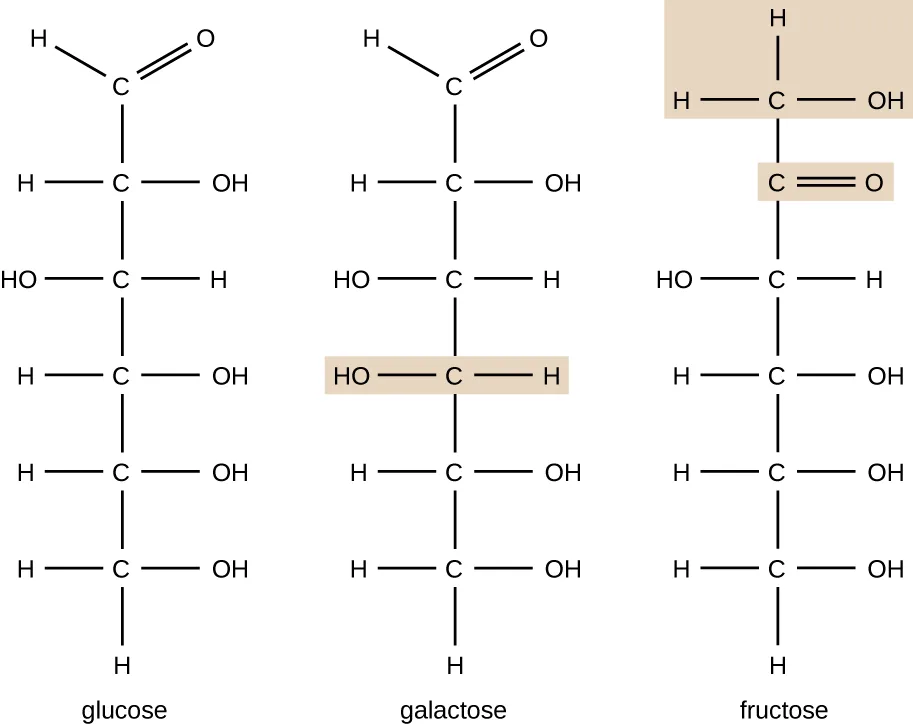
Molecules with the same atomic makeup but different structural arrangement of atoms are called isomers. The concept of isomerism is very important in chemistry because the structure of a molecule is always directly related to its function. Slight changes in the structural arrangements of atoms in a molecule may lead to very different properties. Chemists represent molecules by their structural formula, which is a graphic representation of the molecular structure, showing how the atoms are arranged. Compounds that have identical molecular formulas but differ in the bonding sequence of the atoms are called structural isomers. The monosaccharides glucose, galactose, and fructose all have the same molecular formula, C₆H₁₂O₆, but we can see from the structural formulas below that the atoms are bonded together differently.
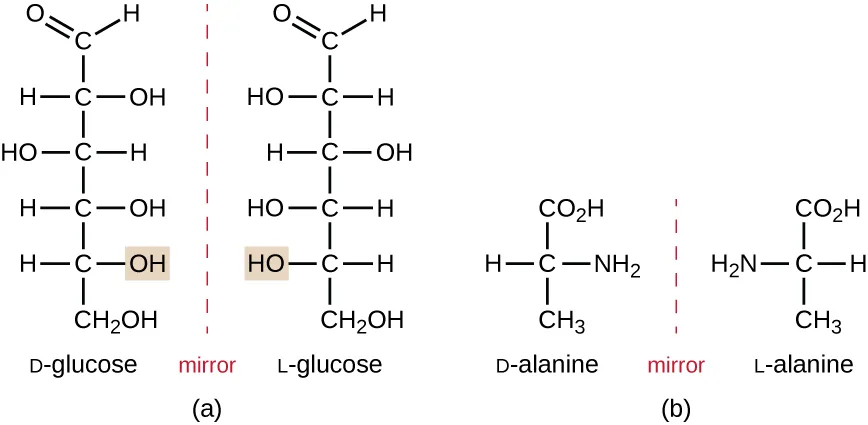
Isomers that differ in the spatial arrangements of atoms are called stereoisomers; one unique type is enantiomers. The properties of enantiomers were originally discovered by Louis Pasteur in 1848 while using a microscope to analyze crystallized fermentation products of wine. Enantiomers are molecules that have the characteristic of chirality, in which their structures are nonsuperimposable mirror images of each other. Chirality is an important characteristic in many biologically important molecules, as illustrated by the examples of structural differences in the enantiomeric forms of the monosaccharide glucose or the amino acid alanine (shown below).
Many organisms are only able to use one enantiomeric form of certain types of molecules as nutrients and as building blocks to make structures within a cell. Some enantiomeric forms of amino acids have distinctly different tastes and smells when consumed as food. For example, L-aspartame, commonly called aspartame, tastes sweet, whereas D-aspartame is tasteless. Drug enantiomers can have very different pharmacologic affects. For example, the compound methorphan exists as two enantiomers, one of which acts as an antitussive (dextromethorphan, a cough suppressant), whereas the other acts as an analgesic (levomethorphan, a drug similar in effect to codeine).
Enantiomers are also called optical isomers because they can rotate the plane of polarized light. Some of the crystals Pasteur observed from wine fermentation rotated light clockwise whereas others rotated the light counterclockwise. Today, we denote enantiomers that rotate polarized light clockwise (+) as d forms, and the mirror image of the same molecule that rotates polarized light counterclockwise (−) as the l form. The d and l labels are derived from the Latin words dexter (on the right) and laevus (on the left), respectively. These two different optical isomers often have very different biological properties and activities. Certain species of molds, yeast, and bacteria, such as Rhizopus, Yarrowia, and Lactobacillus spp., respectively, can only metabolize one type of optical isomer; the opposite isomer is not suitable as a source of nutrients. Another important reason to be aware of optical isomers is the therapeutic use of these types of chemicals for drug treatment, because some microorganisms can only be affected by one specific optical isomer.
Check Your Understanding
We say that life is carbon based. What makes carbon so suitable to be part of all the macromolecules of living organisms?
Show model answer
Did your answer mention:
Biologically Significant Functional Groups
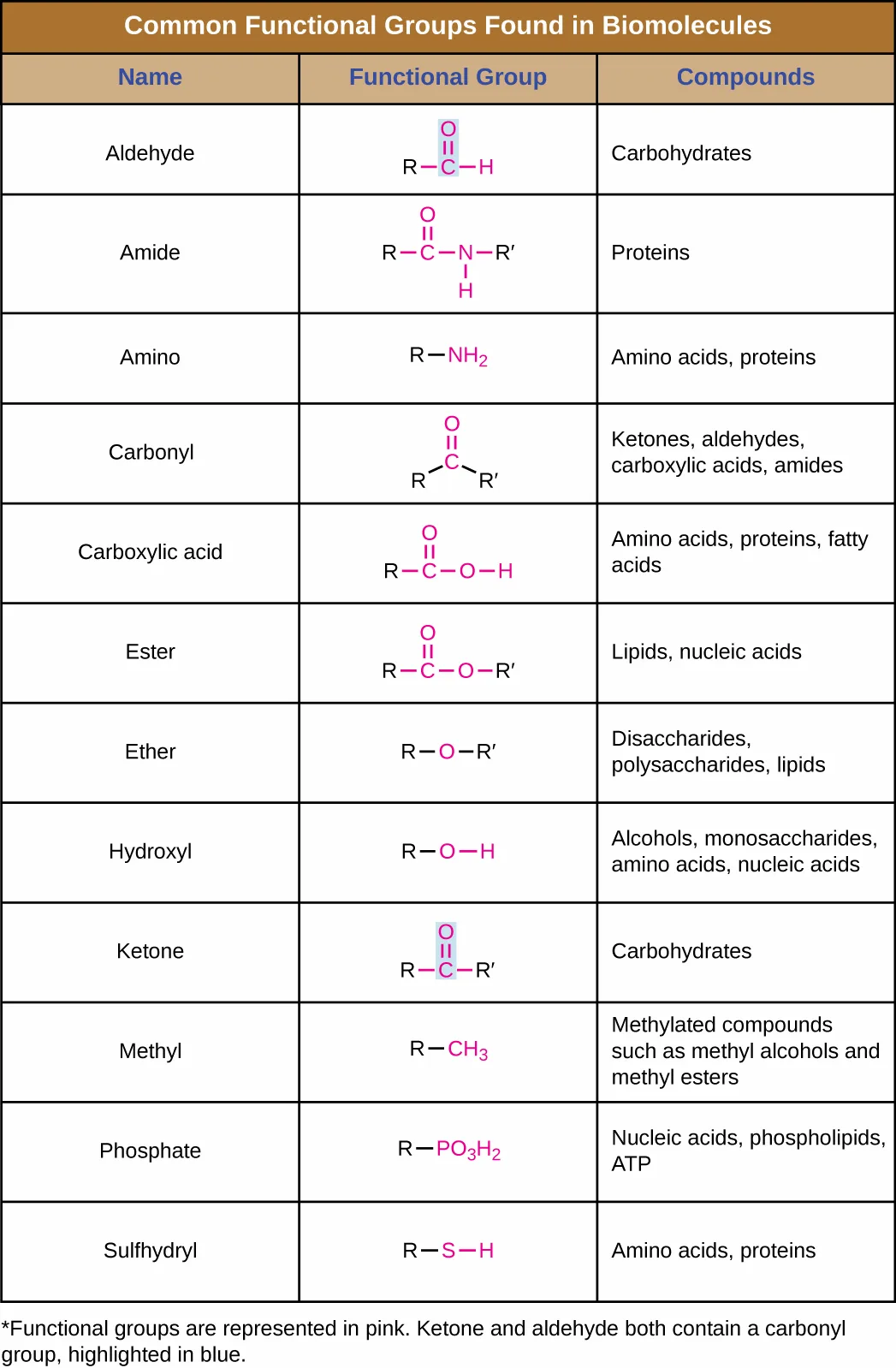
In addition to containing carbon atoms, biomolecules also contain functional groups—groups of atoms within molecules that are categorized by their specific chemical composition and the chemical reactions they perform, regardless of the molecule in which the group is found. Some of the most common functional groups are listed below. In the formulas, the symbol R stands for “residue” and represents the remainder of the molecule. R might symbolize just a single hydrogen atom or it may represent a group of many atoms. Notice that some functional groups are relatively simple, consisting of just one or two atoms, while some comprise two of these simpler functional groups. For example, a carbonyl group is a functional group composed of a carbon atom double bonded to an oxygen atom: C=O. It is present in several classes of organic compounds as part of larger functional groups such as ketones, aldehydes, carboxylic acids, and amides. In ketones, the carbonyl is present as an internal group, whereas in aldehydes it is a terminal group.
| Name | Functional Group | Compounds |
|---|---|---|
| Aldehyde | R—C(=O)—H | Carbohydrates |
| Amide | R—C(=O)—N(H)—R′ | Proteins |
| Amino | R—NH₂ | Amino acids, proteins |
| Carbonyl | R—C(=O)—R′ | Ketones, aldehydes, carboxylic acids, amides |
| Carboxylic acid | R—C(=O)—O—H | Amino acids, proteins, fatty acids |
| Ester | R—C(=O)—O—R′ | Lipids, nucleic acids |
| Ether | R—O—R′ | Disaccharides, polysaccharides, lipids |
| Hydroxyl | R—O—H | Alcohols, monosaccharides, amino acids, nucleic acids |
| Ketone | R—C(=O)—R′ | Carbohydrates |
| Methyl | R—CH₃ | Methylated compounds such as methyl alcohols and methyl esters |
| Phosphate | R—PO₃H₂ | Nucleic acids, phospholipids, ATP |
| Sulfhydryl | R—S—H | Amino acids, proteins |
Macromolecules
Carbon chains form the skeletons of most organic molecules. Functional groups combine with the chain to form biomolecules. Because these biomolecules are typically large, we call them macromolecules. Many biologically relevant macromolecules are formed by linking together a great number of identical, or very similar, smaller organic molecules. The smaller molecules act as building blocks and are called monomers, and the macromolecules that result from their linkage are called polymers. Cells and cell structures include four main groups of carbon-containing macromolecules: polysaccharides, proteins, lipids, and nucleic acids. The first three groups of molecules will be studied throughout this chapter. The biochemistry of nucleic acids will be discussed in Biochemistry of the Genome.
Of the many possible ways that monomers may be combined to yield polymers, one common approach encountered in the formation of biological macromolecules is dehydration synthesis. In this chemical reaction, monomer molecules bind end to end in a process that results in the formation of water molecules as a byproduct:
H—monomer—OH + H—monomer—OH ⟶ H—monomer—monomer—OH + H₂O
The figure below shows dehydration synthesis of glucose binding together to form maltose and a water molecule. The table below summarizes macromolecules and some of their functions.

| Macromolecule | Functions |
|---|---|
| Carbohydrates | Energy storage, receptors, food, structural role in plants, fungal cell walls, exoskeletons of insects |
| Lipids | Energy storage, membrane structure, insulation, hormones, pigments |
| Nucleic acids | Storage and transfer of genetic information |
| Proteins | Enzymes, structure, receptors, transport, structural role in the cytoskeleton of a cell and the extracellular matrix |
Check Your Understanding
Dehydration synthesis links monomers together and, as a byproduct, forms molecules of ________.
The paragraph introducing dehydration synthesis names exactly one small molecule released alongside the new monomer-to-monomer bond.Summary
- The most abundant elements in cells are hydrogen, carbon, oxygen, nitrogen, phosphorus, and sulfur.
- Life is carbon based. Each carbon atom can bind to another one producing a carbon skeleton that can be straight, branched, or ring shaped.
- The same numbers and types of atoms may bond together in different ways to yield different molecules called isomers. Isomers may differ in the bonding sequence of their atoms (structural isomers) or in the spatial arrangement of atoms whose bonding sequences are the same (stereoisomers), and their physical and chemical properties may vary slightly or drastically.
- Functional groups confer specific chemical properties to molecules bearing them. Common functional groups in biomolecules are hydroxyl, methyl, carbonyl, carboxyl, amino, phosphate, and sulfhydryl.
- Macromolecules are polymers assembled from individual units, the monomers, which bind together like building blocks. Many biologically significant macromolecules are formed by dehydration synthesis, a process in which monomers bind together by combining their functional groups and generating water molecules as byproducts.
Key terms
- macronutrients — element required in abundance in cells; account for approximately 99% of the cell’s dry weight.
- micronutrients — indispensable element present in cells in lower amounts than macronutrients; also called trace element.
- trace elements — indispensable element present in cells in lower amounts than macronutrients; also called micronutrient.
- organic molecule — composed primarily of carbon; typically contains at least one carbon atom bound to one or more hydrogen atoms.
- biomolecules — a molecule that is part of living matter.
- carbon skeleton — chain of carbon atoms to which one or more functional groups are bound.
- isomers — molecules that have the same atomic makeup but differ in the structural arrangement of the atoms.
- structural formula — graphic representation of the molecular structure showing how the atoms are arranged.
- structural isomers — molecules composed of the same numbers and types of atoms but with different bonding sequences.
- stereoisomers — isomers that differ in the spatial arrangements of atoms.
- enantiomers — stereoisomers that are mirror images of each other and nonsuperimposable.
- chirality — property of stereoisomer molecules by which their structures are nonsuperimposable mirror-images.
- functional groups — specific groups of atoms that may occur within a molecule, conferring specific chemical properties.
- macromolecules — polymer assembled from individual units, monomers, that bind together like building blocks.
- monomers — small organic molecule that binds with like molecules, forming a polymer or macromolecule.
- polymers — macromolecule composed of individual units, monomers, that bind together like building blocks.
- dehydration synthesis — chemical reaction in which monomer molecules bind end to end in a process that results in the formation of water molecules as a byproduct.
Practice
Identify common elements and structures found in organic molecules
Which of these elements is not a micronutrient?
Compare each symbol against the six macronutrients and the list of micronutrient examples.Why are carbon, nitrogen, oxygen, and hydrogen the most abundant elements in living matter and, therefore, considered macronutrients?
Look for the sentence that gives a shared atomic property of these four elements, not a fact about only one of them.Each carbon atom can bind to another one, producing a ________ that can be straight, branched, or ring shaped.
This is the section’s own term for a chain of bonded carbon atoms.A molecule that is part of living matter and contains carbon is called a ________.
This is the general term the section gives to any carbon-containing molecule found in living matter, distinct from an inorganic compound.Explain the concept of isomerism
Which of the following is the name for molecules whose structures are nonsuperimposable mirror images?
This type of stereoisomer is the one Pasteur first observed rotating polarized light in opposite directions.Two molecules containing the same types and numbers of atoms but different bonding sequences are called enantiomers.
Compare this statement against the section’s separate definitions of the isomer type built on bonding sequence and the isomer type built on mirror-image spatial arrangement.Isomers that differ in the bonding sequence of their atoms, though their molecular formulas are identical, are called ________.
This is the isomer type the glucose, galactose, and fructose example illustrates.The property by which enantiomers’ structures are nonsuperimposable mirror images of each other is called ________.
This property, not the molecules themselves, is what the section names right after introducing enantiomers.Identify examples of functional groups
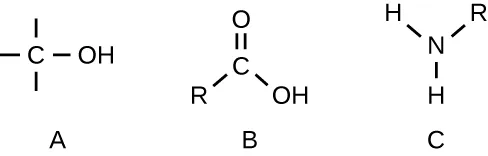
Identify the functional group depicted in structural formula A.
Match the atoms bonded to the carbon in formula A against the table’s one-oxygen, one-hydrogen entry.Identify the functional group depicted in structural formula B.
Formula B’s carbon carries both a double-bonded oxygen and a hydroxyl group; match that combination in the table.Identify the functional group depicted in structural formula C.
Formula C’s nitrogen is bonded only to an R group and two hydrogens; match that against the table’s nitrogen-only entry.Aldehydes, amides, carboxylic acids, esters, and ketones all contain carbonyl groups.
Check each of the five named compound classes against the table’s own carbonyl-containing formulas.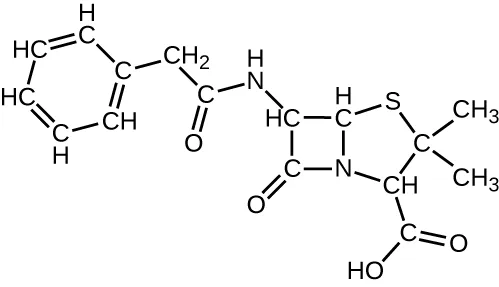
(a) Identify three major functional groups in this molecule that each comprise two simpler functional groups. (b) Name the two simpler functional groups composing each of the major functional groups identified in (a).
Show model answer
Did your answer mention:
Describe the role of functional groups in synthesizing polymers
Sort each function of macromolecules under the class of macromolecule the section’s table assigns it to.
Carbohydrates
Lipids
Nucleic acids
Proteins
The smaller molecules that act as building blocks and link together to form a macromolecule are called ________.
This general term for the individual linked units is named in the same sentence that introduces the term polymer.A biomolecule formed by linking together a great number of identical, or very similar, smaller organic molecules is called a ________.
This is the general term this subsection gives to a large biomolecule built from many linked building blocks.This section is adapted from Microbiology, Section 7.1: Organic Molecules by Nina Parker, Mark Schneegurt, Anh-Hue Thi Tu, Philip Lister, Brian M. Forster, and OpenStax, © OpenStax, licensed under CC BY-NC-SA 4.0. Access the original for free at openstax.org. Changes: all eight figures (the six in the body plus the two exercise figures) are re-encoded as WebP and rendered as mediafigures with explicit kind="diagram" (the manifest’s JPEG-based guess of “photo” is wrong for every one of this section’s drawn structural formulas and the ball-and-stick common-molecules figure), and their alts are rewritten from the source’s incomplete or malformed originals, described at the atom level so no alt names the functional-group answer of a paired item (the commonMol alt repeated its own text twice verbatim, an upstream defect reported for the errata file); the Clinical Focus box is rendered as a callout, its “Jump to the next Clinical Focus box” link replaced by a Markdown link naming the section the case continues in; the functional-group table (a rendered image upstream) is transcribed as a Markdown table from the image, checked against the PDF page, with the vendored image kept immediately after it because a checker cannot verify a transcribed chemical formula without the source figure beside it; the table’s own footnote (“Functional groups are represented in pink…”) is folded into the kept figure’s caption since the Markdown table cannot show color; the dehydration-synthesis equation is rendered as a plain-text line with the Unicode arrow; the CALS table of macromolecule functions is transcribed from its cells (its summary attribute misspells “storage” as “torage,” a source defect that is not copied) and given one sort-bins activity under the objective it serves; all four <link document="m58946"> targets are Appendix A, named four times in plain text because that appendix is not authored; <link document="m58834"> (Biochemistry of the Genome, the chapter 10 introduction) is likewise plain text; same-module figure and table cross-references are rendered as describing prose; Check Your Understanding questions are rendered as body items, one of four graded from this module’s own sentence (the dehydration-synthesis byproduct) and three left as self-checks because their honest answers assemble several of the module’s own sentences; of the source’s two unkeyed Short Answer questions, one (“why are C, N, O, and H the most abundant elements…”) is graded as a multiple choice from this module’s own atomic-number sentence, and the other (the three-formula functional-group identification, OSC_Microbio_07_01_matching_img) becomes three multiple-choice items, one per lettered formula, keyed from the image and the functional-group table; the unkeyed Critical Thinking question (the penicillin G figure, OSC_Microbio_07_01_fungroup_img) stays a self-check because the module’s text and table can fix only the shared carbonyl component of its three functional groups, not the nitrogen-bearing side of its two amide bonds, and the model answer says so and stops; the two source Multiple Choice and two True/False items are adapted into Practice unchanged; key terms are compiled from the module’s 17 defined terms and the book’s Glossary appendix, with the glossary’s own “assembled from of individual units” corrected to “assembled from individual units” for the macromolecule definition (a one-word source defect, reported for the errata file) and no definitions needed a sentence-derived fallback; six cloze textin items (carbon skeleton, biomolecule, structural isomers, and chirality from body or summary sentences; monomers and macromolecule from the Macromolecules subsection) and one table-based sortbins fill out the objective-1, objective-2, and (entirely) objective-4 Practice groups, none of which the source’s own exercise set reaches; no source exercise was omitted.