Carbohydrates
By the end of this section, you will be able to:
- Give examples of monosaccharides and polysaccharides
- Describe the function of monosaccharides and polysaccharides within a cell
The most abundant biomolecules on earth are carbohydrates. From a chemical viewpoint, carbohydrates are primarily a combination of carbon and water, and many of them have the empirical formula (CH₂O)ₙ, where n is the number of repeated units. This view represents these molecules simply as “hydrated” carbon atom chains in which water molecules attach to each carbon atom, leading to the term “carbohydrates.” Although all carbohydrates contain carbon, hydrogen, and oxygen, there are some that also contain nitrogen, phosphorus, and/or sulfur. Carbohydrates have myriad different functions. They are abundant in terrestrial ecosystems, many forms of which we use as food sources. These molecules are also vital parts of macromolecular structures that store and transmit genetic information (i.e., DNA and RNA). They are the basis of biological polymers that impart strength to various structural components of organisms (e.g., cellulose and chitin), and they are the primary source of energy storage in the form of starch and glycogen.
Monosaccharides: The Sweet Ones
In biochemistry, carbohydrates are often called saccharides, from the Greek sakcharon, meaning sugar, although not all the saccharides are sweet. The simplest carbohydrates are called monosaccharides, or simple sugars. They are the building blocks (monomers) for the synthesis of polymers or complex carbohydrates, as will be discussed further in this section. Monosaccharides are classified based on the number of carbons in the molecule. General categories are identified using a prefix that indicates the number of carbons and the suffix –ose, which indicates a saccharide; for example, triose (three carbons), tetrose (four carbons), pentose (five carbons), and hexose (six carbons) (shown below). The hexose D-glucose is the most abundant monosaccharide in nature. Other very common and abundant hexose monosaccharides are galactose, used to make the disaccharide milk sugar lactose, and the fruit sugar fructose.
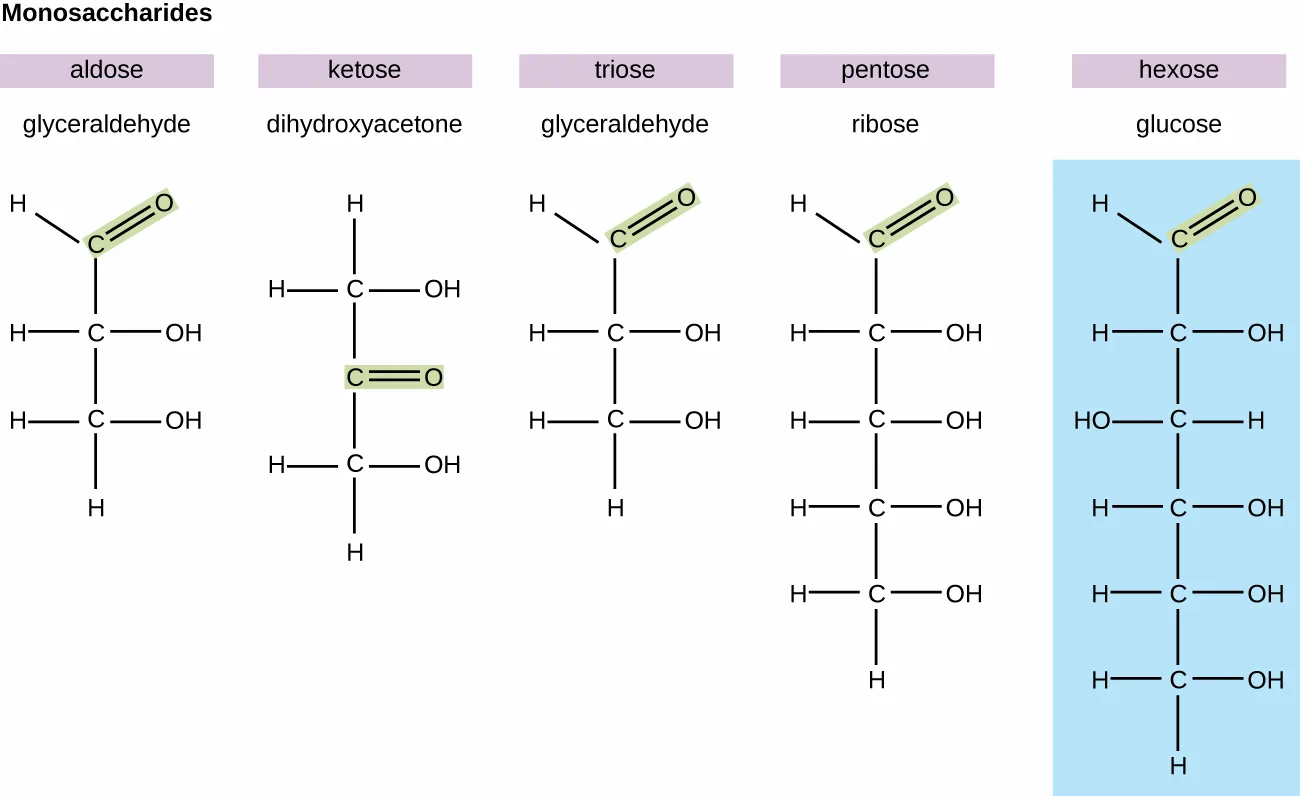
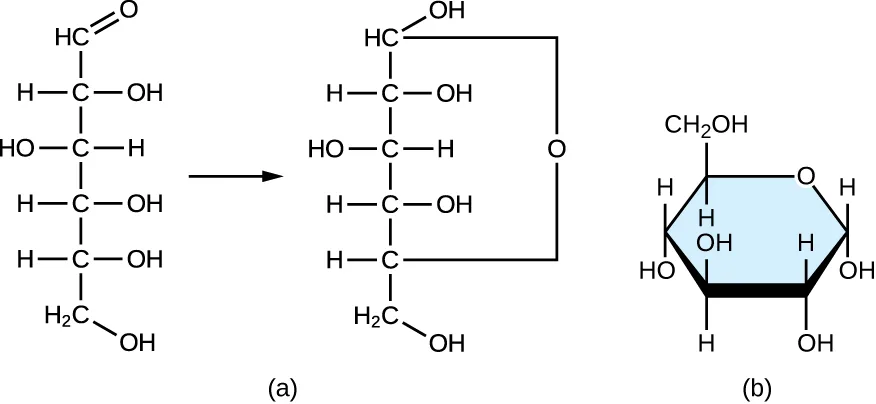
Monosaccharides of four or more carbon atoms are typically more stable when they adopt cyclic, or ring, structures. These ring structures result from a chemical reaction between functional groups on opposite ends of the sugar’s flexible carbon chain, namely the carbonyl group and a relatively distant hydroxyl group. Glucose, for example, forms a six-membered ring (shown below).
Check Your Understanding
Why do monosaccharides form ring structures?
Look at the sentence introducing ring structures, just before the example of glucose forming a six-membered ring.Disaccharides
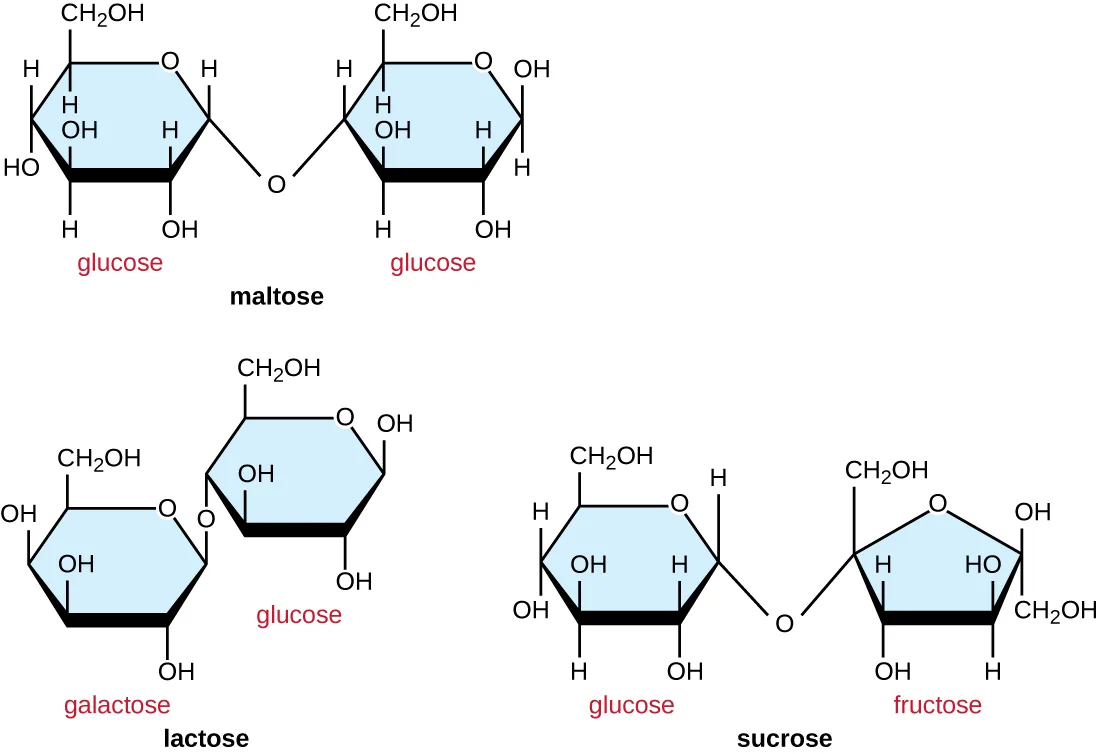
Two monosaccharide molecules may chemically bond to form a disaccharide. The name given to the covalent bond between the two monosaccharides is a glycosidic bond. Glycosidic bonds form between hydroxyl groups of the two saccharide molecules, an example of the dehydration synthesis described in the previous section of this chapter:
monosaccharide—OH + HO—monosaccharide ⟶ monosaccharide—O—monosaccharide (a disaccharide)
Common disaccharides are the grain sugar maltose, made of two glucose molecules; the milk sugar lactose, made of a galactose and a glucose molecule; and the table sugar sucrose, made of a glucose and a fructose molecule (shown below).
Polysaccharides
Polysaccharides, also called glycans, are large polymers composed of hundreds of monosaccharide monomers. Unlike mono- and disaccharides, polysaccharides are not sweet and, in general, they are not soluble in water. Like disaccharides, the monomeric units of polysaccharides are linked together by glycosidic bonds.
Polysaccharides are very diverse in their structure. Three of the most biologically important polysaccharides—starch, glycogen, and cellulose—are all composed of repetitive glucose units, although they differ in their structure (shown below). Cellulose consists of a linear chain of glucose molecules and is a common structural component of cell walls in plants and other organisms. Glycogen and starch are branched polymers; glycogen is the primary energy-storage molecule in animals and bacteria, whereas plants primarily store energy in starch. The orientation of the glycosidic linkages in these three polymers is different as well and, as a consequence, linear and branched macromolecules have different properties.
Modified glucose molecules can be fundamental components of other structural polysaccharides. Examples of these types of structural polysaccharides are N-acetyl glucosamine (NAG) and N-acetyl muramic acid (NAM) found in bacterial cell wall peptidoglycan. Polymers of NAG form chitin, which is found in fungal cell walls and in the exoskeleton of insects.
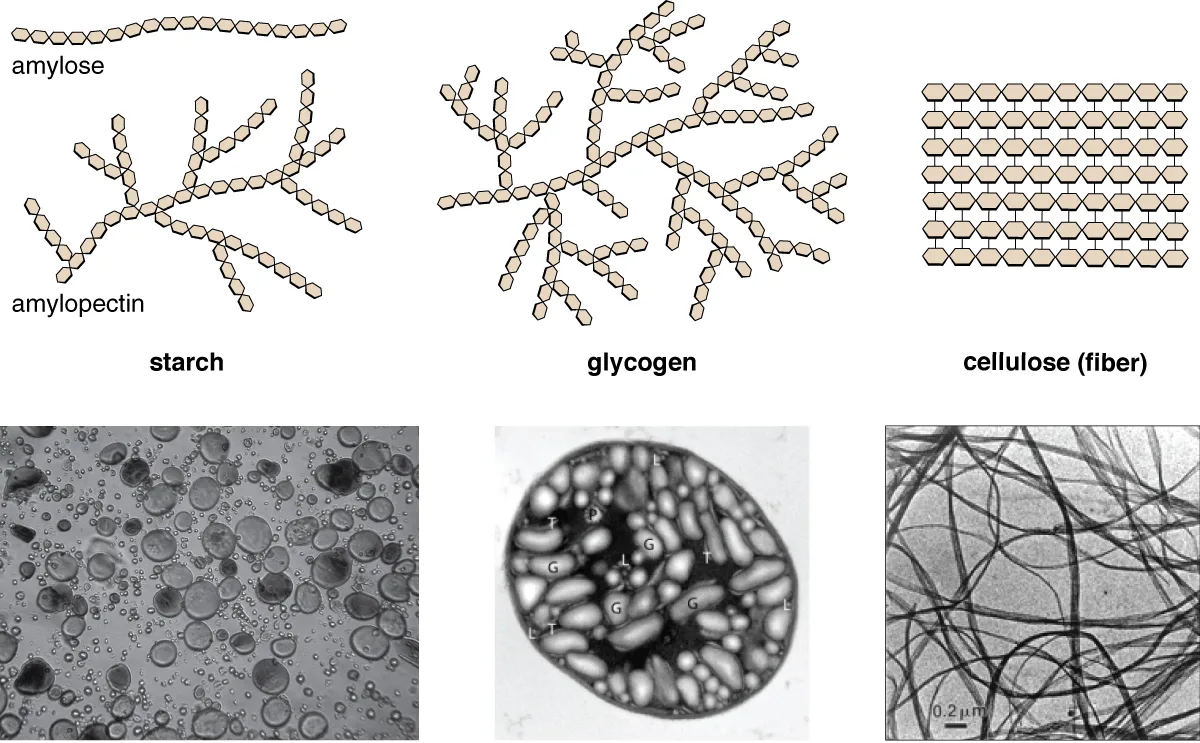
Extended description
Top row, left to right: amylose, a single unbranched chain of linked glucose hexagons, and amylopectin, a branching chain of the same hexagons, together forming starch; glycogen, an even more densely branched chain of hexagons; and cellulose (fiber), many parallel rows of hexagons cross-linked into a flat, grid-like sheet. Bottom row: a light micrograph of wheat starch granules appearing as round, bubble-like bodies; an electron micrograph of a cyanobacterial cell containing oval glycogen granules; and an electron micrograph of tangled, thread-like bacterial cellulose fibers with a 0.2 µm scale bar.
Check Your Understanding
What are the most biologically important polysaccharides and why are they important?
Show model answer
Did your answer mention:
Summary
- Carbohydrates, the most abundant biomolecules on earth, are widely used by organisms for structural and energy-storage purposes.
- Carbohydrates include individual sugar molecules (monosaccharides) as well as two or more molecules chemically linked by glycosidic bonds. Monosaccharides are classified based on the number of carbons the molecule as trioses (3 C), tetroses (4 C), pentoses (5 C), and hexoses (6 C). They are the building blocks for the synthesis of polymers or complex carbohydrates.
- Disaccharides such as sucrose, lactose, and maltose are molecules composed of two monosaccharides linked together by a glycosidic bond.
- Polysaccharides, or glycans, are polymers composed of hundreds of monosaccharide monomers linked together by glycosidic bonds. The energy-storage polymers starch and glycogen are examples of polysaccharides and are all composed of branched chains of glucose molecules.
- The polysaccharide cellulose is a common structural component of the cell walls of organisms. Other structural polysaccharides, such as N-acetyl glucosamine (NAG) and N-acetyl muramic acid (NAM), incorporate modified glucose molecules and are used in the construction of peptidoglycan or chitin.
Key terms
- carbohydrate — the most abundant type of biomolecule, consisting of carbon, hydrogen, and oxygen.
- saccharide — carbohydrate.
- monosaccharide — monomer for the synthesis of carbohydrate polymers; the simplest carbohydrate, called a simple sugar.
- disaccharide — one of two monosaccharides linked together by a glycosidic bond.
- glycosidic bond — forms between the hydroxyl groups of two sugar molecules.
- polysaccharides — polymer composed of hundreds of monosaccharides linked together by glycosidic bonds; also called glycans.
- starch — energy-storage polysaccharide in plants; composed of two types of glucose polymers: amylose and amylopectin.
- glycogen — highly branched storage polysaccharide in animal cells and bacteria.
- cellulose — a structural polysaccharide composed of glucose monomers linked together in a linear chain by glycosidic bonds.
Practice
Give examples of monosaccharides and polysaccharides
By definition, carbohydrates contain which elements?
Read the sentence naming which elements every carbohydrate always contains, even though a few also carry nitrogen, phosphorus, or sulfur.What are monosaccharides, disaccharides, and polysaccharides?
Show model answer
Did your answer mention:
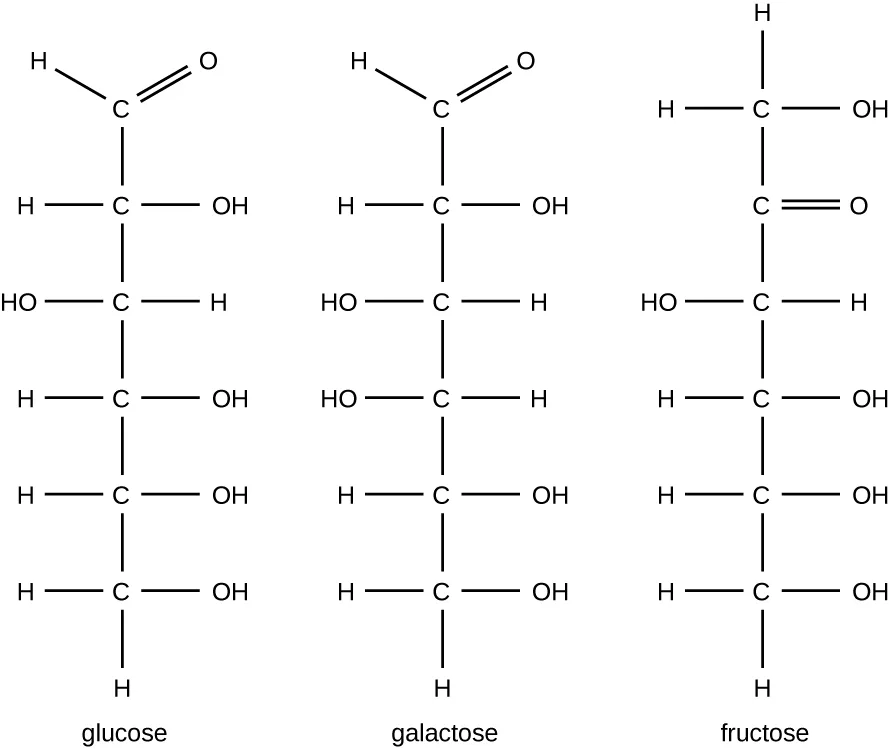
Based on the position of its carbonyl group, is glucose an aldose or a ketose?
An aldose carries its carbonyl group at a terminal carbon; find where glucose’s double-bonded oxygen sits.Based on the position of its carbonyl group, is galactose an aldose or a ketose?
Galactose’s double-bonded oxygen sits at the same carbon as glucose’s.Based on the position of its carbonyl group, is fructose an aldose or a ketose?
A ketose carries its carbonyl group at an internal carbon, not a terminal one.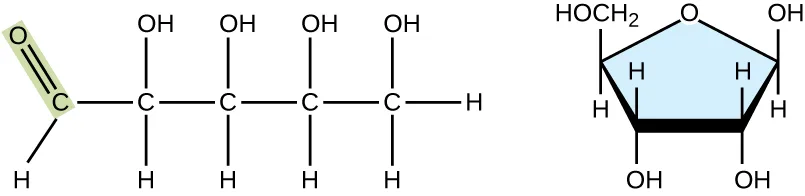
Counting the carbon, hydrogen, and oxygen atoms in the linear structure shown, what is this monosaccharide’s molecular formula?
Count the carbons in the chain, then apply the empirical carbohydrate formula (CH₂O)ₙ.In the linear structure shown, which hydroxyl group reacts with the carbonyl carbon to close the ring drawn beside it?
Compare the linear chain to the ring: the module says the carbonyl group reacts with ‘a relatively distant hydroxyl group,’ and the ring in the picture has five members.Describe the function of monosaccharides and polysaccharides within a cell
Monosaccharides may link together to form polysaccharides by forming which type of bond?
Identify the name given to the covalent bond formed between two monosaccharides.Which polysaccharide is a structural polymer found in cell walls of fungi and exoskeletons of some animals?
This polysaccharide is built from polymers of NAG, described alongside NAM in the Polysaccharides section.Which polysaccharide is an energy-storage polymer found in animal cells and bacteria?
Of the two energy-storage polysaccharides named in this section, one belongs to plants and the other to animals and bacteria.Which polysaccharide is an energy-storage polymer in plants?
Of the two energy-storage polysaccharides named in this section, one belongs to animals and bacteria and the other to plants.Which polysaccharide is a structural polymer found in plants?
This polysaccharide forms a linear chain of glucose molecules in plant cell walls.This section is adapted from Microbiology, Section 7.2: Carbohydrates by Nina Parker, Mark Schneegurt, Anh-Hue Thi Tu, Philip Lister, Brian M. Forster, and OpenStax, © OpenStax, licensed under CC BY-NC-SA 4.0. Access the original for free at openstax.org. Changes: all six source figures re-encoded as WebP and rendered as mediafigures, all given explicit kind="diagram" after image inspection (the manifest guessed “photo” for all six, wrongly, because every source file is a JPEG; the polysaccharide figure is a composite of drawn diagrams above micrographs and is classified diagram because its top row is drawn art); the polysaccharide figure’s source alt was corrected — it read “Amylose is a chain of hexagons. Starch is a branching chain of hexagons,” but the image draws amylose (linear) and amylopectin (branching) as the two glucose polymers that together make up starch, so the alt is rewritten and a longdesc walks all three panels and their micrographs; the disaccharide-bond <equation> is rendered as plain Unicode text with an arrow, its underbrace label “disaccharide” rendered as a trailing parenthetical since plain text cannot draw an underbrace; the “described in the previous section of this chapter” cross-reference is linked to Organic Molecules; four same-module figure cross-references are rendered as “(shown below)”; the two source Multiple Choice items and the one source Matching item (keyed C, D, A, B) are adapted into Practice — the Matching item becomes four multiple-choice items, one per polysaccharide, each offering all four polysaccharides as options in the table’s own order, so the correct option’s position varies row to row on its own; the module’s two Check Your Understanding questions become one body multiple-choice (the ring-stability question, graded from one sentence) and one body self-check (the “most biologically important polysaccharides” question, whose honest answer assembles several sentences); of the section’s three Critical Thinking questions and one Short Answer question, the unkeyed Short Answer (“What are monosaccharides, disaccharides, and polysaccharides?”) stays a self-check whose model answer and rubric are assembled from this module’s own definitions; the aldose/ketose Critical Thinking question’s part (a) is graded as three multiple-choice items (one per sugar), keyed from the position of the carbonyl group visible in the image and from this module’s own monosaccharide figure, which defines aldose and ketose by that same position; its part (b) (“What are such compounds called?”) is omitted because the answer, isomers, is a term this module never uses (it is defined only in Section 7.1); the linear/cyclic Critical Thinking question is graded as two multiple-choice items — the molecular formula from counting the image’s atoms against this module’s own empirical formula (CH₂O)ₙ, and the ring-closing hydroxyl group from the image together with the module’s “a relatively distant hydroxyl group” sentence; the third Critical Thinking question (about the term “dextrose”) is omitted entirely because this module never discusses dextrose or biologically relevant isomers and gives nothing to answer it with; the two Critical-Thinking figures carry author-written captions, since the source prints none, describing only what each image shows; key terms compiled from the module’s nine defined terms and the book’s Glossary appendix, all nine definitions taken directly from the Glossary. No source exercise item is otherwise omitted.