Lipids
By the end of this section, you will be able to:
- Describe the chemical composition of lipids
- Describe the unique characteristics and diverse structures of lipids
- Compare and contrast triacylglycerides (triglycerides) and phospholipids.
- Describe how phospholipids are used to construct biological membranes.
Although they are composed primarily of carbon and hydrogen, lipid molecules may also contain oxygen, nitrogen, sulfur, and phosphorous. Lipids serve numerous and diverse purposes in the structure and functions of organisms. They can be a source of nutrients, a storage form for carbon, energy-storage molecules, or structural components of membranes and hormones. Lipids comprise a broad class of many chemically distinct compounds, the most common of which are discussed in this section.
Fatty Acids and Triacylglycerides
The fatty acids are lipids that contain long-chain hydrocarbons terminated with a carboxylic acid functional group. Because of the long hydrocarbon chain, fatty acids are hydrophobic (“water fearing”) or nonpolar. Fatty acids with hydrocarbon chains that contain only single bonds are called saturated fatty acids because they have the greatest number of hydrogen atoms possible and are, therefore, “saturated” with hydrogen. Fatty acids with hydrocarbon chains containing at least one double bond are called unsaturated fatty acids because they have fewer hydrogen atoms. Saturated fatty acids have a straight, flexible carbon backbone, whereas unsaturated fatty acids have “kinks” in their carbon skeleton because each double bond causes a rigid bend of the carbon skeleton. These differences in saturated versus unsaturated fatty acid structure result in different properties for the corresponding lipids in which the fatty acids are incorporated. For example, lipids containing saturated fatty acids are solids at room temperature, whereas lipids containing unsaturated fatty acids are liquids.
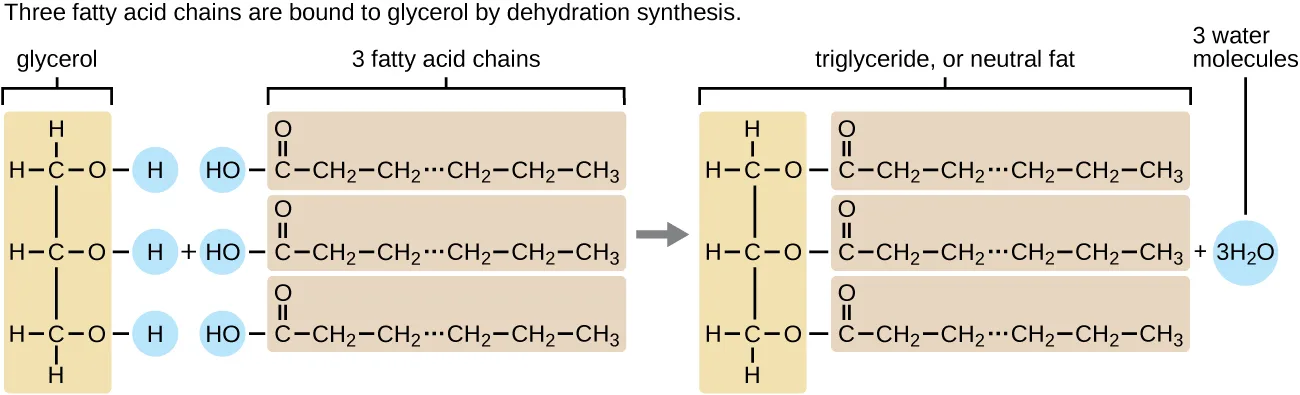
A triacylglycerol, or triglyceride, is formed when three fatty acids are chemically linked to a glycerol molecule (see the diagram below). Triglycerides are the primary components of adipose tissue (body fat), and are major constituents of sebum (skin oils). They play an important metabolic role, serving as efficient energy-storage molecules that can provide more than double the caloric content of both carbohydrates and proteins.
Check Your Understanding
Explain why fatty acids with hydrocarbon chains that contain only single bonds are called saturated fatty acids.
Compare how many hydrogen atoms a fully single-bonded carbon chain can hold versus a chain with a double bond.Phospholipids and Biological Membranes
Triglycerides are classified as simple lipids because they are formed from just two types of compounds: glycerol and fatty acids. In contrast, complex lipids contain at least one additional component, for example, a phosphate group (phospholipids) or a carbohydrate moiety (glycolipids). The illustration below depicts a typical phospholipid composed of two fatty acids linked to glycerol (a diglyceride). The two fatty acid carbon chains may be both saturated, both unsaturated, or one of each. Instead of another fatty acid molecule (as for triglycerides), the third binding position on the glycerol molecule is occupied by a modified phosphate group.
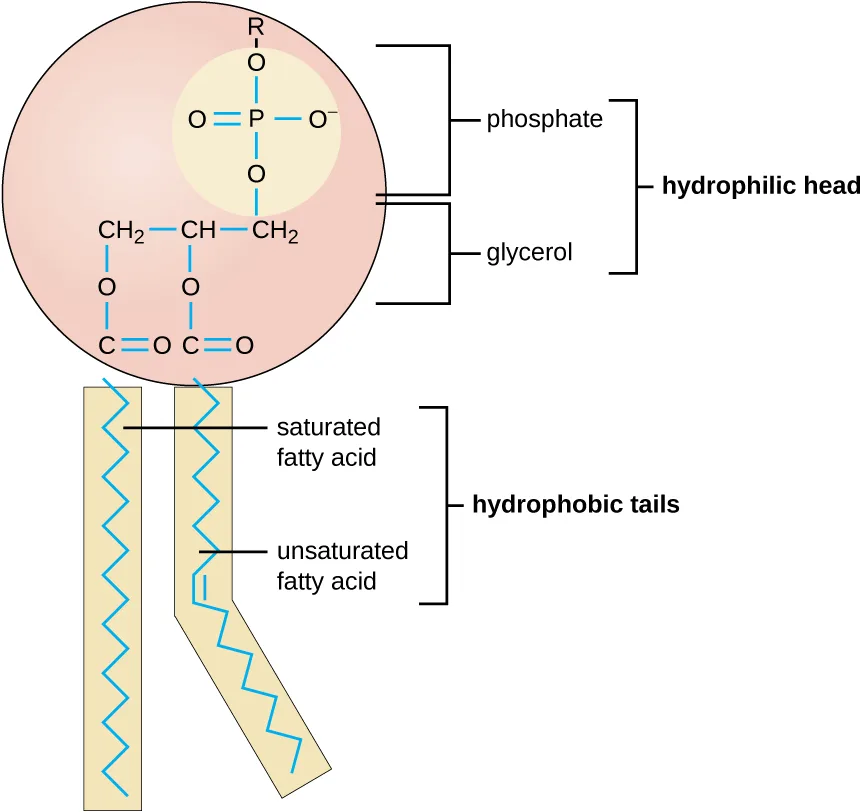
The molecular structure of lipids results in unique behavior in aqueous environments. The triglyceride diagram above depicts the structure of a triglyceride. Because all three substituents on the glycerol backbone are long hydrocarbon chains, these compounds are nonpolar and not significantly attracted to polar water molecules—they are hydrophobic. Conversely, phospholipids such as the one shown above have a negatively charged phosphate group. Because the phosphate is charged, it is capable of strong attraction to water molecules and thus is hydrophilic, or “water loving.” The hydrophilic portion of the phospholipid is often referred to as a polar “head,” and the long hydrocarbon chains as nonpolar “tails.” A molecule presenting a hydrophobic portion and a hydrophilic moiety is said to be amphipathic. Notice the “R” designation within the hydrophilic head depicted above, indicating that a polar head group can be more complex than a simple phosphate moiety. Glycolipids are examples in which carbohydrates are bonded to the lipids’ head groups.
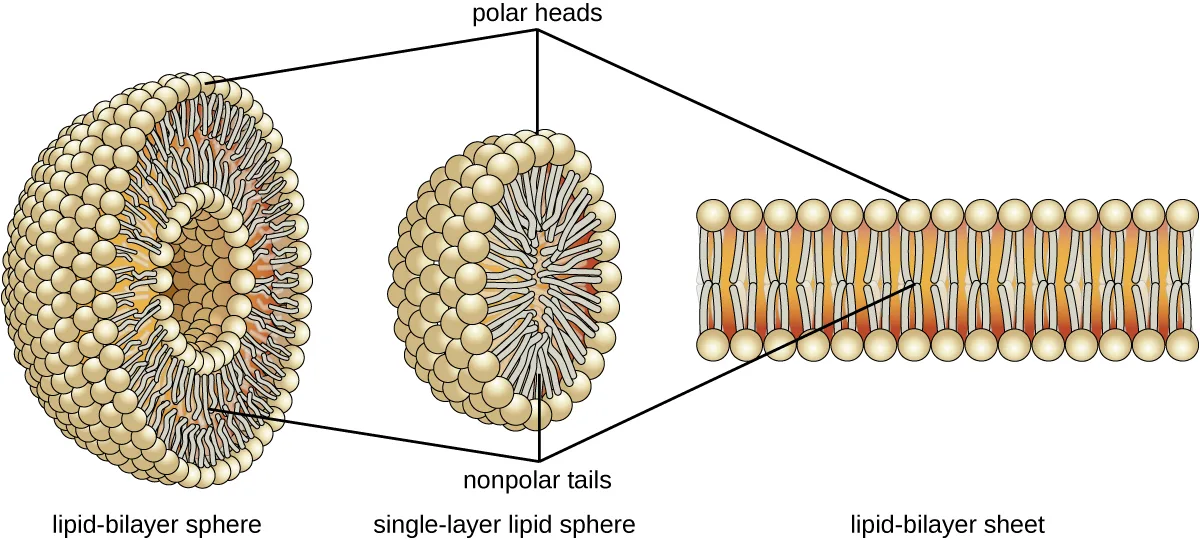
The amphipathic nature of phospholipids enables them to form uniquely functional structures in aqueous environments. As mentioned, the polar heads of these molecules are strongly attracted to water molecules, and the nonpolar tails are not. Because of their considerable lengths, these tails are, in fact, strongly attracted to one another. As a result, energetically stable, large-scale assemblies of phospholipid molecules are formed in which the hydrophobic tails congregate within enclosed regions, shielded from contact with water by the polar heads (see the diagram below). The simplest of these structures are micelles, spherical assemblies containing a hydrophobic interior of phospholipid tails and an outer surface of polar head groups. Larger and more complex structures are created from lipid-bilayer sheets, or unit membranes, which are large, two-dimensional assemblies of phospholipids congregated tail to tail. The cell membranes of nearly all organisms are made from lipid-bilayer sheets, as are the membranes of many intracellular components. These sheets may also form lipid-bilayer spheres that are the structural basis of vesicles and liposomes, subcellular components that play a role in numerous physiological functions.
Check Your Understanding
How is the amphipathic nature of phospholipids significant?
Show model answer
Did your answer mention:
Isoprenoids and Sterols
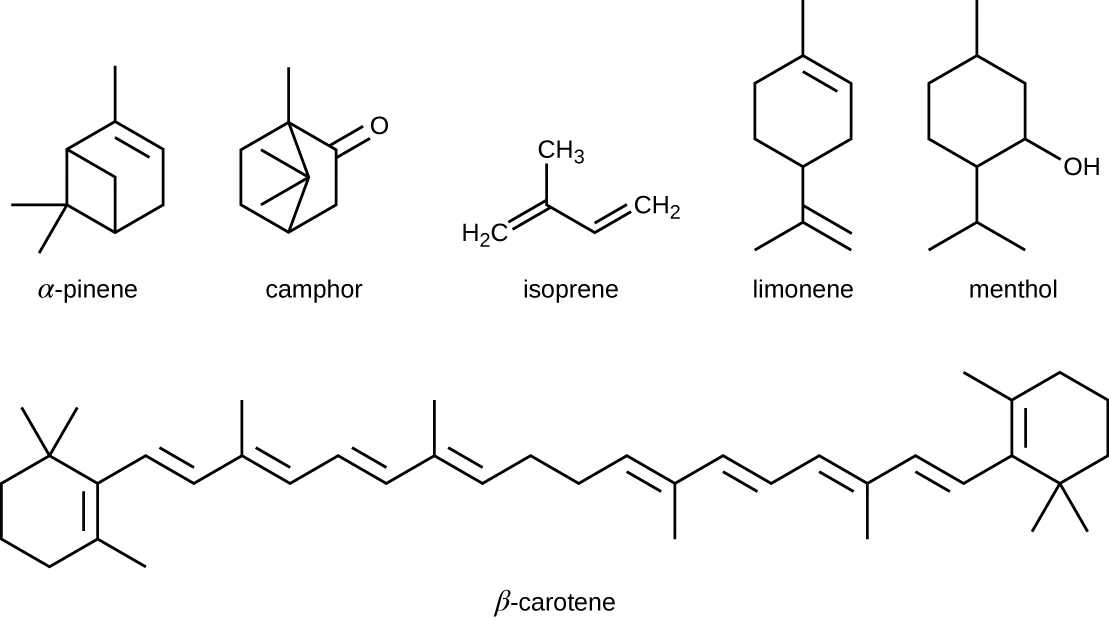
The isoprenoids are branched lipids, also referred to as terpenoids, that are formed by chemical modifications of the isoprene molecule (see the diagram below). These lipids play a wide variety of physiological roles in plants and animals, with many technological uses as pharmaceuticals (capsaicin), pigments (e.g., orange beta carotene, xanthophylls), and fragrances (e.g., menthol, camphor, limonene [lemon fragrance], and pinene [pine fragrance]). Long-chain isoprenoids are also found in hydrophobic oils and waxes. Waxes are typically water resistant and hard at room temperature, but they soften when heated and liquefy if warmed adequately. In humans, the main wax production occurs within the sebaceous glands of hair follicles in the skin, resulting in a secreted material called sebum, which consists mainly of triacylglycerol, wax esters, and the hydrocarbon squalene. There are many bacteria in the microbiota on the skin that feed on these lipids. One of the most prominent bacteria that feed on lipids is Cutibacterium acnes, which uses the skin’s lipids to generate short-chain fatty acids and is involved in the production of acne.
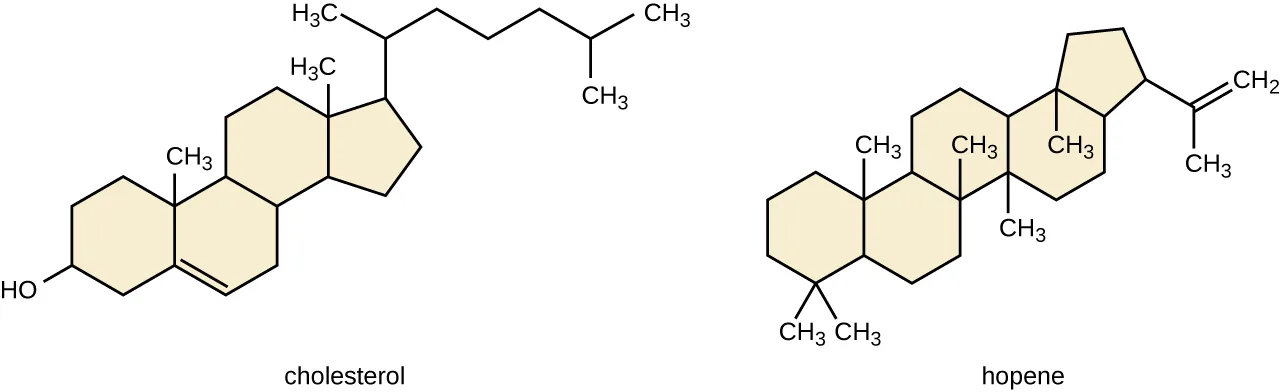
Another type of lipids are steroids, complex, ringed structures that are found in cell membranes; some function as hormones. The most common types of steroids are sterols, which are steroids containing an OH group. These are mainly hydrophobic molecules, but also have hydrophilic hydroxyl groups. The most common sterol found in animal tissues is cholesterol. Its structure consists of four rings with a double bond in one of the rings, and a hydroxyl group at the sterol-defining position. The function of cholesterol is to strengthen cell membranes in eukaryotes and in bacteria without cell walls, such as Mycoplasma. Prokaryotes generally do not produce cholesterol, although bacteria produce similar compounds called hopanoids, which are also multiringed structures that strengthen bacterial membranes (see the diagram below). Fungi and some protozoa produce a similar compound called ergosterol, which strengthens the cell membranes of these organisms.
Link to Learning. Liposomes
This video provides additional information about phospholipids and liposomes.
Check Your Understanding
How are isoprenoids used in technology? Sort each example below under the technological use it illustrates.
Pharmaceuticals
Pigments
Fragrances
Clinical Focus. Part 2
The moisturizing cream prescribed by Penny’s doctor was a topical corticosteroid cream containing hydrocortisone. Hydrocortisone is a synthetic form of cortisol, a corticosteroid hormone produced in the adrenal glands, from cholesterol. When applied directly to the skin, it can reduce inflammation and temporarily relieve minor skin irritations, itching, and rashes by reducing the secretion of histamine, a compound produced by cells of the immune system in response to the presence of pathogens or other foreign substances. Because histamine triggers the body’s inflammatory response, the ability of hydrocortisone to reduce the local production of histamine in the skin effectively suppresses the immune system and helps limit inflammation and accompanying symptoms such as pruritus (itching) and rashes.
- Does the corticosteroid cream treat the cause of Penny’s rash, or just the symptoms?
The case continues in Using Biochemistry to Identify Microorganisms. The case began in Organic Molecules.
Summary
- Lipids are composed mainly of carbon and hydrogen, but they can also contain oxygen, nitrogen, sulfur, and phosphorous. They provide nutrients for organisms, store carbon and energy, play structural roles in membranes, and function as hormones, pharmaceuticals, fragrances, and pigments.
- Fatty acids are long-chain hydrocarbons with a carboxylic acid functional group. Their relatively long nonpolar hydrocarbon chains make them hydrophobic. Fatty acids with no double bonds are saturated; those with double bonds are unsaturated.
- Fatty acids chemically bond to glycerol to form structurally essential lipids such as triglycerides and phospholipids. Triglycerides comprise three fatty acids bonded to glycerol, yielding a hydrophobic molecule. Phospholipids contain both hydrophobic hydrocarbon chains and polar head groups, making them amphipathic and capable of forming uniquely functional large scale structures.
- Biological membranes are large-scale structures based on phospholipid bilayers that provide hydrophilic exterior and interior surfaces suitable for aqueous environments, separated by an intervening hydrophobic layer. These bilayers are the structural basis for cell membranes in most organisms, as well as subcellular components such as vesicles.
- Isoprenoids are lipids derived from isoprene molecules that have many physiological roles and a variety of commercial applications.
- A wax is a long-chain isoprenoid that is typically water resistant; an example of a wax-containing substance is sebum, produced by sebaceous glands in the skin. Steroids are lipids with complex, ringed structures that function as structural components of cell membranes and as hormones. Sterols are a subclass of steroids containing a hydroxyl group at a specific location on one of the molecule’s rings; one example is cholesterol.
- Bacteria produce hopanoids, structurally similar to cholesterol, to strengthen bacterial membranes. Fungi and protozoa produce a strengthening agent called ergosterol.
Key terms
- lipid — macromolecule composed primarily of carbon and hydrogen; source of nutrients for organisms, a storage form for carbon and energy, a part of the structure of membranes, and may function as hormones, pharmaceuticals, fragrances, and pigments.
- fatty acid — lipid that contains long-chain hydrocarbons terminated with a carboxylic acid functional group.
- hydrophobic — “water fearing”; refers to a nonpolar molecule or portion of a molecule not capable of strong attraction to water molecules.
- saturated fatty acid — lipid with hydrocarbon chains containing only single bonds, which results in the maximum number of hydrogen atoms per chain.
- unsaturated fatty acid — lipid with hydrocarbon chains containing one or more carbon-carbon double bonds and subsequently fewer than the maximum number of hydrogen atoms per chain.
- triacylglycerol — three fatty acids chemically linked to a glycerol molecule; also called a triglyceride.
- triglyceride — three fatty acids chemically linked to a glycerol molecule; also called a triacylglycerol.
- phospholipids — complex lipid that contains a phosphate group.
- glycolipids — complex lipid that contains a carbohydrate moiety.
- hydrophilic — “water loving”; refers to a polar molecule or portion of a molecule capable of strong attraction to water molecules.
- amphipathic — a molecule containing both polar and nonpolar parts.
- micelles — simple spherical arrangement of amphipathic lipid molecules with nonpolar tails aggregated within the interior and polar heads forming the outer surface.
- lipid-bilayer — biological membranes composed of two layers of phospholipid molecules with the nonpolar tails associating to form a hydrophobic barrier between the polar heads; also called unit membrane.
- unit membranes — biological membrane composed of two layers of phospholipid molecules with the nonpolar tails associating to form a hydrophobic barrier between the polar heads; also called lipid bilayer.
- isoprenoids — branched lipid derived from five-carbon isoprene molecules.
- steroids — lipid with complex, ringed structures found in cell membranes and hormones.
- sterols — the most common type of steroid; contains an OH group at one specific position on one of the molecule’s carbon rings.
Practice
Describe the chemical composition of lipids
Which of the following describes lipids?
Look back at how the section introduces the many roles lipids play.Lipids are a naturally occurring group of substances that are not soluble in water but are freely soluble in organic solvents.
Compare this statement with how the section describes the hydrophobic, nonpolar nature of lipids.Lipids are composed mainly of carbon and hydrogen, but they can also contain oxygen, nitrogen, sulfur, and __________.
Named for the same element found in a phosphate group.Describe the unique characteristics and diverse structures of lipids
Fatty acids having no double bonds are called “unsaturated.”
Compare this name with the term the section uses for a hydrocarbon chain that has the greatest number of hydrogen atoms possible.Waxes contain esters formed from long-chain __________ and saturated fatty acids, and they may also contain substituted hydrocarbons.
An ester bond forms between a fatty acid and this other class of organic molecule.Cholesterol is the most common member of the __________ group, found in animal tissues; it has a tetracyclic carbon ring system with a double bond in one of the rings and one free hydroxyl group.
This lipid category is defined by its four-ring carbon skeleton; the section names it just before it introduces the OH-bearing subgroup.Compare and contrast triacylglycerides (triglycerides) and phospholipids.
Molecules bearing both polar and nonpolar groups are said to be which of the following?
This is the same word the section uses for phospholipids, which have both a polar head and nonpolar tails.A triglyceride is formed by joining three glycerol molecules to a fatty acid backbone in a dehydration reaction.
Compare this description with how the section says fatty acids and glycerol are joined to build a triglyceride.Describe the structure of a typical phospholipid. Are these molecules polar or nonpolar?
Show model answer
Did your answer mention:
Describe how phospholipids are used to construct biological membranes.
Microorganisms can thrive under many different conditions, including high-temperature environments such as hot springs. To function properly, cell membranes have to be in a fluid state. How do you expect the fatty acid content (saturated versus unsaturated) of bacteria living in high-temperature environments might compare with that of bacteria living in more moderate temperatures?
Show model answer
Did your answer mention:
The simplest of these self-assembled phospholipid structures are __________, spherical assemblies containing a hydrophobic interior of phospholipid tails and an outer surface of polar head groups.
This is the simplest of the three self-assembled phospholipid structures the section describes.Larger and more complex structures than these are created from lipid-bilayer sheets, or __________, which are large, two-dimensional assemblies of phospholipids congregated tail to tail.
This is the general name for the two-layered phospholipid sheets that make up cell membranes.This section is adapted from Microbiology, Section 7.3: Lipids by Nina Parker, Mark Schneegurt, Anh-Hue Thi Tu, Philip Lister, Brian M. Forster, and OpenStax, © OpenStax, licensed under CC BY-NC-SA 4.0. Access the original for free at openstax.org. Changes: all five figures are re-encoded as WebP and rendered as mediafigures with explicit kind="diagram" on every one, overriding the media manifest’s file-extension guess of “photo” for all five (they are drawn structural formulas and schematic diagrams, not photographs); alts are rewritten from the served images rather than reused verbatim — the micelle/lipid-bilayer figure’s source alt misspelled “bilayer” as “bilyaer” and described its three structures out of the order the artwork draws them (both reported as source-alt defects), and the isoprenoid figure’s source alt misspelled “isoprene” as “Isophrene” and ran “Menthol is” together as “Menthol i s” (also reported); the sterols figure’s alt is extended to note the hydroxyl (OH) group cholesterol carries, which the artwork shows but the source alt omitted; eight same-module figure cross-references (<link target-id>) are rendered as describing phrases (“see the diagram below,” “the diagram above,” “shown above”); the Link to Learning box keeps its title, its URL, and its own “video” anchor text; the Clinical Focus Part 2 box’s “Jump to the next / Go back to the previous Clinical Focus box” links are replaced with a plain-text sentence naming that the case continues in Using Biochemistry to Identify Microorganisms and began in Organic Molecules; of the section’s three body Check Your Understanding bullets, the first (“why are fatty acids with only single bonds called saturated”) is graded as a multiple choice from the module’s own explanatory sentence, the second (the significance of phospholipids’ amphipathic nature) remains a self-check because its honest answer assembles several of the module’s sentences, and the third (how isoprenoids are used in technology) is graded as a sort-into-bins item whose three bins (pharmaceuticals, pigments, fragrances) and seven items are the module’s own single sentence naming isoprenoid technological uses and examples; the two source Multiple Choice and three True/False items (the True/False items rendered as two-option multiple choice, True then False) keep the source’s own keys and option order; of the section’s two Fill in the Blank items, each has more blanks than a single text field can hold, so each keeps only its most central blank as the graded textin field and prints the source’s other keyed word(s) directly in the stem as given text (a response-mode adaptation, disclosed here and in the ledger) — the wax-ester item keeps “fatty acids” in the stem and blanks “alcohols,” and the cholesterol item keeps “double bond” and “hydroxyl group” in the stem and blanks “steroid”; the unkeyed Short Answer question (describing a typical phospholipid’s structure) remains a self-check, because its honest answer both assembles several of the module’s sentences and would otherwise duplicate the “amphipathic” multiple choice built from the same module fact; the unkeyed Critical Thinking question (fatty acid content of bacteria at different temperatures) remains a self-check, because answering the comparison it asks for needs an inference — how ambient temperature and fatty acid saturation interact to keep a membrane fluid — that the module states only the underlying facts for and never draws itself; two filler textin items (from the module’s own micelle and lipid-bilayer/unit-membrane sentences) and one cloze textin (from the module’s own composition sentence) round out three Practice groups that the section’s own exercise set does not reach past two items on its own; no source exercise was omitted; key terms are compiled from the module’s 17 defined terms and the book’s Glossary appendix (the hyphenated body term “lipid-bilayer” takes the appendix’s “lipid bilayer” entry); the module’s own “phosphorous” (for the element more commonly spelled “phosphorus”) is printed as the module prints it, both here and in the composition cloze, since the module uses this spelling consistently rather than as an isolated slip.