Microbial Metabolism
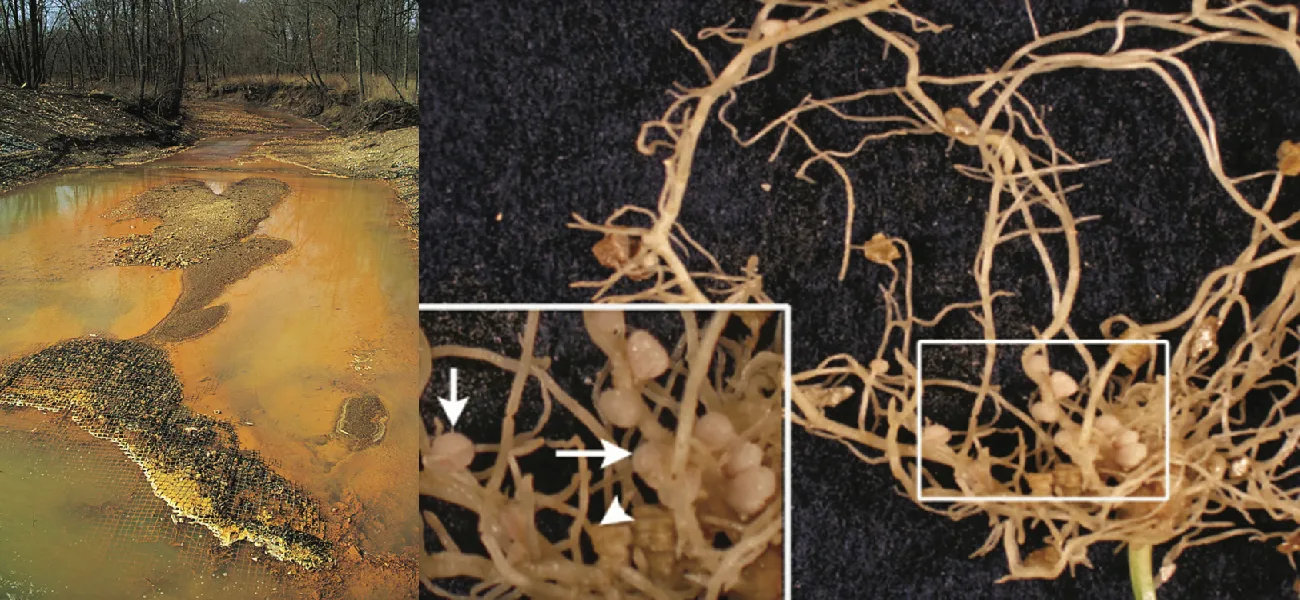
Throughout earth’s history, microbial metabolism has been a driving force behind the development and maintenance of the planet’s biosphere. Eukaryotic organisms such as plants and animals typically depend on organic molecules for energy, growth, and reproduction. Prokaryotes, on the other hand, can metabolize a wide range of organic as well as inorganic matter, from complex organic molecules like cellulose to inorganic molecules and ions such as atmospheric nitrogen (N₂), molecular hydrogen (H₂), sulfide (S²⁻), manganese (II) ions (Mn²⁺), ferrous iron (Fe²⁺), and ferric iron (Fe³⁺), to name a few. By metabolizing such substances, microbes chemically convert them to other forms. In some cases, microbial metabolism produces chemicals that can be harmful to other organisms; in others, it produces substances that are essential to the metabolism and survival of other life forms, as the two photographs above show.
Sections
- Energy, Matter, and Enzymes — metabolism as catabolism and anabolism, the classification of organisms by energy and carbon source, redox reactions and electron carriers, ATP, and how enzymes work and are regulated.
- Catabolism of Carbohydrates — glycolysis by the Embden-Meyerhof-Parnas, Entner-Doudoroff, and pentose phosphate pathways, the transition reaction, and the Krebs cycle.
- Cellular Respiration — electron transport systems, chemiosmosis and the proton motive force, oxidative phosphorylation, and the ATP yields of aerobic and anaerobic respiration.
- Fermentation — fermentation as the alternative to respiration, the common fermentation pathways and their products, and fermentation as a tool for identifying microbes.
- Catabolism of Lipids and Proteins — lipid catabolism and β-oxidation, protein catabolism, and the tests that detect lipases and proteases.
- Photosynthesis — the light-dependent and light-independent reactions, photosynthetic pigments and structures, oxygenic and anoxygenic photosynthesis, and the Calvin cycle.
- Biogeochemical Cycles — the carbon, nitrogen, and sulfur cycles that microbial metabolism drives, and bioremediation.
This chapter is adapted from Microbiology, Chapter 8: Microbial Metabolism by Nina Parker, Mark Schneegurt, Anh-Hue Thi Tu, Philip Lister, Brian M. Forster, and OpenStax, © OpenStax, licensed under CC BY-NC-SA 4.0. Access the original for free at openstax.org. Each section page records its own changes from the source. Changes: the chapter-opening figure is the source’s pair of photographs, re-encoded for the web, with its alt text rewritten to describe both panels and the inset; the source’s figure cross-reference is replaced by a describing phrase; chemical formulas and ions are set in Unicode subscripts and superscripts.