Catabolism of Carbohydrates
By the end of this section, you will be able to:
- Describe why glycolysis is not oxygen dependent
- Define and describe the net yield of three-carbon molecules, ATP, and NADH from glycolysis
- Explain how three-carbon pyruvate molecules are converted into two-carbon acetyl groups that can be funneled into the Krebs cycle.
- Define and describe the net yield of CO₂, GTP/ATP, FADH₂, and NADH from the Krebs cycle
- Explain how intermediate carbon molecules of the Krebs cycle can be used in a cell
Extensive enzyme pathways exist for breaking down carbohydrates to capture energy in ATP bonds. In addition, many catabolic pathways produce intermediate molecules that are also used as building blocks for anabolism. Understanding these processes is important for several reasons. First, because the main metabolic processes involved are common to a wide range of chemoheterotrophic organisms, we can learn a great deal about human metabolism by studying metabolism in more easily manipulated bacteria like E. coli. Second, because animal and human pathogens are also chemoheterotrophs, learning about the details of metabolism in these bacteria, including possible differences between bacterial and human pathways, is useful for the diagnosis of pathogens as well as for the discovery of antimicrobial therapies targeting specific pathogens. Last, learning specifically about the pathways involved in chemoheterotrophic metabolism also serves as a basis for comparing other more unusual metabolic strategies used by microbes. Although the chemical source of electrons initiating electron transfer is different between chemoheterotrophs and chemoautotrophs, many similar processes are used in both types of organisms.
The typical example used to introduce concepts of metabolism to students is carbohydrate catabolism. For chemoheterotrophs, our examples of metabolism start with the catabolism of polysaccharides such as glycogen, starch, or cellulose. Enzymes such as amylase, which breaks down glycogen or starch, and cellulases, which break down cellulose, can cause the hydrolysis of glycosidic bonds between the glucose monomers in these polymers, releasing glucose for further catabolism.
Glycolysis
For bacteria, eukaryotes, and most archaea, glycolysis is the most common pathway for the catabolism of glucose; it produces energy, reduced electron carriers, and precursor molecules for cellular metabolism. Every living organism carries out some form of glycolysis, suggesting this mechanism is an ancient universal metabolic process. The process itself does not use oxygen; however, glycolysis can be coupled with additional metabolic processes that are either aerobic or anaerobic. Glycolysis takes place in the cytoplasm of prokaryotic and eukaryotic cells. It begins with a single six-carbon glucose molecule and ends with two molecules of a three-carbon sugar called pyruvate. Pyruvate may be broken down further after glycolysis to harness more energy through aerobic or anaerobic respiration, but many organisms, including many microbes, may be unable to respire; for these organisms, glycolysis may be their only source of generating ATP.
The type of glycolysis found in animals and that is most common in microbes is the Embden-Meyerhof-Parnas (EMP) pathway, named after Gustav Embden (1874–1933), Otto Meyerhof (1884–1951), and Jakub Parnas (1884–1949). Glycolysis using the EMP pathway consists of two distinct phases (shown below). The first part of the pathway, called the energy investment phase, uses energy from two ATP molecules to modify a glucose molecule so that the six-carbon sugar molecule can be split evenly into two phosphorylated three-carbon molecules called glyceraldehyde 3-phosphate (G3P). The second part of the pathway, called the energy payoff phase, extracts energy by oxidizing G3P to pyruvate, producing four ATP molecules and reducing two molecules of NAD⁺ to two molecules of NADH, using electrons that originated from glucose. (A discussion and illustration of the full EMP pathway with chemical structures and enzyme names appear in Appendix C.)
The ATP molecules produced during the energy payoff phase of glycolysis are formed by substrate-level phosphorylation (shown below), one of two mechanisms for producing ATP. In substrate-level phosphorylation, a phosphate group is removed from an organic molecule and is directly transferred to an available ADP molecule, producing ATP. During glycolysis, high-energy phosphate groups from the intermediate molecules are added to ADP to make ATP.
Overall, in this process of glycolysis, the net gain from the breakdown of a single glucose molecule is:
- two ATP molecules
- two NADH molecules, and
- two pyruvate molecules.
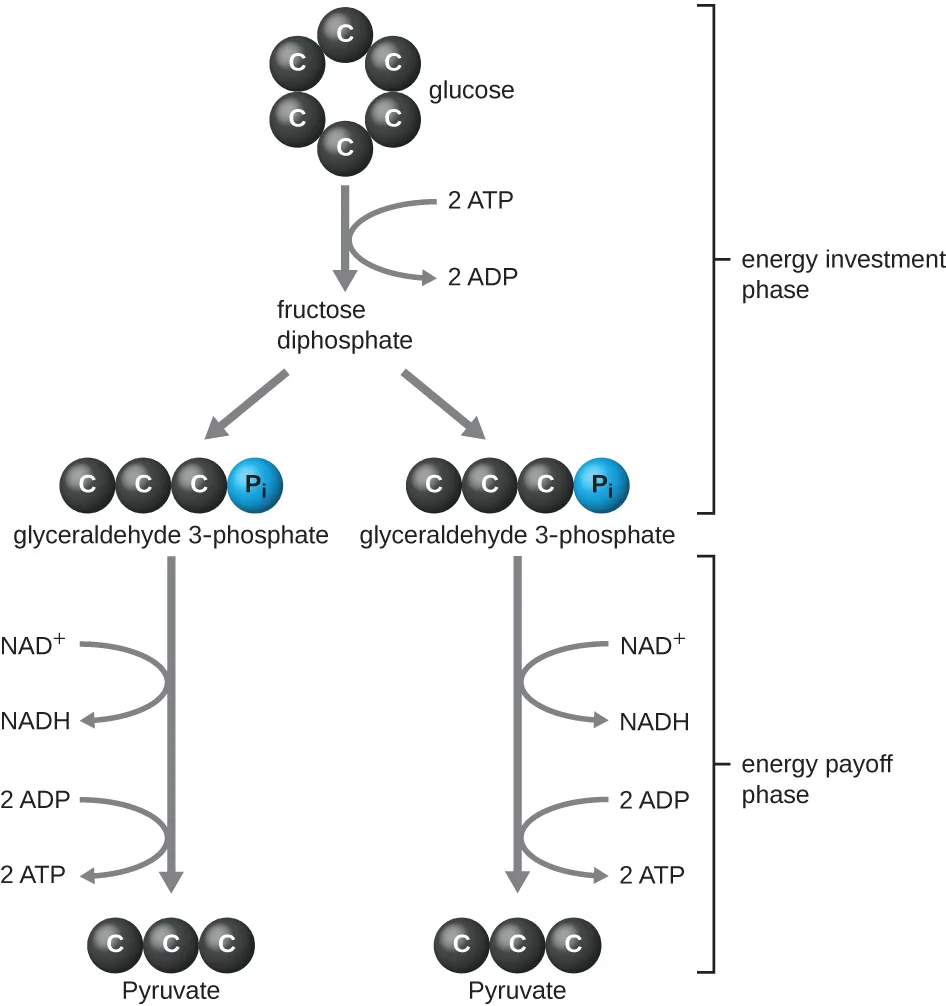
Extended description
Energy investment phase: one six-carbon glucose molecule (a ring of six dark carbon spheres) reacts with two ATP, releasing two ADP, and is relabeled as the intermediate fructose diphosphate (named but not drawn as spheres); fructose diphosphate splits into two three-carbon glyceraldehyde 3-phosphate molecules, each drawn as three carbon spheres bonded to one blue phosphate sphere (Pᵢ). Energy payoff phase, shown once for each of the two three-carbon branches: each glyceraldehyde 3-phosphate reacts with NAD⁺ to release one NADH, then reacts with two ADP to release two ATP, ending as a three-carbon pyruvate (three carbon spheres, no phosphate). Because both payoff-phase reactions run once per branch, and there are two branches, the diagram’s totals are two ATP spent, four ATP made (a net of two), two NADH made, and two pyruvate molecules made per glucose.
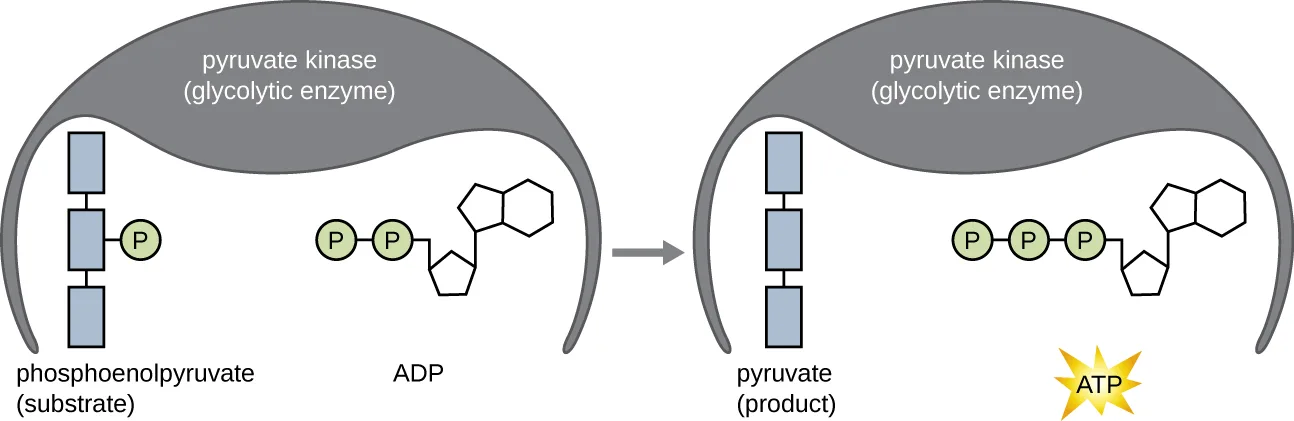
Extended description
Two panels under the same pyruvate-kinase enzyme arch. Left panel: the substrate phosphoenolpyruvate (three linked carbon units with one phosphate group attached) sits beside ADP (two linked phosphate groups attached to an adenine-and-ribose ring). Right panel, after the reaction: the product pyruvate (the same three carbon units, now with no phosphate group) sits beside ATP (three linked phosphate groups attached to the same ring), with a burst symbol labeling the newly made ATP. The phosphate removed from phosphoenolpyruvate is transferred directly to ADP, illustrating substrate-level phosphorylation without an electron transport chain.
Other Glycolytic Pathways
When we refer to glycolysis, unless otherwise indicated, we are referring to the EMP pathway used by animals and many bacteria. However, some prokaryotes use alternative glycolytic pathways. One important alternative is the Entner-Doudoroff (ED) pathway, named after its discoverers Nathan Entner and Michael Doudoroff (1911–1975). Although some bacteria, including the opportunistic gram-negative pathogen Pseudomonas aeruginosa, contain only the ED pathway for glycolysis, other bacteria, like E. coli, have the ability to use either the ED pathway or the EMP pathway.
A third type of glycolytic pathway that occurs in all cells, which is quite different from the previous two pathways, is the pentose phosphate pathway (PPP) also called the phosphogluconate pathway or the hexose monophosphate shunt. Evidence suggests that the PPP may be the most ancient universal glycolytic pathway. The intermediates from the PPP are used for the biosynthesis of nucleotides and amino acids. Therefore, this glycolytic pathway may be favored when the cell has need for nucleic acid and/or protein synthesis, respectively. A discussion and illustration of the complete ED pathway and PPP with chemical structures and enzyme names appear in Appendix C.
Check Your Understanding
When might an organism use the ED pathway or the PPP for glycolysis?
Show model answer
Did your answer mention:
Transition Reaction, Coenzyme A, and the Krebs Cycle
Glycolysis produces pyruvate, which can be further oxidized to capture more energy. For pyruvate to enter the next oxidative pathway, it must first be decarboxylated by the enzyme complex pyruvate dehydrogenase to a two-carbon acetyl group in the transition reaction, also called the bridge reaction (see Appendix C and the figure below). In the transition reaction, electrons are also transferred to NAD⁺ to form NADH. To proceed to the next phase of this metabolic process, the comparatively tiny two-carbon acetyl must be attached to a very large carrier compound called coenzyme A (CoA). The transition reaction occurs in the mitochondrial matrix of eukaryotes; in prokaryotes, it occurs in the cytoplasm because prokaryotes lack membrane-enclosed organelles.
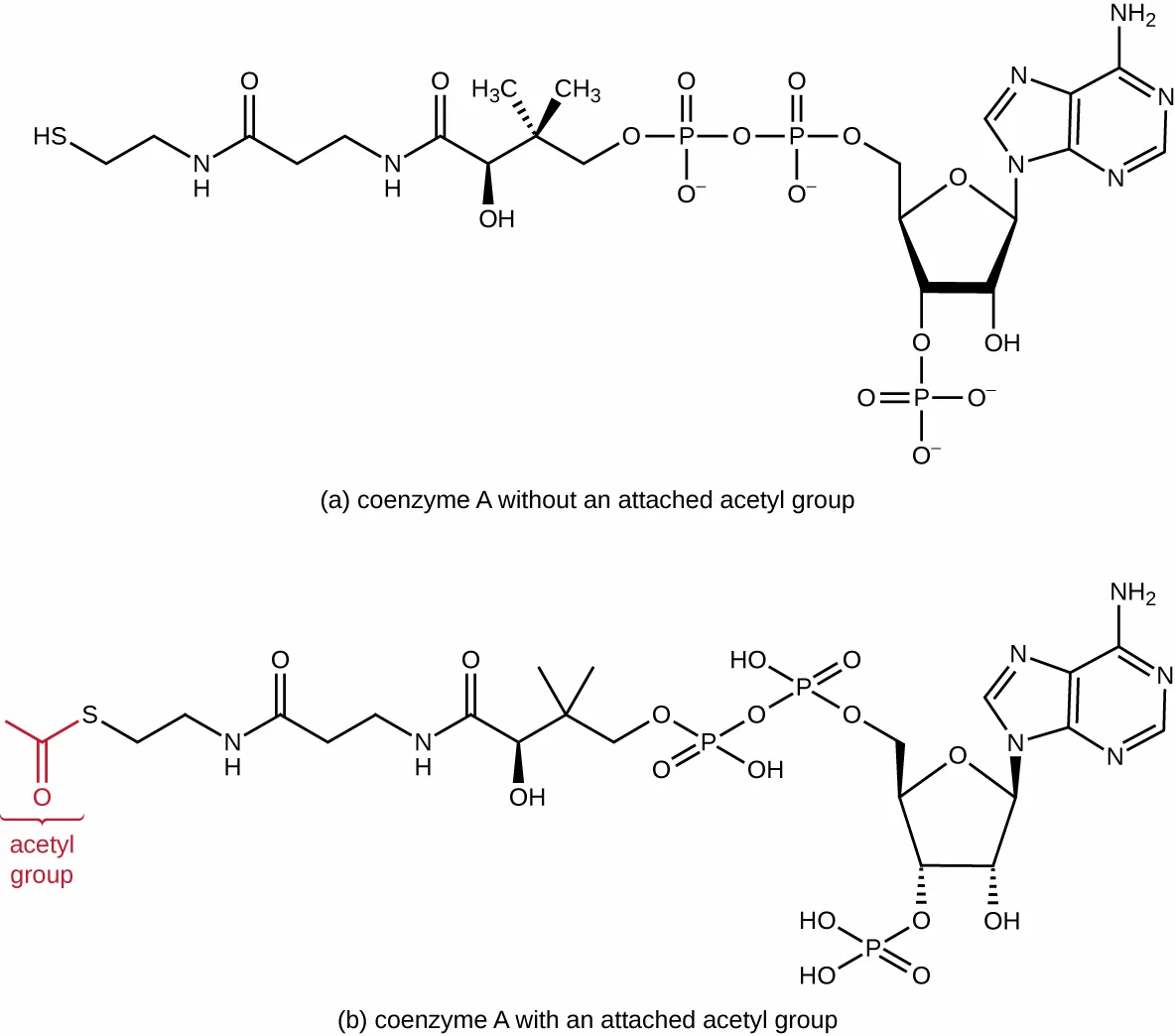
Extended description
The backbone runs from a sulfur-terminated end, through two amide bonds and a two-methyl, hydroxyl-bearing carbon unit, to a chain of two linked phosphate groups that attaches to carbon 5 of the ribose ring; the ring also carries a single phosphate group on carbon 3 and the base adenine on carbon 1. In panel (a) the terminal sulfur is unbound (coenzyme A); in panel (b) an acetyl group (highlighted) is attached to that same sulfur, forming acetyl-CoA.
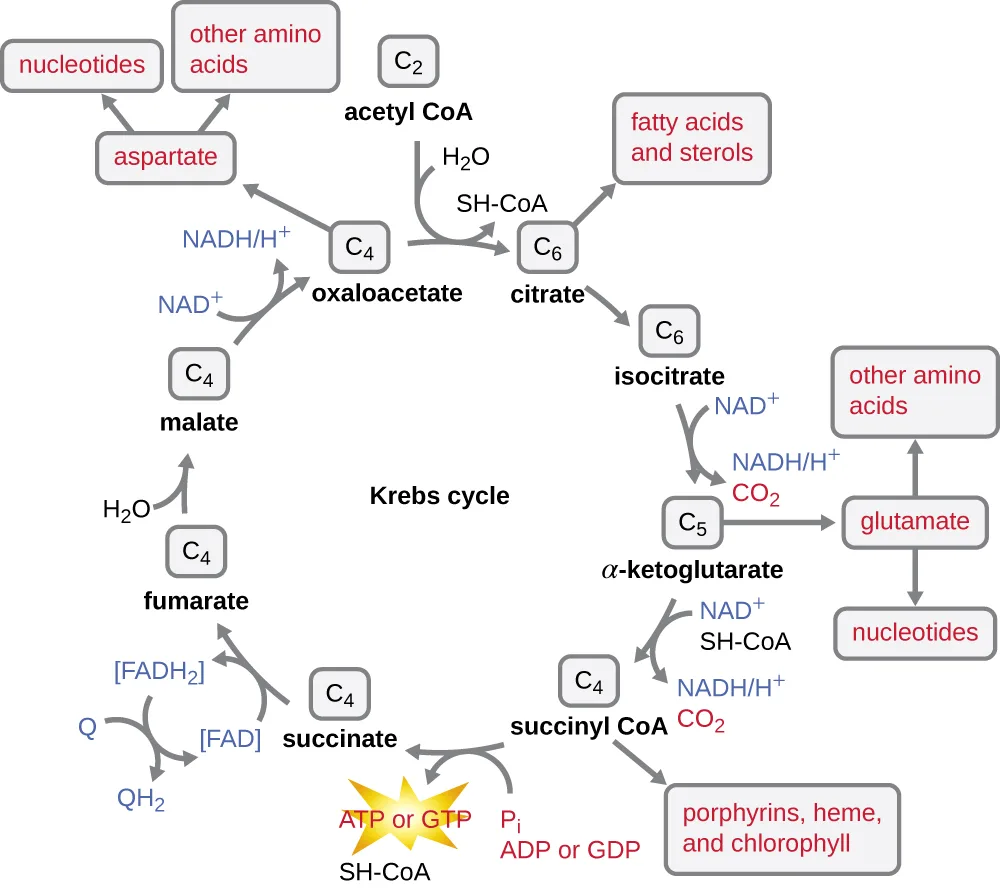
The Krebs cycle transfers remaining electrons from the acetyl group produced during the transition reaction to electron carrier molecules, thus reducing them. The Krebs cycle also occurs in the cytoplasm of prokaryotes along with glycolysis and the transition reaction, but it takes place in the mitochondrial matrix of eukaryotic cells where the transition reaction also occurs. The Krebs cycle is named after its discoverer, British scientist Hans Adolf Krebs (1900–1981) and is also called the citric acid cycle, or the tricarboxylic acid cycle (TCA) because citric acid has three carboxyl groups in its structure. Unlike glycolysis, the Krebs cycle is a closed loop: The last part of the pathway regenerates the compound used in the first step (shown below). The eight steps of the cycle are a series of chemical reactions that capture the two-carbon acetyl group (the CoA carrier does not enter the Krebs cycle) from the transition reaction, which is added to a four-carbon intermediate in the Krebs cycle, producing the six-carbon intermediate citric acid (giving the alternate name for this cycle). As one turn of the cycle returns to the starting point of the four-carbon intermediate, the cycle produces two CO₂ molecules, one ATP molecule (or an equivalent, such as guanosine triphosphate [GTP]) produced by substrate-level phosphorylation, and three molecules of NADH and one of FADH₂. (A discussion and detailed illustration of the full Krebs cycle appear in Appendix C.)
Although many organisms use the Krebs cycle as described as part of glucose metabolism, several of the intermediate compounds in the Krebs cycle can be used in synthesizing a wide variety of important cellular molecules, including amino acids, chlorophylls, fatty acids, and nucleotides; therefore, the cycle is both anabolic and catabolic (shown below).
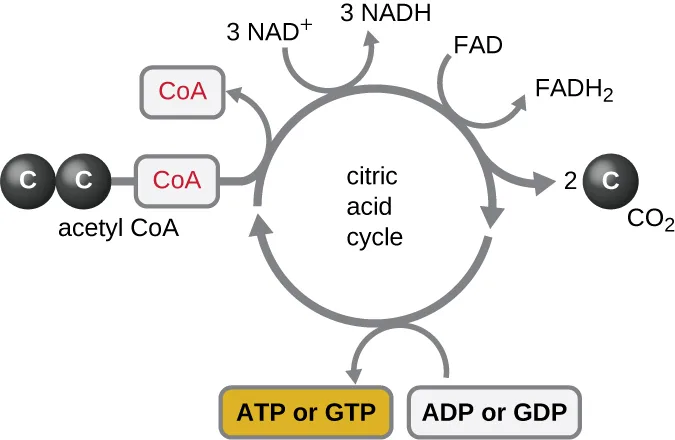
Extended description
Reading around the circle from the acetyl-CoA input at upper left: acetyl-CoA (two linked carbon spheres bound to a CoA tag) enters the cycle and CoA is released. Continuing clockwise, one arrow labeled ‘3 NAD⁺’ becomes ‘3 NADH,’ one arrow labeled ‘FAD’ becomes ‘FADH₂,’ one arrow releases a single labeled carbon sphere marked ‘2’ as ‘CO₂,’ and at the bottom one arrow converts ‘ADP or GDP’ into ‘ATP or GTP.’ The diagram’s printed counts are the per-turn totals: two CO₂, three NADH, one FADH₂, and one ATP (or GTP) for each two-carbon acetyl group that enters.
Extended description
Eight numbered intermediates run clockwise from the top. (1) Acetyl-CoA (C2) combines with water and the four-carbon oxaloacetate, releasing CoA-SH, to form the six-carbon citrate; a side arrow shows citrate can be drawn off to build fatty acids and sterols. (2) Citrate (C6) converts to isocitrate (C6). (3) Isocitrate reacts with NAD⁺, releasing NADH/H⁺ and one CO₂, to form the five-carbon α-ketoglutarate; a side arrow shows α-ketoglutarate can be converted to glutamate, which in turn feeds other amino acids and nucleotides. (4) α-ketoglutarate reacts with NAD⁺ and CoA-SH, releasing NADH/H⁺ and one CO₂, to form the four-carbon succinyl-CoA; a side arrow shows succinyl-CoA can be drawn off to build porphyrins, heme, and chlorophyll. (5) Succinyl-CoA reacts with phosphate and ADP or GDP, releasing CoA-SH and forming ATP or GTP, to give the four-carbon succinate. (6) Succinate is oxidized to the four-carbon fumarate, reducing FAD to FADH₂, shown passing electrons to the carrier Q to form QH₂. (7) Fumarate reacts with water to form the four-carbon malate. (8) Malate reacts with NAD⁺, releasing NADH/H⁺, to regenerate the four-carbon oxaloacetate that started the cycle; a side arrow shows oxaloacetate can be converted to aspartate, which in turn feeds other amino acids and nucleotides. Across the full turn the cycle releases two CO₂, produces three NADH/H⁺, one FADH₂, and one ATP (or GTP), consistent with the summary diagram above.
Summary
- Glycolysis is the first step in the breakdown of glucose, resulting in the formation of ATP, which is produced by substrate-level phosphorylation; NADH; and two pyruvate molecules. Glycolysis does not use oxygen and is not oxygen dependent.
- After glycolysis, a three-carbon pyruvate is decarboxylated to form a two-carbon acetyl group, coupled with the formation of NADH. The acetyl group is attached to a large carrier compound called coenzyme A.
- After the transition step, coenzyme A transports the two-carbon acetyl to the Krebs cycle, where the two carbons enter the cycle. Per turn of the cycle, one acetyl group derived from glycolysis is further oxidized, producing three NADH molecules, one FADH₂, and one ATP by substrate-level phosphorylation, and releasing two CO₂ molecules.
- The Krebs cycle may be used for other purposes. Many of the intermediates are used to synthesize important cellular molecules, including amino acids, chlorophylls, fatty acids, and nucleotides.
Key terms
- glycolysis — first step in the breakdown of glucose, the most common example of which is the Embden-Meyerhoff-Parnas pathway, producing two pyruvates, two NADH molecules, and two (net yield) ATP per starting glucose molecule.
- Embden-Meyerhof-Parnas (EMP) pathway — type of glycolysis found in animals and the most common in microbes.
- substrate-level phosphorylation — direct method of ATP production in which a high-energy phosphate group is removed from an organic molecule and added to an ADP molecule.
- Entner-Doudoroff (ED) pathway — alternative glycolytic pathway used by some bacteria.
- pentose phosphate pathway — alternative glycolytic pathway that produces intermediates used for the biosynthesis of nucleotides and amino acids; also called the phosphogluconate pathway or the hexose monophosphate shunt.
- phosphogluconate pathway — see pentose phosphate pathway.
- hexose monophosphate shunt — see pentose phosphate pathway.
- transition reaction — reaction linking glycolysis to the Krebs cycle, during which each pyruvate is decarboxylated and oxidized (forming NADH), and the resulting two-carbon acetyl group is attached to a large carrier molecule called coenzyme A, resulting in the formation of acetyl-CoA and CO₂; also called the bridge reaction.
- bridge reaction — reaction linking glycolysis to the Krebs cycle during which each pyruvate is decarboxylated and oxidized (forming NADH), and the resulting two-carbon acetyl group is attached to a large carrier called coenzyme A, resulting in the formation of acetyl-CoA and CO₂; also called the transition reaction.
- Krebs cycle — cyclic pathway during which each two-carbon unit entering the cycle is further oxidized, producing three NADH, one FADH₂, and one ATP by substrate-level phosphorylation, releasing two CO₂ molecules and regenerating the molecule used in the first step; also called the citric acid cycle or the tricarboxylic acid cycle.
- citric acid cycle — see Krebs cycle.
- tricarboxylic acid cycle (TCA) — see Krebs cycle.
Practice
Describe why glycolysis is not oxygen dependent
Glycolysis requires oxygen or another inorganic final electron acceptor to proceed.
Compare this statement against the sentence stating whether the process of glycolysis itself uses oxygen.Although glycolysis itself does not use oxygen, what does this section say can happen to the pyruvate it produces?
Glycolysis itself is oxygen-independent; review what the module says can happen next to the pyruvate it leaves behind.For an organism that is unable to respire, what role can glycolysis play in its ATP production?
Read the sentence about organisms, including many microbes, that may be unable to respire.Define and describe the net yield of three-carbon molecules, ATP, and NADH from glycolysis
Most commonly, glycolysis occurs by the ________ pathway.
Identify the type of glycolysis found in animals and most common in microbes, the same pathway named for its three discoverers earlier in this subsection.During which of the following is ATP not made by substrate-level phosphorylation?
Substrate-level phosphorylation makes ATP directly in glycolysis and in the Krebs cycle; find the one listed process that makes no ATP of its own.Which of the following products is made during Embden-Meyerhof glycolysis?
Glycolysis’s net products are ATP, NADH, and one three-carbon molecule — the other three options are either consumed, made only later, or never made in this section’s glycolysis.What is substrate-level phosphorylation? When does it occur during the breakdown of glucose to CO2?
Show model answer
Did your answer mention:
Explain how three-carbon pyruvate molecules are converted into two-carbon acetyl groups that can be funneled into the Krebs cycle.
The enzyme complex ________ decarboxylates pyruvate to a two-carbon acetyl group in the transition reaction.
Name the enzyme complex introduced at the start of the paragraph about the transition reaction.In prokaryotes, the transition reaction occurs in the ________ because prokaryotes lack membrane-enclosed organelles.
Name the cell compartment where this reaction occurs in a prokaryote, contrasted with the mitochondrial-matrix location in a eukaryote.What would be the consequences to a cell of having a mutation that knocks out coenzyme A synthesis?
Show model answer
Did your answer mention:
Define and describe the net yield of CO₂, GTP/ATP, FADH₂, and NADH from the Krebs cycle
During the catabolism of glucose, which of the following is produced only in the Krebs cycle?
Two of these four are also made during glycolysis; find the electron carrier this section says is made only in the Krebs cycle.Per turn of the Krebs cycle, one acetyl is oxidized, forming ____ CO₂, ____ ATP, ____ NADH, and ____ FADH₂ molecules. Which set of numbers, in that order, correctly fills the blanks?
Recount the CO₂, ATP, NADH, and FADH₂ totals stated for one turn of the cycle, in the same order as the blanks.Which of the following is not a name for the cycle resulting in the conversion of a two-carbon acetyl to one ATP, two CO₂, one FADH₂, and three NADH molecules?
Three of these four are synonyms this section gives for the same cycle; the fourth names a different pathway this section never describes.Explain how intermediate carbon molecules of the Krebs cycle can be used in a cell
Because citric acid has three carboxyl groups in its structure, the Krebs cycle is also known as the ________ acid cycle.
This alternate name counts the three carboxyl (-COOH) groups in citric acid.The Krebs cycle is named after its discoverer, British scientist ________ (1900–1981).
Name the British biochemist the cycle is named after, introduced at the start of this paragraph.Why is the Krebs cycle important in both catabolism and anabolism? Sort each output or use below into the role it represents.
Catabolic (energy-yielding) output
Anabolic (biosynthetic) use
This section is adapted from Microbiology, Section 8.2: Catabolism of Carbohydrates by Nina Parker, Mark Schneegurt, Anh-Hue Thi Tu, Philip Lister, Brian M. Forster, and OpenStax, © OpenStax, licensed under CC BY-NC-SA 4.0. Access the original for free at openstax.org. Changes: all five source figures are re-encoded as WebP and rendered as mediafigures, all given explicit kind="diagram" after image inspection (the media manifest guessed “photo” for all five because every source file is a JPEG, but all five are drawn schematics); the substrate-level-phosphorylation figure’s source alt is corrected — it read “An enzyme has 2 substrates bound: ATP and another substrate. One of the phosphates from ATP is transferred to the other substrate,” but the image shows pyruvate kinase binding phosphoenolpyruvate and ADP and releasing pyruvate and ATP (a phosphate moves FROM phosphoenolpyruvate TO ADP, making ATP, not the reverse), so this is reported as a source-alt defect and the alt is rewritten from the image; the Krebs-cycle-intermediates figure’s source alt is also rewritten (it contained several typos — “for form,” “SH-CO,” “from NADH” where the reaction is from NAD⁺ — reported as source-alt defects) and a longdesc numbers its eight steps with the molecule counts as drawn; a longdesc is likewise added to the glycolysis and Krebs-cycle-summary figures, walking their steps and per-turn counts; five same-module figure cross-references (<link target-id>) are rendered as describing phrases (“shown below,” “the figure below”); the four cross-references to Appendix C (m58948, not authored) are plain text; two one-word source typos are corrected without an inline note and disclosed here — the introductory paragraph’s “chemoheterorophs” is printed “chemoheterotrophs,” and the glycolysis net-yield list’s “two NADH molecule” is printed “two NADH molecules” — both logged as suspected source defects; the four-blank Fill in the Blank (keyed “2; 1; 3; 1”) is rendered as one multiple choice whose key is the source’s ordered quadruple and whose three distractors are other CO₂/ATP/NADH/FADH₂ quadruples in the same format, never four separate cloze fields; the “Embden-Meyerhof” Fill in the Blank keeps the source’s own word as the graded answer, with accept="Embden-Meyerhof-Parnas|EMP" because the module also prints the pathway’s full name and abbreviation; residual key exposure, disclosed rather than fixed where it could not be reordered away: the source’s own multiple-choice options and stems are transcribed verbatim, and in three places that verbatim text prints another item’s exact key — (1) the “ATP not made by substrate-level phosphorylation” multiple choice has “Embden-Meyerhof pathway” as its first distractor, printing the Embden-Meyerhof textin’s key, so that textin is placed first in its Practice group, before this multiple choice, to reduce (not eliminate, since the whole page is visible at once) the exposure; (2) the source’s own “which of the following is not a name for the cycle…” multiple choice states the cycle’s full per-turn quadruple in its stem (“one ATP, two CO₂, one FADH₂, and three NADH”), which is exactly the key of the four-blank-FIB-derived quadruple multiple choice in the same group, so that item is placed before the “not a name” item; and (3) that same “not a name” multiple choice’s own second distractor, “tricarboxylic acid cycle,” prints the exact key of the textin built from the next objective’s Krebs-cycle-naming sentence — this one could not be reordered away without disturbing the objective-group order the source’s learning objectives fix, so it is disclosed here instead. None of the three stems or option lists can be reworded without violating source-verbatim transcription, and dropping any of the affected items would leave a source exercise set (this section’s only Fill in the Blank set, or its only Multiple Choice set) under-represented; the section’s one body Check Your Understanding question stays a self-check, because its honest answer needs the ED pathway’s and the PPP’s circumstances assembled from two separate sentences, not one; of the two unkeyed Short Answer questions, “What is substrate-level phosphorylation? When does it occur…” stays a self-check, because its “when” draws on two separate mentions (glycolysis’s energy payoff phase and the Krebs cycle) that must be assembled, while “Why is the Krebs cycle important in both catabolism and anabolism?” is graded as a sort-into-bins item whose two bins (catabolic output, anabolic use) and eight items are the module’s own sentence naming the cycle’s per-turn products and its biosynthetic uses; the unkeyed Critical Thinking question (the coenzyme A synthesis mutation) stays a self-check, because its consequence is an inference the module does not state outright, though its model answer is assembled from the module’s own sentences about what coenzyme A carries; three Practice groups short of the book’s floor are filled with author-built multiple-choice and textin items built strictly from this module’s own sentences — the fate of pyruvate after glycolysis and glycolysis as a sole ATP source for non-respiring organisms (both from the module’s own Glycolysis paragraph, unrelated to the substrate-level-phosphorylation self-check above), the enzyme and the prokaryotic location of the transition reaction (from the Transition Reaction paragraph), and the “tricarboxylic” and “Hans Adolf Krebs” name-recall items (from the Krebs cycle paragraph) — each disclosed in the ledger with the sentence it came from; the pyruvate-dehydrogenase textin’s accept list adds “pyruvate dehydrogenase complex” (parent-adjudicated, grader-checked) because the module itself calls it “the enzyme complex pyruvate dehydrogenase,” so a learner who mirrors that phrasing types a name the bare grading would otherwise mark wrong; key terms are compiled from the module’s twelve defined terms, all twelve definitions taken directly from the book’s Glossary appendix. No source exercise item is otherwise omitted.