Fermentation
By the end of this section, you will be able to:
- Define fermentation and explain why it does not require oxygen
- Describe the fermentation pathways and their end products and give examples of microorganisms that use these pathways
- Compare and contrast fermentation and anaerobic respiration
Many cells are unable to carry out respiration because of one or more of the following circumstances:
- The cell lacks a sufficient amount of any appropriate, inorganic, final electron acceptor to carry out cellular respiration.
- The cell lacks genes to make appropriate complexes and electron carriers in the electron transport system.
- The cell lacks genes to make one or more enzymes in the Krebs cycle.
Whereas lack of an appropriate inorganic final electron acceptor is environmentally dependent, the other two conditions are genetically determined. Thus, many prokaryotes, including members of the clinically important genus Streptococcus, are permanently incapable of respiration, even in the presence of oxygen. Conversely, many prokaryotes are facultative, meaning that, should the environmental conditions change to provide an appropriate inorganic final electron acceptor for respiration, organisms containing all the genes required to do so will switch to cellular respiration for glucose metabolism because respiration allows for much greater ATP production per glucose molecule.
If respiration does not occur, NADH must be reoxidized to NAD⁺ for reuse as an electron carrier for glycolysis, the cell’s only mechanism for producing any ATP, to continue. Some living systems use an organic molecule (commonly pyruvate) as a final electron acceptor through a process called fermentation. Fermentation does not involve an electron transport system and does not directly produce any additional ATP beyond that produced during glycolysis by substrate-level phosphorylation. Organisms carrying out fermentation, called fermenters, produce a maximum of two ATP molecules per glucose during glycolysis. The table below compares the final electron acceptors and methods of ATP synthesis in aerobic respiration, anaerobic respiration, and fermentation. Note that the number of ATP molecules shown for glycolysis assumes the Embden-Meyerhof-Parnas pathway. The number of ATP molecules made by substrate-level phosphorylation (SLP) versus oxidative phosphorylation (OP) are indicated.
| Type of Metabolism | Example | Final Electron Acceptor | Pathways Involved in ATP Synthesis (Type of Phosphorylation) | Maximum Yield of ATP Molecules |
|---|---|---|---|---|
| Aerobic respiration | Staphylococcus aureus | O₂ | EMP glycolysis (SLP): 2; Krebs cycle (SLP): 2; Electron transport and chemiosmosis (OP): 34 | 38 |
| Anaerobic respiration | Paracoccus denitrificans | NO₃⁻, SO₄²⁻, Fe³⁺, CO₂, and other inorganics | EMP glycolysis (SLP): 2; Krebs cycle (SLP): 2; Electron transport and chemiosmosis (OP): 1–32 | 5–36 |
| Fermentation | Candida albicans | Organics (usually pyruvate) | EMP glycolysis (SLP): 2; Fermentation: 0 | 2 |
Microbial fermentation processes have been manipulated by humans and are used extensively in the production of various foods and other commercial products, including pharmaceuticals. Microbial fermentation can also be useful for identifying microbes for diagnostic purposes.
Fermentation by some bacteria, like those in yogurt and other soured food products, and by animals in muscles during oxygen depletion, is lactic acid fermentation. The chemical reaction of lactic acid fermentation is as follows:
Pyruvate + NADH ↔ lactic acid + NAD⁺
Bacteria of several gram-positive genera, including Lactobacillus, Leuconostoc, and Streptococcus, are collectively known as the lactic acid bacteria (LAB), and various strains are important in food production. During yogurt and cheese production, the highly acidic environment generated by lactic acid fermentation denatures proteins contained in milk, causing it to solidify. When lactic acid is the only fermentation product, the process is said to be homolactic fermentation; such is the case for Lactobacillus delbrueckii and S. thermophiles used in yogurt production. However, many bacteria perform heterolactic fermentation, producing a mixture of lactic acid, ethanol and/or acetic acid, and CO₂ as a result, because of their use of the branched pentose phosphate pathway instead of the EMP pathway for glycolysis. One important heterolactic fermenter is Leuconostoc mesenteroides, which is used for souring vegetables like cucumbers and cabbage, producing pickles and sauerkraut, respectively.
Lactic acid bacteria are also important medically. The production of low pH environments within the body inhibits the establishment and growth of pathogens in these areas. For example, the vaginal microbiota is composed largely of lactic acid bacteria, but when these bacteria are reduced, yeast can proliferate, causing a yeast infection. Additionally, lactic acid bacteria are important in maintaining the health of the gastrointestinal tract and, as such, are the primary component of probiotics.
Another familiar fermentation process is alcohol fermentation, which produces ethanol. The ethanol fermentation reaction is shown below. In the first reaction, the enzyme pyruvate decarboxylase removes a carboxyl group from pyruvate, releasing CO₂ gas while producing the two-carbon molecule acetaldehyde. The second reaction, catalyzed by the enzyme alcohol dehydrogenase, transfers an electron from NADH to acetaldehyde, producing ethanol and NAD⁺. The ethanol fermentation of pyruvate by the yeast Saccharomyces cerevisiae is used in the production of alcoholic beverages and also makes bread products rise due to CO₂ production. Outside of the food industry, ethanol fermentation of plant products is important in biofuel production.
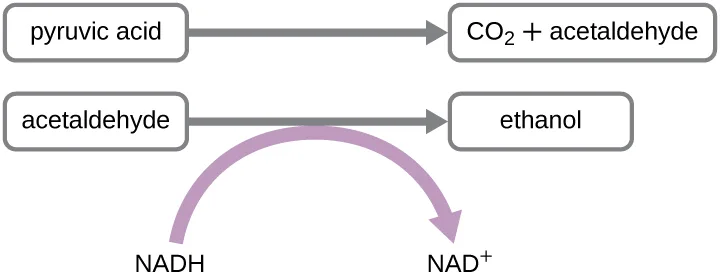
Extended description
Two boxed reactions read left to right. Step one: a box labeled pyruvic acid points by a straight arrow to a box labeled CO₂ + acetaldehyde. Step two, below it: a box labeled acetaldehyde points by a straight arrow to a box labeled ethanol; a curved arrow beneath this second reaction runs from the label NADH to the label NAD⁺, showing that NADH is oxidized to NAD⁺ as acetaldehyde is reduced to ethanol.
Beyond lactic acid fermentation and alcohol fermentation, many other fermentation methods occur in prokaryotes, all for the purpose of ensuring an adequate supply of NAD⁺ for glycolysis (see the table below). Without these pathways, glycolysis would not occur and no ATP would be harvested from the breakdown of glucose. It should be noted that most forms of fermentation besides homolactic fermentation produce gas, commonly CO₂ and/or hydrogen gas. Many of these different types of fermentation pathways are also used in food production and each results in the production of different organic acids, contributing to the unique flavor of a particular fermented food product. The propionic acid produced during propionic acid fermentation contributes to the distinctive flavor of Swiss cheese, for example.
Several fermentation products are important commercially outside of the food industry. For example, chemical solvents such as acetone and butanol are produced during acetone-butanol-ethanol fermentation. Complex organic pharmaceutical compounds used in antibiotics (e.g., penicillin), vaccines, and vitamins are produced through mixed acid fermentation. Fermentation products are used in the laboratory to differentiate various bacteria for diagnostic purposes. For example, enteric bacteria are known for their ability to perform mixed acid fermentation, reducing the pH, which can be detected using a pH indicator. Similarly, the bacterial production of acetoin during butanediol fermentation can also be detected. Gas production from fermentation can also be seen in an inverted Durham tube that traps produced gas in a broth culture.
Microbes can also be differentiated according to the substrates they can ferment. For example, E. coli can ferment lactose, forming gas, whereas some of its close gram-negative relatives cannot. The ability to ferment the sugar alcohol sorbitol is used to identify the pathogenic enterohemorrhagic O157:H7 strain of E. coli because, unlike other E. coli strains, it is unable to ferment sorbitol. Last, mannitol fermentation differentiates the mannitol-fermenting Staphylococcus aureus from other non–mannitol-fermenting staphylococci.
| Pathway | End Products | Example Microbes | Commercial Products |
|---|---|---|---|
| Acetone-butanol-ethanol | Acetone, butanol, ethanol, CO₂ | Clostridium acetobutylicum | Commercial solvents, gasoline alternative |
| Alcohol | Ethanol, CO₂ | Candida, Saccharomyces | Beer, bread |
| Butanediol | Formic and lactic acid; ethanol; acetoin; 2,3 butanediol; CO₂; hydrogen gas | Klebsiella, Enterobacter | Chardonnay wine |
| Butyric acid | Butyric acid, CO₂, hydrogen gas | Clostridium butyricum | Butter |
| Lactic acid | Lactic acid | Streptococcus, Lactobacillus | Sauerkraut, yogurt, cheese |
| Mixed acid | Acetic, formic, lactic, and succinic acids; ethanol, CO₂, hydrogen gas | Escherichia, Shigella | Vinegar, cosmetics, pharmaceuticals |
| Propionic acid | Acetic acid, propionic acid, CO₂ | Cutibacterium, Bifidobacterium | Swiss cheese |
Check Your Understanding
When would a metabolically versatile microbe perform fermentation rather than cellular respiration?
Show model answer
Did your answer mention:
Micro Connection. Identifying Bacteria by Using API Test Panels
Identification of a microbial isolate is essential for the proper diagnosis and appropriate treatment of patients. Scientists have developed techniques that identify bacteria according to their biochemical characteristics. Typically, they either examine the use of specific carbon sources as substrates for fermentation or other metabolic reactions, or they identify fermentation products or specific enzymes present in reactions. In the past, microbiologists have used individual test tubes and plates to conduct biochemical testing. However, scientists, especially those in clinical laboratories, now more frequently use plastic, disposable, multitest panels that contain a number of miniature reaction tubes, each typically including a specific substrate and pH indicator. After inoculation of the test panel with a small sample of the microbe in question and incubation, scientists can compare the results to a database that includes the expected results for specific biochemical reactions for known microbes, thus enabling rapid identification of a sample microbe. These test panels have allowed scientists to reduce costs while improving efficiency and reproducibility by performing a larger number of tests simultaneously.
Many commercial, miniaturized biochemical test panels cover a number of clinically important groups of bacteria and yeasts. One of the earliest and most popular test panels is the Analytical Profile Index (API) panel invented in the 1970s. Once some basic laboratory characterization of a given strain has been performed, such as determining the strain’s Gram morphology, an appropriate test strip that contains 10 to 20 different biochemical tests for differentiating strains within that microbial group can be used. Currently, the various API strips can be used to quickly and easily identify more than 600 species of bacteria, both aerobic and anaerobic, and approximately 100 different types of yeasts. Based on the colors of the reactions when metabolic end products are present, due to the presence of pH indicators, a metabolic profile is created from the results (shown below). Microbiologists can then compare the sample’s profile to the database to identify the specific microbe.

Clinical Focus. Part 2
Many of Hannah’s symptoms are consistent with several different infections, including influenza and pneumonia. However, her sluggish reflexes along with her light sensitivity and stiff neck suggest some possible involvement of the central nervous system, perhaps indicating meningitis. Meningitis is an infection of the cerebrospinal fluid (CSF) around the brain and spinal cord that causes inflammation of the meninges, the protective layers covering the brain. Meningitis can be caused by viruses, bacteria, or fungi. Although all forms of meningitis are serious, bacterial meningitis is particularly serious. Bacterial meningitis may be caused by several different bacteria, but the bacterium Neisseria meningitidis, a gram-negative, bean-shaped diplococcus, is a common cause and leads to death within 1 to 2 days in 5% to 10% of patients.
Given the potential seriousness of Hannah’s conditions, her physician advised her parents to take her to the hospital in the Gambian capital of Banjul and there have her tested and treated for possible meningitis. After a 3-hour drive to the hospital, Hannah was immediately admitted. Physicians took a blood sample and performed a lumbar puncture to test her CSF. They also immediately started her on a course of the antibiotic ceftriaxone, the drug of choice for treatment of meningitis caused by N. meningitidis, without waiting for laboratory test results.
- How might biochemical testing be used to confirm the identity of N. meningitidis?
- Why did Hannah’s doctors decide to administer antibiotics without waiting for the test results?
The case continues in Catabolism of Lipids and Proteins. The case began in Energy, Matter, and Enzymes.
Summary
- Fermentation uses an organic molecule as a final electron acceptor to regenerate NAD⁺ from NADH so that glycolysis can continue.
- Fermentation does not involve an electron transport system, and no ATP is made by the fermentation process directly. Fermenters make very little ATP—only two ATP molecules per glucose molecule during glycolysis.
- Microbial fermentation processes have been used for the production of foods and pharmaceuticals, and for the identification of microbes.
- During lactic acid fermentation, pyruvate accepts electrons from NADH and is reduced to lactic acid. Microbes performing homolactic fermentation produce only lactic acid as the fermentation product; microbes performing heterolactic fermentation produce a mixture of lactic acid, ethanol and/or acetic acid, and CO₂.
- Lactic acid production by the normal microbiota prevents growth of pathogens in certain body regions and is important for the health of the gastrointestinal tract.
- During ethanol fermentation, pyruvate is first decarboxylated (releasing CO₂) to acetaldehyde, which then accepts electrons from NADH, reducing acetaldehyde to ethanol. Ethanol fermentation is used for the production of alcoholic beverages, for making bread products rise, and for biofuel production.
- Fermentation products of pathways (e.g., propionic acid fermentation) provide distinctive flavors to food products. Fermentation is used to produce chemical solvents (acetone-butanol-ethanol fermentation) and pharmaceuticals (mixed acid fermentation).
- Specific types of microbes may be distinguished by their fermentation pathways and products. Microbes may also be differentiated according to the substrates they are able to ferment.
Key terms
- fermentation — process that uses an organic molecule as a final electron acceptor to regenerate NAD⁺ from NADH such that glycolysis can continue.
- homolactic fermentation — process producing only lactic acid as a fermentation product; the microbes that do this use Embden-Meyerhof-Parnas glycolysis.
- heterolactic fermentation — process producing a mixture of lactic acid, ethanol and/or acetic acid, and CO₂ as fermentation products; the microbes that do this use pentose phosphate pathway glycolysis, which is why they generate multiple fermentation products.
Practice
Define fermentation and explain why it does not require oxygen
Which of the following is the purpose of fermentation?
Recall what fermentation regenerates so that the cell’s only remaining ATP-producing pathway can continue.Which molecule typically serves as the final electron acceptor during fermentation?
Recall the organic molecule named as the usual final electron acceptor when fermentation is defined.Fermenting organisms make ATP through the process of ________.
Name the one pathway fermentation depends on for its two ATP molecules per glucose, since fermentation itself makes none directly.Why are some microbes, including Streptococcus spp., unable to perform aerobic respiration, even in the presence of oxygen?
Of the three reasons a cell might be unable to respire, decide which are genetic rather than a matter of an absent electron acceptor — oxygen is already present here — and recall that the module calls Streptococcus permanently incapable, not facultative.Describe the fermentation pathways and their end products and give examples of microorganisms that use these pathways
Which fermentation product is important for making bread rise?
Recall the gas released during the first reaction of ethanol fermentation, before acetaldehyde is reduced to ethanol.Which of the following is not a commercially important fermentation product?
Three of these four are named as fermentation end products or products used commercially in this section; one is only an intermediate the others are made from.The microbe responsible for ethanol fermentation for the purpose of producing alcoholic beverages is ________.
Name the type of eukaryotic microbe identified by genus and species in the Alcohol Fermentation discussion.________ results in the production of a mixture of fermentation products, including lactic acid, ethanol and/or acetic acid, and CO₂.
Contrast this term with homolactic fermentation, which yields only lactic acid because it uses the EMP pathway instead of the branched pentose phosphate pathway.Which commercial product is acetone-butanol-ethanol fermentation used to produce?
Recall which fermentation pathway’s end products include acetone and butanol, chemical solvents described earlier in this section.Which commercial product is alcohol fermentation used to produce?
Recall which product’s rising depends on the CO₂ released during ethanol fermentation.Which commercial product is lactic acid fermentation used to produce?
Recall the dairy product whose highly acidic environment, generated by lactic acid fermentation, denatures milk proteins and solidifies it.Which commercial product is mixed acid fermentation used to produce?
Recall which fermentation pathway produces complex organic compounds used in antibiotics, vaccines, and vitamins.Which commercial product is propionic acid fermentation used to produce?
Recall the cheese whose distinctive flavor comes from the propionic acid produced by this pathway.Sort each fermentation pathway below by whether its end products, as listed in the table above, include ethanol.
Produces ethanol
Does not produce ethanol
How can fermentation be used to differentiate various types of microbes?
Show model answer
Did your answer mention:
Compare and contrast fermentation and anaerobic respiration
Sort each fact about a final electron acceptor or an example microbe under the type of metabolism it describes.
Aerobic respiration
Anaerobic respiration
Fermentation
Which statement correctly compares the maximum ATP yield of fermentation to that of anaerobic respiration?
Compare the Maximum Yield of ATP Molecules column of the table above for the fermentation row and the anaerobic respiration row.The bacterium E. coli is capable of performing aerobic respiration, anaerobic respiration, and fermentation. When would it perform each process and why? How is ATP made in each case?
Show model answer
Did your answer mention:
This section is adapted from Microbiology, Section 8.4: Fermentation by Nina Parker, Mark Schneegurt, Anh-Hue Thi Tu, Philip Lister, Brian M. Forster, and OpenStax, © OpenStax, licensed under CC BY-NC-SA 4.0. Access the original for free at openstax.org. Changes: both source figures re-encoded as WebP and rendered as mediafigures after image and PDF inspection; the ethanol-fermentation reaction figure is set kind="diagram" (a drawn flow diagram) with eager="true" as the first figure on the page, its alt rewritten to fix the source alt’s missing word-boundary (“CO2 andacetaldehyde”) and given a longdesc walking its two reaction steps in order since its caption does not name the mechanism; the API test-strip figure is kind="photo", its alt rewritten from the image using the standard API 20NE well abbreviations (the source alt reads “DNPG” for the first well, printed “ping” for “pink”, printed “MA” for “MAN”, and repeats “IND” for what the strip prints as “INO” — all four logged as suspected source-alt defects); the source’s lactic-acid <equation> is rendered as its own plain-text paragraph with the Unicode double arrow and NAD⁺, not $…$; both CALS tables (Comparison of Respiration Versus Fermentation; Common Fermentation Pathways) are transcribed as Markdown from the CNXML cells, checked against the PDF page, never from the summary attribute, and each gets its own sortbins in the Practice block — the Respiration-vs-Fermentation table’s sortbins sorts the final electron acceptor and example microbe of each metabolic type, and the Common-Fermentation-Pathways table’s sortbins sorts by whether a pathway’s end products include ethanol, deliberately avoiding the pathway↔commercial-product mapping the Matching exercise already tests; same-module figure and table cross-references are rendered as describing prose (“the table below,” “shown below”); the Micro Connection and Clinical Focus boxes are rendered as callouts in source order, the Micro Connection’s figure kept at its document position inside the callout; the Clinical Focus box’s closing “Jump to the next / go back to the previous Clinical Focus box” links are replaced by a sentence naming where the case continues, Catabolism of Lipids and Proteins, and where it began, Energy, Matter, and Enzymes; its two closing questions stay inside the callout as unanswered plain bullets; the body Check Your Understanding bullet is a self-check, because its honest answer assembles two sentences from two different paragraphs (the facultative-switch sentence and the following paragraph’s “if respiration does not occur … fermentation” sentence) rather than resting on one fixing sentence, with a model answer and rubric quoting both; the four source Multiple Choice items, three Fill in the Blank items (one, the yeast/Saccharomyces cerevisiae answer, keeps yeast as the graded answer with the binomial in accept; one, the Heterolactic fermentation answer, adds the bare adjective heterolactic to accept per parent adjudication, since the stem’s blank is the pathway name and a learner who types the adjective alone is not wrong), and the five-row Matching exercise (keyed 1. e; 2. a; 3. d; 4. b; 5. c) — rendered as five multiple-choice items, one per pathway, each offering all five lettered commercial products in the table’s own order — are adapted into Practice; of the two unkeyed Short Answer questions, the Streptococcus one is graded as a multiple-choice from the module’s own list of why a cell cannot respire, with only two honest distractors the module itself supports (the electron-acceptor reason, wrong here because the stem states oxygen is present; and the module’s own facultative-switch concept, wrong because the module calls Streptococcus permanently incapable rather than facultative), and the microbe-differentiation one stays a self-check whose model answer and rubric are assembled only from this module’s diagnostic and substrate-fermentation paragraphs; the unkeyed Critical Thinking question (E. coli’s three metabolic modes) stays a self-check assembled from the facultative-switch sentence and the comparison table’s own values; one author-written multiple-choice comparing the fermentation and anaerobic-respiration ATP-yield figures from the comparison table is added to bring the third objective’s group to the book’s floor; key terms compiled from the module’s three defined terms and the book’s Glossary appendix, all three definitions taken directly from the Glossary. No source exercise item is otherwise omitted.