Photosynthesis
By the end of this section, you will be able to:
- Describe the function and locations of photosynthetic pigments in eukaryotes and prokaryotes
- Describe the major products of the light-dependent and light-independent reactions
- Describe the reactions that produce glucose in a photosynthetic cell
- Compare and contrast cyclic and noncyclic photophosphorylation
Heterotrophic organisms ranging from E. coli to humans rely on the chemical energy found mainly in carbohydrate molecules. Many of these carbohydrates are produced by photosynthesis, the biochemical process by which phototrophic organisms convert solar energy (sunlight) into chemical energy. Although photosynthesis is most commonly associated with plants, microbial photosynthesis is also a significant supplier of chemical energy, fueling many diverse ecosystems. In this section, we will focus on microbial photosynthesis.
Photosynthesis takes place in two sequential stages: the light-dependent reactions and the light-independent reactions (the diagram below). In the light-dependent reactions, energy from sunlight is absorbed by pigment molecules in photosynthetic membranes and converted into stored chemical energy. In the light-independent reactions, the chemical energy produced by the light-dependent reactions is used to drive the assembly of sugar molecules using CO₂; however, these reactions are still light dependent because the products of the light-dependent reactions necessary for driving them are short-lived. The light-dependent reactions produce ATP and either NADPH or NADH to temporarily store energy. These energy carriers are used in the light-independent reactions to drive the energetically unfavorable process of “fixing” inorganic CO₂ in an organic form, sugar.
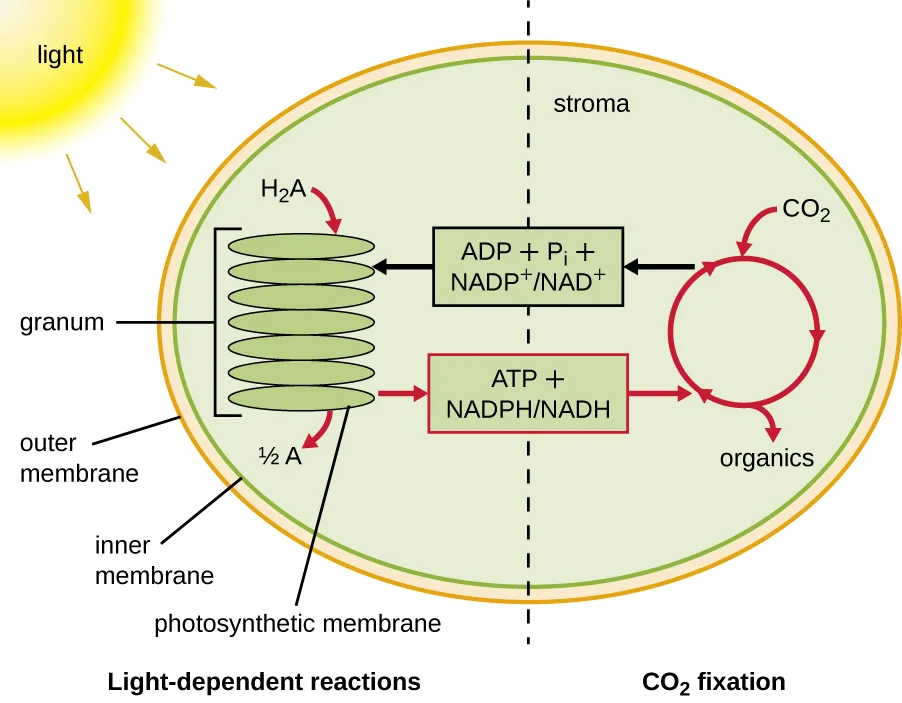
Extended description
The oval chloroplast is divided by a dashed vertical line into the light-dependent reactions (left) and CO₂ fixation (right). On the left, three yellow arrows carry light onto a stack of green disc-shaped membranes labeled the granum (the photosynthetic membrane), sitting between an outer membrane and an inner membrane; a red arrow labeled H₂A points into the top of the stack, and a second red arrow labeled ½A points out of its bottom. A red arrow leads right from the granum to a box reading ATP + NADPH/NADH, and a black arrow leads left from a box reading ADP + Pᵢ + NADP⁺/NAD⁺ back into the granum. On the right, a red circular arrow represents the CO₂ fixation cycle: CO₂ enters the cycle at the upper right, the ATP + NADPH/NADH box feeds into the cycle from the left, the cycle releases organics at the lower right, and a black arrow carries ADP + Pᵢ + NADP⁺/NAD⁺ back out of the cycle to the left, closing the loop with the light-dependent side.
Photosynthetic Structures in Eukaryotes and Prokaryotes
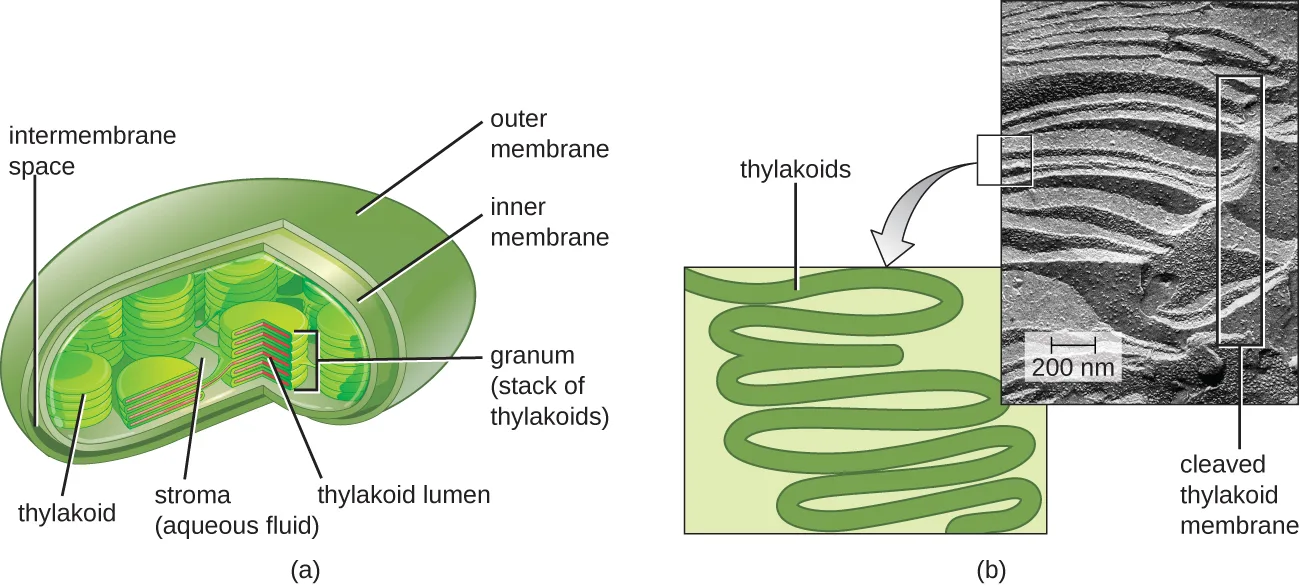
In all phototrophic eukaryotes, photosynthesis takes place inside a chloroplast, an organelle that arose in eukaryotes by endosymbiosis of a photosynthetic bacterium (see Unique Characteristics of Eukaryotic Cells). These chloroplasts are enclosed by a double membrane with inner and outer layers. Within the chloroplast is a third membrane that forms stacked, disc-shaped photosynthetic structures called thylakoids (the diagram below). A stack of thylakoids is called a granum, and the space surrounding the granum within the chloroplast is called stroma.
Photosynthetic membranes in prokaryotes, by contrast, are not organized into distinct membrane-enclosed organelles; rather, they are infolded regions of the plasma membrane. In cyanobacteria, for example, these infolded regions are also referred to as thylakoids. In either case, embedded within the thylakoid membranes or other photosynthetic bacterial membranes are photosynthetic pigment molecules organized into one or more photosystems, where light energy is actually converted into chemical energy.
Photosynthetic pigments within the photosynthetic membranes are organized into photosystems, each of which is composed of a light-harvesting (antennae) complex and a reaction center. The light-harvesting complex consists of multiple proteins and associated pigments that each may absorb light energy and, thus, become excited. This energy is transferred from one pigment molecule to another until eventually (after about a millionth of a second) it is delivered to the reaction center. Up to this point, only energy—not electrons—has been transferred between molecules. The reaction center contains a pigment molecule that can undergo oxidation upon excitation, actually giving up an electron. It is at this step in photosynthesis that light energy is converted into an excited electron.
Different kinds of light-harvesting pigments absorb unique patterns of wavelengths (colors) of visible light. Pigments reflect or transmit the wavelengths they cannot absorb, making them appear the corresponding color. Examples of photosynthetic pigments (molecules used to absorb solar energy) are bacteriochlorophylls (green, purple, or red), carotenoids (orange, red, or yellow), chlorophylls (green), phycocyanins (blue), and phycoerythrins (red). By having mixtures of pigments, an organism can absorb energy from more wavelengths. Because photosynthetic bacteria commonly grow in competition for sunlight, each type of photosynthetic bacteria is optimized for harvesting the wavelengths of light to which it is commonly exposed, leading to stratification of microbial communities in aquatic and soil ecosystems by light quality and penetration.
Once the light harvesting complex transfers the energy to the reaction center, the reaction center delivers its high-energy electrons, one by one, to an electron carrier in an electron transport system, and electron transfer through the ETS is initiated. The ETS is similar to that used in cellular respiration and is embedded within the photosynthetic membrane. Ultimately, the electron is used to produce NADH or NADPH. The electrochemical gradient that forms across the photosynthetic membrane is used to generate ATP by chemiosmosis through the process of photophosphorylation, another example of oxidative phosphorylation (the figure below).
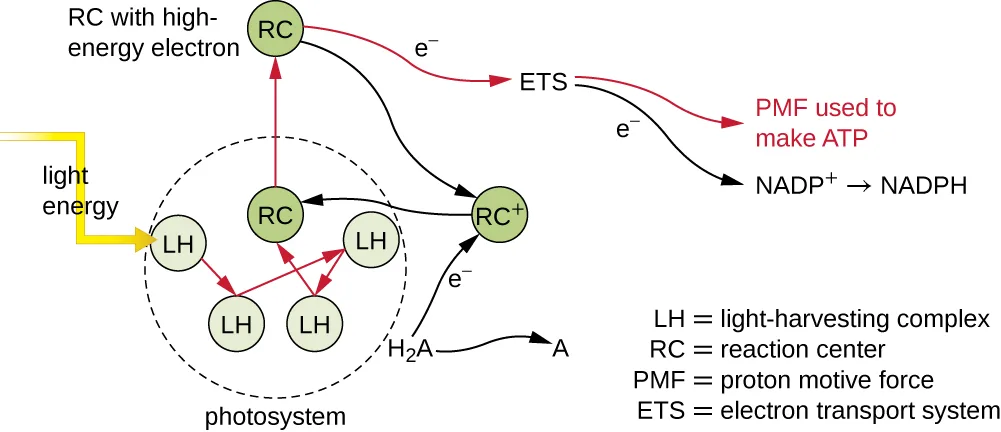
Extended description
Light energy (yellow arrow, lower left) strikes a light-harvesting (LH) pigment inside the dashed circle marking the photosystem. That energy passes from one LH pigment to another (red double-headed arrows) and then to the reaction center (RC) pigment at the top of the circle, exciting an electron. The excited electron (red arrow) leaves the RC pigment for the electron transport system (ETS) outside the circle; the ETS uses the resulting proton motive force (PMF) to make ATP and separately reduces NADP⁺ to NADPH (both shown as arrows branching to the right). The oxidized RC pigment (RC⁺) recovers a replacement electron from a reduced molecule H₂A, which is thereby converted to A (black arrows, lower right).
Check Your Understanding
In a phototrophic eukaryote, where does photosynthesis take place?
Identify the double-membrane-bound organelle this subsection names as the site of eukaryotic photosynthesis.Oxygenic and Anoxygenic Photosynthesis
For photosynthesis to continue, the electron lost from the reaction center pigment must be replaced. The source of this electron (H₂A) differentiates the oxygenic photosynthesis of plants and cyanobacteria from anoxygenic photosynthesis carried out by other types of bacterial phototrophs (the figure below). In oxygenic photosynthesis, H₂O is split and supplies the electron to the reaction center. Because oxygen is generated as a byproduct and is released, this type of photosynthesis is referred to as oxygenic photosynthesis. However, when other reduced compounds serve as the electron donor, oxygen is not generated; these types of photosynthesis are called anoxygenic photosynthesis. Hydrogen sulfide (H₂S) or thiosulfate (S₂O₃²⁻) can serve as the electron donor, generating elemental sulfur and sulfate (SO₄²⁻) ions, respectively, as a result.
After several scientists hypothesized that two light reactions, rather than one, were required to split water and capture energy, Joan Mary Anderson undertook a series of experiments to prove the existence of two types of photosystems: photosystem I (PSI) and photosystem II (PSII) (the figure below). Working with colleague Keith Boardman, Anderson chemically fragmented active chloroplasts, then used a centrifuge to separate the components. She was able to demonstrate that different portions of the chloroplasts produced different products, thereby showing that there were two parts to the photosystems. This work also laid the foundation to understanding how the structures within the chloroplasts related to the different systems. Cyanobacteria and plant chloroplasts have both photosystems, whereas anoxygenic photosynthetic bacteria use only one of the photosystems. Both photosystems are excited by light energy simultaneously. If the cell requires both ATP and NADPH for biosynthesis, then it will carry out noncyclic photophosphorylation. Upon passing of the PSII reaction center electron to the ETS that connects PSII and PSI, the lost electron from the PSII reaction center is replaced by the splitting of water. The excited PSI reaction center electron is used to reduce NADP⁺ to NADPH and is replaced by the electron exiting the ETS. The flow of electrons in this way is called the Z-scheme.
If a cell’s need for ATP is significantly greater than its need for NADPH, it may bypass the production of reducing power through cyclic photophosphorylation. Only PSI is used during cyclic photophosphorylation; the high-energy electron of the PSI reaction center is passed to an ETS carrier and then ultimately returns to the oxidized PSI reaction center pigment, thereby reducing it.
![Oxygenic photosynthesis: 6CO₂ + 12H₂O + light energy → C₆H₁₂O₆ + 6O₂ + 6H₂O (carbon dioxide + water + light energy → glucose + oxygen + water). Anoxygenic photosynthesis: CO₂ + 2H₂A + light energy → [CH₂O] + 2A + H₂O (carbon dioxide + an electron donor + light energy → a carbohydrate + water), where H₂A stands for H₂O, H₂S, H₂, or another electron donor.](/media/microbiology/OSC_Microbio_08_06_PhotoEquat-787.webp)
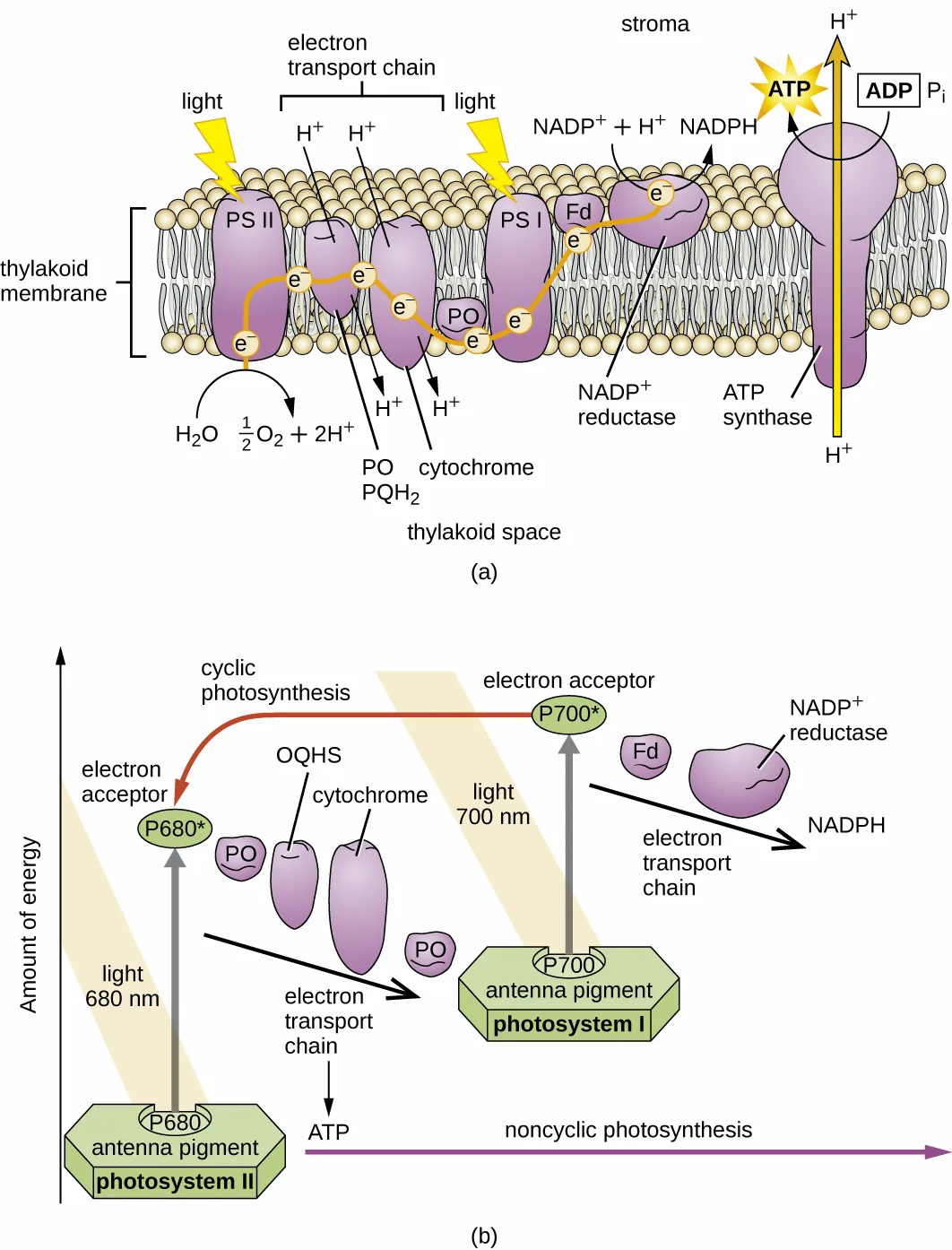
Extended description
Panel (a) follows one electron’s path left to right along the thylakoid membrane. Light striking photosystem II (PS II) splits a water molecule into ½O₂, two H⁺ ions released into the thylakoid space, and an electron. That electron passes through a short chain of membrane-embedded carriers — plastoquinone (PQ; the artwork itself prints this label as “PO”), paired with its reduced form PQH₂, then a cytochrome complex, then a second carrier the artwork also labels “PO” — toward photosystem I (PS I), and H⁺ is pumped from the stroma into the thylakoid space at two points along this chain. A second photon striking PS I re-excites the same electron, which passes to ferredoxin (Fd) and then to NADP⁺ reductase, which combines it with NADP⁺ and H⁺ to form NADPH. Separately, the H⁺ ions that built up in the thylakoid space flow back out to the stroma through ATP synthase, driving ATP synthesis from ADP and Pᵢ. Panel (b) plots the same path as electron energy (vertical axis) against the PS II-to-PS I sequence (horizontal axis): light at 680 nm raises the PS II reaction-center electron from P680 to its excited state, the electron loses energy stepping through the same carrier chain to PS I, light at 700 nm raises the PS I electron to its own excited state, and the electron then loses energy again passing through ferredoxin and NADP⁺ reductase to form NADPH — this full left-to-right path is noncyclic photosynthesis. A red arrow shows the alternative, cyclic path: the excited PS I electron returns directly to the PS II-side electron acceptor instead of continuing on to NADP⁺ reductase.
Check Your Understanding
Why would a photosynthetic bacterium have different pigments?
Look at the sentence right after this subsection introduces the idea of pigment mixtures, just before the point about competition for sunlight.Light-Independent Reactions
After the energy from the sun is converted into chemical energy and temporarily stored in ATP and NADPH molecules (having lifespans of millionths of a second), photoautotrophs have the fuel needed to build multicarbon carbohydrate molecules, which can survive for hundreds of millions of years, for long-term energy storage. The carbon comes from CO₂, the gas that is a waste product of cellular respiration.
The Calvin-Benson cycle (named for Melvin Calvin [1911–1997] and Andrew Benson [1917–2015]), the biochemical pathway used for fixation of CO₂, is located within the cytoplasm of photosynthetic bacteria and in the stroma of eukaryotic chloroplasts. The light-independent reactions of the Calvin cycle can be organized into three basic stages: fixation, reduction, and regeneration (see Appendix C for a detailed illustration of the Calvin cycle).
- Fixation: The enzyme ribulose bisphosphate carboxylase (RuBisCO) catalyzes the addition of a CO₂ to ribulose bisphosphate (RuBP). This results in the production of 3-phosphoglycerate (3-PGA).
- Reduction: Six molecules of both ATP and NADPH (from the light-dependent reactions) are used to convert 3-PGA into glyceraldehyde 3-phosphate (G3P). Some G3P is then used to build glucose.
- Regeneration: The remaining G3P not used to synthesize glucose is used to regenerate RuBP, enabling the system to continue CO₂ fixation. Three more molecules of ATP are used in these regeneration reactions.
The Calvin cycle is used extensively by plants and photoautotrophic bacteria, and the enzyme RuBisCO is said to be the most plentiful enzyme on earth, composing 30%–50% of the total soluble protein in plant chloroplasts. (A. Dhingra et al. “Enhanced Translation of a Chloroplast-Expressed RbcS Gene Restores Small Subunit Levels and Photosynthesis in Nuclear RbcS Antisense Plants.” Proceedings of the National Academy of Sciences of the United States of America 101 no. 16 (2004):6315–6320.) However, besides its prevalent use in photoautotrophs, the Calvin cycle is also used by many nonphotosynthetic chemoautotrophs to fix CO₂. Additionally, other bacteria and archaea use alternative systems for CO₂ fixation. Although most bacteria using Calvin cycle alternatives are chemoautotrophic, certain green sulfur photoautotrophic bacteria have been also shown to use an alternative CO₂ fixation pathway.
Check Your Understanding
Describe the three stages of the Calvin cycle.
Show model answer
Did your answer mention:
Summary
- Heterotrophs depend on the carbohydrates produced by autotrophs, many of which are photosynthetic, converting solar energy into chemical energy.
- Different photosynthetic organisms use different mixtures of photosynthetic pigments, which increase the range of the wavelengths of light an organism can absorb.
- Photosystems (PSI and PSII) each contain a light-harvesting complex, composed of multiple proteins and associated pigments that absorb light energy. The light-dependent reactions of photosynthesis convert solar energy into chemical energy, producing ATP and NADPH or NADH to temporarily store this energy.
- In oxygenic photosynthesis, H₂O serves as the electron donor to replace the reaction center electron, and oxygen is formed as a byproduct. In anoxygenic photosynthesis, other reduced molecules like H₂S or thiosulfate may be used as the electron donor; as such, oxygen is not formed as a byproduct.
- Noncyclic photophosphorylation is used in oxygenic photosynthesis when there is a need for both ATP and NADPH production. If a cell’s needs for ATP outweigh its needs for NADPH, then it may carry out cyclic photophosphorylation instead, producing only ATP.
- The light-independent reactions of photosynthesis use the ATP and NADPH from the light-dependent reactions to fix CO₂ into organic sugar molecules.
Key terms
- photosynthesis — process whereby phototrophic organisms convert solar energy into chemical energy that can then be used to build carbohydrates.
- light-dependent reaction — process by which energy from sunlight is absorbed by pigment molecules in photosynthetic membranes and converted into stored chemical energy in the forms of ATP and NADPH.
- light-independent reaction — process by which chemical energy, in the form of ATP and NADPH produced by the light-dependent reactions, is used to fix inorganic CO₂ into organic sugar; usually referred to as the Calvin-Benson cycle.
- chloroplast — organelle found in plant and algal cells in which photosynthesis occurs.
- photosynthetic pigment — pigment molecule used by a cell to absorb solar energy; each one appears the color of light that it transmits or reflects.
- photosystem — organized unit of pigments found within a photosynthetic membrane, containing both a light-harvesting complex and a reaction center.
- light-harvesting complex — group of multiple proteins and associated pigments that each may absorb light energy to become excited, and transfer this energy from one pigment molecule to another until the energy is delivered to a reaction center pigment.
- reaction center — protein complex in a photosystem, containing a pigment molecule that can undergo oxidation upon excitation by a light-harvesting pigment, actually giving up an electron.
- oxygenic photosynthesis — type of photosynthesis found in plants, algae, and cyanobacteria, and in which H₂O is used as the electron donor to replace an electron lost by a reaction center pigment, resulting in oxygen as a byproduct.
- anoxygenic photosynthesis — type of photosynthesis found in many photosynthetic bacteria, including the purple and green bacteria, where an electron donor other than H₂O is used to replace an electron lost by a reaction center pigment, resulting no oxygen production.
- noncyclic photophosphorylation — pathway used in photosynthetic organisms when both ATP and NADPH are required by the cell.
- Z-scheme — electron flow seen in noncyclic photophosphorylation in plants, algae, and cyanobacteria due to the use of both PSI and PSII.
- cyclic photophosphorylation — pathway used in photosynthetic organisms when the cell’s need for ATP outweighs that for NADPH, thus bypassing NADPH production.
- Calvin-Benson cycle — most common CO₂ fixation pathway in most photoautotrophs; involves light-independent reactions of photosynthesis that occur in the cytoplasm of photosynthetic bacteria and in the stroma of eukaryotic chloroplasts.
- ribulose bisphosphate carboxylase (RuBisCO) — first enzyme of the Calvin cycle responsible for adding a CO₂ molecule onto a five-carbon ribulose bisphosphate (RuBP) molecule.
Practice
Describe the function and locations of photosynthetic pigments in eukaryotes and prokaryotes
In prokaryotes, in which direction are hydrogen ions pumped by the electron transport system of photosynthetic membranes?
Prokaryotes have no membrane-bound organelle enclosing their photosynthetic membranes, so the electron transport system pumps across the plasma membrane itself, not into an internal compartment.The types of pigment molecules found in plants, algae, and cyanobacteria are ________.
Two of the five photosynthetic pigment types this section names are the ones common to plants, algae, and cyanobacteria; the others belong to other bacterial phototrophs.What is the function of photosynthetic pigments in the light-harvesting complex?
Show model answer
Did your answer mention:
Describe the major products of the light-dependent and light-independent reactions
During the light-dependent reactions, which molecule loses an electron?
Recall which of the two kinds of pigment in a photosystem actually gives up an electron upon excitation, rather than only passing energy along.Which of the following are two products of the light-dependent reactions?
These are the two energy carriers the light-dependent reactions produce to temporarily store chemical energy for the light-independent reactions.Photosynthesis always results in the formation of oxygen.
Compare this statement with the difference between oxygenic and anoxygenic photosynthesis.Describe the reactions that produce glucose in a photosynthetic cell
The enzyme responsible for CO₂ fixation during the Calvin cycle is called ________.
Name the enzyme this section calls the most plentiful enzyme on earth.Six molecules of both ATP and NADPH from the light-dependent reactions are used to convert 3-PGA into ________.
Some of this molecule is used to build glucose; the rest regenerates RuBP.Is life dependent on the carbon fixation that occurs during the light-independent reactions of photosynthesis? Explain.
Show model answer
Did your answer mention:
Compare and contrast cyclic and noncyclic photophosphorylation
Which of the following does not occur during cyclic photophosphorylation in cyanobacteria?
Cyclic photophosphorylation bypasses the production of one particular energy carrier.Why would an organism perform cyclic phosphorylation instead of noncyclic phosphorylation?
Compare a cell’s relative need for ATP against its need for NADPH — this pathway meets primarily one of them.Sort each feature below under the type of photophosphorylation it describes.
Cyclic photophosphorylation
Noncyclic photophosphorylation
This section is adapted from Microbiology, Section 8.6: Photosynthesis by Nina Parker, Mark Schneegurt, Anh-Hue Thi Tu, Philip Lister, Brian M. Forster, and OpenStax, © OpenStax, licensed under CC BY-NC-SA 4.0. Access the original for free at openstax.org. Changes: all five figures are re-encoded as WebP and rendered as mediafigures, all given explicit kind="diagram" after image inspection (the manifest guessed “photo” for all five because every source file is a JPEG, but all five are drawn schematics); the thylakoid-structure figure’s source alt misspelled “thylakoids” as “thyladoids,” corrected without a source note (a suspected source-alt defect, logged); the photosystem-mechanism figure’s source alt misspelled “also” as “aslo” and named the electron transport system “ETC” in one place after calling it “ETS” everywhere else in the same sentence, both corrected without a source note (suspected source-alt defects, logged); the PSI/PSII figure’s own artwork — not just its source alt — prints the label “PO” three times (paired with “PQH2” in panel a, and again as an unlabeled-further carrier after “cytochrome” in panel a and twice more in panel b) and never prints “PQ” or “PC” anywhere; the longdesc identifies only the carrier paired with the artwork’s own “PQH2” label as plastoquinone (PQ), disclosing that the artwork itself prints that label as “PO” (a suspected artwork defect, logged for the parent’s errata file), and describes the other “PO”-labelled carrier only by its position, between the cytochrome complex and PSI, without naming it as plastocyanin, since the artwork gives it no distinguishing text of its own; the equation figure (a rendered image of the oxygenic/anoxygenic reaction equations) has its alt rewritten with Unicode formulas and arrows rather than reused verbatim, since the source alt states the equations in words only; five same-module figure cross-references (<link target-id>) are rendered as “the diagram below,” “the figure below,” or “(a)”/"(b)" callouts; the cross-reference to Section 3.4 is an absolute site-root Markdown link (the page exists); the cross-reference to Appendix C is left as plain text (not authored); the light-dependent-reactions, photosystem-mechanism, and PSI/PSII figures each carry a longdesc walking their electron or metabolite flow in the order drawn, since none is fully named by its caption; the one footnote (a PNAS citation) is rendered as an inline parenthetical after the sentence it supports, with no bare access URL to drop and no DOI printed; of the section’s three body Check Your Understanding bullets, the first (where eukaryotic photosynthesis takes place) is graded as a text-recall from the subsection’s own defining sentence, the second (why a photosynthetic bacterium would have different pigments) is graded as a multiple choice from the module’s own “more wavelengths” sentence, with distractors built from this module’s other pathway facts, and the third (the three stages of the Calvin cycle) remains a self-check because its honest answer assembles three bulleted stages into one description; the section’s four Multiple Choice and one True/False item (rendered as two-option multiple choice, True then False) keep the source’s own keys and option order; of the two Fill in the Blank items, the RuBisCO item keeps the source key with accept="RuBisCO" (the brief’s suggested accept="RuBisCO|rubisco" was rejected by verify-section as a duplicate normalization, reported below), and the two-blank “chlorophylls and carotenoids” item — unordered — is rendered as one textin whose accept list carries the reversed order plus the singular and mixed-number forms a learner might type (the grader’s plural fold is one-directional, so chlorophyll and carotenoid, carotenoid and chlorophyll, carotenoids and chlorophyll, and chlorophylls and carotenoid are each listed once — each already covers its own regular-plural variant by the grader’s own fold, confirmed against assets/js/lib/text/check-text.mjs for all eight number/order combinations); of the two unkeyed Short Answer questions, “why cyclic instead of noncyclic phosphorylation” is graded as a multiple choice from the module’s own single sentence about a cell’s relative ATP/NADPH need, with distractors built from this module’s other pigment and photosynthesis-type facts, and “the function of photosynthetic pigments in the light-harvesting complex” remains a self-check because its honest answer assembles two sentences (absorption, then energy transfer to the reaction center); the unkeyed Critical Thinking question (whether life depends on the carbon fixation of the light-independent reactions) remains a self-check, assembled from this module’s own opening and Calvin-cycle sentences, because the module never states the conclusion outright; no source exercise was omitted; two filler items round out two Practice groups past their own three source items — a text-recall textin for glyceraldehyde 3-phosphate (G3P) from the Reduction step’s own sentence, and a sortbins comparing cyclic and noncyclic photophosphorylation built from this module’s own distinguishing sentences, since this section is one of the “compare and contrast” objectives but prints no comparison table; key terms are compiled from the module’s 15 defined terms and the book’s Glossary appendix, all 15 definitions taken directly from the Glossary.