Biogeochemical Cycles
By the end of this section, you will be able to:
- Define and describe the importance of microorganisms in the biogeochemical cycles of carbon, nitrogen, and sulfur
- Define and give an example of bioremediation
Energy flows directionally through ecosystems, entering as sunlight for phototrophs or as inorganic molecules for chemoautotrophs. The six most common elements associated with organic molecules—carbon, hydrogen, nitrogen, oxygen, phosphorus, and sulfur—take a variety of chemical forms and may exist for long periods in the atmosphere, on land, in water, or beneath earth’s surface. Geologic processes, such as erosion, water drainage, the movement of the continental plates, and weathering, all are involved in the cycling of elements on earth. Because geology and chemistry have major roles in the study of this process, the recycling of inorganic matter between living organisms and their nonliving environment is called a biogeochemical cycle. Here, we will focus on the function of microorganisms in these cycles, which play roles at each step, most frequently interconverting oxidized versions of molecules with reduced ones.
Carbon Cycle
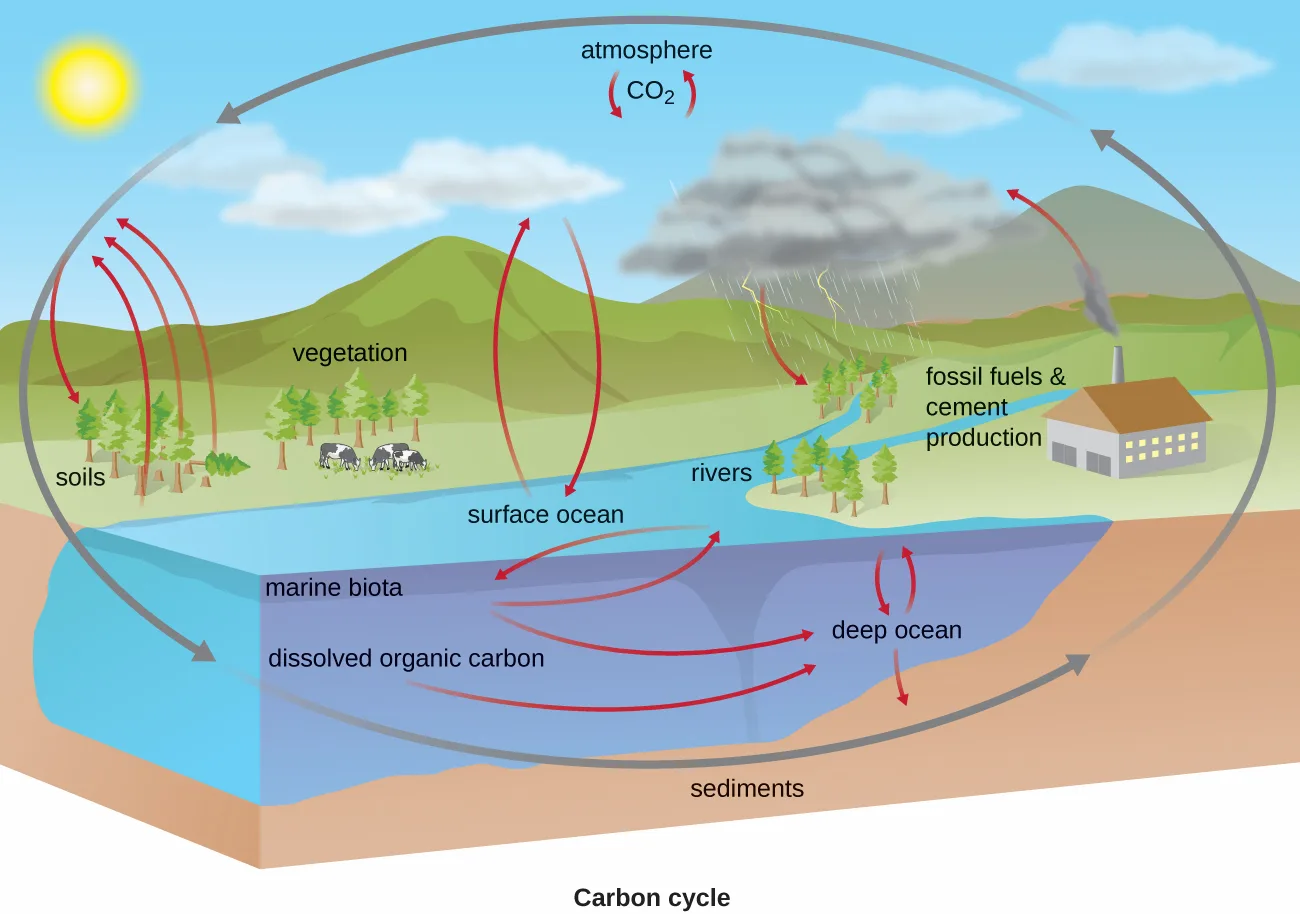
Carbon is one of the most important elements to living organisms, as shown by its abundance and presence in all organic molecules. The carbon cycle exemplifies the connection between organisms in various ecosystems. Carbon is exchanged between heterotrophs and autotrophs within and between ecosystems primarily by way of atmospheric CO₂, a fully oxidized version of carbon that serves as the basic building block that autotrophs use to build multicarbon, high-energy organic molecules such as glucose. Photoautotrophs and chemoautotrophs harness energy from the sun and from inorganic chemical compounds, respectively, to covalently bond carbon atoms together into reduced organic compounds whose energy can be later accessed through the processes of respiration and fermentation (see the figure below).
Overall, there is a constant exchange of CO₂ between the heterotrophs (which produce CO₂ as a result of respiration or fermentation) and the autotrophs (which use the CO₂ for fixation). Autotrophs also respire or ferment, consuming the organic molecules they form; they do not fix carbon for heterotrophs, but rather use it for their own metabolic needs.
Bacteria and archaea that use methane as their carbon source are called methanotrophs. Reduced one-carbon compounds like methane accumulate in certain anaerobic environments when CO₂ is used as a terminal electron acceptor in anaerobic respiration by archaea called methanogens. Some methanogens also ferment acetate (two carbons) to produce methane and CO₂. Methane accumulation due to methanogenesis occurs in both natural anaerobic soil and aquatic environments; methane accumulation also occurs as a result of animal husbandry because methanogens are members of the normal microbiota of ruminants. Environmental methane accumulation due to methanogenesis is of consequence because it is a strong greenhouse gas, and methanotrophs help to reduce atmospheric methane levels.
Extended description
Reading the diagram’s red arrows: CO2 in the atmosphere exchanges with soils and vegetation, with arrows running up from both soils and vegetation to the atmosphere, showing carbon returning to the air. CO2 also moves between the atmosphere and the surface ocean, with arrows in both directions. Rain from the clouds feeds the rivers, which run past the vegetation toward the ocean, and the fossil-fuels-and-cement-production building sends an arrow of CO2 up to the atmosphere. Underwater, arrows connect the surface ocean with marine biota and dissolved organic carbon, which in turn connect to the deep ocean; the deep ocean exchanges with the sediments below it. A large gray oval arrow frames the whole illustration, marking it as a cycle.
Check Your Understanding
Describe the interaction between heterotrophs and autotrophs in the carbon cycle.
Compare what heterotrophs release through respiration and fermentation with what autotrophs do with that same molecule.Nitrogen Cycle
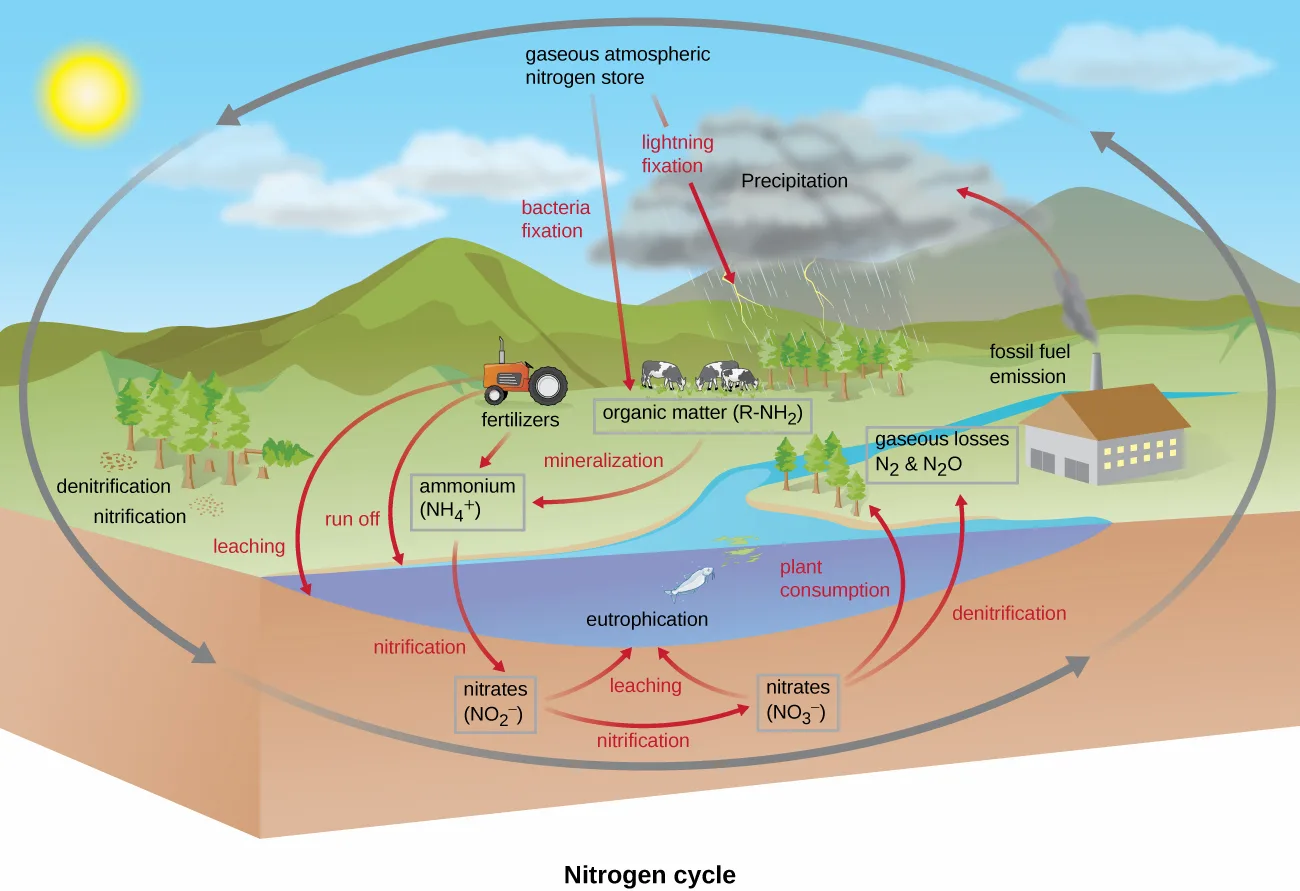
Many biological macromolecules, including proteins and nucleic acids, contain nitrogen; however, getting nitrogen into living organisms is difficult. Prokaryotes play essential roles in the nitrogen cycle (see the figure below), transforming nitrogen between various forms for their own needs, benefiting other organisms indirectly. Plants and phytoplankton cannot incorporate nitrogen from the atmosphere (where it exists as tightly bonded, triple covalent N₂), even though this molecule composes approximately 78% of the atmosphere. Nitrogen enters the living world through free-living and symbiotic bacteria, which incorporate nitrogen into their macromolecules through specialized biochemical pathways called nitrogen fixation. Cyanobacteria in aquatic ecosystems fix inorganic nitrogen (from nitrogen gas) into ammonia (NH₃) that can be easily incorporated into biological macromolecules. Rhizobium bacteria (see the chapter introduction) also fix nitrogen and live symbiotically in the root nodules of legumes (such as beans, peanuts, and peas), providing them with needed organic nitrogen while receiving fixed carbon as sugar in exchange. Free-living bacteria, such as members of the genus Azotobacter, are also able to fix nitrogen.
The nitrogen that enters living systems by nitrogen fixation is eventually converted from organic nitrogen back into nitrogen gas by microbes through three steps: ammonification, nitrification, and denitrification. In terrestrial systems, the first step is the ammonification process, in which certain bacteria and fungi convert nitrogenous waste from living animals or from the remains of dead organisms into ammonia (NH₃). This ammonia is then oxidized to nitrite (NO₂⁻), then to nitrate (NO₃⁻), by nitrifying soil bacteria such as members of the genus Nitrosomonas, through the process of nitrification. Last, the process of denitrification occurs, whereby soil bacteria, such as members of the genera Pseudomonas and Clostridium, use nitrate as a terminal electron acceptor in anaerobic respiration, converting it into nitrogen gas that reenters the atmosphere. A similar process occurs in the marine nitrogen cycle, where these three processes are performed by marine bacteria and archaea.
Human activity releases nitrogen into the environment by the use of artificial fertilizers that contain nitrogen and phosphorus compounds, which are then washed into lakes, rivers, and streams by surface runoff. A major effect from fertilizer runoff is saltwater and freshwater eutrophication, in which nutrient runoff causes the overgrowth and subsequent death of aquatic algae, making water sources anaerobic and inhospitable for the survival of aquatic organisms.
Extended description
Reading the diagram’s labeled arrows in sequence: atmospheric nitrogen gas is converted to organic matter (R-NH2) by two fixation pathways, labeled ’lightning fixation’ and ‘bacteria fixation.’ Fertilizers, applied by tractor, and ‘mineralization’ of organic matter both lead to an ammonium (NH4+) box. From ammonium, ‘run off’ and ’leaching’ arrows lead to a box the diagram itself labels ’nitrates (NO2-),’ which an arrow labeled ’nitrification’ converts to a box labeled ’nitrates (NO3-).’ From the nitrate boxes, a ‘plant consumption’ arrow leads back toward the organic-matter side of the cycle and a ‘denitrification’ arrow leads to a box labeled ‘gaseous losses N2 & N2O,’ which also receives an arrow from a smokestack building labeled ‘fossil fuel emission.’ A lake in the middle of the scene is labeled ’eutrophication,’ fed by the run-off and leaching arrows. A large gray oval arrow frames the whole illustration.
Check Your Understanding
What are the four steps of the nitrogen cycle?
Show model answer
Did your answer mention:
Link to Learning
To learn more about the nitrogen cycle, visit the PBS website.
Sulfur Cycle
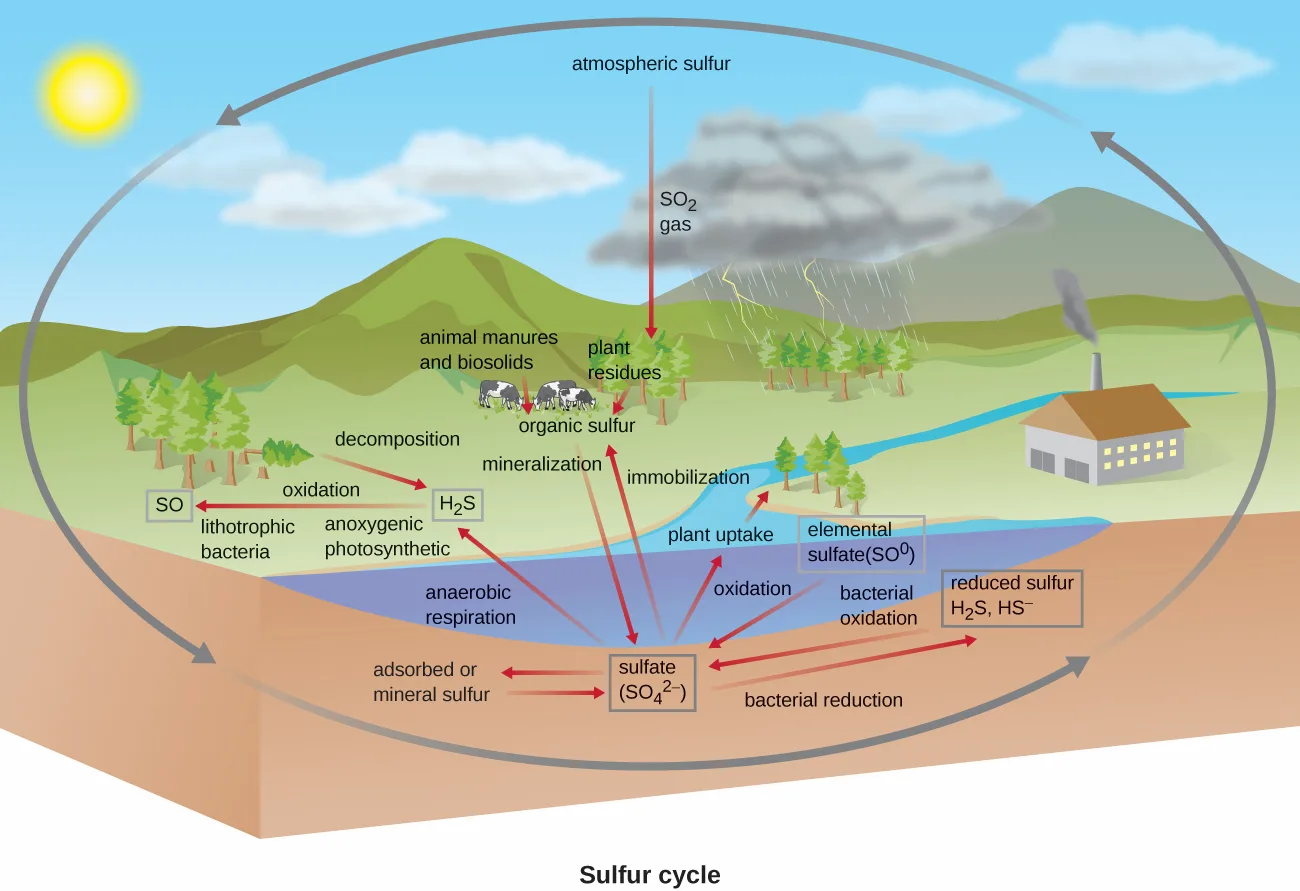
Sulfur is an essential element for the macromolecules of living organisms. As part of the amino acids cysteine and methionine, it is involved in the formation of proteins. It is also found in several vitamins necessary for the synthesis of important biological molecules like coenzyme A. Several groups of microbes are responsible for carrying out processes involved in the sulfur cycle (see the figure below). Anoxygenic photosynthetic bacteria as well as chemoautotrophic archaea and bacteria use hydrogen sulfide as an electron donor, oxidizing it first to elemental sulfur (S⁰), then to sulfate (SO₄²⁻). This leads to stratification of hydrogen sulfide in soil, with levels increasing at deeper, more anaerobic depths.
Many bacteria and plants can use sulfate as a sulfur source. Decomposition of dead organisms by fungi and bacteria removes sulfur groups from amino acids, producing hydrogen sulfide, returning inorganic sulfur to the environment.
Extended description
Reading the diagram’s labeled arrows: atmospheric sulfur enters as ‘SO2 gas,’ raining down toward the trees. Grazing animals, labeled ‘animal manures and biosolids,’ and plant matter, labeled ‘plant residues,’ both feed into an ‘organic sulfur’ box. At the left, an arrow labeled ‘decomposition’ leads from the trees to an ‘H2S’ box, labeled nearby with ’lithotrophic bacteria’ and ‘anoxygenic photosynthetic’; an ‘oxidation’ arrow leads from H2S to a box labeled ‘SO.’ Below ground, a ‘mineralization’ arrow converts organic sulfur to a ‘sulfate (SO4 2-)’ box, and an ‘immobilization’ arrow converts sulfate back to organic sulfur. From the sulfate box, an ‘adsorbed or mineral sulfur’ arrow leads to storage, a ‘plant uptake’ arrow leads toward the surface, an ‘anaerobic respiration’ arrow leads to the H2S box, and a ‘bacterial reduction’ arrow leads to a box labeled ‘reduced sulfur H2S, HS-.’ A ‘bacterial oxidation’ arrow leads from that box to a box labeled ’elemental sulfate(SO0),’ and on toward sulfate again. A large gray oval arrow frames the whole illustration.
Check Your Understanding
Which groups of microbes carry out the sulfur cycle?
Show model answer
Did your answer mention:
Other Biogeochemical Cycles
Beyond their involvement in the carbon, nitrogen, and sulfur cycles, prokaryotes are involved in other biogeochemical cycles as well. Like the carbon, nitrogen, and sulfur cycles, several of these additional biogeochemical cycles, such as the iron (Fe), manganese (Mn), and chromium (Cr) cycles, also involve redox chemistry, with prokaryotes playing roles in both oxidation and reduction. Several other elements undergo chemical cycles that do not involve redox chemistry. Examples of these are phosphorus (P), calcium (Ca), and silica (Si) cycles. The cycling of these elements is particularly important in oceans because large quantities of these elements are incorporated into the exoskeletons of marine organisms. These biogeochemical cycles do not involve redox chemistry but instead involve fluctuations in the solubility of compounds containing calcium, phosphorous, and silica. The overgrowth of naturally occurring microbial communities is typically limited by the availability of nitrogen (as previously mentioned), phosphorus, and iron. Human activities introducing excessive amounts of iron, nitrogen, or phosphorus (typically from detergents) may lead to eutrophication.
Bioremediation
Microbial bioremediation leverages microbial metabolism to remove xenobiotics or other pollutants. Xenobiotics are compounds synthesized by humans and introduced into the environment in much higher concentrations than would naturally occur. Such environmental contamination may involve adhesives, dyes, flame retardants, lubricants, oil and petroleum products, organic solvents, pesticides, and products of the combustion of gasoline and oil. Many xenobiotics resist breakdown, and some accumulate in the food chain after being consumed or absorbed by fish and wildlife, which, in turn, may be eaten by humans. Of particular concern are contaminants like polycyclic aromatic hydrocarbon (PAH), a carcinogenic xenobiotic found in crude oil, and trichloroethylene (TCE), a common groundwater contaminant.
Bioremediation processes can be categorized as in situ or ex situ. Bioremediation conducted at the site of contamination is called in situ bioremediation and does not involve movement of contaminated material. In contrast, ex situ bioremediation involves the removal of contaminated material from the original site so that it can be treated elsewhere, typically in a large, lined pit where conditions are optimized for degradation of the contaminant.
Some bioremediation processes rely on microorganisms that are indigenous to the contaminated site or material. Enhanced bioremediation techniques, which may be applied to either in situ or ex situ processing, involve the addition of nutrients and/or air to encourage the growth of pollution-degrading microbes; they may also involve the addition of non-native microbes known for their ability to degrade contaminants. For example, certain bacteria of the genera Rhodococcus and Pseudomonas are known for their ability to degrade many environmental contaminants, including aromatic compounds like those found in oil, down to CO₂. The genes encoding their degradatory enzymes are commonly found on plasmids. Others, like Alcanivorax borkumensis, produce surfactants that are useful in the solubilization of the hydrophobic molecules found in oil, making them more accessible to other microbes for degradation.
Check Your Understanding
Compare and contrast the benefits of in situ and ex situ bioremediation. Sort each phrase below under the form of bioremediation it describes.
In situ
Ex situ
Clinical Focus. Resolution
Although there is a DNA test specific for Neisseria meningitidis, it is not practical for use in some developing countries because it requires expensive equipment and a high level of expertise to perform. The hospital in Banjul was not equipped to perform DNA testing. Biochemical testing, however, is much less expensive and is still effective for microbial identification.
Fortunately for Hannah, her symptoms began to resolve with antibiotic therapy. Patients who survive bacterial meningitis often suffer from long-term complications such as brain damage, hearing loss, and seizures, but after several weeks of recovery, Hannah did not seem to be exhibiting any long-term effects and her behavior returned to normal. Because of her age, her parents were advised to monitor her closely for any signs of developmental issues and have her regularly evaluated by her pediatrician.
N. meningitidis is found in the normal respiratory microbiota in 10%–20% of the human population (Centers for Disease Control and Prevention, “Meningococcal Disease: Causes and Transmission,” accessed September 12, 2016). In most cases, it does not cause disease, but for reasons not fully understood, the bacterium can sometimes invade the bloodstream and cause infections in other areas of the body, including the brain. The disease is more common in infants and children, like Hannah.
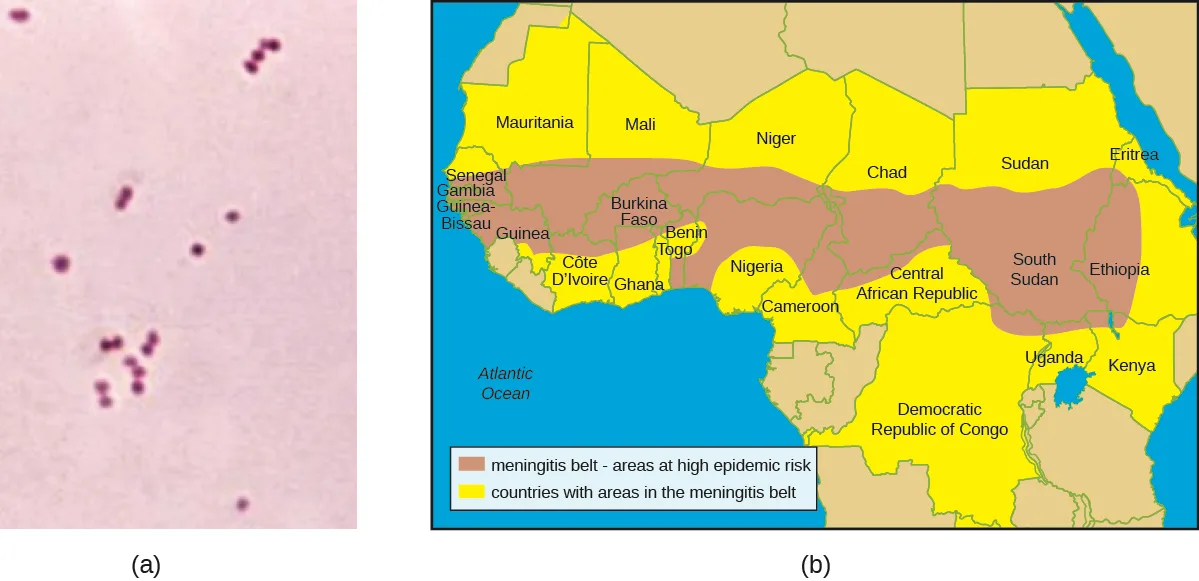
The prevalence of meningitis caused by N. meningitidis is particularly high in the so-called meningitis belt, a region of sub-Saharan Africa that includes 26 countries stretching from Senegal to Ethiopia (see the map below). The reasons for this high prevalence are not clear, but several factors may contribute to higher rates of transmission, such as the dry, dusty climate; overcrowding and low standards of living; and the relatively low immunocompetence and nutritional status of the population (Centers for Disease Control and Prevention, “Meningococcal Disease in Other Countries,” accessed September 12, 2016). A vaccine against four bacterial strains of N. meningitidis is available. Vaccination is recommended for 11- and 12-year-old children, with a booster at age 16 years. Vaccination is also recommended for young people who live in close quarters with others (e.g., college dormitories, military barracks), where the disease is more easily transmitted. Travelers visiting the “meningitis belt” should also be vaccinated, especially during the dry season (December through June) when the prevalence is highest (Centers for Disease Control and Prevention, “Health Information for Travelers to the Gambia: Traveler View,” accessed September 12, 2016; Centers for Disease Control and Prevention, “Meningococcal: Who Needs to Be Vaccinated?,” accessed September 12, 2016).
Extended description
The map labels these countries, roughly west to east: Mauritania, Senegal, Gambia, Guinea-Bissau, Guinea, Mali, Burkina Faso, Cote d’Ivoire, Ghana, Togo, Benin, Niger, Nigeria, Chad, Cameroon, Central African Republic, Sudan, South Sudan, Democratic Republic of the Congo, Uganda, Kenya, Eritrea, and Ethiopia. A coral band marking the area of highest epidemic risk crosses the map from the Senegal-Gambia-Guinea-Bissau-Guinea cluster in the west, through the Sahel, to South Sudan, Ethiopia, and Eritrea in the east; the other labeled countries are shaded to mark them as also having areas within the wider meningitis belt, per the map’s legend.
Go back to the previous Clinical Focus box. The case began in Energy, Matter, and Enzymes.
Summary
- The recycling of inorganic matter between living organisms and their nonliving environment is called a biogeochemical cycle. Microbes play significant roles in these cycles.
- In the carbon cycle, heterotrophs degrade reduced organic molecule to produce carbon dioxide, whereas autotrophs fix carbon dioxide to produce organics. Methanogens typically form methane by using CO₂ as a final electron acceptor during anaerobic respiration; methanotrophs oxidize the methane, using it as their carbon source.
- In the nitrogen cycle, nitrogen-fixing bacteria convert atmospheric nitrogen into ammonia (nitrogen fixation). The ammonia can then be oxidized to nitrite and nitrate (nitrification). Nitrates can then be assimilated by plants. Soil bacteria convert nitrate back to nitrogen gas (denitrification). (Source note: the source’s summary prints “(ammonification)” here; the module’s own Nitrogen Cycle text defines that step as nitrogen fixation and ammonification as the release of ammonia from organic nitrogen, so this page uses the module’s term.)
- In sulfur cycling, many anoxygenic photosynthesizers and chemoautotrophs use hydrogen sulfide as an electron donor, producing elemental sulfur and then sulfate; sulfate-reducing bacteria and archaea then use sulfate as a final electron acceptor in anaerobic respiration, converting it back to hydrogen sulfide.
- Human activities that introduce excessive amounts of naturally limited nutrients (like iron, nitrogen, or phosphorus) to aquatic systems may lead to eutrophication.
- Microbial bioremediation is the use of microbial metabolism to remove or degrade xenobiotics and other environmental contaminants and pollutants. Enhanced bioremediation techniques may involve the introduction of non-native microbes specifically chosen or engineered for their ability to degrade contaminants.
Key terms
- biogeochemical cycle — recycling of inorganic matter between living organisms and their nonliving environment.
- nitrogen fixation — bacterial biochemical pathways that incorporate inorganic nitrogen gas into organic forms more easily used by other organisms.
- bioremediation — use of microbes to remove xenobiotics or environmental pollutants from a contaminated site.
- xenobiotic — compound synthesized by humans and introduced to an environment in much higher concentrations than expected in nature.
Practice
Define and describe the importance of microorganisms in the biogeochemical cycles of carbon, nitrogen, and sulfur
Which of the following is the group of archaea that can use CO₂ as their final electron acceptor during anaerobic respiration, producing CH₄?
This group’s name is built from the gas it produces, methane, not from the gas it uses as an electron acceptor.Which of the following processes is not involved in the conversion of organic nitrogen to nitrogen gas?
Three of these four processes move nitrogen from organic and ammonia forms toward nitrogen gas — one of them moves nitrogen the other direction, into living systems.Which of the following processes produces hydrogen sulfide?
This is the process by which sulfate-reducing bacteria and archaea use sulfate as a final electron acceptor.The biogeochemical cycle of which of the following elements is based on changes in solubility rather than redox chemistry?
Compare this element’s cycle, described under Other Biogeochemical Cycles, with the redox-based carbon, nitrogen, and sulfur cycles.The molecule central to the carbon cycle that is exchanged within and between ecosystems, being produced by heterotrophs and used by autotrophs, is ________.
This gas is released by respiration and fermentation, and it is the molecule autotrophs fix to build organic matter.Why must autotrophic organisms also respire or ferment in addition to fixing CO₂?
Show model answer
Did your answer mention:
How can human activity lead to eutrophication?
Show model answer
Did your answer mention:
In considering the symbiotic relationship between Rhizobium species and their plant hosts, what metabolic activity does each organism perform that benefits the other member of the pair?
The module names what Rhizobium fixes for the legume and what the legume gives back in exchange.Define and give an example of bioremediation
The use of microbes to remove pollutants from a contaminated system is called ________.
This is the general term for using microbial metabolism to clean up pollution — the word appears in this subsection’s own heading.There are many naturally occurring microbes that have the ability to degrade several of the compounds found in oil.
Compare this statement with the module’s description of Rhodococcus, Pseudomonas, and Alcanivorax borkumensis and their known ability to act on oil compounds.Term for a compound synthesized by humans and introduced into the environment in much higher concentrations than would occur naturally.
This word describes human-made pollutants such as adhesives, dyes, and pesticides — not the microbes that break them down.This section is adapted from Microbiology, Section 8.7: Biogeochemical Cycles by Nina Parker, Mark Schneegurt, Anh-Hue Thi Tu, Philip Lister, Brian M. Forster, and OpenStax, © OpenStax, licensed under CC BY-NC-SA 4.0. Access the original for free at openstax.org. Changes: all four figures are re-encoded as WebP and rendered as mediafigures with an explicit kind="diagram", overriding the media manifest’s file-extension guess of “photo” for all four — the three cycle figures are fully drawn landscape diagrams, and the Clinical Focus figure is a composite whose map panel is drawn art even though its other panel is a micrograph; each cycle figure and the composite figure carry an author-written longdesc walking their labeled compartments and arrows, since the source printed no numbered steps of its own to preserve; the Link to Learning box keeps its title-less form, its URL, and the source’s own sentence boundary; the four CDC footnotes are rendered as inline parenthetical citations after the sentences they support, with the bare access URLs dropped; the Clinical Focus Resolution’s closing “go back to the previous Clinical Focus box” link is rendered as an absolute site-root link to Catabolism of Lipids and Proteins (8.5, the previous part in the chain) PLUS the house “the case began in” sentence, an absolute link to Energy, Matter, and Enzymes (8.1, where the case actually opened) — the chain runs 8.1 → 8.4 → 8.5 → 8.7, so “previous part” and “where the case began” are different pages once a case runs past two sections; the module’s one cross-reference to the chapter introduction (m58818, a self-closing link beside the Rhizobium sentence) is rendered as an absolute link to the chapter introduction reading “the chapter introduction” — the task brief expected two occurrences of this cross-reference but the pinned module carries only the one; of this section’s four body Check Your Understanding bullets, the Carbon Cycle one (the heterotroph/autotroph interaction) is graded as a multiple choice from a single module sentence and the Bioremediation one (in situ versus ex situ) is graded as a sort-into-bins item whose two bins and four items are the module’s own distinguishing phrases for each form, while the Nitrogen Cycle one (the four steps) and the Sulfur Cycle one remain self-checks because each one’s honest answer assembles sentences from more than one module paragraph rather than resting on a single one; the section’s four Multiple Choice and two Fill in the Blank items (one with accept="CO2") and its one True/False item (rendered as a two-option multiple choice, True then False) keep the source’s own keys and option order; the section prints no key for its two Short Answer questions or its one Critical Thinking question — the Critical Thinking question (what each partner in the Rhizobium–legume symbiosis contributes) is graded as a multiple choice because a single module sentence fixes its whole answer and its distractors are built from the module’s own vocabulary, while both Short Answer questions (why autotrophs must also respire or ferment; how human activity leads to eutrophication) remain self-checks because each one’s honest answer needs a second module sentence assembled in, or an inference beyond what one sentence states, and their distractors would otherwise have to be invented rather than drawn from the module; one filler textin (the key term “xenobiotic”) rounds the bioremediation objective’s Practice group out to the book’s three-item floor; key terms are compiled from the module’s four defined terms and the book’s Glossary appendix (all four glossary-provenance, none sentence-derived); a claim correction (parent-adjudicated, erratum 518): the Summary’s nitrogen-cycle bullet prints “(ammonification)” after “convert atmospheric nitrogen into ammonia,” but the module’s own Nitrogen Cycle text defines that conversion step as nitrogen fixation and defines ammonification as a separate, later step (bacteria and fungi converting nitrogenous waste into ammonia); the bullet is corrected to “(nitrogen fixation)” with a visible source note explaining the change, in place of a silent fix, because this is a claim the module’s own body contradicts rather than a one-word typo; three one-word source departures are corrected here without an inline note and logged as suspected source defects: the Multiple Choice option “chemoautrophy” (printed correctly as “chemoautotrophy”), “sub-Saharan African” in the Clinical Focus Resolution (corrected to “sub-Saharan Africa”), and a missing preposition and a resulting subject-verb mismatch in the Sulfur Cycle’s second paragraph (“Decomposition dead organisms…remove” corrected to “Decomposition of dead organisms…removes”); two source-artwork defects are transcribed as printed rather than silently fixed, and flagged here for the parent: the Nitrogen Cycle figure’s own printed labels read “nitrates (NO2-)” for what the body text correctly calls nitrite, and the Sulfur Cycle figure’s own printed label reads “elemental sulfate(SO0)” where SO⁰ denotes elemental sulfur, not sulfate, and the module’s own source alt for that figure gets the chemistry right (“elemental sulfur (SO0)”) — in both cases the artwork itself, not just its alt, disagrees with the module’s own chemistry, and both alts/longdescs describe what the artwork actually prints rather than correcting it.