The Effects of pH on Microbial Growth
By the end of this section, you will be able to:
- Illustrate and briefly describe minimum, optimum, and maximum pH requirements for growth
- Identify and describe the different categories of microbes with pH requirements for growth: acidophiles, neutrophiles, and alkaliphiles
- Give examples of microorganisms for each category of pH requirement
Yogurt, pickles, sauerkraut, and lime-seasoned dishes all owe their tangy taste to a high acid content (see the photos below). Recall that acidity is a function of the concentration of hydrogen ions [H⁺] and is measured as pH. Environments with pH values below 7.0 are considered acidic, whereas those with pH values above 7.0 are considered basic. Extreme pH affects the structure of all macromolecules. The hydrogen bonds holding together strands of DNA break up at high pH. Lipids are hydrolyzed by an extremely basic pH. The proton motive force responsible for production of ATP in cellular respiration depends on the concentration gradient of H⁺ across the plasma membrane (see Cellular Respiration). If H⁺ ions are neutralized by hydroxide ions, the concentration gradient collapses and impairs energy production. But the component most sensitive to pH in the cell is its workhorse, the protein. Moderate changes in pH modify the ionization of amino-acid functional groups and disrupt hydrogen bonding, which, in turn, promotes changes in the folding of the molecule, promoting denaturation and destroying activity.

The optimum growth pH is the most favorable pH for the growth of an organism. The lowest pH value that an organism can tolerate is called the minimum growth pH and the highest pH is the maximum growth pH. These values can cover a wide range, which is important for the preservation of food and to microorganisms’ survival in the stomach. For example, the optimum growth pH of Salmonella spp. is 7.0–7.5, but the minimum growth pH is closer to 4.2.
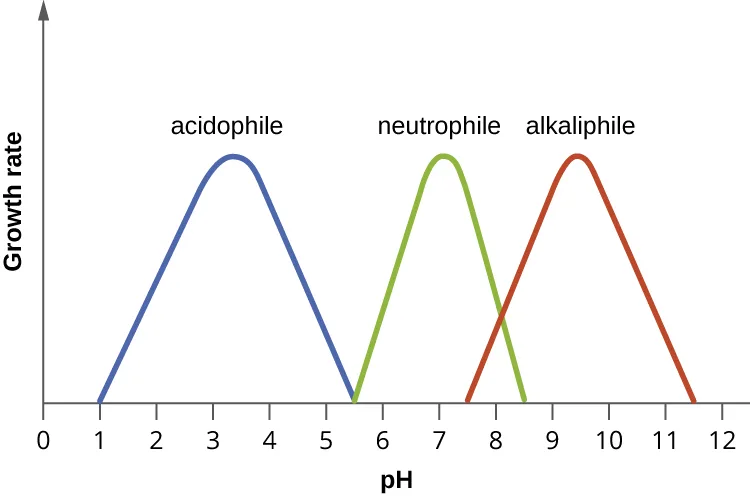
Most bacteria are neutrophiles, meaning they grow optimally at a pH within one or two pH units of the neutral pH of 7 (see the graph below). Most familiar bacteria, like Escherichia coli, staphylococci, and Salmonella spp. are neutrophiles and do not fare well in the acidic pH of the stomach. However, there are pathogenic strains of E. coli, S. typhi, and other species of intestinal pathogens that are much more resistant to stomach acid. In comparison, fungi thrive at slightly acidic pH values of 5.0–6.0.
Microorganisms that grow optimally at pH less than 5.55 are called acidophiles. For example, the sulfur-oxidizing Sulfolobus spp. isolated from sulfur mud fields and hot springs in Yellowstone National Park are extreme acidophiles. These archaea survive at pH values of 2.5–3.5. Species of the archaean genus Ferroplasma live in acid mine drainage at pH values of 0–2.9. Lactobacillus bacteria, which are an important part of the normal microbiota of the vagina, can tolerate acidic environments at pH values 3.5–6.8 and also contribute to the acidity of the vagina (pH of 4, except at the onset of menstruation) through their metabolic production of lactic acid. The vagina’s acidity plays an important role in inhibiting other microbes that are less tolerant of acidity. Acidophilic microorganisms display a number of adaptations to survive in strong acidic environments. For example, proteins show increased negative surface charge that stabilizes them at low pH. Pumps actively eject H⁺ ions out of the cells. The changes in the composition of membrane phospholipids probably reflect the need to maintain membrane fluidity at low pH.
Extended description
The x-axis is labeled pH and is marked in single units from 0 to 12; the y-axis is labeled growth rate and carries no numeric scale, only an upward arrow. Three triangular, bell-like curves are drawn left to right. The leftmost curve, labeled acidophile, starts at zero at pH 1, rises in a straight line to a rounded peak between pH 3 and 4, and descends in a straight line back to zero at about pH 5.5. The middle curve, labeled neutrophile, starts at zero at about pH 5.5, rises to a rounded peak at pH 7, and descends back to zero at about pH 8.5; its rising edge meets the acidophile curve’s falling edge at a single point on the baseline, pH 5.5 at a growth rate of zero, and the two curves do not otherwise overlap. The rightmost curve, labeled alkaliphile, starts at zero at about pH 7.5, rises to a rounded peak between pH 9 and 10, and descends back to zero at about pH 11.5, its rising edge crossing the neutrophile curve’s falling edge between pH 7.5 and 8.5.
At the other end of the spectrum are alkaliphiles, microorganisms that grow best at pH between 8.0 and 10.5. Vibrio cholerae, the pathogenic agent of cholera, grows best at the slightly basic pH of 8.0; it can survive pH values of 11.0 but is inactivated by the acid of the stomach. When it comes to survival at high pH, the bright pink archaean Natronobacterium, found in the soda lakes of the African Rift Valley, may hold the record at a pH of 10.5 (see the photo below). Extreme alkaliphiles have adapted to their harsh environment through evolutionary modification of lipid and protein structure and compensatory mechanisms to maintain the proton motive force in an alkaline environment. For example, the alkaliphile Bacillus firmus derives the energy for transport reactions and motility from a Na⁺ ion gradient rather than a proton motive force. Many enzymes from alkaliphiles have a higher isoelectric point, due to an increase in the number of basic amino acids, than homologous enzymes from neutrophiles.

Micro Connection. Survival at the Low pH of the Stomach
Peptic ulcers (or stomach ulcers) are painful sores on the stomach lining. Until the 1980s, they were believed to be caused by spicy foods, stress, or a combination of both. Patients were typically advised to eat bland foods, take anti-acid medications, and avoid stress. These remedies were not particularly effective, and the condition often recurred. This all changed dramatically when the real cause of most peptic ulcers was discovered to be a slim, corkscrew-shaped bacterium, Helicobacter pylori. This organism was identified and isolated by Barry Marshall and Robin Warren, whose discovery earned them the Nobel Prize in Medicine in 2005.
The ability of H. pylori to survive the low pH of the stomach would seem to suggest that it is an extreme acidophile. As it turns out, this is not the case. In fact, H. pylori is a neutrophile. So, how does it survive in the stomach? Remarkably, H. pylori creates a microenvironment in which the pH is nearly neutral. It achieves this by producing large amounts of the enzyme urease, which breaks down urea to form NH₄⁺ and CO₂. The ammonium ion raises the pH of the immediate environment.
This metabolic capability of H. pylori is the basis of an accurate, noninvasive test for infection. The patient is given a solution of urea containing radioactively labeled carbon atoms. If H. pylori is present in the stomach, it will rapidly break down the urea, producing radioactive CO₂ that can be detected in the patient’s breath. Because peptic ulcers may lead to gastric cancer, patients who are determined to have H. pylori infections are treated with antibiotics.
Check Your Understanding
What effect do extremes of pH have on proteins?
Show model answer
Did your answer mention:
What pH-adaptive type of bacteria would most human pathogens be?
Show model answer
Did your answer mention:
Summary
- Bacteria are generally neutrophiles. They grow best at neutral pH close to 7.0.
- Acidophiles grow optimally at a pH near 3.0. Alkaliphiles are organisms that grow optimally between a pH of 8 and 10.5. Extreme acidophiles and alkaliphiles grow slowly or not at all near neutral pH.
- Microorganisms grow best at their optimum growth pH. Growth occurs slowly or not at all below the minimum growth pH and above the maximum growth pH.
Key terms
- optimum growth pH — the pH at which an organism grows best.
- minimum growth pH — lowest pH value that an organism can tolerate for growth.
- maximum growth pH — highest pH value that an organism can tolerate for growth.
- neutrophile — organism that grows best at a near a neutral pH of 6.5–7.5.
- acidophile — organism that grows optimally at a pH near 3.0.
- alkaliphile — organism that grows optimally at pH above 9.0.
Practice
Illustrate and briefly describe minimum, optimum, and maximum pH requirements for growth
Which macromolecule in the cell is most sensitive to changes in pH?
Recall the cell’s ‘workhorse’ macromolecule named right after the paragraph’s discussion of how extreme pH affects DNA and lipids.Which metabolic process in the bacterial cell is particularly challenging at high pH?
Show model answer
Did your answer mention:
The ________ is the most favorable pH for the growth of an organism.
Name the defined term introduced in the same sentence that also names the minimum and maximum growth pH.Identify and describe the different categories of microbes with pH requirements for growth: acidophiles, neutrophiles, and alkaliphiles
People who use proton pump inhibitors or antacids are more prone to infections of the gastrointestinal tract. Can you explain the observation in light of what you have learned?
Show model answer
Did your answer mention:
A bacterium that thrives in a soda lake where the average pH is 10.5 can be classified as a(n) ________.
Recall the category of pH-adaptive microbe that grows best between pH 8.0 and 10.5 — a soda lake at pH 10.5 falls within that range.Bacteria that grow in mine drainage at pH 1–2 are probably which of the following?
Recall which pH-adaptive category grows optimally at pH values well below 5.55 — mine drainage this acidic matches it.Give examples of microorganisms for each category of pH requirement
Bacteria isolated from Lake Natron, where the water pH is close to 10, are which of the following?
Recall which category’s optimal range of 8.0–10.5 includes a soda lake’s water pH near 10, and this section’s own soda-lake example.In which environment are you most likely to encounter an acidophile?
Recall the pH range in which acidophiles grow optimally (well below 5.55) and pick the only listed environment that falls within it.Lactobacillus acidophilus grows best at pH 4.5. It is considered a(n) ________.
Recall the category of pH-adaptive microbe whose optimal range, below pH 5.55, includes this species’ preferred pH of 4.5.This section is adapted from Microbiology, Section 9.3: The Effects of pH on Microbial Growth by Nina Parker, Mark Schneegurt, Anh-Hue Thi Tu, Philip Lister, Brian M. Forster, and OpenStax, © OpenStax, licensed under CC BY-NC-SA 4.0. Access the original for free at openstax.org. Changes: all three source figures re-encoded as WebP and rendered as mediafigures after image and PDF inspection; the food-photo composite (yogurt, pickles, sauerkraut, pico de gallo) is kind="photo" with eager="true" as the first figure on the page, its alt rewritten from the image (the source alt’s “Photo of pickes” is a one-word typo for “pickles,” logged as a suspected source-alt defect, and the source alt does not describe that the sauerkraut panel shows two labeled store jars rather than home canning); the pH-versus-growth-rate curve figure is kind="diagram", its alt confirmed accurate against the image and given a longdesc walking each of the three curves’ rise, peak, and fall in order since neither the alt nor caption reads the axes as drawn; the Lake Natron aerial photo is kind="photo", its source alt (“A photo of a red lake”) too thin to teach anything the image shows and rewritten from the image without naming a count not printed. Its own module cross-reference to Cellular Respiration (§8.3, “see Cellular Respiration”) is rendered as a link to the existing page; the module’s three in-module figure cross-references (to the yogurt photos, the pH-curve graph, and the Lake Natron photo) are each rendered as a short describing phrase (“see the photos/graph/photo below”) at the point the source’s <link target-id> sat, with no print number. The Micro Connection box is rendered as a callout in its source position (no figure, no closing question). The body Check Your Understanding box’s two bullets are both rendered as self-checks: neither has a single fixing sentence — “What effect do extremes of pH have on proteins?” needs the cell’s-most-pH-sensitive-macromolecule sentence and its own long descriptive follow-on sentence assembled together, and “What pH-adaptive type of bacteria would most human pathogens be?” needs an inference from the general neutrophile sentence combined with the Micro Connection’s H. pylori discussion — so both keep author-written model answers and rubrics quoting only this module’s own sentences. Of the three source Multiple Choice items and two Fill in the Blank items (all five source-keyed), the Fill in the Blank items are rendered as textin, keyed alkaliphile and acidophile per the source solutions; the mine-drainage Multiple Choice item is placed immediately after, not before, the soda-lake textin in the same objective group, because its distractor option “alkaliphiles” sits directly above and would leak the textin’s key if the order were reversed. Of the two unkeyed Short Answer questions, one is graded: “Which macromolecule in the cell is most sensitive to changes in pH?” is a textin keyed protein, fixed verbatim by the sentence naming the protein as the cell’s most pH-sensitive component. The other, “Which metabolic process in the bacterial cell is particularly challenging at high pH?”, stays a self-check rather than a textin: its honest answer needs the proton-motive-force sentence and the hydroxide-neutralization sentence assembled together, plus the inference that hydroxide ions are the abundant species at high pH, not one fixing sentence, so its model answer and rubric quote both module sentences and state that inference explicitly. The unkeyed Critical Thinking question (proton pump inhibitors/antacids and gastrointestinal infection) stays a self-check, since its honest answer requires the learner to connect a stomach-acidity fact to a drug’s mechanism rather than resting on one fixing sentence; its stem prints “proton pump inhibitors” in place of the source’s “proton pumps inhibitors,” a one-word ordering typo logged as a suspected source defect and corrected here without an inline note. One filler textin cloze (“The ________ is the most favorable pH for the growth of an organism,” keyed optimum growth pH) is added, built from this module’s own defining sentence, to bring the first objective’s Practice group and the section to the book’s nine-item floor. All five source-keyed items and the one graded Short Answer item are split across the three objective groups by which aspect of pH tolerance each one tests (general effects and definitions; category identification; organism examples), since several of the source items test more than one objective at once. Key terms compiled from the module’s six defined terms and the book’s Glossary appendix; all six definitions taken directly from the Glossary, none sentence-derived. No source exercise item is otherwise omitted.