Temperature and Microbial Growth
By the end of this section, you will be able to:
- Illustrate and briefly describe minimum, optimum, and maximum temperature requirements for growth
- Identify and describe different categories of microbes with temperature requirements for growth: psychrophile, psychrotrophs, mesophile, thermophile, hyperthermophile
- Give examples of microorganisms in each category of temperature tolerance
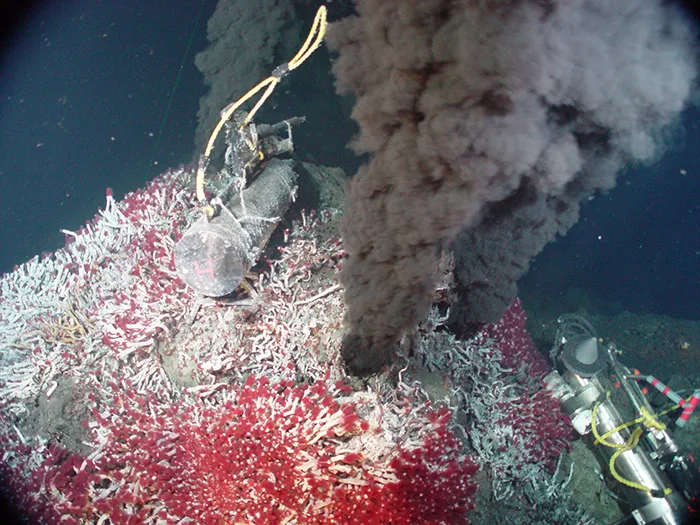
When the exploration of Lake Whillans started in Antarctica, researchers did not expect to find much life. Constant subzero temperatures and lack of obvious sources of nutrients did not seem to be conditions that would support a thriving ecosystem. To their surprise, the samples retrieved from the lake showed abundant microbial life. In a different but equally harsh setting, bacteria grow at the bottom of the ocean in sea vents, shown below, where temperatures can reach 340 °C (700 °F).
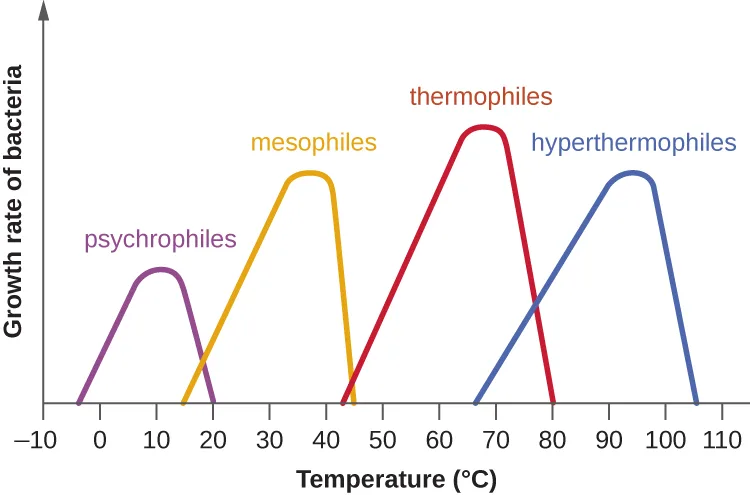
Microbes can be roughly classified according to the range of temperature at which they can grow. The growth rates are the highest at the optimum growth temperature for the organism. The lowest temperature at which the organism can survive and replicate is its minimum growth temperature. The highest temperature at which growth can occur is its maximum growth temperature. The following ranges of permissive growth temperatures are approximate only and can vary according to other environmental factors.
Organisms categorized as mesophiles (“middle loving”) are adapted to moderate temperatures, with optimal growth temperatures ranging from room temperature (about 20 °C) to about 45 °C. As would be expected from the core temperature of the human body, 37 °C (98.6 °F), normal human microbiota and pathogens (e.g., E. coli, Salmonella spp., and Lactobacillus spp.) are mesophiles.
Organisms called psychrotrophs, also known as psychrotolerant, prefer cooler environments, from a high temperature of 25 °C to refrigeration temperature about 4 °C. They are found in many natural environments in temperate climates. They are also responsible for the spoilage of refrigerated food.
Clinical Focus. Resolution
The presence of Listeria in Jeni’s blood suggests that her symptoms are due to listeriosis, an infection caused by L. monocytogenes. Listeriosis is a serious infection with a 20% mortality rate and is a particular risk to Jeni’s fetus. A sample from the amniotic fluid cultured for the presence of Listeria gave negative results. Because the absence of organisms does not rule out the possibility of infection, a molecular test based on the nucleic acid amplification of the 16S ribosomal RNA of Listeria was performed to confirm that no bacteria crossed the placenta. Fortunately, the results from the molecular test were also negative.
Jeni was admitted to the hospital for treatment and recovery. She received a high dose of two antibiotics intravenously for 2 weeks. The preferred drugs for the treatment of listeriosis are ampicillin or penicillin G with an aminoglycoside antibiotic. Resistance to common antibiotics is still rare in Listeria and antibiotic treatment is usually successful. She was released to home care after a week and fully recovered from her infection.
L. monocytogenes is a gram-positive short rod found in soil, water, and food. It is classified as a psychrotroph and is halotolerant. (Source note: the source says “classified as a psychrophile.” This module defines psychrophiles as organisms that usually do not survive above 20 °C and psychrotrophs as those thriving between about 4 °C and 25 °C, and the book’s own section on bacterial infections of the nervous system states that Listeria grows at temperatures between 0 °C and 50 °C, so this page follows those passages.) Its ability to multiply at refrigeration temperatures (4–10 °C) and its tolerance for high concentrations of salt (up to 10% sodium chloride [NaCl]) make it a frequent source of food poisoning. Because Listeria can infect animals, it often contaminates food such as meat, fish, or dairy products. Contamination of commercial foods can often be traced to persistent biofilms that form on manufacturing equipment that is not sufficiently cleaned.
Listeria infection is relatively common among pregnant people because the elevated levels of progesterone downregulate the immune system, making them more vulnerable to infection. The pathogen can cross the placenta and infect the fetus, often resulting in miscarriage, stillbirth, or fatal neonatal infection. Pregnant people are thus advised to avoid consumption of soft cheeses, refrigerated cold cuts, smoked seafood, and unpasteurized dairy products. Because Listeria bacteria can easily be confused with diphtheroids, another common group of gram-positive rods, it is important to alert the laboratory when listeriosis is suspected.
The case began in How Microbes Grow.
The organisms retrieved from arctic lakes such as Lake Whillans are considered extreme psychrophiles (cold loving). Psychrophiles are microorganisms that can grow at 0 °C and below, have an optimum growth temperature close to 15 °C, and usually do not survive at temperatures above 20 °C. They are found in permanently cold environments such as the deep waters of the oceans. Because they are active at low temperature, psychrophiles and psychrotrophs are important decomposers in cold climates.
Organisms that grow at optimum temperatures of 50 °C to a maximum of 80 °C are called thermophiles (“heat loving”). They do not multiply at room temperature. Thermophiles are widely distributed in hot springs, geothermal soils, and manmade environments such as garden compost piles where the microbes break down kitchen scraps and vegetal material. Examples of thermophiles include Thermus aquaticus and Geobacillus spp. Higher up on the extreme temperature scale we find the hyperthermophiles, which are characterized by growth ranges from 80 °C to a maximum of 110 °C, with some extreme examples that survive temperatures above 121 °C, the average temperature of an autoclave. The hydrothermal vents at the bottom of the ocean are a prime example of extreme environments, with temperatures reaching an estimated 340 °C, as shown below. Microbes isolated from the vents achieve optimal growth at temperatures higher than 100 °C. Noteworthy examples are Pyrobolus and Pyrodictium, archaea that grow at 105 °C and survive autoclaving. The graph below shows the typical skewed curves of temperature-dependent growth for the categories of microorganisms we have discussed.
Extended description
Four skewed bell-shaped curves are plotted left to right along the temperature axis, which is marked in 10 °C steps from −10 to 110. Each curve rises gently from a baseline of zero growth and falls steeply after its peak. The psychrophile curve rises from about −5 °C, peaks near 10 °C, and returns to zero by about 20 °C. The mesophile curve rises from about 15 °C, peaks near 37 °C, and returns to zero by about 45 °C. The thermophile curve rises from about 45 °C, peaks near 67 °C, and returns to zero by about 80 °C. The hyperthermophile curve rises from about 65 °C, peaks near 93 °C, and returns to zero by about 105 °C. Each successive curve’s rising limb overlaps the falling limb of the curve before it. The thermophile curve reaches the highest peak of the four; the mesophile and hyperthermophile curves peak lower than the thermophile curve and about level with each other; the psychrophile curve peaks distinctly lower than all three.
Life in extreme environments raises fascinating questions about the adaptation of macromolecules and metabolic processes. Very low temperatures affect cells in many ways. Membranes lose their fluidity and are damaged by ice crystal formation. Chemical reactions and diffusion slow considerably. Proteins become too rigid to catalyze reactions and may undergo denaturation. At the opposite end of the temperature spectrum, heat denatures proteins and nucleic acids. Increased fluidity impairs metabolic processes in membranes. Some of the practical applications of the destructive effects of heat on microbes are sterilization by steam, pasteurization, and incineration of inoculating loops. Proteins in psychrophiles are, in general, rich in hydrophobic residues, display an increase in flexibility, and have a lower number of secondary stabilizing bonds when compared with homologous proteins from mesophiles. Antifreeze proteins and solutes that decrease the freezing temperature of the cytoplasm are common. The lipids in the membranes tend to be unsaturated to increase fluidity. Growth rates are much slower than those encountered at moderate temperatures. Under appropriate conditions, mesophiles and even thermophiles can survive freezing. Liquid cultures of bacteria are mixed with sterile glycerol solutions and frozen to −80 °C for long-term storage as stocks. Cultures can withstand freeze drying (lyophilization) and then be stored as powders in sealed ampules to be reconstituted with broth when needed.
Macromolecules in thermophiles and hyperthermophiles show some notable structural differences from what is observed in the mesophiles. The ratio of saturated to polyunsaturated lipids increases to limit the fluidity of the cell membranes. Their DNA sequences show a higher proportion of guanine–cytosine nitrogenous bases, which are held together by three hydrogen bonds in contrast to adenine and thymine, which are connected in the double helix by two hydrogen bonds. Additional secondary structures, ionic and covalent bonds, as well as the replacement of key amino acids to stabilize folding, contribute to the resistance of proteins to denaturation. The so-called thermoenzymes purified from thermophiles have important practical applications. For example, amplification of nucleic acids in the polymerase chain reaction (PCR) depends on the thermal stability of Taq polymerase, an enzyme isolated from T. aquaticus. Degradation enzymes from thermophiles are added as ingredients in hot-water detergents, increasing their effectiveness.
Check Your Understanding
What temperature requirements do most bacterial human pathogens have?
Recall which single temperature category the summary says most pathogens belong to.Which DNA adaptation do thermophiles exhibit?
Of the several heat adaptations this module describes, pick the one specifically about the nitrogenous bases in DNA rather than membrane lipids or protein folding.Eye on Ethics. Feeding the World…and the World’s Algae
Artificial fertilizers have become an important tool in food production around the world. They are responsible for many of the gains of the so-called green revolution of the 20th century, which has allowed the planet to feed many of its more than 7 billion people. Artificial fertilizers provide nitrogen and phosphorus, key limiting nutrients, to crop plants, removing the normal barriers that would otherwise limit the rate of growth. Thus, fertilized crops grow much faster, and farms that use fertilizer produce higher crop yields.
However, careless use and overuse of artificial fertilizers have been demonstrated to have significant negative impacts on aquatic ecosystems, both freshwater and marine. Fertilizers that are applied at inappropriate times or in too-large quantities allow nitrogen and phosphorus compounds to escape use by crop plants and enter drainage systems. Inappropriate use of fertilizers in residential settings can also contribute to nutrient loads, which find their way to lakes and coastal marine ecosystems. As water warms and nutrients are plentiful, microscopic algae bloom, often changing the color of the water because of the high cell density.
Most algal blooms are not directly harmful to humans or wildlife; however, they can cause harm indirectly. As the algal population expands and then dies, it provides a large increase in organic matter to the bacteria that live in deep water. With this large supply of nutrients, the population of nonphotosynthetic microorganisms explodes, consuming available oxygen and creating “dead zones” where animal life has virtually disappeared.
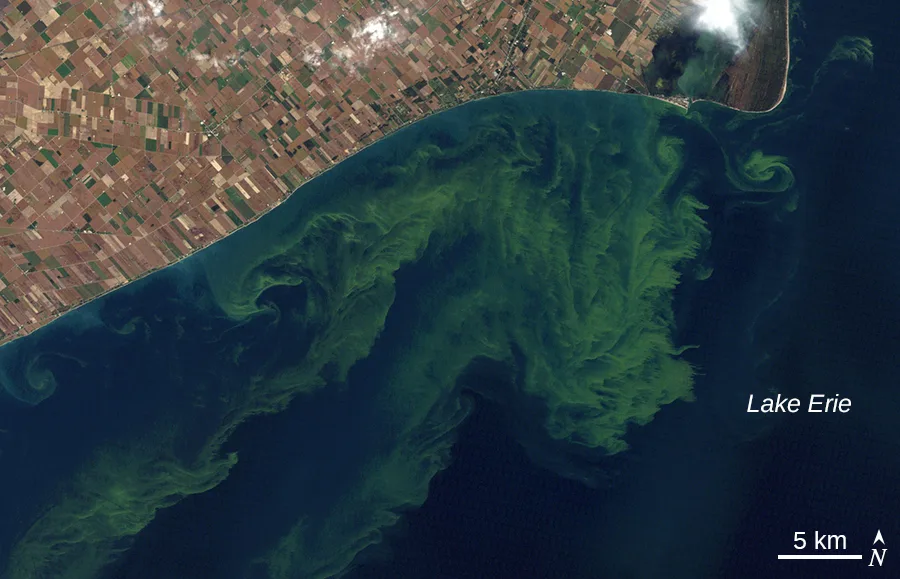
Depletion of oxygen in the water is not the only damaging consequence of some algal blooms. The algae that produce red tides in the Gulf of Mexico, Karenia brevis, secrete potent toxins that can kill fish and other organisms and also accumulate in shellfish. Consumption of contaminated shellfish can cause severe neurological and gastrointestinal symptoms in humans. Shellfish beds must be regularly monitored for the presence of the toxins, and harvests are often shut down when it is present, incurring economic costs to the fishery. Cyanobacteria, which can form blooms in marine and freshwater ecosystems, produce toxins called microcystins, which can cause allergic reactions and liver damage when ingested in drinking water or during swimming. Recurring cyanobacterial algal blooms in Lake Erie, shown below, have forced municipalities to issue drinking water bans for days at a time because of unacceptable toxin levels.
This is just a small sampling of the negative consequences of algal blooms, red tides, and dead zones. Yet the benefits of crop fertilizer—the main cause of such blooms—are difficult to dispute. There is no easy solution to this dilemma, as a ban on fertilizers is not politically or economically feasible. In lieu of this, we must advocate for responsible use and regulation in agricultural and residential contexts, as well as the restoration of wetlands, which can absorb excess fertilizers before they reach lakes and oceans.
Link to Learning
This video discusses algal blooms and dead zones in more depth.
Summary
- Microorganisms thrive at a wide range of temperatures; they have colonized different natural environments and have adapted to extreme temperatures. Both extreme cold and hot temperatures require evolutionary adjustments to macromolecules and biological processes.
- Psychrophiles grow best in the temperature range of 0–15 °C whereas psychrotrophs thrive between 4 °C and 25 °C.
- Mesophiles grow best at moderate temperatures in the range of 20 °C to about 45 °C. Pathogens are usually mesophiles.
- Thermophiles and hyperthermophiles are adapted to life at temperatures above 50 °C.
- Adaptations to cold and hot temperatures require changes in the composition of membrane lipids and proteins.
Key terms
- optimum growth temperature — the temperature at which a microorganism’s growth rate is highest.
- minimum growth temperature — lowest temperature at which a microorganism will divide or survive.
- maximum growth temperature — highest temperature at which a microorganism will divide or survive.
- mesophile — a microorganism that grows best at moderate temperatures, typically between about 20 °C and 45 °C.
- psychrotrophs — a microorganism that grows best at cool temperatures, typically between about 4 °C and 25 °C, with optimum growth at about 20 °C.
- psychrophiles — a microorganism that grows best at cold temperatures; most have an optimum growth temperature of about 15 °C and can survive temperatures below 0 °C; most cannot survive temperatures above 20 °C.
- thermophiles — a microorganism that grows best at warm temperatures, typically between about 50 °C and 80 °C.
- hyperthermophiles — a microorganism that has an optimum growth temperature close to the temperature of boiling water.
Practice
Illustrate and briefly describe minimum, optimum, and maximum temperature requirements for growth
The lowest temperature at which the organism can survive and replicate is its ________.
This boundary sits at the cold end of an organism’s permissive range — not the point of fastest growth, and not the hot-end boundary.The highest temperature at which growth can occur is its ________.
This boundary sits at the hot end of an organism’s permissive range — not the point of fastest growth, and not the cold-end boundary.The growth rates are the highest at the ________ for the organism.
This is the single temperature within an organism’s range where growth is fastest, not either boundary of the range.Identify and describe different categories of microbes with temperature requirements for growth: psychrophile, psychrotrophs, mesophile, thermophile, hyperthermophile
A soup container was forgotten in the refrigerator and shows contamination. The contaminants are probably which of the following?
Refrigeration temperature is cool, not freezing and not room temperature — match the category defined by that specific range.Bacteria isolated from a hot tub at 39 °C are probably which of the following?
39 °C is close to human body temperature and squarely inside one category’s moderate range.In which environment are you most likely to encounter a hyperthermophile?
Recall which environment reaches temperatures well above 100 °C, matching the highest growth range described.Which of the following environments would harbor psychrophiles?
Compare each option’s temperature to the cold range described for this category, keeping in mind which of the other options are actually warm.Match the type of bacterium with its environment: which environment matches a psychrotroph?
This category prefers cool, not freezing, temperatures and is linked to the spoilage of refrigerated food.Match the type of bacterium with its environment: which environment matches a mesophile?
This category’s optimal range includes human core body temperature.Match the type of bacterium with its environment: which environment matches a thermophile?
This category is widely distributed in hot springs, geothermal soils, and manmade environments that generate heat as microbes break down organic matter.Match the type of bacterium with its environment: which environment matches a hyperthermophile?
This category has the highest growth range of all, matching the hottest listed environment.Match the type of bacterium with its environment: which environment matches a psychrophile?
This category is found in permanently cold environments.How are hyperthermophile’s proteins adapted to the high temperatures of their environment?
Of the several heat adaptations this module describes for thermophiles and hyperthermophiles, pick the one specifically about protein structure rather than DNA or membrane lipids.Refer to the growth-rate-versus-temperature graph above. Some hyperthermophiles can survive autoclaving temperatures. Are they a concern in health care?
Compare the average autoclave temperature this module gives to the survival temperatures it states for extreme hyperthermophile examples.Why would NASA be funding microbiology research in Antarctica?
Show model answer
Did your answer mention:
Give examples of microorganisms in each category of temperature tolerance
Which of the following is given as an example organism in the mesophile category?
This organism is named alongside Salmonella and Lactobacillus as normal human microbiota and pathogens sharing the same temperature category.Which of the following is given as an example organism in the hyperthermophile category?
This organism is named alongside Pyrobolus as an archaeon that grows at 105 °C and survives autoclaving.Which organism does the Clinical Focus Resolution describe as halotolerant and able to multiply at refrigeration temperatures?
Recall the gram-positive short rod found in soil, water, and food that is a frequent source of food poisoning.This section is adapted from Microbiology, Section 9.4: Temperature and Microbial Growth by Nina Parker, Mark Schneegurt, Anh-Hue Thi Tu, Philip Lister, Brian M. Forster, and OpenStax, © OpenStax, licensed under CC BY-NC-SA 4.0. Access the original for free at openstax.org. Changes: all three source figures re-encoded as WebP and rendered as mediafigures after image inspection, kind="photo" for the black-smoker and algal-bloom photographs and kind="diagram" for the temperature-curve graph, eager="true" on the first figure only; the black-smoker alt is rewritten from the manifest’s generic “a vent billowing out dark smoke” to describe the visible tubeworms, pale organisms, and sampling instrumentation the caption discusses; the temperature-curve alt is rewritten and given a longdesc reading each of the four skewed curves’ rise, peak, and fall in order as plotted — the source alt’s peak values (35 °C, 65 °C, 90 °C) read a few degrees low against the artwork’s gridlines (closer to 37 °C, 67 °C, and 93 °C) and it misspells “mesophile” as “mesoophile” and drops the “d” from “and” four times (once per curve clause), all logged as suspected source-alt defects; the longdesc also notes that the thermophile curve peaks highest, the mesophile and hyperthermophile curves peak lower and about level with each other, and the psychrophile curve peaks distinctly lowest, as drawn; the algal-bloom alt is rewritten from the manifest’s one-sentence gloss to describe the farmland, bloom pattern, and scale bar visible in the satellite photo; the Summary’s one-word source typo “hyperthemophiles” is printed corrected as “hyperthermophiles,” logged as a suspected source defect; cross-references to the module’s own figures are rendered as describing prose (“shown below,” “as shown below”) rather than print numbers; the Clinical Focus and Eye on Ethics boxes are rendered as callouts in source order, the Eye on Ethics figure kept at the end of the box as in the source; the Clinical Focus box’s “go back to the previous Clinical Focus box” link is replaced by a sentence naming where the case began, How Microbes Grow — not Oxygen Requirements for Microbial Growth, which the source’s link target points at but which is only where the case’s previous part ran, not where it began; this Resolution is the case’s last part, so no “case continues” sentence is added; the body Check Your Understanding box’s two bullets are both graded from the module’s own sentences — a textin (the pathogens/mesophile sentence, matching the Summary’s “Pathogens are usually mesophiles”) and a multiplechoice (the DNA-adaptation sentence, with three distractors built from this module’s own lipid-, protein-, and psychrophile-adaptation sentences in the same and adjacent paragraphs); the five-row Matching exercise (source-keyed A, D, E, B, C) is rendered as five multiple-choice items, one per bacterial type, each offering all five lettered environments in the table’s own order — the source prints the first row’s type as “psychotroph”; the module’s body prints “psychrotrophs” six times and the Glossary headword is “psychrotroph”, so the stem prints the corrected psychrotroph and this is logged as a suspected source defect, not silently fixed; the unkeyed Short Answer “How are hyperthermophile’s proteins adapted…” (source’s own singular possessive, kept verbatim) is graded as a multiple-choice from the module’s own protein-adaptation sentence, with three distractors drawn from this module’s own lipid-, DNA-, and psychrophile-adaptation sentences; the unkeyed Critical Thinking “Refer to [the temperature-curve figure]. Some hyperthermophiles can survive autoclaving temperatures. Are they a concern in health care?” is graded as a multiple-choice from the module’s own autoclave-temperature and survival-temperature sentences, its figure cross-reference rendered as the describing phrase “Refer to the growth-rate-versus-temperature graph above” rather than re-rendered media, since the exercise links to the body figure rather than carrying its own; the unkeyed Short Answer “Why would NASA be funding microbiology research in Antarctica?” stays a self-check, its model answer assembled only from the opening Lake Whillans anecdote and the psychrophile-decomposer sentence, because the module gives that background but never states NASA’s motivation and supplying one would require outside knowledge; the unkeyed Critical Thinking “Can you make an educated guess as to [M. leprae’s] optimum temperature of growth?” is omitted from Practice because the module gives no information connecting body location to temperature preference, and an honest answer would require outside anatomical knowledge (that the extremities run cooler than the body’s core) that this module never states; three textin cloze items (minimum/maximum/optimum growth temperature) and three author-built multiple-choice items (organism examples per category) fill the first and third objective groups, built strictly from this module’s own definitional and example sentences, since the source provides no exercises for those two objectives; key terms compiled from the module’s eight defined terms and the book’s Glossary appendix, all eight definitions taken directly from the Glossary (the appendix headword is the singular “psychrotroph”/“thermophile”/“hyperthermophile”/“psychrophile” for the module’s plural forms, bolded as printed in the body). One claim is corrected against the book itself: the source’s Clinical Focus Resolution calls L. monocytogenes a psychrophile, which contradicts this module’s own psychrophile and psychrotroph definitions and the book’s statement that Listeria grows between 0 °C and 50 °C, so the sentence prints “psychrotroph” with a visible Source note (erratum 532), and the author-built item that had asked which organism the module classifies as a psychrophile now asks which organism the Resolution describes as halotolerant and able to multiply at refrigeration temperatures.