Other Environmental Conditions that Affect Growth
By the end of this section, you will be able to:
- Identify and describe different categories of microbes with specific growth requirements other than oxygen, pH, and temperature, such as altered barometric pressure, osmotic pressure, humidity, and light
- Give at least one example microorganism for each category of growth requirement
Microorganisms interact with their environment along more dimensions than pH, temperature, and free oxygen levels, although these factors require significant adaptations. We also find microorganisms adapted to varying levels of salinity, barometric pressure, humidity, and light.
Osmotic and Barometric Pressure
Most natural environments tend to have lower solute concentrations than the cytoplasm of most microorganisms. Rigid cell walls protect the cells from bursting in a dilute environment. Not much protection is available against high osmotic pressure. In this case, water, following its concentration gradient, flows out of the cell. This results in plasmolysis (the shrinking of the protoplasm away from the intact cell wall) and cell death. This fact explains why brines and layering meat and fish in salt are time-honored methods of preserving food. Microorganisms called halophiles (“salt loving”) actually require high salt concentrations for growth. These organisms are found in marine environments where salt concentrations hover at 3.5%. Extreme halophilic microorganisms, such as the red alga Dunaliella salina and the archaeal species Halobacterium in the photograph below, grow in hypersaline lakes such as the Great Salt Lake, which is 3.5–8 times saltier than the ocean, and the Dead Sea, which is 10 times saltier than the ocean.
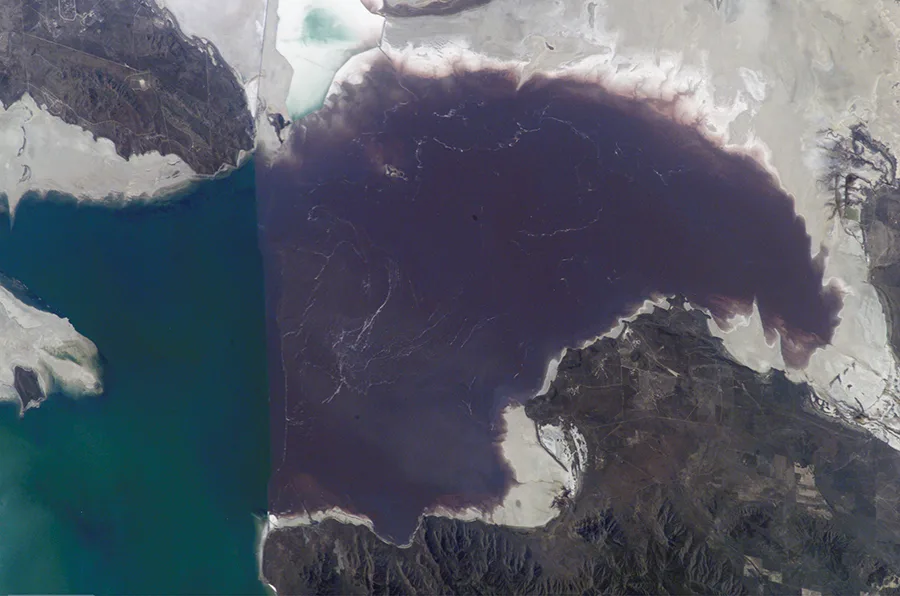
Dunaliella spp. counters the tremendous osmotic pressure of the environment with a high cytoplasmic concentration of glycerol and by actively pumping out salt ions. Halobacterium spp. accumulates large concentrations of K⁺ and other ions in its cytoplasm. Its proteins are designed for high salt concentrations and lose activity at salt concentrations below 1–2 M. Although most halotolerant organisms, for example Halomonas spp. in salt marshes, do not need high concentrations of salt for growth, they will survive and divide in the presence of high salt. Not surprisingly, the staphylococci, micrococci, and corynebacteria that colonize our skin tolerate salt in their environment. Halotolerant pathogens are an important cause of food-borne illnesses because they survive and multiply in salty food. For example, the halotolerant bacteria S. aureus, Bacillus cereus, and V. cholerae produce dangerous enterotoxins and are major causes of food poisoning.
Microorganisms depend on available water to grow. Available moisture is measured as water activity (aw), which is the ratio of the vapor pressure of the medium of interest to the vapor pressure of pure distilled water; therefore, the aw of water is equal to 1.0. Bacteria require high aw (0.97–0.99), whereas fungi can tolerate drier environments; for example, the range of aw for growth of Aspergillus spp. is 0.8–0.75. Decreasing the water content of foods by drying, as in jerky, or through freeze-drying or by increasing osmotic pressure, as in brine and jams, are common methods of preventing spoilage.
Microorganisms that require high atmospheric pressure for growth are called barophiles. The bacteria that live at the bottom of the ocean must be able to withstand great pressures. Because it is difficult to retrieve intact specimens and reproduce such growth conditions in the laboratory, the characteristics of these microorganisms are largely unknown.
Light
Photoautotrophs, such as cyanobacteria or green sulfur bacteria, and photoheterotrophs, such as purple nonsulfur bacteria, depend on sufficient light intensity at the wavelengths absorbed by their pigments to grow and multiply. Energy from light is captured by pigments and converted into chemical energy that drives carbon fixation and other metabolic processes. The portion of the electromagnetic spectrum that is absorbed by these organisms is defined as photosynthetically active radiation (PAR). It lies within the visible light spectrum ranging from 400 to 700 nanometers (nm) and extends in the near infrared for some photosynthetic bacteria. A number of accessory pigments, such as fucoxanthin in brown algae and phycobilins in cyanobacteria, widen the useful range of wavelengths for photosynthesis and compensate for the low light levels available at greater depths of water. Other microorganisms, such as the archaea of the class Halobacteria, use light energy to drive their proton and sodium pumps. The light is absorbed by a pigment protein complex called bacteriorhodopsin, which is similar to the eye pigment rhodopsin. Photosynthetic bacteria are present not only in aquatic environments but also in soil and in symbiosis with fungi in lichens. The peculiar watermelon snow is caused by a microalga Chlamydomonas nivalis, a green alga rich in a secondary red carotenoid pigment (astaxanthin) which gives the pink hue to the snow where the alga grows.
Check Your Understanding
Which photosynthetic pigments were described in this section?
Show model answer
Did your answer mention:
What is the fundamental stress of a hypersaline environment for a cell?
Show model answer
Did your answer mention:
Summary
- Halophiles require high salt concentration in the medium, whereas halotolerant organisms can grow and multiply in the presence of high salt but do not require it for growth.
- Halotolerant pathogens are an important source of foodborne illnesses because they contaminate foods preserved in salt.
- Photosynthetic bacteria depend on visible light for energy.
- Most bacteria, with few exceptions, require high moisture to grow.
Key terms
- halophiles — organism that depends on high concentrations of salt in the environment to grow.
- halotolerant — organism that grows in the presence of high salt concentration but does not require it.
- barophiles — organism that grows under high atmospheric pressure.
Practice
Identify and describe different categories of microbes with specific growth requirements other than oxygen, pH, and temperature, such as altered barometric pressure, osmotic pressure, humidity, and light
Which of the following is the reason jams and dried meats often do not require refrigeration to prevent spoilage?
Consider what happens to the amount of available water when sugar or salt concentration is high, rather than to acidity, chemistry, or antibiotic production.A bacterium that thrives in the Great Salt Lake but not in fresh water is probably a ________.
Recall the term for an organism that requires high salt concentrations for growth, as described for organisms living in briny lakes.Bacteria isolated from the bottom of the ocean need high atmospheric pressures to survive. They are ________.
Recall the term for microorganisms that require high atmospheric pressure to grow, as described for bacteria living at extreme ocean depths.Photosynthetic bacteria depend on ________ for energy.
Use the Summary’s statement about what photosynthetic bacteria need to generate energy.Give at least one example microorganism for each category of growth requirement
Bacteria living in salt marshes are most likely which of the following?
Salt marshes are salty but not deep-sea or acidic environments, so rule out the options describing pressure, pH, and heat tolerance.The peculiar watermelon snow is caused by the microalga ________.
Use the green alga named for its secondary red carotenoid pigment, astaxanthin, which gives the snow its pink hue.Staphylococcus aureus can be grown on multipurpose growth medium or on mannitol salt agar that contains 7.5% NaCl. The bacterium is ________.
Recall the term for organisms that survive and divide in high salt but do not need high salt concentrations to grow at all.Fish sauce is a salty condiment produced using fermentation. What type of organism is likely responsible for the fermentation of the fish sauce?
Show model answer
Did your answer mention:
This section is adapted from Microbiology, Section 9.5: Other Environmental Conditions that Affect Growth by Nina Parker, Mark Schneegurt, Anh-Hue Thi Tu, Philip Lister, Brian M. Forster, and OpenStax, © OpenStax, licensed under CC BY-NC-SA 4.0. Access the original for free at openstax.org. Changes: the source figure re-encoded as WebP and rendered as a mediafigure after image and PDF inspection, with explicit kind="photo" and eager="true" as the page’s first figure; its alt rewritten from the source’s minimal “A photo of a lake with purple and green regions” to describe the causeway split, both color halves, and the salt-flat and land margins visible in the image; the in-text figure cross-reference rendered as the describing phrase “in the photograph below”; the water-activity subscript (aw) kept as HTML <sub>, which this book’s corpus already uses where Unicode has no matching subscript letter, and K⁺ kept as a Unicode superscript. The two body Check Your Understanding bullets both remain self-checks: the pigment question needs several sentences assembled across the Light subsection, and the hypersaline-stress question needs the fundamental-stress framing inferred from consecutive sentences rather than one sentence’s exact words. Of the six source exercises, both Multiple Choice and all three Fill in the Blank items are adapted into graded Practice items keyed from the source solutions; the unkeyed Short Answer question (fish sauce) stays a self-check whose model answer and rubric are assembled only from this module’s halophile/halotolerant sentences, because the module does not name the organism responsible for fish sauce fermentation. The Fill in the Blank key “barophiles” is a regular plural, so its textin carries accept="barophile" per this book’s one-directional plural-fold rule. Two filler items were added to reach this book’s eight-item practice floor: a cloze textin from the Summary’s “Photosynthetic bacteria depend on visible light for energy” and a cloze textin from the Light subsection’s watermelon-snow sentence naming Chlamydomonas nivalis. Key terms compiled from the module’s three defined terms (halophiles, halotolerant, barophiles) and the book’s Glossary appendix, all three from the Glossary. No source exercise was omitted.