Media Used for Bacterial Growth
By the end of this section, you will be able to:
- Identify and describe culture media for the growth of bacteria, including examples of all-purpose media, enriched, selective, differential, defined, and enrichment media
The study of microorganisms is greatly facilitated if we are able to culture them, that is, to keep reproducing populations alive under laboratory conditions. Culturing many microorganisms is challenging because of highly specific nutritional and environmental requirements and the diversity of these requirements among different species.
Nutritional Requirements
The number of available media to grow bacteria is considerable. Some media are considered general all-purpose media and support growth of a large variety of organisms. A prime example of an all-purpose medium is tryptic soy broth (TSB). Specialized media are used in the identification of bacteria and are supplemented with dyes, pH indicators, or antibiotics. One type, enriched media, contains growth factors, vitamins, and other essential nutrients to promote the growth of fastidious organisms, organisms that cannot make certain nutrients and require them to be added to the medium. When the complete chemical composition of a medium is known, it is called a chemically defined medium. For example, in EZ medium, all individual chemical components are identified and the exact amounts of each is known. In complex media, which contain extracts and digests of yeasts, meat, or plants, the precise chemical composition of the medium is not known. Amounts of individual components are undetermined and variable. Nutrient broth, tryptic soy broth, and brain heart infusion, are all examples of complex media.
Non-selective media support the growth of all microorganisms without any specific inhibition. They may be used to cultivate organisms for other uses, as well as in specific procedures. The Mueller-Hinton agar, developed by John Mueller and Jane Hinton, is a non-selective media often used to test antibiotics and such as in the Kirby-Bauer disc diffusion test, described in the chapter on Antimicrobial Drugs. In addition to beef extract and agar, it contains starch, which supports growth and also absorbs toxins, which ensures that the antibiotics continue to function. Mueller-Hinton agar is also known as a loose agar, which allows chemicals to diffuse more effectively than similar substances.
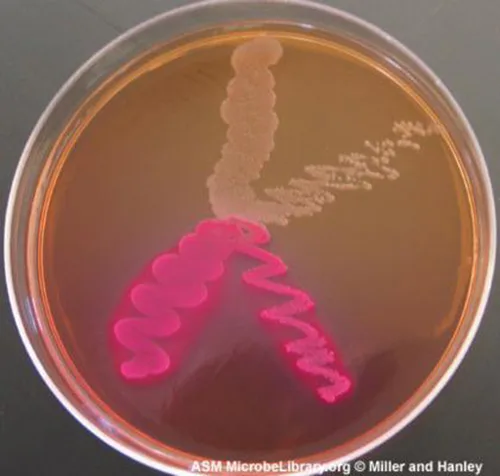
Media that inhibit the growth of unwanted microorganisms and support the growth of the organism of interest by supplying nutrients and reducing competition are called selective media. An example of a selective medium is MacConkey agar. It contains bile salts and crystal violet, which interfere with the growth of many gram-positive bacteria and favor the growth of gram-negative bacteria, particularly the Enterobacteriaceae. These species are commonly named enterics, reside in the intestine, and are adapted to the presence of bile salts. The enrichment cultures foster the preferential growth of a desired microorganism that represents a fraction of the organisms present in an inoculum. For example, if we want to isolate bacteria that break down crude oil, hydrocarbonoclastic bacteria, sequential subculturing in a medium that supplies carbon only in the form of crude oil will enrich the cultures with oil-eating bacteria. The differential media make it easy to distinguish colonies of different bacteria by a change in the color of the colonies or the color of the medium. Color changes are the result of end products created by interaction of bacterial enzymes with differential substrates in the medium or, in the case of hemolytic reactions, the lysis of red blood cells in the medium. Shown below, the differential fermentation of lactose can be observed on MacConkey agar. The lactose fermenters produce acid, which turns the medium and the colonies of strong fermenters hot pink. The medium is supplemented with the pH indicator neutral red, which turns to hot pink at low pH. Selective and differential media can be combined and play an important role in the identification of bacteria by biochemical methods.
Check Your Understanding
Distinguish complex and chemically defined media: sort each phrase below by the type of medium it describes.
Chemically defined
Complex
Distinguish selective and enrichment media: sort each phrase below by the type of medium it describes.
Selective media
Enrichment culture
Link to Learning
Compare the compositions of EZ medium and sheep blood agar.
Case in Point. The End-of-Year Picnic
The microbiology department is celebrating the end of the school year in May by holding its traditional picnic on the green. The speeches drag on for a couple of hours, but finally all the faculty and students can dig into the food: chicken salad, tomatoes, onions, salad, and custard pie. By evening, the whole department, except for two vegetarian students who did not eat the chicken salad, is stricken with nausea, vomiting, retching, and abdominal cramping. Several individuals complain of diarrhea. One patient shows signs of shock (low blood pressure). Blood and stool samples are collected from patients, and an analysis of all foods served at the meal is conducted.
Bacteria can cause gastroenteritis (inflammation of the stomach and intestinal tract) either by colonizing and replicating in the host, which is considered an infection, or by secreting toxins, which is considered intoxication. Signs and symptoms of infections are typically delayed, whereas intoxication manifests within hours, as happened after the picnic.
Blood samples from the patients showed no signs of bacterial infection, which further suggests that this was a case of intoxication. Since intoxication is due to secreted toxins, bacteria are not usually detected in blood or stool samples. MacConkey agar and sorbitol-MacConkey agar plates and xylose-lysine-deoxycholate (XLD) plates were inoculated with stool samples and did not reveal any unusually colored colonies, and no black colonies or white colonies were observed on XLD. All lactose fermenters on MacConkey agar also ferment sorbitol. These results ruled out common agents of food-borne illnesses: E. coli, Salmonella spp., and Shigella spp.
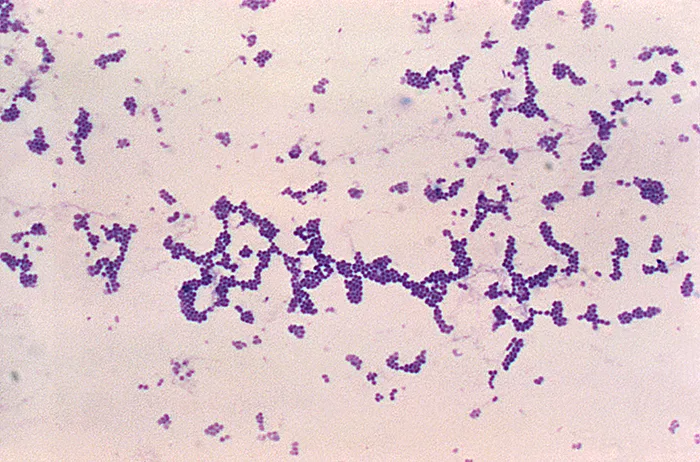
Analysis of the chicken salad revealed an abnormal number of gram-positive cocci arranged in clusters, shown in the micrograph below. A culture of the gram-positive cocci releases bubbles when mixed with hydrogen peroxide. The culture turned mannitol salt agar yellow after a 24-hour incubation.
All the tests point to Staphylococcus aureus as the organism that secreted the toxin. Samples from the salad showed the presence of gram-positive cocci bacteria in clusters. The colonies were positive for catalase. The bacteria grew on mannitol salt agar fermenting mannitol, as shown by the change to yellow of the medium. The pH indicator in mannitol salt agar is phenol red, which turns to yellow when the medium is acidified by the products of fermentation.
The toxin secreted by S. aureus is known to cause severe gastroenteritis. The organism was probably introduced into the salad during preparation by the food handler and multiplied while the salad was kept in the warm ambient temperature during the speeches.
- What are some other factors that might have contributed to rapid growth of S. aureus in the chicken salad?
- Why would S. aureus not be inhibited by the presence of salt in the chicken salad?
Summary
- Chemically defined media contain only chemically known components.
- Selective media favor the growth of some microorganisms while inhibiting others.
- Enriched media contain added essential nutrients a specific organism needs to grow
- Differential media help distinguish bacteria by the color of the colonies or the change in the medium.
Key terms
- enriched media — media that contain additional essential nutrients to support growth.
- fastidious organisms — organism that has extensive growth requirements.
- chemically defined medium — a medium whose complete chemical composition, and the exact amount of every component, is known.
- complex media — media that contain extracts of animals and plants that are not chemically defined.
- selective media — media that contain additives that encourage the growth of some bacteria while inhibiting others.
- enrichment culture — media providing growth conditions that favor the expansion of an organism present in low numbers.
- differential media — media that contain additives that make it possible to distinguish bacterial colonies based on metabolic activities of the organisms.
Practice
Identify and describe culture media for the growth of bacteria, including examples of all-purpose media, enriched, selective, differential, defined, and enrichment media
EMB agar is a medium used in the identification and isolation of pathogenic bacteria. It contains digested meat proteins as a source of organic nutrients. Two indicator dyes, eosin and methylene blue, inhibit the growth of gram-positive bacteria and distinguish between lactose fermenting and nonlactose fermenting organisms. Lactose fermenters form metallic green or deep purple colonies, whereas the nonlactose fermenters form completely colorless colonies. EMB agar is an example of which of the following?
Check whether EMB agar’s ingredients and effects match more than one definition given earlier in this section: inhibiting some bacteria is one property, producing distinct colony colors is another, and an undefined organic-nutrient source is a third.Haemophilus influenzae must be grown on chocolate agar, which is blood agar treated with heat to release growth factors in the medium. H. influenzae is described as ________.
Recall the term for an organism that cannot make certain nutrients itself and must have them supplied by the medium — the same requirement that makes this organism need chocolate agar’s heat-released growth factors.Blood agar contains many unspecified nutrients, supports the growth of a large number of bacteria, and allows differentiation of bacteria according to hemolysis (breakdown of blood). The medium is complex and ________.
Name the term for a medium that lets you tell colonies apart by a change in color from hemolysis.Rogosa agar contains yeast extract. The pH is adjusted to 5.2 and discourages the growth of many microorganisms; however, all the colonies look similar. The medium is complex and ________.
Name the term for a medium whose low pH holds back the growth of some organisms while favoring others.Haemophilus influenzae grows best at 35–37 °C with ~5% CO₂ (or in a candle-jar) and requires hemin (X factor) and nicotinamide-adenine-dinucleotide (NAD, also known as V factor) for growth (Centers for Disease Control and Prevention and World Health Organization, CDC Laboratory Methods for the Diagnosis of Meningitis Caused by Neisseria meningitidis, Streptococcus pneumoniae, and Haemophilus influenzae, WHO Manual, 2nd edition, 2011). Using the vocabulary learned in this chapter, describe H. influenzae.
Show model answer
Did your answer mention:
________ media help distinguish bacteria by the color of the colonies or the change in the medium.
Name the type of medium the Key Concepts and Summary section says lets you tell bacteria apart by a colony or medium color change.Which of the following describes a medium that supports the growth of all microorganisms without any specific inhibition?
Recall the one type of medium in this section that does not hold back any organisms, unlike a medium that favors some organisms over others or one that distinguishes colonies by color.A medium whose complete chemical composition — including the exact amount of every component — is known is called a(n) ________.
Contrast this with a medium made from extracts and digests of yeast, meat, or plant material, whose precise composition is not known.This section is adapted from Microbiology, Section 9.6: Media Used for Bacterial Growth by Nina Parker, Mark Schneegurt, Anh-Hue Thi Tu, Philip Lister, Brian M. Forster, and OpenStax, © OpenStax, licensed under CC BY-NC-SA 4.0. Access the original for free at openstax.org. Changes: both source figures re-encoded as WebP and rendered as mediafigures after image and PDF inspection, kind="photo" on both (a plated photograph and a stained micrograph); the MacConkey agar plate figure carries eager="true" as the first figure on the page and is kept at its document position after the paragraph naming it, its cross-reference rewritten from a figure number to a describing phrase (“the MacConkey agar plate below”); the Staphylococcus aureus micrograph is kept at its CNXML document position, at the end of the Case in Point box after its closing questions (matching the printed page layout), and its cross-reference is likewise rewritten to a describing phrase; neither source alt needed correction against the image. The Link to Learning’s one sentence keeps both source URLs as separate Markdown links. The Case in Point box is rendered as a callout in source order; its two closing questions stay inside the callout as unanswered plain bullets, per the source, which prints no answer. The cross-reference to the chapter 14 introduction (Antimicrobial Drugs, m58857, not authored) is left as plain text rather than a link. The body Check Your Understanding box’s two bullets are both graded as sortbins, because each asks a two-way distinction the module’s own sentences state completely: “Distinguish complex and chemically defined media” sorts six of the module’s own distinguishing phrases about composition and examples, and “Distinguish selective and enrichment media” sorts five of the module’s own phrases about inhibition/favoring and the module’s own examples; neither re-asks a matching set, since this chapter has none. Of the six source exercises, both Multiple Choice items and both Fill in the Blank items are adapted into Practice unchanged in content: the two Fill in the Blank items each have two blanks whose keys are independent classification words (“complex, differential” and “complex, selective”), so each grades its distinguishing blank as the textin (keyed “differential” and “selective”) and prints the source’s other keyed word, “complex”, as given text in the stem, and their hints are written so neither prints the other exercise’s distinguishing word. The unkeyed Short Answer question (“What is the major difference between an enrichment culture and a selective culture?”) is dropped from Practice because it restates the body Check Your Understanding bullet “Distinguish selective and enrichment media” reworded; that bullet is graded in the body instead, per the life-sciences rule against asking the same thing twice. The unkeyed Critical Thinking question (describe H. influenzae “using the vocabulary learned in this chapter”) stays a selfcheck, because an honest answer restricted to this module’s own sentences — as the authoring rule requires, since “vocabulary learned in this chapter” would otherwise reach into terms this module does not define, such as capnophile or mesophile from other sections of chapter 9 — needs the fastidious-organism definition plus the growth factors and medium the problem’s own stem states, assembled into more than one sentence; its model answer and rubric quote only this module’s definition sentence and the problem’s own stated facts. Three filler items bring the section’s single objective group to the book’s eight-item floor: a cloze textin built from the Key Concepts and Summary section’s differential-media sentence; a select-the-term multiplechoice built from the body’s non-selective-media sentence, with the module’s own selective/differential/enrichment terms as distractors; and a term-recall textin built from the Key terms scaffold’s sentence-derived definition of chemically defined medium (which has no Glossary appendix entry). Key terms compiled from the module’s seven defined terms and the book’s Glossary appendix; six definitions come from the Glossary and one, chemically defined medium, has no Glossary entry and is taken from this module’s own defining sentence. No source exercise item is otherwise omitted.