Structure and Function of RNA
By the end of this section, you will be able to:
- Describe the biochemical structure of ribonucleotides
- Describe the similarities and differences between RNA and DNA
- Describe the functions of the three main types of RNA used in protein synthesis
- Explain how RNA can serve as hereditary information
Structurally speaking, ribonucleic acid (RNA), is quite similar to DNA. However, whereas DNA molecules are typically long and double stranded, RNA molecules are much shorter and are typically single stranded. RNA molecules perform a variety of roles in the cell but are mainly involved in the process of protein synthesis (translation) and its regulation.
RNA Structure
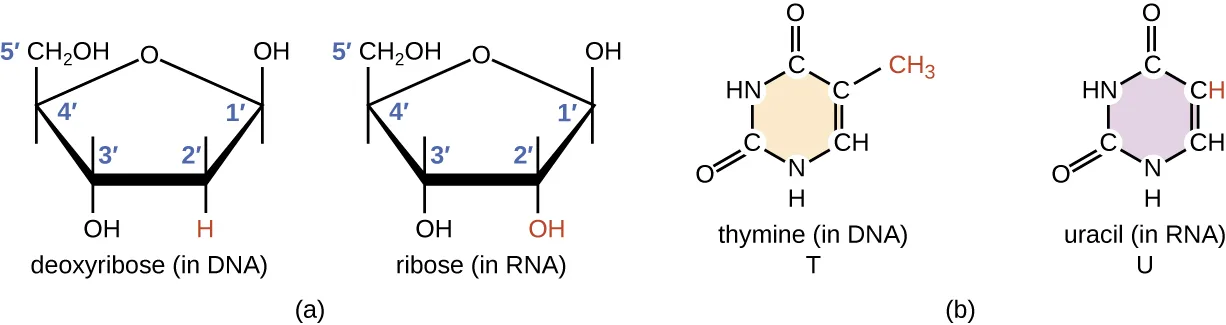
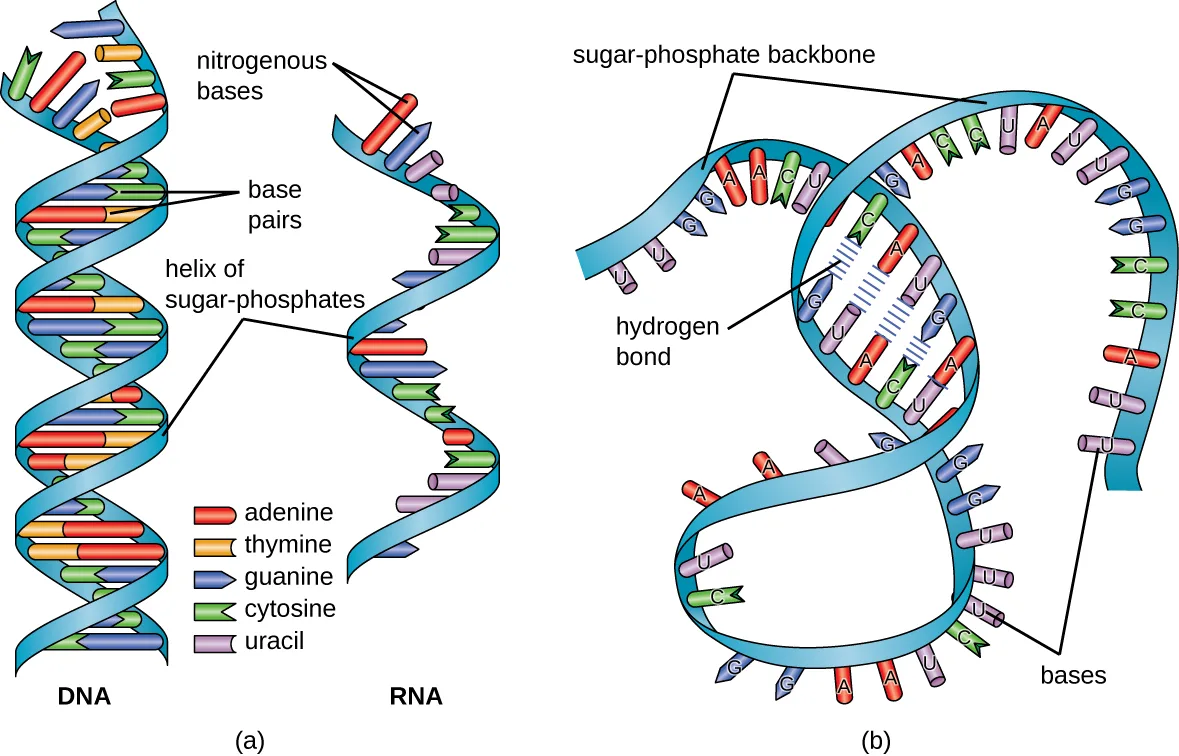
RNA is typically single stranded and is made of ribonucleotides that are linked by phosphodiester bonds. A ribonucleotide in the RNA chain contains ribose (the pentose sugar), one of the four nitrogenous bases (A, U, G, and C), and a phosphate group. The subtle structural difference between the sugars gives DNA added stability, making DNA more suitable for storage of genetic information, whereas the relative instability of RNA makes it more suitable for its more short-term functions. The RNA-specific pyrimidine uracil forms a complementary base pair with adenine and is used instead of the thymine used in DNA. Even though RNA is single stranded, most types of RNA molecules show extensive intramolecular base pairing between complementary sequences within the RNA strand, creating a predictable three-dimensional structure essential for their function (the figures below).
Extended description
(a) The DNA helix shows two backbone ribbons twisted around each other with colored bars for adenine (red), thymine (orange), guanine (blue), and cytosine (green) paired across the middle; the RNA strand beside it is a single ribbon with the same four colors plus a fifth, lavender, for uracil, projecting from one side only, unpaired. (b) The RNA strand coils into a loop; where two stretches of the loop lie close together, their bases (for example G with C, or A with U) are joined by dashed hydrogen-bond lines, while the bases on the rest of the loop point outward with no partner.
Check Your Understanding
How does the structure of RNA differ from the structure of DNA?
Show model answer
Did your answer mention:
Functions of RNA in Protein Synthesis
Cells access the information stored in DNA by creating RNA to direct the synthesis of proteins through the process of translation. Proteins within a cell have many functions, including building cellular structures and serving as enzyme catalysts for cellular chemical reactions that give cells their specific characteristics. The three main types of RNA directly involved in protein synthesis are messenger RNA (mRNA), ribosomal RNA (rRNA), and transfer RNA (tRNA).
In 1961, French scientists François Jacob and Jacques Monod hypothesized the existence of an intermediary between DNA and its protein products, which they called messenger RNA (A. Rich, “The Era of RNA Awakening: Structural Biology of RNA in the Early Years,” Quarterly Reviews of Biophysics 42, no. 2 (2009): 117–137). Evidence supporting their hypothesis was gathered soon afterwards showing that information from DNA is transmitted to the ribosome for protein synthesis using mRNA. If DNA serves as the complete library of cellular information, mRNA serves as a photocopy of specific information needed at a particular point in time that serves as the instructions to make a protein.
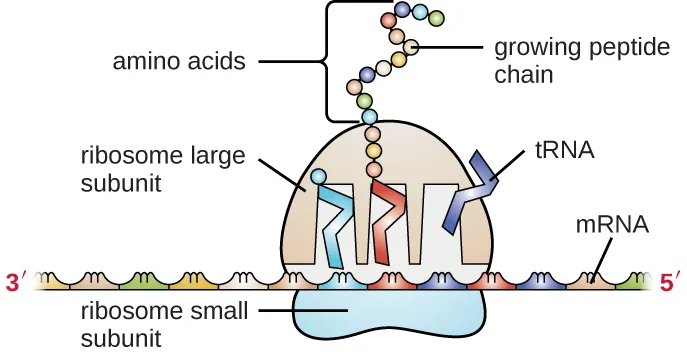
The mRNA carries the message from the DNA, which controls all of the cellular activities in a cell. If a cell requires a certain protein to be synthesized, the gene for this product is “turned on” and the mRNA is synthesized through the process of transcription (see RNA Transcription). The mRNA then interacts with ribosomes and other cellular machinery (the figure below) to direct the synthesis of the protein it encodes during the process of translation (see Protein Synthesis). mRNA is relatively unstable and short-lived in the cell, especially in prokaryotic cells, ensuring that proteins are only made when needed.
Extended description
The mRNA is labeled 3′ at the left end and 5′ at the right end, so the ribosome moves leftward along it, from the 5′ end toward the 3′ end, as it translates. The rightmost tRNA trails behind the ribosome’s direction of travel, holding no amino acid because it has already released it into the chain, and is shown pulling away; the middle tRNA holds a chain of several linked amino-acid beads, the growing peptide; the leftmost tRNA, at the ribosome’s leading edge, carries a single amino acid about to be added to the chain.
rRNA and tRNA are stable types of RNA. In prokaryotes and eukaryotes, tRNA and rRNA are encoded in the DNA, then copied into long RNA molecules that are cut to release smaller fragments containing the individual mature RNA species. In eukaryotes, synthesis, cutting, and assembly of rRNA into ribosomes takes place in the nucleolus region of the nucleus, but these activities occur in the cytoplasm of prokaryotes. Neither of these types of RNA carries instructions to direct the synthesis of a polypeptide, but they play other important roles in protein synthesis.
Ribosomes are composed of rRNA and protein. As its name suggests, rRNA is a major constituent of ribosomes, composing up to about 60% of the ribosome by mass and providing the location where the mRNA binds. The rRNA ensures the proper alignment of the mRNA, tRNA, and the ribosomes; the rRNA of the ribosome also has an enzymatic activity (peptidyl transferase) and catalyzes the formation of the peptide bonds between two aligned amino acids during protein synthesis. Although rRNA had long been thought to serve primarily a structural role, its catalytic role within the ribosome was proven in 2000 (P. Nissen et al., “The Structural Basis of Ribosome Activity in Peptide Bond Synthesis,” Science 289, no. 5481 (2000): 920–930). Scientists in the laboratories of Thomas Steitz (1940–) and Peter Moore (1939–) at Yale University were able to crystallize the ribosome structure from Haloarcula marismortui, a halophilic archaeon isolated from the Dead Sea. Because of the importance of this work, Steitz shared the 2009 Nobel Prize in Chemistry with other scientists who made significant contributions to the understanding of ribosome structure.
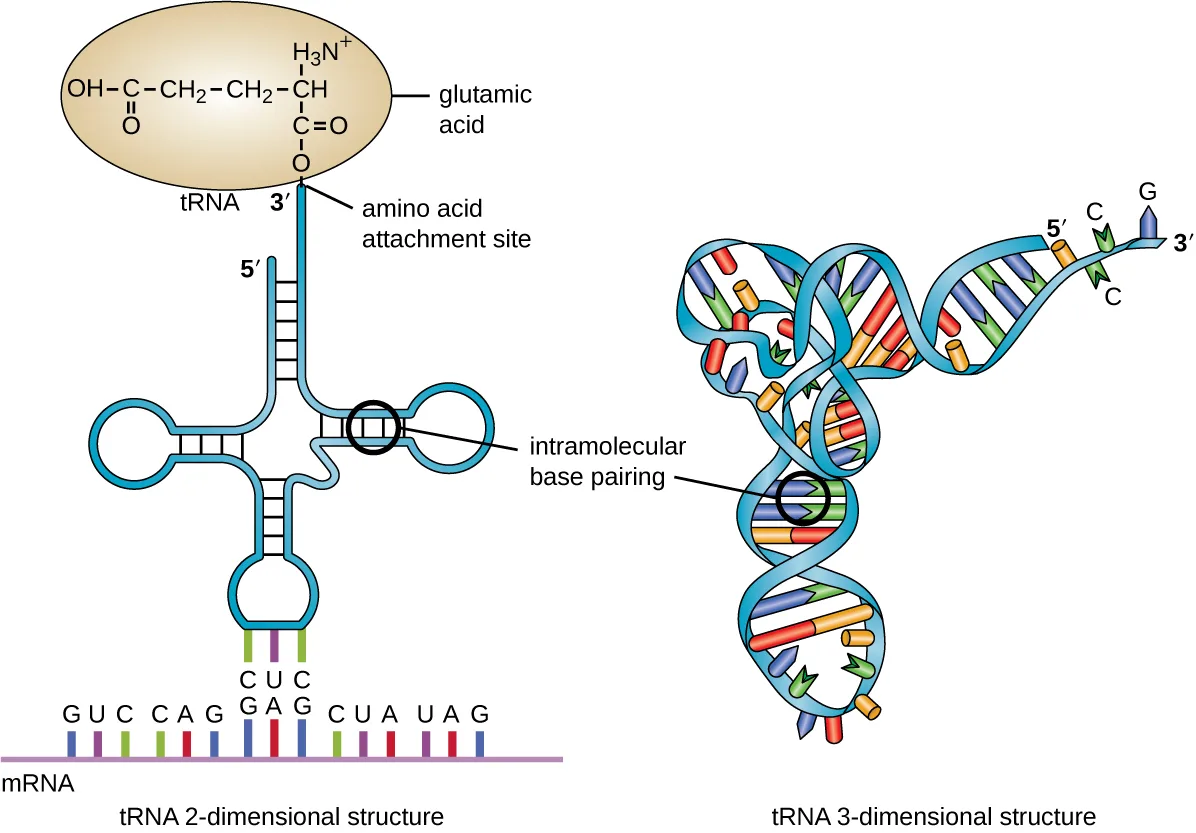
Transfer RNA is the third main type of RNA and one of the smallest, usually only 70–90 nucleotides long. It carries the correct amino acid to the site of protein synthesis in the ribosome. It is the base pairing between the tRNA and mRNA that allows for the correct amino acid to be inserted in the polypeptide chain being synthesized (the figure below). Any mutations in the tRNA or rRNA can result in global problems for the cell because both are necessary for proper protein synthesis (the table below).
Extended description
(a) The tRNA strand folds into a shape with three side loops and a stem region; where the folded strand’s two sides run side by side, their bases pair through hydrogen bonds, circled and labeled intramolecular base pairing. The single-stranded 3′ end extends upward and attaches to an amino acid (glutamic acid) at the amino acid attachment site. The bottom loop’s three exposed bases pair with three complementary bases on a separate strip of mRNA drawn beneath the molecule. (b) The same molecule, folded into its compact three-dimensional shape, twists the stem and loops into an L-shaped structure; the amino-acid-attachment end and the mRNA-pairing end sit at the two opposite tips of the L, with an intramolecular base-paired region circled partway along one arm.
Structure and Function of RNA
| mRNA | rRNA | tRNA | |
|---|---|---|---|
| Structure | Short, unstable, single-stranded RNA corresponding to a gene encoded within DNA | Longer, stable RNA molecules composing 60% of ribosome’s mass | Short (70–90 nucleotides), stable RNA with extensive intramolecular base pairing; contains an amino acid binding site and an mRNA binding site |
| Function | Serves as intermediary between DNA and protein; used by ribosome to direct synthesis of protein it encodes | Ensures the proper alignment of mRNA, tRNA, and ribosome during protein synthesis; catalyzes peptide bond formation between amino acids | Carries the correct amino acid to the site of protein synthesis in the ribosome |
Check Your Understanding
What are the functions of the three major types of RNA molecules involved in protein synthesis? Sort each phrase below under the type of RNA it describes.
mRNA
rRNA
tRNA
RNA as Hereditary Information
Although RNA does not serve as the hereditary information in most cells, RNA does hold this function for many viruses that do not contain DNA. Thus, RNA clearly does have the additional capacity to serve as genetic information. Although RNA is typically single stranded within cells, there is significant diversity in viruses. Rhinoviruses, which cause the common cold; influenza viruses; and the Ebola virus are single-stranded RNA viruses. Rotaviruses, which cause severe gastroenteritis in children and other immunocompromised individuals, are examples of double-stranded RNA viruses. Because double-stranded RNA is uncommon in eukaryotic cells, its presence serves as an indicator of viral infection. The implications for a virus having an RNA genome instead of a DNA genome are discussed in more detail in Viruses.
Summary
- Ribonucleic acid (RNA) is typically single stranded and contains ribose as its pentose sugar and the pyrimidine uracil instead of thymine. An RNA strand can undergo significant intramolecular base pairing to take on a three-dimensional structure.
- There are three main types of RNA, all involved in protein synthesis.
- Messenger RNA (mRNA) serves as the intermediary between DNA and the synthesis of protein products during translation.
- Ribosomal RNA (rRNA) is a type of stable RNA that is a major constituent of ribosomes. It ensures the proper alignment of the mRNA and the ribosomes during protein synthesis and catalyzes the formation of the peptide bonds between two aligned amino acids during protein synthesis.
- Transfer RNA (tRNA) is a small type of stable RNA that carries an amino acid to the corresponding site of protein synthesis in the ribosome. It is the base pairing between the tRNA and mRNA that allows for the correct amino acid to be inserted in the polypeptide chain being synthesized.
- Although RNA is not used for long-term genetic information in cells, many viruses do use RNA as their genetic material.
Key terms
- ribonucleic acid (RNA) — single-stranded nucleic acid composed of ribonucleotides; important in transcription and translation (protein synthesis).
- ribonucleotides — RNA nucleotides containing ribose as the pentose sugar component and a nitrogenous base.
- uracil — pyrimidine nitrogenous base found only in RNA nucleotides.
- messenger RNA (mRNA) — short-lived type of RNA that serves as the intermediary between DNA and the synthesis of protein products.
- ribosomal RNA (rRNA) — type of stable RNA that is a major constituent of ribosomes, ensuring proper alignment of the mRNA and the ribosomes as well as catalyzing the formation of the peptide bonds between two aligned amino acids during protein synthesis.
- transfer RNA (tRNA) — small type of stable RNA that carries the correct amino acid to the site of protein synthesis in the ribosome and base pairs with the mRNA to allow the amino acid it carries to be inserted in the polypeptide chain being synthesized.
Practice
Describe the biochemical structure of ribonucleotides
A nucleotide subunit of the RNA chain, containing ribose, a nitrogenous base, and a phosphate group and linked to others by phosphodiester bonds, is called a ________.
Name the class of molecule that contains ribose, one of four nitrogenous bases, and a phosphate group, linked into an RNA chain by phosphodiester bonds.Which three components make up a ribonucleotide in the RNA chain?
Recall the sugar, base, and functional group named in the RNA Structure section’s opening description of a ribonucleotide.How do complementary base pairs contribute to intramolecular base pairing within an RNA molecule?
Recall what the RNA Structure section says intramolecular base pairing between complementary sequences creates.If an antisense RNA has the sequence 5′-AUUCGAAUGC-3′, what is the sequence of the mRNA to which it will bind? Be sure to label the 5′ and 3′ ends of the molecule you draw.
Show model answer
5′-AUUCGAAUGC-3′ from its 3′ end back toward its 5′ end and taking the complement of each base in turn — C pairs with G, G pairs with C, U pairs with A, A pairs with U, A pairs with U, G pairs with C, C pairs with G, U pairs with A, U pairs with A, and finally the antisense 5′-end A pairs with the mRNA’s 3′-end U — gives the mRNA sequence 5′-GCAUUCGAAU-3′. The two molecules therefore run antiparallel to one another, with the mRNA’s 5′ end aligned opposite the antisense strand’s 3′ end.Did your answer mention:
Describe the similarities and differences between RNA and DNA
What are the differences between DNA nucleotides and RNA nucleotides? Sort each phrase below under the type of nucleotide it describes.
RNA nucleotides
DNA nucleotides
Double-stranded RNA is commonly found inside cells.
Recall what the RNA as Hereditary Information section says about how common double-stranded RNA is inside eukaryotic cells.An RNA strand contains the pyrimidine ________ instead of the thymine found in DNA.
Name the RNA-specific pyrimidine that pairs with adenine in place of DNA’s thymine.Describe the functions of the three main types of RNA used in protein synthesis
Which of the following types of RNA codes for a protein?
Recall which RNA type serves as the intermediary carrying the protein-coding message from DNA.A nucleic acid is purified from a mixture. The molecules are relatively small, contain uracil, and most are covalently bound to an amino acid. Which of the following was purified?
Recall which RNA type is one of the smallest, at 70–90 nucleotides, and carries an amino acid.Which of the following types of RNA is known for its catalytic abilities?
Recall which RNA type’s enzymatic activity (peptidyl transferase) catalyzes peptide bond formation.Ribosomes are composed of rRNA and what other component?
Recall the two components the Functions of RNA in Protein Synthesis section says ribosomes are composed of.Ribosomes are composed mostly of RNA.
Recall the percentage of the ribosome’s mass the Functions of RNA in Protein Synthesis section attributes to rRNA.Which description matches tRNA?
Recall which RNA type physically carries an amino acid to the ribosome for protein synthesis.Which description matches rRNA?
Recall which RNA type is described as a major structural component of the ribosome itself.Which description matches mRNA?
Recall which RNA type serves as an intermediary photocopy of the genetic information in a gene.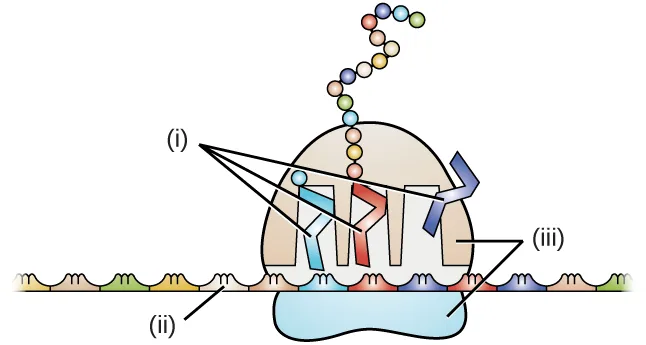
Which labeled part of the figure marks the tRNA?
Recall which shapes in the figure sit inside the ribosome’s large subunit, each carrying an amino acid or a growing peptide chain.Which labeled part of the figure marks the mRNA?
Recall which part of the figure is the long strand the ribosome moves along.Which labeled part of the figure marks the rRNA?
Recall that rRNA is described as a major constituent of the ribosome itself — the structures making up the ribosome as a whole.How is the information stored within the base sequence of DNA used to determine a cell’s properties?
Show model answer
Did your answer mention:
Why does it make sense that tRNA and rRNA molecules are more stable than mRNA molecules?
Show model answer
Did your answer mention:
Explain how RNA can serve as hereditary information
Which of the following may use RNA as its genome?
Recall which of these four options the RNA as Hereditary Information section says does not contain DNA and instead can use RNA as genetic material.Rotaviruses, which cause severe gastroenteritis in children and other immunocompromised individuals, are examples of which type of RNA virus?
Recall the term the section uses to distinguish rotaviruses from the single-stranded RNA viruses named alongside them.Because double-stranded RNA is uncommon in eukaryotic cells, its presence inside a eukaryotic cell serves as an indicator of ________.
Recall what the presence of an uncommon form of RNA inside a eukaryotic cell is said to signal.This section is adapted from Microbiology, Section 10.3: Structure and Function of RNA by Nina Parker, Mark Schneegurt, Anh-Hue Thi Tu, Philip Lister, Brian M. Forster, and OpenStax, © OpenStax, licensed under CC BY-NC-SA 4.0. Access the original for free at openstax.org. Changes: all four body figures re-encoded as WebP and rendered as mediafigures after image and PDF inspection, each set kind="diagram" (the media manifest guessed “photo” for every one, since the source files are JPEGs, but all four are drawn structural diagrams) with the first, the ribose/deoxyribose and thymine/uracil comparison, given eager="true"; the ribose/deoxyribose comparison figure’s alt is rewritten from the image, which draws deoxyribose (in DNA) before ribose (in RNA) — the reverse of the order the source alt names them in, logged as a suspected source-alt defect; the DNA/RNA helix and RNA-folding figure, the mRNA/tRNA/ribosome figure, and the tRNA structure figure each get a longdesc walking their labeled parts in reading order, since their captions do not name the labels; the “Structure and Function of RNA” CALS table is transcribed as Markdown from the CNXML cells (its spanning header row is kept as a bold line above the table, not a data row), checked against the PDF page, never from the summary attribute, and feeds one sortbins (bins mRNA/rRNA/tRNA, items the table’s own structure and function phrases, reworded only to avoid printing a bin’s own name inside another bin’s item); the second body Check Your Understanding bullet, which asks the functions the table already states, is converted into that sortbins per the life-sciences unkeyed-question rule, rather than adding a second item beside it; the first Check Your Understanding bullet stays a self-check, since its honest answer assembles several sentences from the RNA Structure section rather than resting on one fixing sentence; the two footnoted journal citations (Rich 2009, Nissen 2000) are kept as inline parenthetical citations after the sentences they support; same-module figure cross-references are rendered as describing prose (“the figure below,” “the table below”); the source’s <link document> cross-references to RNA Transcription (11.3) and Protein Synthesis (11.4) are absolute site-root links, as is the cross-reference to Viruses (6.1); the five source Multiple Choice items, the two True/False items (rendered as two-option multiple choice, True then False), and the three-row Matching exercise (keyed C, A, B) — rendered as one multiple-choice item per row, each offering all three lettered descriptions in the table’s own list order — are adapted into Practice unchanged; of the five unkeyed Short Answer questions, the DNA-versus-RNA-nucleotide question is graded as a sortbins (bins RNA nucleotides/DNA nucleotides, items the module’s own sugar and base phrases), the intramolecular-base-pairing question is graded as a multiple-choice keyed by the RNA Structure section’s own sentence, the antisense-RNA sequence question is a fully worked self-check deriving the complementary mRNA sequence base by base (primes normalized to U+2032 ′; the source prints the modifier letter prime ʹ U+02B9), and the DNA-information-to-cell-properties question stays a self-check assembling three sentences of the Functions of RNA in Protein Synthesis section; the fifth, “Why does double-stranded RNA (dsRNA) stimulate RNA interference?”, is omitted from the page — the module never discusses RNA interference, so no self-check model answer could be built from this section’s own text without importing outside knowledge; of the two unkeyed Critical Thinking questions, the figure-labeling question is graded as three figure-keyed multiple-choice items, one per RNA type, keyed from the image with an alt that names no molecule (the (iii) key follows the module’s own sentence that rRNA is a major constituent of ribosomes), and the tRNA/rRNA-stability question stays a self-check assembling the mRNA-instability sentence with the tRNA and rRNA function sentences; four author-written filler items (a ribonucleotide-composition multiple choice and a term-recall textin for the first objective’s group, and a rotavirus/double-stranded-RNA-virus multiple choice plus a “viral infection” cloze textin for the fourth) are added from this section’s own sentences to bring thin objective groups to the book’s floor; key terms compiled from the module’s six defined terms and the book’s Glossary appendix, all six definitions taken from the appendix, the mRNA, rRNA, and tRNA bullets from the appendix’s abbreviated headwords mRNA, rRNA, and tRNA (which state the same meaning as the module). No source exercise item is otherwise omitted.