The Functions of Genetic Material
By the end of this section, you will be able to:
- Explain the two functions of the genome
- Explain the meaning of the central dogma of molecular biology
- Differentiate between genotype and phenotype and explain how environmental factors influence phenotype
Clinical Focus. Part 1
Mark is 60-year-old software engineer who suffers from type II diabetes, which he monitors and keeps under control largely through diet and exercise. One spring morning, while doing some gardening, he scraped his lower leg while walking through blackberry brambles. He continued working all day in the yard and did not bother to clean the wound and treat it with antibiotic ointment until later that evening. For the next 2 days, his leg became increasingly red, swollen, and warm to the touch. It was sore not only on the surface, but deep in the muscle. After 24 hours, Mark developed a fever and stiffness in the affected leg. Feeling increasingly weak, he called a neighbor, who drove him to the emergency department.
- Did Mark wait too long to seek medical attention? At what point do his signs and symptoms warrant seeking medical attention?
- What types of infections or other conditions might be responsible for Mark’s symptoms?
The case continues in RNA Transcription.
DNA serves two essential functions that deal with cellular information. First, DNA is the genetic material responsible for inheritance and is passed from parent to offspring for all life on earth. To preserve the integrity of this genetic information, DNA must be replicated with great accuracy, with minimal errors that introduce changes to the DNA sequence. A genome contains the full complement of DNA within a cell and is organized into smaller, discrete units called genes that are arranged on chromosomes and plasmids. The second function of DNA is to direct and regulate the construction of the proteins necessary to a cell for growth and reproduction in a particular cellular environment.
A gene is composed of DNA that is “read” or transcribed to produce an RNA molecule during the process of transcription. One major type of RNA molecule, called messenger RNA (mRNA), provides the information for the ribosome to catalyze protein synthesis in a process called translation. The processes of transcription and translation are collectively referred to as gene expression. Gene expression is the synthesis of a specific protein with a sequence of amino acids that is encoded in the gene. The flow of genetic information from DNA to RNA to protein is described by the central dogma (see the figure below). This central dogma of molecular biology further elucidates the mechanism behind Beadle and Tatum’s “one gene-one enzyme” hypothesis (see Using Microbiology to Discover the Secrets of Life). Each of the processes of replication, transcription, and translation includes the stages of 1) initiation, 2) elongation (polymerization), and 3) termination. These stages will be described in more detail in this chapter.

Extended description
The diagram reads left to right as three colored, rounded rectangles joined by two gray arrows. The first box is light blue and reads DNA. A gray arrow labeled transcription points from the DNA box to the second box, which is magenta/pink and reads RNA. A second gray arrow labeled translation points from the RNA box to the third box, which is orange and reads protein.
A cell’s genotype is the full collection of genes it contains, whereas its phenotype is the set of observable characteristics that result from those genes. The phenotype is the product of the array of proteins being produced by the cell at a given time, which is influenced by the cell’s genotype as well as interactions with the cell’s environment. Genes code for proteins that have functions in the cell. Production of a specific protein encoded by an individual gene often results in a distinct phenotype for the cell compared with the phenotype without that protein. For this reason, it is also common to refer to the genotype of an individual gene and its phenotype. Although a cell’s genotype remains constant, not all genes are used to direct the production of their proteins simultaneously. Cells carefully regulate expression of their genes, only using genes to make specific proteins when those proteins are needed (see the figure below).
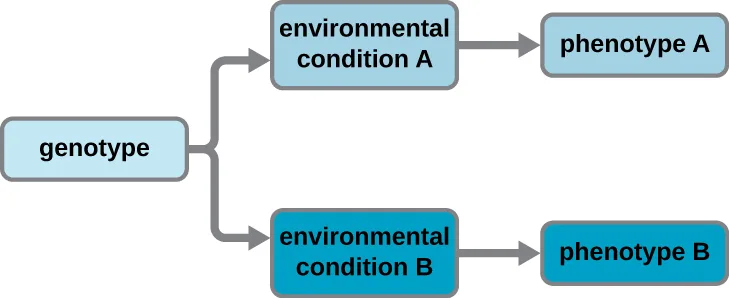
Extended description
The diagram reads left to right as five colored, rounded rectangles joined by gray arrows. On the left, a light blue box reads genotype. Two gray arrows branch from it: the upper arrow leads to a light blue box labeled environmental condition A, and the lower arrow leads to a darker teal box labeled environmental condition B. A gray arrow continues from environmental condition A to a light blue box labeled phenotype A. A second gray arrow continues from environmental condition B to a darker teal box labeled phenotype B, matching the teal color of environmental condition B.
Check Your Understanding
What are the two functions of DNA?
Look for the two functions named together in the opening paragraph of this section.Distinguish between the genotype and phenotype of a cell.
Match each term to whether it describes the genes a cell has or the traits that result from them.How can cells have the same genotype but differ in their phenotype?
Show model answer
Did your answer mention:
Eye on Ethics. Use and Abuse of Genome Data
Why can some humans harbor opportunistic pathogens like Haemophilus influenzae, Staphylococcus aureus, or Streptococcus pyogenes, in their upper respiratory tracts but remain asymptomatic carriers, while other individuals become seriously ill when infected? There is evidence suggesting that differences in susceptibility to infection between patients may be a result, at least in part, of genetic differences between human hosts. For example, genetic differences in human leukocyte antigens (HLAs) and red blood cell antigens among hosts have been implicated in different immune responses and resulting disease progression from infection with H. influenzae.
Because the genetic interplay between pathogen and host may contribute to disease outcomes, understanding differences in genetic makeup between individuals may be an important clinical tool. Ecological genomics is a relatively new field that seeks to understand how the genotypes of different organisms interact with each other in nature. The field answers questions about how gene expression of one organism affects gene expression of another. Medical applications of ecological genomics will focus on how pathogens interact with specific individuals, as opposed to humans in general. Such analyses would allow medical professionals to use knowledge of an individual’s genotype to apply more individualized plans for treatment and prevention of disease.
With the advent of next-generation sequencing, it is relatively easy to obtain the entire genomic sequences of pathogens; a bacterial genome can be sequenced in as little as a day (D.J. Edwards, K.E. Holt, “Beginner’s Guide to Comparative Bacterial Genome Analysis Using Next-Generation Sequence Data,” Microbial Informatics and Experimentation 3, no. 1 [2013]: 2). The speed and cost of sequencing the human genome has also been greatly reduced and, already, individuals can submit samples to receive extensive reports on their personal genetic traits, including ancestry and carrier status for various genetic diseases. As sequencing technologies progress further, such services will continue to become less expensive, more extensive, and quicker.
However, as this day quickly approaches, there are many ethical concerns with which society must grapple. For example, should genome sequencing be a standard practice for everybody? Should it be required by law or by employers if it will lower health-care costs? If one refuses genome sequencing, do they forfeit their right to health insurance coverage? For what purposes should the data be used? Who should oversee proper use of these data? If genome sequencing reveals predisposition to a particular disease, do insurance companies have the right to increase rates? Will employers treat an employee differently? Knowing that environmental influences also affect disease development, how should the data on the presence of a particular disease-causing allele in an individual be used ethically? The Genetic Information Nondiscrimination Act of 2008 (GINA) currently prohibits discriminatory practices based on genetic information by both health insurance companies and employers. However, GINA does not cover life, disability, or long-term care insurance policies. Clearly, all members of society must continue to engage in conversations about these issues so that such genomic data can be used to improve health care while simultaneously protecting an individual’s rights.
Summary
- DNA serves two important cellular functions: It is the genetic material passed from parent to offspring and it serves as the information to direct and regulate the construction of the proteins necessary for the cell to perform all of its functions.
- The central dogma states that DNA organized into genes specifies the sequences of messenger RNA (mRNA), which, in turn, specifies the amino acid sequence of proteins.
- The genotype of a cell is the full collection of genes a cell contains. Not all genes are used to make proteins simultaneously. The phenotype is a cell’s observable characteristics resulting from the proteins it is producing at a given time under specific environmental conditions.
Key terms
- gene expression — production of proteins from the information contained in DNA through the processes of transcription and translation.
- central dogma — scientific principle explaining the flow of genetic information from DNA to RNA to protein.
Practice
Explain the two functions of the genome
DNA does all but which of the following?
Distinguish what DNA itself is used for from what happens to messenger RNA once it has been made.DNA serves two important cellular functions: it is the ________ passed from parent to offspring, and it directs and regulates the construction of the proteins the cell needs.
Name what DNA is, as stated at the start of this section’s summary.A genome contains the full complement of DNA within a cell and is organized into smaller, discrete units called ________ that are arranged on chromosomes and plasmids.
Name the discrete units into which a genome’s DNA is organized.Explain the meaning of the central dogma of molecular biology
According to the central dogma, which of the following represents the flow of genetic information in cells?
Follow the two arrows in the central dogma figure above, from genetic material to messenger RNA to protein.The process of making an RNA copy of a gene is called ________.
Name the process in which a gene is read to produce messenger RNA from a DNA template.The combined processes of transcription and translation are referred to as ________.
Name the term this section uses for the two processes shown together in the central dogma figure.Differentiate between genotype and phenotype and explain how environmental factors influence phenotype
Cells are always producing proteins from every gene they possess.
Compare this claim with what the section says about a cell’s full collection of genes staying fixed while the proteins it produces change.A cell’s ________ remains constant whereas its phenotype changes in response to environmental influences.
Name the term for a cell’s full collection of genes, which does not change.A pure culture of an unknown bacterium was streaked onto plates of a variety of media. You notice that the colony morphology is strikingly different on plates of minimal media with glucose compared to that seen on trypticase soy agar plates. How can you explain these differences in colony morphology?
Show model answer
Did your answer mention:
This section is adapted from Microbiology, Section 11.1: The Functions of Genetic Material by Nina Parker, Mark Schneegurt, Anh-Hue Thi Tu, Philip Lister, Brian M. Forster, and OpenStax, © OpenStax, licensed under CC BY-NC-SA 4.0. Access the original for free at openstax.org. Changes: both source figures re-encoded as WebP and rendered as mediafigures with explicit kind="diagram" (the manifest guessed “photo” for both; each is a drawn flow chart, not a photograph), each with a longdesc walking its boxes, colors, and arrows in reading order; the source’s “Jump to the next Clinical Focus box” link is replaced with a sentence naming where the case continues, in RNA Transcription; the Eye on Ethics feature box rendered as a callout with its one footnote rendered as an inline parenthetical citation; the cross-reference to Section 10.1 rendered as a link to its local page; the module’s two body Check Your Understanding questions that a single body sentence or definition fixes (“What are the two functions of DNA?” and “Distinguish between the genotype and phenotype of a cell.”) are rendered as graded body multiple-choice items, and the third (“How can cells have the same genotype but differ in their phenotype?”), whose honest answer assembles two sentences, remains a body self-check with a model answer and rubric from this section’s text; the two source Multiple Choice items, the True/False item (rendered as a two-option multiple choice), and the two Fill in the Blank items are adapted into Practice unchanged; the source’s unkeyed Short Answer question (“Can two observably different cells have the same genotype? Explain?”) is a reworded repeat of the body Check Your Understanding question above and is not used a second time in Practice, per the life-sciences distinct-item rule; the unkeyed Critical Thinking question about colony morphology on different media remains a self-check, because its answer requires assembling this section’s genotype/phenotype/environment sentences and applying them to a scenario the section does not itself describe; three filler items — two cloze textins from this section’s summary and body text (the “genetic material” and “genes” blanks) and one term-recall textin for “gene expression” — fill the first two Practice groups to the section’s three-per-objective floor; key terms compiled from the module’s two defined terms, both definitions taken directly from the book’s Glossary appendix.