RNA Transcription
By the end of this section, you will be able to:
- Explain how RNA is synthesized using DNA as a template
- Distinguish between transcription in prokaryotes and eukaryotes
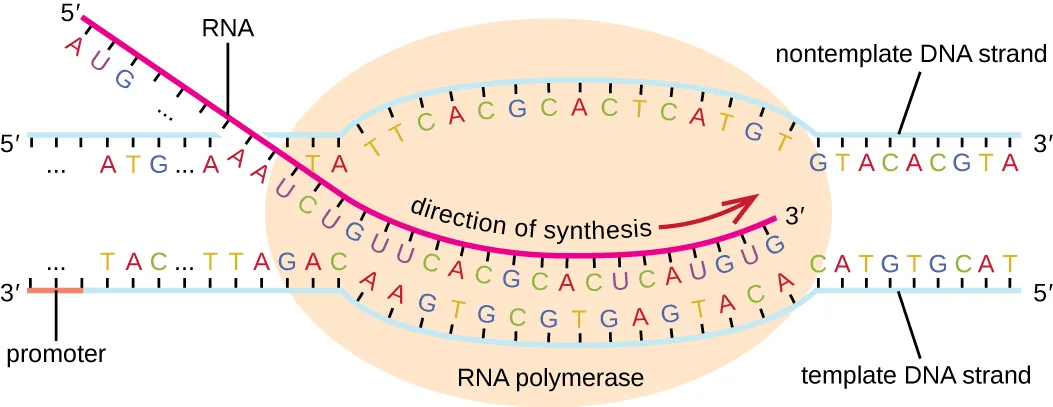
During the process of transcription, the information encoded within the DNA sequence of one or more genes is transcribed into a strand of RNA, also called an RNA transcript. The resulting single-stranded RNA molecule, composed of ribonucleotides containing the bases adenine (A), cytosine (C), guanine (G), and uracil (U), acts as a mobile molecular copy of the original DNA sequence. Transcription in prokaryotes and in eukaryotes requires the DNA double helix to partially unwind in the region of RNA synthesis. The unwound region is called a transcription bubble. Transcription of a particular gene always proceeds from one of the two DNA strands that acts as a template, the so-called antisense strand. The RNA product is complementary to the template strand of DNA and is almost identical to the nontemplate DNA strand, or the sense strand. The only difference is that in RNA, all of the T nucleotides are replaced with U nucleotides; during RNA synthesis, U is incorporated when there is an A in the complementary antisense strand.
Transcription in Bacteria
Bacteria use the same RNA polymerase to transcribe all of their genes. Like DNA polymerase, RNA polymerase adds nucleotides one by one to the 3′-OH group of the growing nucleotide chain. One critical difference in activity between DNA polymerase and RNA polymerase is the requirement for a 3′-OH onto which to add nucleotides: DNA polymerase requires such a 3′-OH group, thus necessitating a primer, whereas RNA polymerase does not. During transcription, a ribonucleotide complementary to the DNA template strand is added to the growing RNA strand and a covalent phosphodiester bond is formed by dehydration synthesis between the new nucleotide and the last one added. In E. coli, RNA polymerase comprises six polypeptide subunits, five of which compose the polymerase core enzyme responsible for adding RNA nucleotides to a growing strand. The sixth subunit is known as sigma (σ). The σ factor enables RNA polymerase to bind to a specific promoter, thus allowing for the transcription of various genes. There are various σ factors that allow for transcription of various genes.
Initiation
The initiation of transcription begins at a promoter, a DNA sequence onto which the transcription machinery binds and initiates transcription. The nucleotide pair in the DNA double helix that corresponds to the site from which the first 5′ RNA nucleotide is transcribed is the initiation site. Nucleotides preceding the initiation site are designated “upstream,” whereas nucleotides following the initiation site are called “downstream” nucleotides. In most cases, promoters are located just upstream of the genes they regulate. Although promoter sequences vary among bacterial genomes, a few elements are conserved. At the −10 and −35 positions within the DNA prior to the initiation site (designated +1), there are two promoter consensus sequences, or regions that are similar across all promoters and across various bacterial species. The −10 consensus sequence, called the TATA box, is TATAAT. The −35 sequence is recognized and bound by σ.
Elongation
The elongation in transcription phase begins when the σ subunit dissociates from the polymerase, allowing the core enzyme to synthesize RNA complementary to the DNA template in a 5′ to 3′ direction at a rate of approximately 40 nucleotides per second. As elongation proceeds, the DNA is continuously unwound ahead of the core enzyme and rewound behind it, as the diagram below shows.
Extended description
Reading left to right: a short segment of the bottom DNA strand at the far left is labeled the promoter. To its right the double helix opens into a transcription bubble enclosed by a large oval labeled RNA polymerase. Inside the bubble the top strand, labeled the nontemplate DNA strand and running 5′ (left) to 3′ (right), and the bottom strand, labeled the template DNA strand and running 3′ (left) to 5′ (right), are shown separated, each with its bases spelled out. A pink RNA strand begins at the upper left labeled 5′, pairs with the exposed template strand across the bubble, and exits at the lower right labeled 3′, with an arrow labeled direction of synthesis pointing left to right. Outside the bubble on both sides the two DNA strands are rewound back into a double helix.
Termination
Once a gene is transcribed, the bacterial polymerase must dissociate from the DNA template and liberate the newly made RNA. This is referred to as termination of transcription. The DNA template includes repeated nucleotide sequences that act as termination signals, causing RNA polymerase to stall and release from the DNA template, freeing the RNA transcript.
Check Your Understanding
Where does σ factor of RNA polymerase bind DNA to start transcription?
Recall which of the two conserved promoter positions this section says σ specifically recognizes and binds, as distinct from the TATA box.What occurs to initiate the polymerization activity of RNA polymerase?
Recall the single event the Initiation subsection names as beginning transcription, before elongation or σ dissociation.Where does the signal to end transcription come from?
Recall what kind of DNA sequence the Termination subsection says causes RNA polymerase to stall and release.Transcription in Eukaryotes
Prokaryotes and eukaryotes perform fundamentally the same process of transcription, with a few significant differences, as the table below shows. Eukaryotes use three different polymerases, RNA polymerases I, II, and III, all structurally distinct from the bacterial RNA polymerase. Each transcribes a different subset of genes. Interestingly, archaea contain a single RNA polymerase that is more closely related to eukaryotic RNA polymerase II than to its bacterial counterpart. Eukaryotic mRNAs are also usually monocistronic, meaning that they each encode only a single polypeptide, whereas prokaryotic mRNAs of bacteria and archaea are commonly polycistronic, meaning that they encode multiple polypeptides.
The most important difference between prokaryotes and eukaryotes is the latter’s membrane-bound nucleus, which influences the ease of use of RNA molecules for protein synthesis. With the genes bound in a nucleus, the eukaryotic cell must transport protein-encoding RNA molecules to the cytoplasm to be translated. Protein-encoding primary transcripts, the RNA molecules directly synthesized by RNA polymerase, must undergo several processing steps to protect these RNA molecules from degradation during the time they are transferred from the nucleus to the cytoplasm and translated into a protein. For example, eukaryotic mRNAs may last for several hours, whereas the typical prokaryotic mRNA lasts no more than 5 seconds.
The primary transcript (also called pre-mRNA) is first coated with RNA-stabilizing proteins to protect it from degradation while it is processed and exported out of the nucleus. The first type of processing begins while the primary transcript is still being synthesized; a special 7-methylguanosine nucleotide, called the 5′ cap, is added to the 5′ end of the growing transcript. In addition to preventing degradation, factors involved in subsequent protein synthesis recognize the cap, which helps initiate translation by ribosomes. Once elongation is complete, another processing enzyme then adds a string of approximately 200 adenine nucleotides to the 3′ end, called the poly-A tail. This modification further protects the pre-mRNA from degradation and signals to cellular factors that the transcript needs to be exported to the cytoplasm.
Eukaryotic genes that encode polypeptides are composed of coding sequences called exons (ex-on signifies that they are expressed) and intervening sequences called introns (int-ron denotes their intervening role). Transcribed RNA sequences corresponding to introns do not encode regions of the functional polypeptide and are removed from the pre-mRNA during processing. It is essential that all of the intron-encoded RNA sequences are completely and precisely removed from a pre-mRNA before protein synthesis so that the exon-encoded RNA sequences are properly joined together to code for a functional polypeptide. If the process errs by even a single nucleotide, the sequences of the rejoined exons would be shifted, and the resulting polypeptide would be nonfunctional. The process of removing intron-encoded RNA sequences and reconnecting those encoded by exons is called RNA splicing and is facilitated by the action of a spliceosome containing small nuclear ribonucleoproteins (snRNPs). Intron-encoded RNA sequences are removed from the pre-mRNA while it is still in the nucleus. Although they are not translated, introns appear to have various functions, including gene regulation and mRNA transport. On completion of these modifications, the mature transcript, the mRNA that encodes a polypeptide, is transported out of the nucleus, destined for the cytoplasm for translation. Introns can be spliced out differently, resulting in various exons being included or excluded from the final mRNA product. This process is known as alternative splicing. The advantage of alternative splicing is that different types of mRNA transcripts can be generated, all derived from the same DNA sequence. In recent years, it has been shown that some archaea also have the ability to splice their pre-mRNA.
| Property | Bacteria | Eukaryotes |
|---|---|---|
| Number of polypeptides encoded per mRNA | Monocistronic or polycistronic | Exclusively monocistronic |
| Strand elongation | core + σ = holoenzyme | RNA polymerases I, II, or III |
| Addition of 5′ cap | No | Yes |
| Addition of 3′ poly-A tail | No | Yes |
| Splicing of pre-mRNA | No | Yes |
Link to Learning
Visualize how mRNA splicing happens by watching the process in action in this video. See how introns are removed during RNA splicing here.
Check Your Understanding
In eukaryotic cells, how is the RNA transcript from a gene for a protein modified after it is transcribed?
Show model answer
Did your answer mention:
Do exons or introns contain information for protein sequences?
Recall which sequences are described as coding and which as intervening, and which type is removed from the pre-mRNA before translation.Clinical Focus. Part 2
In the emergency department, a nurse told Mark that he had made a good decision to come to the hospital because his symptoms indicated an infection that had gotten out of control. Mark’s symptoms had progressed, with the area of skin affected and the amount of swelling increasing. Within the affected area, a rash had begun, blistering and small gas pockets underneath the outermost layer of skin had formed, and some of the skin was becoming gray. Based on the putrid smell of the pus draining from one of the blisters, the rapid progression of the infection, and the visual appearance of the affected skin, the physician immediately began treatment for necrotizing fasciitis. Mark’s physician ordered a culture of the fluid draining from the blister and also ordered blood work, including a white blood cell count.
Mark was admitted to the intensive care unit and began intravenous administration of a broad-spectrum antibiotic to try to minimize further spread of the infection. Despite antibiotic therapy, Mark’s condition deteriorated quickly. Mark became confused and dizzy. Within a few hours of his hospital admission, his blood pressure dropped significantly and his breathing became shallower and more rapid. Additionally, blistering increased, with the blisters intensifying in color to purplish black, and the wound itself seemed to be progressing rapidly up Mark’s leg.
- What are possible causative agents of Mark’s necrotizing fasciitis?
- What are some possible explanations for why the antibiotic treatment does not seem to be working?
The case continues in How Asexual Prokaryotes Achieve Genetic Diversity. The case began in The Functions of Genetic Material.
Summary
- During transcription, the information encoded in DNA is used to make RNA.
- RNA polymerase synthesizes RNA, using the antisense strand of the DNA as template by adding complementary RNA nucleotides to the 3′ end of the growing strand.
- RNA polymerase binds to DNA at a sequence called a promoter during the initiation of transcription.
- Genes encoding proteins of related functions are frequently transcribed under the control of a single promoter in prokaryotes, resulting in the formation of a polycistronic mRNA molecule that encodes multiple polypeptides.
- Unlike DNA polymerase, RNA polymerase does not require a 3′-OH group to add nucleotides, so a primer is not needed during initiation.
- Termination of transcription in bacteria occurs when the RNA polymerase encounters specific DNA sequences that lead to stalling of the polymerase. This results in release of RNA polymerase from the DNA template strand, freeing the RNA transcript.
- Eukaryotes have three different RNA polymerases. Eukaryotes also have monocistronic mRNA, each encoding only a single polypeptide.
- Eukaryotic primary transcripts are processed in several ways, including the addition of a 5′ cap and a 3′-poly-A tail, as well as splicing, to generate a mature mRNA molecule that can be transported out of the nucleus and that is protected from degradation.
Key terms
- transcription — process of synthesizing RNA using the information encoded in DNA.
- RNA transcript — mRNA produced during transcription.
- transcription bubble — region of unwinding of the DNA double helix during transcription.
- antisense strand — transcription template strand of DNA; the strand that is transcribed for gene expression.
- sense strand — strand of DNA that is not transcribed for gene expression; it is complementary to the antisense strand.
- RNA polymerase — enzyme that adds nucleotides to the 3′-OH group of the growing mRNA molecule that are complementary to the template strand, forming covalent phosphodiester bonds between the nucleotides in the RNA.
- initiation of transcription — stage of transcription during which RNA polymerase binds to a promoter and transcription begins.
- promoter — DNA sequence onto which the transcription machinery binds to initiate transcription.
- elongation in transcription — stage of transcription during which RNA polymerase extends the RNA molecule by adding RNA nucleotides, complementary to the template DNA strand.
- termination of transcription — stage of transcription that occurs when RNA polymerase has reached specific DNA sequences, leading to release of the enzyme from the DNA template, freeing the RNA transcript and, thus, halting transcription.
- polycistronic — single mRNA molecule commonly produced during prokaryotic transcription that carries information encoding multiple polypeptides.
- primary transcript — RNA molecule directly synthesized by RNA polymerase in eukaryotes before undergoing the additional processing required to become a mature mRNA molecule.
- 5′ cap — methylguanosine nucleotide added to the 5′ end of a eukaryotic primary transcript.
- poly-A tail — string of approximately 200 adenine nucleotides added to the 3′ end of a eukaryotic primary mRNA transcript to stabilize it.
- exon — protein-coding sequence of a eukaryotic gene that is transcribed into RNA and spliced together to code for a polypeptide.
- intron — intervening sequence of a eukaryotic gene that does not code for protein and whose corresponding RNA sequences are removed from the primary transcript during splicing.
- RNA splicing — process of removing intron-encoded RNA sequences from eukaryotic primary transcripts and reconnecting those encoded by exons.
- spliceosome — protein complex containing small nuclear ribonucleoproteins that catalyzes the splicing out of intron-encoded RNA sequences from the primary transcript during RNA maturation in eukaryotes.
Practice
Explain how RNA is synthesized using DNA as a template
During which stage of bacterial transcription is the σ subunit of the RNA polymerase involved?
Recall which stage of bacterial transcription ends when the σ subunit dissociates from the core enzyme — σ’s job is done by the stage that follows.Which of the following components is involved in the initiation of transcription?
Recall the DNA sequence onto which RNA polymerase’s transcription machinery binds to begin transcribing a gene.Predict the effect of an alteration in the sequence of nucleotides in the −35 region of a bacterial promoter.
Show model answer
Did your answer mention:
Below is a DNA sequence. Envision that this is a section of a DNA molecule that has separated in preparation for transcription, so you are only seeing the antisense strand. Construct the mRNA sequence transcribed from this template. Antisense DNA strand: 3′-T A C T G A C T G A C G A T C-5′
Show model answer
3′-T A C T G A C T G A C G A T C-5′ base by base and substituting each complementary RNA nucleotide in the same left-to-right order gives the mRNA sequence 5′-A U G A C U G A C U G C U A G-3′.Did your answer mention:
Distinguish between transcription in prokaryotes and eukaryotes
Which of the following is not a function of the 5′ cap or 3′ poly-A tail of a mature eukaryotic mRNA molecule?
Three of these are functions this section assigns to the 5′ cap or the poly-A tail; the fourth is carried out by a different molecular machine entirely.Mature mRNA from a eukaryote would contain each of these features except which of the following?
Recall which RNA sequences are removed from the pre-mRNA before it becomes mature mRNA.A ________ mRNA is one that codes for multiple polypeptides.
Name the adjective for an mRNA molecule that encodes more than one polypeptide, common in prokaryotes and archaea.The protein complex responsible for removing intron-encoded RNA sequences from primary transcripts in eukaryotes is called the ________.
Name the protein complex containing small nuclear ribonucleoproteins that carries out RNA splicing.What is the purpose of RNA processing in eukaryotes? Why don’t prokaryotes require similar processing?
Show model answer
Did your answer mention:
Sort each property of transcription below by whether the comparison table above describes it as true of bacteria or of eukaryotes.
Bacteria
Eukaryotes
This section is adapted from Microbiology, Section 11.3: RNA Transcription by Nina Parker, Mark Schneegurt, Anh-Hue Thi Tu, Philip Lister, Brian M. Forster, and OpenStax, © OpenStax, licensed under CC BY-NC-SA 4.0. Access the original for free at openstax.org. Changes: the source’s single figure is re-encoded as WebP and rendered as a mediafigure, set kind="diagram" (a drawn schematic; the media manifest guessed “photo”) with eager="true" as the page’s only figure, its alt kept from the source with the 5′/3′ marks normalized to the prime character, and given a longdesc walking the diagram’s labels in reading order since the caption does not name them; all 5′/3′ marks, normally printed with a right single quote or (once) a true prime in the source, are normalized to the prime character throughout the page, and the −10/−35 promoter positions are set with the Unicode minus sign per this run’s house form, though the source itself prints these with an en dash; the Comparison of Transcription in Bacteria Versus Eukaryotes table is transcribed as Markdown from the CNXML cells, checked against the PDF page, never from the table’s summary attribute, and gets its own sortbins in the second objective’s Practice group, sorting each of its ten property/value pairs by whether the table lists it under Bacteria or Eukaryotes; the Link to Learning callout keeps both of the source’s URLs inside its own two original sentences; the Clinical Focus Part 2 callout’s closing “Jump to the next / go back to the previous Clinical Focus box” links are replaced by a sentence naming where the case continues, How Asexual Prokaryotes Achieve Genetic Diversity, and where it began, The Functions of Genetic Material; its two closing questions stay inside the callout as unanswered plain bullets; of the section’s five body Check Your Understanding bullets, three (σ’s binding site, what begins polymerization, and the source of the termination signal) are graded as multiple-choice items from single sentences of this module, and one (do exons or introns carry coding information) is graded as a multiple-choice from the exon/intron paragraph, while one (how a eukaryotic transcript is modified after transcription) stays a self-check because its honest answer assembles three separate processing steps; of the section’s two unkeyed Short Answer questions, one (constructing the mRNA transcribed from a given antisense strand) is a fully worked self-check giving every base pairing and both strands’ 5′/3′ ends, and one (the purpose of eukaryotic RNA processing and why prokaryotes do not need it) is a self-check assembled from this module’s own sentences on nuclear transport and mRNA lifetime; the section’s one unkeyed Critical Thinking question (predicting the effect of an altered −35 region) is a self-check reasoning from this module’s own sentence that σ recognizes and binds the −35 sequence, since the consequence is an inference rather than a sentence the module states outright; the four source Multiple Choice items and two Fill in the Blank items (the second, Spliceosome, is graded lower-case as spliceosome) are adapted into Practice unchanged; key terms compiled from the module’s eighteen defined terms and the book’s Glossary appendix, with polycistronic taken from its nearest appendix headword polycistronic mRNA rather than its own missing headword. No source exercise item is omitted. One-word correction: the source’s “small nuclear ribonucleo proteins” is printed as “ribonucleoproteins”.