Control of Microbial Growth
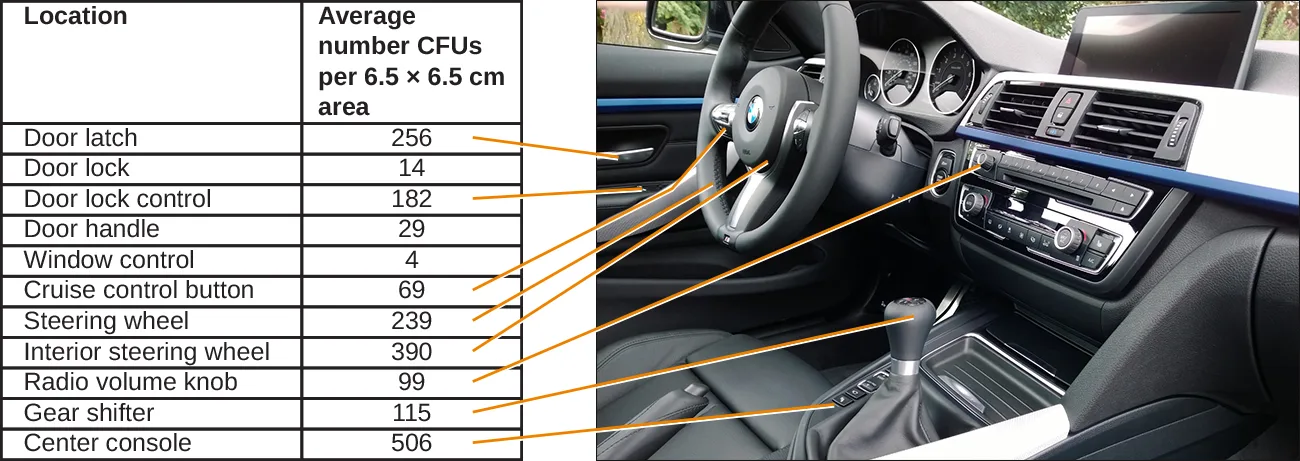
How clean is clean? People wash their cars and vacuum the carpets, but most would not want to eat from these surfaces. Similarly, we might eat with silverware cleaned in a dishwasher, but we could not use the same dishwasher to clean surgical instruments. As these examples illustrate, “clean” is a relative term. Car washing, vacuuming, and dishwashing all reduce the microbial load on the items treated, thus making them “cleaner.” But whether they are “clean enough” depends on their intended use. Because people do not normally eat from cars or carpets, these items do not require the same level of cleanliness that silverware does. Likewise, because silverware is not used for invasive surgery, these utensils do not require the same level of cleanliness as surgical equipment, which requires sterilization to prevent infection.
Why not play it safe and sterilize everything? Sterilizing everything we come in contact with is impractical, as well as potentially dangerous. As this chapter will demonstrate, sterilization protocols often require time- and labor-intensive treatments that may degrade the quality of the item being treated or have toxic effects on users. Therefore, the user must consider the item’s intended application when choosing a cleaning method to ensure that it is “clean enough.”
Sections
- Controlling Microbial Growth — sterilants, disinfectants, and antiseptics; the four biological safety levels; critical, semicritical, and noncritical items; aseptic technique; -cidal versus -static treatments; and the microbial death curve and decimal reduction time.
- Using Physical Methods to Control Microorganisms — heat (boiling, autoclaving, pasteurization, dry heat), refrigeration and freezing, pressure, desiccation and lyophilization, ionizing and nonionizing radiation, sonication, and filtration including HEPA filters and biological safety cabinets.
- Using Chemicals to Control Microorganisms — phenolics, heavy metals, halogens, alcohols, surfactants, bisbiguanides, alkylating agents, peroxygens, supercritical fluids, and chemical food preservatives, and how each acts on the microbial cell.
- Testing the Effectiveness of Antiseptics and Disinfectants — the phenol coefficient, the disk-diffusion method, use-dilution and in-use tests, and the low-, intermediate-, and high-level germicide categories.
This chapter is adapted from Microbiology, Chapter 13: Control of Microbial Growth by Nina Parker, Mark Schneegurt, Anh-Hue Thi Tu, Philip Lister, Brian M. Forster, and OpenStax, © OpenStax, licensed under CC BY-NC-SA 4.0. Access the original for free at openstax.org. Each section page records its own changes from the source. Changes: the chapter-opening figure is the source’s table-and-photograph pair, re-encoded for the web, with its alt text rewritten to describe both panels and transcribe the table’s eleven values; the source footnote in the caption is rendered as an inline parenthetical citation; the module defines no terms.