Antimicrobial Drugs
In nature, some microbes produce substances that inhibit or kill other microbes that might otherwise compete for the same resources. Humans have successfully exploited these abilities, using microbes to mass-produce substances that can be used as antimicrobial drugs. Since their discovery, antimicrobial drugs have saved countless lives, and they remain an essential tool for treating and controlling infectious disease. But their widespread and often unnecessary use has had an unintended side effect: the rise of multidrug-resistant microbial strains. In this chapter, we will discuss how antimicrobial drugs work, why microbes develop resistance, and what health professionals can do to encourage responsible use of antimicrobials.
Sections
- History of Chemotherapy and Antimicrobial Discovery — Ehrlich’s “magic bullet,” the sulfa drugs, Fleming’s penicillin and its development by Florey and Chain, and Waksman’s soil actinomycetes as a source of natural antibiotics.
- Fundamentals of Antimicrobial Chemotherapy — bacteriostatic versus bactericidal drugs, narrow- and broad-spectrum activity and superinfection, dosage, route of administration and half-life, side effects, and drug interactions.
- Mechanisms of Antibacterial Drugs — inhibitors of cell wall synthesis, protein synthesis, membrane function, and nucleic acid synthesis, and the antimetabolites.
- Mechanisms of Other Antimicrobial Drugs — antifungal, antiprotozoan, antihelminthic, and antiviral drugs and the eukaryotic and viral targets they exploit.
- Drug Resistance — how resistance arises and spreads, the mechanisms of drug modification, target modification, efflux, and altered permeability, and the multidrug-resistant “superbugs.”
- Testing the Effectiveness of Antimicrobials — the Kirby-Bauer disk diffusion test, dilution tests for the MIC and MBC, and the Etest.
- Current Strategies for Antimicrobial Discovery — where new antimicrobials are being sought and the economic and regulatory obstacles to bringing them to market.
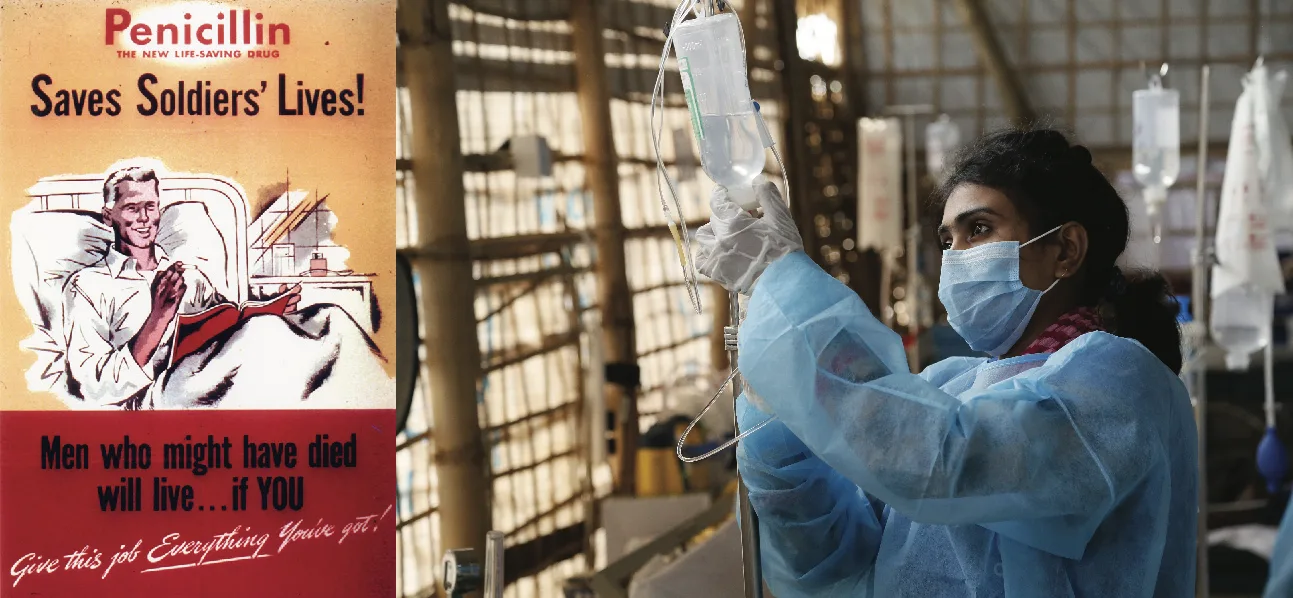
This chapter is adapted from Microbiology, Chapter 14: Antimicrobial Drugs by Nina Parker, Mark Schneegurt, Anh-Hue Thi Tu, Philip Lister, Brian M. Forster, and OpenStax, © OpenStax, licensed under CC BY-NC-SA 4.0. Access the original for free at openstax.org. Each section page records its own changes from the source. Changes: the chapter-opening figure is the source’s poster-and-photograph pair, re-encoded for the web, with its alt text rewritten to describe both panels; the source footnote in the caption is rendered as an inline parenthetical citation; the module defines no terms.