Current Strategies for Antimicrobial Discovery
By the end of this section, you will be able to:
- Describe the methods and strategies used for discovery of new antimicrobial agents.
With the continued evolution and spread of antimicrobial resistance, and now the identification of pan-resistant bacterial pathogens, the search for new antimicrobials is essential for preventing the postantibiotic era. Although development of more effective semisynthetic derivatives is one strategy, resistance to them develops rapidly because bacterial pathogens are already resistant to earlier-generation drugs in the family and can easily mutate and develop resistance to the new semisynthetic drugs. Today, scientists continue to hunt for new antimicrobial compounds and explore new avenues of antimicrobial discovery and synthesis. They check large numbers of soils and microbial products for antimicrobial activity by using high-throughput screening methods, which use automation to test large numbers of samples simultaneously. The recent development of the iChip (L. Losee et al., “A New Antibiotic Kills Pathogens Without Detectable Resistance,” Nature 517, no. 7535 (2015): 455–459) allows researchers to investigate the antimicrobial-producing capabilities of soil microbes that are difficult to grow by standard cultivation techniques in the laboratory. Rather than grow the microbes in the laboratory, they are grown in situ—right in the soil. Use of the iChip has resulted in the discovery of teixobactin, a novel antimicrobial from a soil sample collected in Maine (Source note: the source says “from Mount Ararat, Turkey”; the discovery paper this passage cites reports that the teixobactin-producing organism came from a grassy-field soil sample in Maine (Ling et al., Nature 517 (2015): 455–459).). Teixobactin targets two distinct steps in gram-positive cell wall synthesis and for which antimicrobial resistance appears not yet to have evolved.
Although soils have been widely examined, other environmental niches have not been tested as fully. Since 70% of the earth is covered with water, marine environments could be mined more fully for the presence of antimicrobial-producing microbes. In addition, researchers are using combinatorial chemistry, a method for making a very large number of related compounds from simple precursors, and testing them for antimicrobial activity. An additional strategy that needs to be explored further is the development of compounds that inhibit resistance mechanisms and restore the activity of older drugs, such as the strategy described earlier for β-lactamase inhibitors like clavulanic acid. Finally, developing inhibitors of virulence factor production and function could be a very important avenue. Although this strategy would not be directly antibacterial, drugs that slow the progression of an infection could provide an advantage for the immune system and could be used successfully in combination with antimicrobial drugs.
Check Your Understanding
What are new sources and strategies for developing drugs to fight infectious diseases?
Show model answer
Did your answer mention:
Eye on Ethics. The (Free?) Market for New Antimicrobials
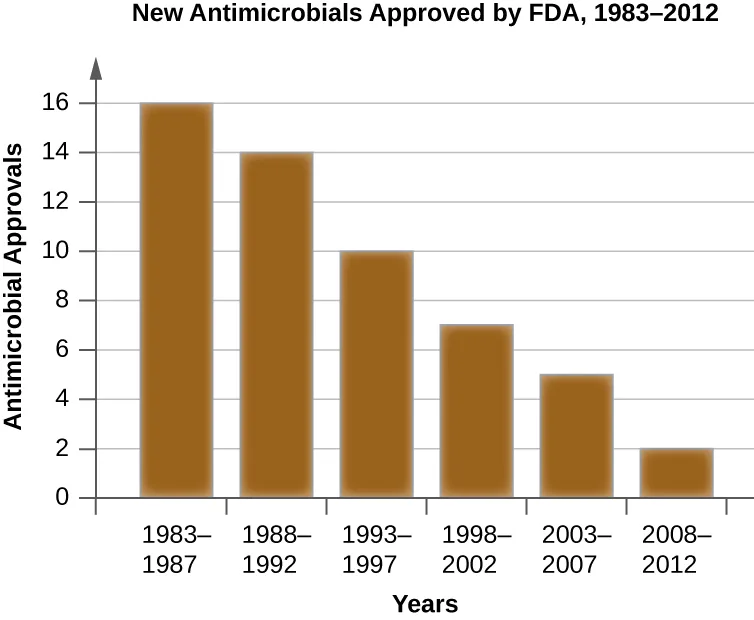
There used to be plenty of antimicrobial drugs on the market to treat infectious diseases. However, the spread of antimicrobial resistance has created a need for new antibiotics to replace those that are no longer as effective as they once were. Unfortunately, pharmaceutical companies are not particularly motivated to fill this need. As of 2009, all but five pharmaceutical companies had moved away from antimicrobial drug development (H.W. Boucher et al., “Bad Bugs, No Drugs: No ESKAPE! An Update from the Infectious Diseases Society of America,” Clinical Infectious Diseases 48, no. 1 (2009): 1–12). As a result, the number of FDA approvals of new antimicrobials has fallen drastically in recent decades (see the figure below).
Given that demand usually encourages supply, one might expect pharmaceutical companies to be rushing to get back in the business of developing new antibiotics. But developing new drugs is a lengthy process and requires large investments in research and development. Pharmaceutical companies can typically get a higher return on their investment by developing products for chronic, nonmicrobial diseases like diabetes; such drugs must be taken for life, and therefore generate more long-term revenue than an antibiotic that does its job in a week or two. But what will happen when drugs like vancomycin, a superantimicrobial reserved for use as a last resort, begin to lose their effectiveness against ever more drug-resistant superbugs? Will drug companies wait until all antibiotics have become useless before beginning to look for new ones?
Recently, it has been suggested that large pharmaceutical companies should be given financial incentives to pursue such research. In September 2014, the White House released an executive order entitled “Combating Antibiotic Resistant Bacteria,” calling upon various government agencies and the private sector to work together to “accelerate basic and applied research and development for new antimicrobials, other therapeutics, and vaccines” (The White House, National Action Plan for Combating Antibiotic-Resistant Bacteria (Washington, DC: The White House, 2015)). As a result, as of March 2015, President Obama’s proposed fiscal year 2016 budget doubled the amount of federal funding to $1.2 billion for “combating and preventing antibiotic resistance,” which includes money for antimicrobial research and development (White House Office of the Press Secretary, “Fact Sheet: Obama Administration Releases National Action Plan to Combat Antibiotic-Resistant Bacteria,” March 27, 2015). Similar suggestions have also been made on a global scale. In December 2014, a report chaired by former Goldman Sachs economist Jim O’Neill was published in The Review on Antimicrobial Resistance (accessed June 1, 2016).
These developments reflect the growing belief that for-profit pharmaceutical companies must be subsidized to encourage development of new antimicrobials. But some ask whether pharmaceutical development should be motivated by profit at all. Given that millions of lives may hang in the balance, some might argue that drug companies have an ethical obligation to devote their research and development efforts to high-utility drugs, as opposed to highly profitable ones. Yet this obligation conflicts with the fundamental goals of a for-profit company. Are government subsidies enough to ensure that drug companies make the public interest a priority, or should government agencies assume responsibility for developing critical drugs that may have little or no return on investment?
Link to Learning
To further examine the scope of the problem, view this video on the shortage of new antimicrobial drugs.
To learn more about the history of antimicrobial drug discovery, visit Michigan State University’s Antimicrobial Resistance Learning Site.
Summary
- Current research into the development of antimicrobial drugs involves the use of high-throughput screening and combinatorial chemistry technologies.
- New technologies are being developed to discover novel antibiotics from soil microorganisms that cannot be cultured by standard laboratory methods.
- Additional strategies include searching for antibiotics from sources other than soil, identifying new antibacterial targets, using combinatorial chemistry to develop novel drugs, developing drugs that inhibit resistance mechanisms, and developing drugs that target virulence factors and hold infections in check.
Practice
Describe the methods and strategies used for discovery of new antimicrobial agents.
Which of the following has yielded compounds with the most antimicrobial activity?
Consider which natural environment the iChip and its first major discovery, described above, both came from.The rate of discovery of antimicrobial drugs has decreased significantly in recent decades.
Compare today’s pace of new antimicrobial discovery with the FDA-approval trend the Eye on Ethics box describes.Who should be responsible for discovering and developing new antibiotics? Support your answer with reasoning.
Show model answer
Did your answer mention:
What did the development of the iChip allow researchers to do?
Recall what the iChip lets researchers do to soil microbes without bringing them into the lab at all.Use of the iChip has resulted in the discovery of a novel antimicrobial from a soil sample collected in Maine, called ________.
It is named in the same sentence that introduces the iChip’s first real-world discovery.Which strategy involves making a very large number of related chemical compounds from simple precursors and testing them for antimicrobial activity?
This strategy is about generating many candidate molecules synthetically, not about screening natural samples.Clavulanic acid is an example of a compound that restores the activity of older antibacterial drugs by doing what?
Think about what a resistant bacterium relies on to withstand an older antibiotic, and what would need to be blocked to restore that antibiotic’s effect.According to the graph in the Eye on Ethics box above, how did the number of new antimicrobials the FDA approved change between the 1988–1992 period and the 1998–2002 period?
Show model answer
Did your answer mention:
This section is adapted from Microbiology, Section 14.7: Current Strategies for Antimicrobial Discovery by Nina Parker, Mark Schneegurt, Anh-Hue Thi Tu, Philip Lister, Brian M. Forster, and OpenStax, © OpenStax, licensed under CC BY-NC-SA 4.0. Access the original for free at openstax.org. Changes: the module’s one figure is re-encoded as WebP and rendered as a mediafigure, kind="diagram" overriding the media manifest’s JPEG-based “photo” guess (it is a drawn bar graph, not a photograph), eager="true" as the only figure on the page; the alt is rewritten from the image and caption, both of which read 16 approvals for 1983–1987, correcting the source alt’s “12,” a suspected source defect; the module’s five footnotes are rendered as inline parenthetical citations after the sentences they support, with the two bare access URLs dropped (the Obama-administration fact-sheet and Review on Antimicrobial Resistance citations); the Review on Antimicrobial Resistance citation, whose only content beyond the report’s own title is an access date, is folded into the sentence that already names the report in italics, kept as an access-date parenthetical; the module has no defined <term> elements (all five body terms are class="no-emphasis" index entries), so the page has no ## Key terms heading; the Eye on Ethics box is rendered as a callout in source order with its figure kept at the box’s own closing position, and the Link to Learning box keeps both of its source sentences, with the generic anchor text “this” and “learn more” expanded to name the destination for a reader who only hears the link text; a dollar amount is escaped (\$1.2 billion) so it is not read as inline math. The module’s three source exercises are all used: the Multiple Choice and True/False items keep the source’s key, options, and order (the True/False item rendered as a two-option multiple choice with no “True or false:” prefix); the unkeyed Critical Thinking question (“Who should be responsible…”) stays a selfcheck, since it asks the learner to argue a position — its model answer summarizes, without adopting, the module’s own for-profit-incentive and public-interest-obligation framing. The body Check Your Understanding bullet is rendered as a body selfcheck at its source position, because its honest answer draws on several of the module’s own strategies rather than one fixing sentence. Five author-written filler items (three multiple choice, one text-recall, and one figure-reading self-check) bring the section’s single objective group to the book’s eight-item floor, each built from a single sentence or the data of this module — the iChip’s function, teixobactin’s name, combinatorial chemistry, clavulanic acid’s resistance-inhibiting mechanism, and the Eye on Ethics bar graph — and named in the ledger; the bar-graph filler is a selfcheck rather than a graded item because the figure’s own source caption already states which period had the fewest approvals, so a multiple choice asking that would be answered by the caption’s prose rather than by reading the graph — it instead asks the learner to read two other bars the caption does not discuss. No source item is omitted. The claim pass corrected teixobactin’s discovery site: the source says “Mount Ararat, Turkey,” while the discovery paper the module itself cites reports a Maine soil sample, so the body sentence and the fill-in-the-blank stem built on it both name Maine, with a Source note.