The Language of Epidemiologists
By the end of this section, you will be able to:
- Explain the difference between prevalence and incidence of disease
- Distinguish the characteristics of sporadic, endemic, epidemic, and pandemic diseases
- Explain the use of Koch’s postulates and their modifications to determine the etiology of disease
- Explain the relationship between epidemiology and public health
Clinical Focus. Part 1
In late November and early December, a hospital in western Florida started to see a spike in the number of cases of acute gastroenteritis-like symptoms. Patients began arriving at the emergency department complaining of excessive bouts of emesis (vomiting) and diarrhea (with no blood in the stool). They also complained of abdominal pain and cramping, and most were severely dehydrated. Alarmed by the number of cases, hospital staff made some calls and learned that other regional hospitals were also seeing 10 to 20 similar cases per day.
- What are some possible causes of this outbreak?
- In what ways could these cases be linked, and how could any suspected links be confirmed?
The field of epidemiology concerns the geographical distribution and timing of infectious disease occurrences and how they are transmitted and maintained in nature, with the goal of recognizing and controlling outbreaks. The science of epidemiology includes etiology (the study of the causes of disease) and investigation of disease transmission (mechanisms by which a disease is spread).
Analyzing Disease in a Population
Epidemiological analyses are always carried out with reference to a population, which is the group of individuals that are at risk for the disease or condition. The population can be defined geographically, but if only a portion of the individuals in that area are susceptible, additional criteria may be required. Susceptible individuals may be defined by particular behaviors, such as intravenous drug use, owning particular pets, or membership in an institution, such as a college. Being able to define the population is important because most measures of interest in epidemiology are made with reference to the size of the population.
The state of being diseased is called morbidity. Morbidity in a population can be expressed in a few different ways. Morbidity or total morbidity is expressed in numbers of individuals without reference to the size of the population. The morbidity rate can be expressed as the number of diseased individuals out of a standard number of individuals in the population, such as 100,000, or as a percent of the population.
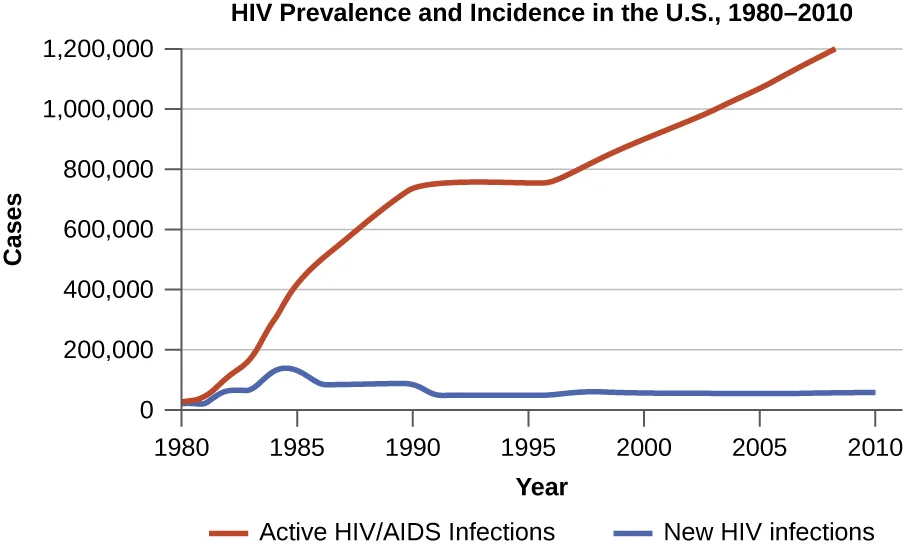
There are two aspects of morbidity that are relevant to an epidemiologist: a disease’s prevalence and its incidence. Prevalence is the number, or proportion, of individuals with a particular illness in a given population at a point in time. For example, the Centers for Disease Control and Prevention (CDC) estimated that in 2012, there were about 1.2 million people 13 years and older with an active human immunodeficiency virus (HIV) infection. Expressed as a proportion, or rate, this is a prevalence of 467 infected persons per 100,000 in the population (H. Irene Hall, Qian An, Tian Tang, Ruiguang Song, Mi Chen, Timothy Green, and Jian Kang, “Prevalence of Diagnosed and Undiagnosed HIV Infection—United States, 2008–2012,” Morbidity and Mortality Weekly Report 64, no. 24 (2015): 657–662). On the other hand, incidence is the number or proportion of new cases in a period of time. For the same year and population, the CDC estimates that there were 43,165 newly diagnosed cases of HIV infection, which is an incidence of 13.7 new cases per 100,000 in the population (Centers for Disease Control and Prevention, “Diagnoses of HIV Infection in the United States and Dependent Areas, 2014,” HIV Surveillance Report 26 (2015)). The relationship between incidence and prevalence can be seen in the graph below. For a chronic disease like HIV infection, prevalence will generally be higher than incidence because it represents the cumulative number of new cases over many years minus the number of cases that are no longer active (e.g., because the patient died or was cured).
In addition to morbidity rates, the incidence and prevalence of mortality (death) may also be reported. A mortality rate can be expressed as the percentage of the population that has died from a disease or as the number of deaths per 100,000 persons (or other suitable standard number).
Check Your Understanding
Explain the difference between incidence and prevalence.
One term counts only the new cases that appear in a period; the other counts everyone currently ill.Describe how morbidity and mortality rates are expressed.
Show model answer
Did your answer mention:
Patterns of Incidence
Diseases that are seen only occasionally, and usually without geographic concentration, are called sporadic diseases. Examples of sporadic diseases include tetanus, rabies, and plague. In the United States, Clostridium tetani, the bacterium that causes tetanus, is ubiquitous in the soil environment, but incidences of infection occur only rarely and in scattered locations because most individuals are vaccinated, clean wounds appropriately, or are only rarely in a situation that would cause infection (Centers for Disease Control and Prevention, “Tetanus Surveillance—United States, 2001–2008,” Morbidity and Mortality Weekly Report 60, no. 12 (2011): 365). Likewise in the United States there are a few scattered cases of plague each year, usually contracted from rodents in rural areas in the western states (Centers for Disease Control and Prevention, “Plague in the United States,” 2015. Accessed June 1, 2016).
Diseases that are constantly present (often at a low level) in a population within a particular geographic region are called endemic diseases. For example, malaria is endemic to some regions of Brazil, but is not endemic to the United States.
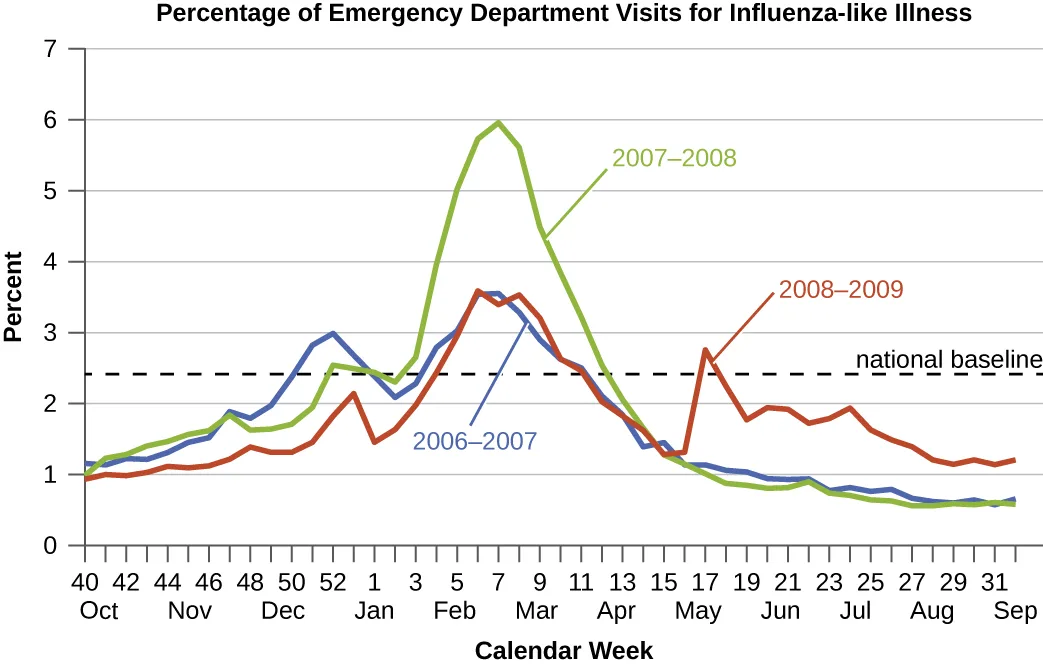
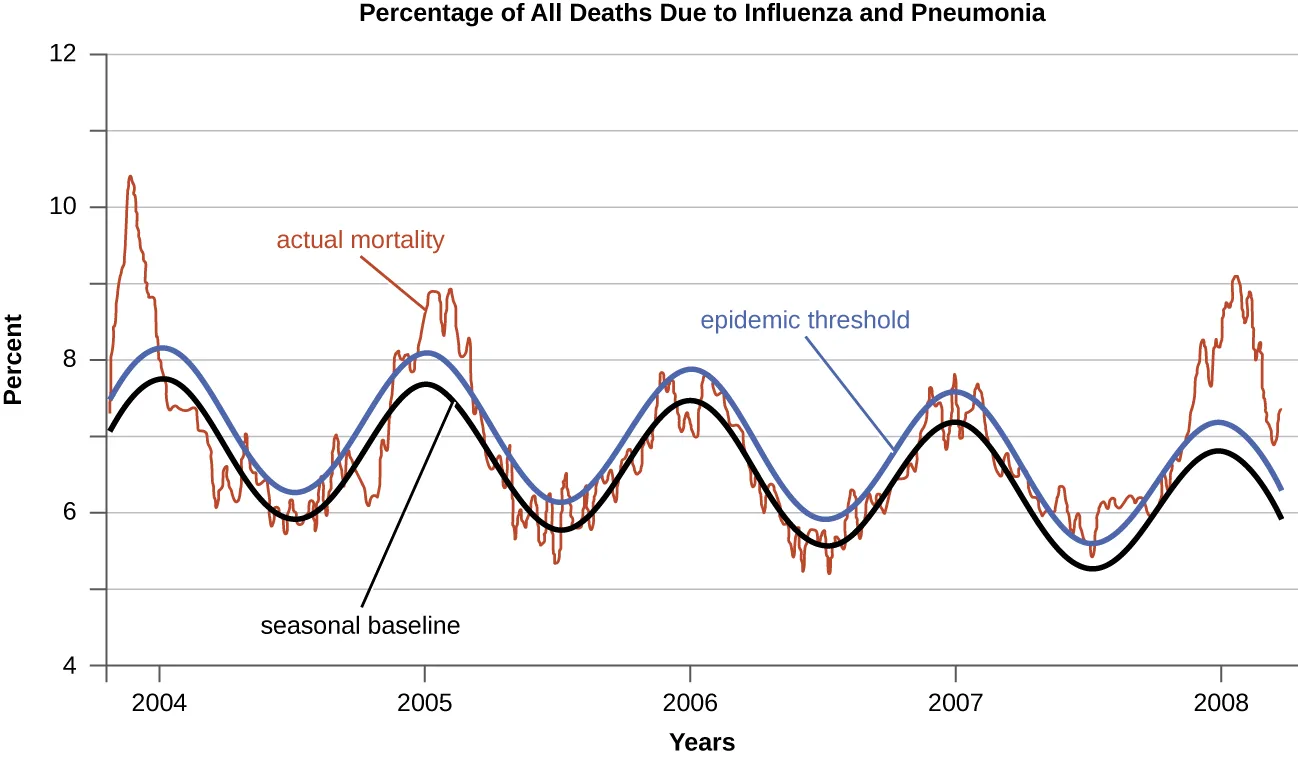
Diseases for which a larger than expected number of cases occurs in a short time within a geographic region are called epidemic diseases. Influenza is a good example of a commonly epidemic disease. Incidence patterns of influenza tend to rise each winter in the northern hemisphere. These seasonal increases are expected, so it would not be accurate to say that influenza is epidemic every winter; however, some winters have an unusually large number of seasonal influenza cases in particular regions, and such situations would qualify as epidemics (shown in the two graphs below).
An epidemic disease signals the breakdown of an equilibrium in disease frequency, often resulting from some change in environmental conditions or in the population. In the case of influenza, the disruption can be due to antigenic shift or drift (see Virulence Factors of Bacterial and Viral Pathogens), which allows influenza virus strains to circumvent the acquired immunity of their human hosts.
An epidemic that occurs on a worldwide scale is called a pandemic disease. For example, HIV/AIDS is a pandemic disease and novel influenza virus strains often become pandemic.
Check Your Understanding
Explain the difference between sporadic and endemic disease.
One of the two terms describes scattered, occasional cases; the other describes a constant, low-level presence in one region.Explain the difference between endemic and epidemic disease.
One of the two terms describes a steady baseline level; the other describes a sudden, larger than expected rise.Clinical Focus. Part 2
Hospital physicians suspected that some type of food poisoning was to blame for the sudden post-Thanksgiving outbreak of gastroenteritis in western Florida. Over a two-week period, 254 cases were observed, but by the end of the first week of December, the epidemic ceased just as quickly as it had started. Suspecting a link between the cases based on the localized nature of the outbreak, hospitals handed over their medical records to the regional public health office for study.
Laboratory testing of stool samples had indicated that the infections were caused by Salmonella bacteria. Patients ranged from children as young as three to seniors in their late eighties. Cases were nearly evenly split between males and females. Across the region, there had been three confirmed deaths in the outbreak, all due to severe dehydration. In each of the fatal cases, the patients had not sought medical care until their symptoms were severe; also, all of the deceased had preexisting medical conditions such as congestive heart failure, diabetes, or high blood pressure.
After reviewing the medical records, epidemiologists with the public health office decided to conduct interviews with a randomly selected sample of patients.
- What conclusions, if any, can be drawn from the medical records?
- What would epidemiologists hope to learn by interviewing patients? What kinds of questions might they ask?
The case continues in Tracking Infectious Diseases.
Etiology
When studying an epidemic, an epidemiologist’s first task is to determine the cause of the disease, called the etiologic agent or causative agent. Connecting a disease to a specific pathogen can be challenging because of the extra effort typically required to demonstrate direct causation as opposed to a simple association. It is not enough to observe an association between a disease and a suspected pathogen; controlled experiments are needed to eliminate other possible causes. In addition, pathogens are typically difficult to detect when there is no immediate clue as to what is causing the outbreak. Signs and symptoms of disease are also commonly nonspecific, meaning that many different agents can give rise to the same set of signs and symptoms. This complicates diagnosis even when a causative agent is familiar to scientists.
Robert Koch was the first scientist to specifically demonstrate the causative agent of a disease (anthrax) in the late 1800s. Koch developed four criteria, now known as Koch’s postulates, which had to be met in order to positively link a disease with a pathogenic microbe. Without Koch’s postulates, the Golden Age of Microbiology would not have occurred. Between 1876 and 1905, many common diseases were linked with their etiologic agents, including cholera, diphtheria, gonorrhea, meningitis, plague, syphilis, tetanus, and tuberculosis. Today, we use the molecular Koch’s postulates, a variation of Koch’s original postulates that can be used to establish a link between the disease state and virulence traits unique to a pathogenic strain of a microbe. Koch’s original postulates and molecular Koch’s postulates were described in more detail in How Pathogens Cause Disease.
Check Your Understanding
List some challenges to determining the causative agent of a disease outbreak.
Show model answer
Did your answer mention:
The Role of Public Health Organizations
The main national public health agency in the United States is the Centers for Disease Control and Prevention (CDC), an agency of the Department of Health and Human Services. The CDC is charged with protecting the public from disease and injury. One way that the CDC carries out this mission is by overseeing the National Notifiable Disease Surveillance System (NNDSS) in cooperation with regional, state, and territorial public health departments. The NNDSS monitors diseases considered to be of public health importance on a national scale. Such diseases are called notifiable diseases or reportable diseases because all cases must be reported to the CDC. A physician treating a patient with a notifiable disease is legally required to submit a report on the case. Notifiable diseases include HIV infection, measles, West Nile virus infections, and many others. Some states have their own lists of notifiable diseases that include diseases beyond those on the CDC’s list.
Notifiable diseases are tracked by epidemiological studies and the data is used to inform health-care providers and the public about possible risks. The CDC publishes the Morbidity and Mortality Weekly Report (MMWR), which provides physicians and health-care workers with updates on public health issues and the latest data pertaining to notifiable diseases. The table below is an example of the kind of data contained in the MMWR.
Incidence of Four Notifiable Diseases in the United States, Week Ending January 2, 2016
| Disease | Current Week (Jan 2, 2016) | Median of Previous 52 Weeks | Maximum of Previous 52 Weeks | Cumulative Cases 2015 |
|---|---|---|---|---|
| Campylobacteriosis | 406 | 869 | 1,385 | 46,618 |
| Chlamydia trachomatis infection | 11,024 | 28,562 | 31,089 | 1,425,303 |
| Giardiasis | 115 | 230 | 335 | 11,870 |
| Gonorrhea | 3,207 | 7,155 | 8,283 | 369,926 |
Link to Learning
The current Morbidity and Mortality Weekly Report is available online.
Check Your Understanding
Describe how health agencies obtain data about the incidence of diseases of public health importance.
Show model answer
Did your answer mention:
Summary
- Epidemiology is the science underlying public health.
- Morbidity means being in a state of illness, whereas mortality refers to death; both morbidity rates and mortality rates are of interest to epidemiologists.
- Incidence is the number of new cases (morbidity or mortality), usually expressed as a proportion, during a specified time period; prevalence is the total number affected in the population, again usually expressed as a proportion.
- Sporadic diseases only occur rarely and largely without a geographic focus. Endemic diseases occur at a constant (and often low) level within a population. Epidemic diseases and pandemic diseases occur when an outbreak occurs on a significantly larger than expected level, either locally or globally, respectively.
- Koch’s postulates specify the procedure for confirming a particular pathogen as the etiologic agent of a particular disease. Koch’s postulates have limitations in application if the microbe cannot be isolated and cultured or if there is no animal host for the microbe. In this case, molecular Koch’s postulates would be utilized.
- In the United States, the Centers for Disease Control and Prevention monitors notifiable diseases and publishes weekly updates in the Morbidity and Mortality Weekly Report.
Key terms
- epidemiology — the study of where and when infectious diseases occur in a population and how they are transmitted and maintained in nature.
- etiology — the science of the causes of disease.
- morbidity — a state of illness.
- morbidity rate — the number of cases of a disease expressed as a percentage of the population or number per standard part of the population, such as 100,000.
- prevalence — the total number or proportion of individuals in a population ill with a specific disease.
- incidence — the number of individuals with new infections of a particular disease in a given period of time.
- mortality — death.
- sporadic disease — an illness that occurs at relatively low levels with no discernible pattern or trend, frequently with no geographic focus.
- endemic disease — an illness that is constantly present (often at low levels) in a population.
- epidemic disease — an illness with a higher-than-expected incidence in a given period within a given population.
- pandemic disease — an epidemic that is worldwide as opposed to regional.
- etiologic agent — the pathogen or substance responsible for causing a particular disease; causative agent.
- causative agent — the pathogen or substance responsible for causing a particular disease; etiologic agent.
- Centers for Disease Control and Prevention (CDC) — the national public health agency in the United States.
- notifiable disease — a disease for which all cases must legally be reported to regional, state, and/or federal public health agencies.
- reportable disease — an illness that must legally be reported to the CDC because it is considered of public health importance; a synonym for notifiable disease.
- Morbidity and Mortality Weekly Report (MMWR) — the trade/industry publication for epidemiologists, reporting US public health data compiled by the CDC.
Practice
Explain the difference between prevalence and incidence of disease
Which term matches this description: ’the number of disease cases per 100,000 individuals'?
This is a rate that counts disease cases, not deaths.Which term matches this description: ’the number of deaths from a disease for every 10,000 individuals'?
This is the rate that counts deaths, not disease cases.During an epidemic, why might the prevalence of a disease at a particular time not be equal to the sum of the incidences of the disease?
Show model answer
Did your answer mention:
Why might an epidemiological population in a state not be the same size as the number of people in a state? Use an example.
Show model answer
Did your answer mention:
Distinguish the characteristics of sporadic, endemic, epidemic, and pandemic diseases
Which term matches this description: ‘a disease found occasionally in a region with cases occurring mainly in isolation from each other’?
This disease pattern has no constant presence and no large-scale surge.Which term matches this description: ‘a disease found regularly in a region’?
This disease pattern is a constant, steady presence, not an occasional or sudden one.Which term matches this description: ‘a disease in higher than expected numbers around the world’?
This disease pattern’s scale is worldwide, not just regional.Which term describes an illness with a higher-than-expected incidence in a given period within a given population?
This disease pattern is regional and short-lived, unlike the worldwide pattern or the constant, low-level one.Explain the use of Koch’s postulates and their modifications to determine the etiology of disease
Which scientist was the first to specifically demonstrate the causative agent of a disease (anthrax), in the late 1800s?
This scientist’s four criteria for linking a disease to a pathogen are named after him.The pathogen or substance responsible for causing a particular disease is called the etiologic agent, or equivalently the ________.
This module gives two names for the same thing; the other name appears in the question.The science of the causes of disease is called ________.
This word names the study of WHY a disease occurs, not the disease itself.How do the molecular Koch’s postulates differ in purpose from Koch’s original postulates?
The molecular version links the disease to specific traits of a strain, not to the microbe as a whole.Explain the relationship between epidemiology and public health
The ________ collects data and conducts epidemiologic studies in the United States.
This is the agency of the Department of Health and Human Services that oversees the National Notifiable Disease Surveillance System.Diseases for which all cases must legally be reported to public health agencies are called ________ diseases.
This module gives two names for the same thing; either one is correct.In what publication would you find data on emerging/reemerging diseases in the United States?
Show model answer
Did your answer mention:
This section is adapted from Microbiology, Section 16.1: The Language of Epidemiologists by Nina Parker, Mark Schneegurt, Anh-Hue Thi Tu, Philip Lister, Brian M. Forster, and OpenStax, © OpenStax, licensed under CC BY-NC-SA 4.0. Access the original for free at openstax.org. Changes: all three source figures re-encoded as WebP and rendered as mediafigures, all given explicit kind="diagram" after image inspection (the manifest guessed “photo” for all three because every source file is a JPEG, but each is a drawn line graph, not a photograph); all three source alts rewritten from the image after inspection — the source alts contained typos (“There as a short plateau,” “The number o people,” “an pneumonia,” “usually large”) and named lines and thresholds without giving their approximate values, which the rewritten alts supply by reading the graphs; the two body cross-references to Virulence Factors of Bacterial and Viral Pathogens (Section 15.3) and How Pathogens Cause Disease (Section 15.2) are absolute site-root links, as is Part 2’s “Jump to the next Clinical Focus box,” which points to the Tracking Infectious Diseases section (16.2); the Clinical Focus box’s “Jump to the next Clinical Focus box” between Part 1 and Part 2 is omitted, because both parts are on this same page and the reader simply continues reading, and Part 2’s own “Go back to the previous Clinical Focus box” is omitted for the same same-page reason; the source’s four footnotes are rendered as inline parenthetical citations after the sentences they support, with the one bare access URL (the CDC plague citation) dropped and its access date kept; the source’s Matching exercise (key: D, E, B, A, C) is rendered as five multiple-choice items, one per printed description, each offering all five of the set’s terms (sporadic disease, endemic disease, pandemic disease, morbidity rate, mortality rate, the table’s own order) as options — three (keyed to sporadic disease, endemic disease, pandemic disease) placed under the sporadic/endemic/epidemic/pandemic objective and two (keyed to morbidity rate, mortality rate) placed under the prevalence/incidence objective; a sixth item recalling epidemic disease’s own definition (not part of the Matching set) is added under the same objective, from this module’s own Key terms definition, with the other three disease-pattern terms as distractors, to cover all four disease patterns the objective names; the Fill in the Blank item (“The ________ collects data and conducts epidemiologic studies in the United States,” keyed “Centers for Disease Control and Prevention, or CDC”) is rendered as a multiple choice keyed to the full CDC name, with the Food and Drug Administration, National Institutes of Health, and U.S. Department of Agriculture as distractors, since this module names no other public-health agency and those three are named in earlier chapters of this book; of the section’s two Short Answer questions and one Critical Thinking question, none has a source key, and none is dropped: all three stay self-checks — the prevalence-during-an-epidemic question because the module’s only relevant sentence is written about a chronic disease (HIV) specifically rather than about epidemics generally; the emerging/reemerging-diseases question because the module’s closest sentence is about notifiable diseases generally and never uses the phrase “emerging/reemerging” (that discussion is in Section 16.4, out of this module’s bounds); and the population-size question because it asks the learner to supply their own example, though the model answer supplies one built from this module’s own list of what can define a susceptible population; three of the section’s six body Check Your Understanding questions (incidence versus prevalence, sporadic versus endemic disease, and endemic versus epidemic disease) are graded as multiple-choice items, each a compare-and-contrast pair the module states in two adjacent or near-adjacent sentences, with distractors built by reversing or otherwise recombining the module’s own defining clauses; the other three (morbidity/mortality rate expression, challenges to determining a causative agent, and how health agencies obtain incidence data) stay self-checks, each needing sentences from more than one paragraph to answer honestly; the Practice block adds three text-recall items (Robert Koch, causative agent, etiology) and one text-recall item (notifiable/reportable disease) from the module’s own Key terms and defining sentences, and one multiple-choice item contrasting Koch’s postulates with the molecular Koch’s postulates, to fill the Koch’s-postulates and public-health objective groups, since this module’s own exercise sets carry no items for either; key terms compiled from the module’s seventeen defined terms and the book’s Glossary appendix, with one (reportable disease) taken from this module’s own defining sentence because the appendix has no entry for it (Morbidity and Mortality Weekly Report / MMWR does have a Glossary entry and uses its wording); the textin keyed to Robert Koch accepts the bare surname “Koch,” since the module itself later refers to him only by surname; two one-word source typos are corrected in place, without an inline note (reported to the parent for the errata log): “determinate” to “determine” (§ Etiology) and “an usually large” to “an unusually large” (§ Patterns of Incidence). No source exercise item is omitted.