Global Public Health
By the end of this section, you will be able to:
- Describe the entities involved in international public health and their activities
- Identify and differentiate between emerging and reemerging infectious diseases
A large number of international programs and agencies are involved in efforts to promote global public health. Among their goals are developing infrastructure in health care, public sanitation, and public health capacity; monitoring infectious disease occurrences around the world; coordinating communications between national public health agencies in various countries; and coordinating international responses to major health crises. In large part, these international efforts are necessary because disease-causing microorganisms know no national boundaries.
The World Health Organization (WHO)
International public health issues are coordinated by the World Health Organization (WHO), an agency of the United Nations. Of its roughly $4 billion budget for 2015–16 (World Health Organization, “Programme Budget 2014–2015.”), about $1 billion was funded by member states and the remaining $3 billion by voluntary contributions. In addition to monitoring and reporting on infectious disease, WHO also develops and implements strategies for their control and prevention. WHO has had a number of successful international public health campaigns. For example, its vaccination program against smallpox, begun in the mid-1960s, resulted in the global eradication of the disease by 1980. WHO continues to be involved in infectious disease control, primarily in the developing world, with programs targeting malaria, HIV/AIDS, and tuberculosis, among others. It also runs programs to reduce illness and mortality that occur as a result of violence, accidents, lifestyle-associated illnesses such as diabetes, and poor health-care infrastructure.
WHO maintains a global alert and response system that coordinates information from member nations. In the event of a public health emergency or epidemic, it provides logistical support and coordinates international response to the emergency. The United States contributes to this effort through the CDC. The CDC carries out international monitoring and public health efforts, mainly in the service of protecting US public health in an increasingly connected world. Similarly, the European Union maintains a Health Security Committee that monitors disease outbreaks within its member countries and internationally, coordinating with WHO.
Check Your Understanding
Name the organizations that participate in international public health monitoring.
Show model answer
Did your answer mention:
Emerging and Reemerging Infectious Diseases
Both WHO and some national public health agencies such as the CDC monitor and prepare for emerging infectious diseases. An emerging infectious disease is either new to the human population or has shown an increase in prevalence in the previous twenty years. Whether the disease is new or conditions have changed to cause an increase in frequency, its status as emerging implies the need to apply resources to understand and control its growing impact.
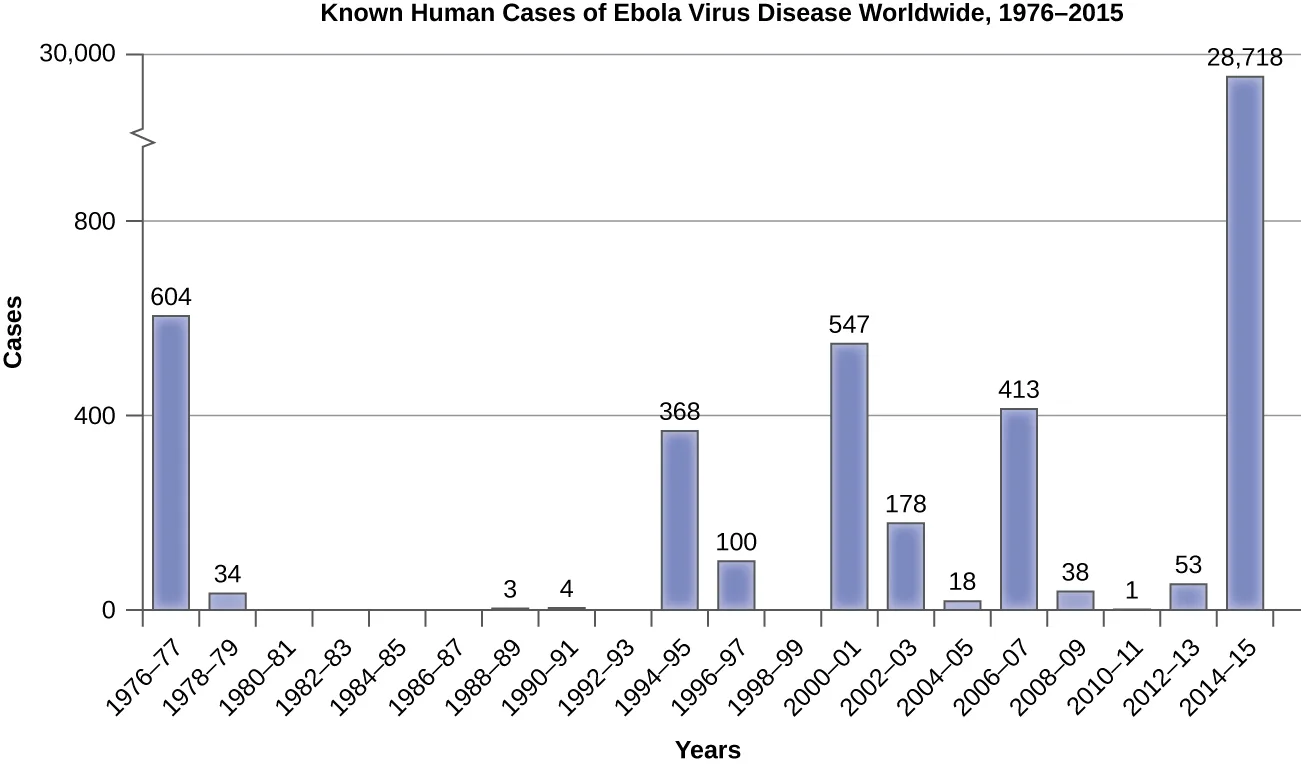
Emerging diseases may change their frequency gradually over time, or they may experience sudden epidemic growth. The importance of vigilance was made clear during the Ebola hemorrhagic fever epidemic in western Africa through 2014–2015. Although health experts had been aware of the Ebola virus since the 1970s, an outbreak on such a large scale had never happened before (shown in the graph below). Previous human epidemics had been small, isolated, and contained. Indeed, the gorilla and chimpanzee populations of western Africa had suffered far worse from Ebola than the human population. The pattern of small isolated human epidemics changed in 2014. Its high transmission rate, coupled with cultural practices for treatment of the dead and perhaps its emergence in an urban setting, caused the disease to spread rapidly, and thousands of people died. The international public health community responded with a large emergency effort to treat patients and contain the epidemic.
Emerging diseases are found in all countries, both developed and developing (see the table below). Some nations are better equipped to deal with them. National and international public health agencies watch for epidemics like the Ebola outbreak in developing countries because those countries rarely have the health-care infrastructure and expertise to deal with large outbreaks effectively. Even with the support of international agencies, the systems in western Africa struggled to identify and care for the sick and control spread. In addition to the altruistic goal of saving lives and assisting nations lacking in resources, the global nature of transportation means that an outbreak anywhere can spread quickly to every corner of the planet. Managing an epidemic in one location—its source—is far easier than fighting it on many fronts.
Ebola is not the only disease that needs to be monitored in the global environment. In 2015, WHO set priorities on several emerging diseases that had a high probability of causing epidemics and that were poorly understood (and thus urgently required research and development efforts).
A reemerging infectious disease is a disease that is increasing in frequency after a previous period of decline. Its reemergence may be a result of changing conditions or old prevention regimes that are no longer working. Examples of such diseases are drug-resistant forms of tuberculosis, bacterial pneumonia, and malaria. Drug-resistant strains of the bacteria causing gonorrhea and syphilis are also becoming more widespread, raising concerns of untreatable infections.
| Disease | Pathogen | Year Discovered | Affected Regions | Transmission |
|---|---|---|---|---|
| AIDS | HIV | 1981 | Worldwide | Contact with infected body fluids |
| Chikungunya fever | Chikungunya virus | 1952 | Africa, Asia, India; spreading to Europe and the Americas | Mosquito-borne |
| Ebola virus disease | Ebola virus | 1976 | Central and Western Africa | Contact with infected body fluids |
| H1N1 Influenza (swine flu) | H1N1 virus | 2009 | Worldwide | Droplet transmission |
| Lyme disease | Borrelia burgdorferi bacterium | 1981 | Northern hemisphere | From mammal reservoirs to humans by tick vectors |
| West Nile virus disease | West Nile virus | 1937 | Africa, Australia, Canada to Venezuela, Europe, Middle East, Western Asia | Mosquito-borne |
Some Emerging and Reemerging Infectious Diseases
Check Your Understanding
Explain why it is important to monitor emerging infectious diseases.
Show model answer
Did your answer mention:
Explain how a bacterial disease could reemerge, even if it had previously been successfully treated and controlled.
Show model answer
Did your answer mention:
Micro Connection. SARS Outbreak and Identification
On November 16, 2002, the first case of a SARS outbreak was reported in Guangdong Province, China. The patient exhibited influenza-like symptoms such as fever, cough, myalgia, sore throat, and shortness of breath. As the number of cases grew, the Chinese government was reluctant to openly communicate information about the epidemic with the World Health Organization (WHO) and the international community. The slow reaction of Chinese public health officials to this new disease contributed to the spread of the epidemic within and later outside China. In April 2003, the Chinese government finally responded with a huge public health effort involving quarantines, medical checkpoints, and massive cleaning projects. Over 18,000 people were quarantined in Beijing alone. Large funding initiatives were created to improve health-care facilities, and dedicated outbreak teams were created to coordinate the response. By August 16, 2003, the last SARS patients were released from a hospital in Beijing nine months after the first case was reported in China.
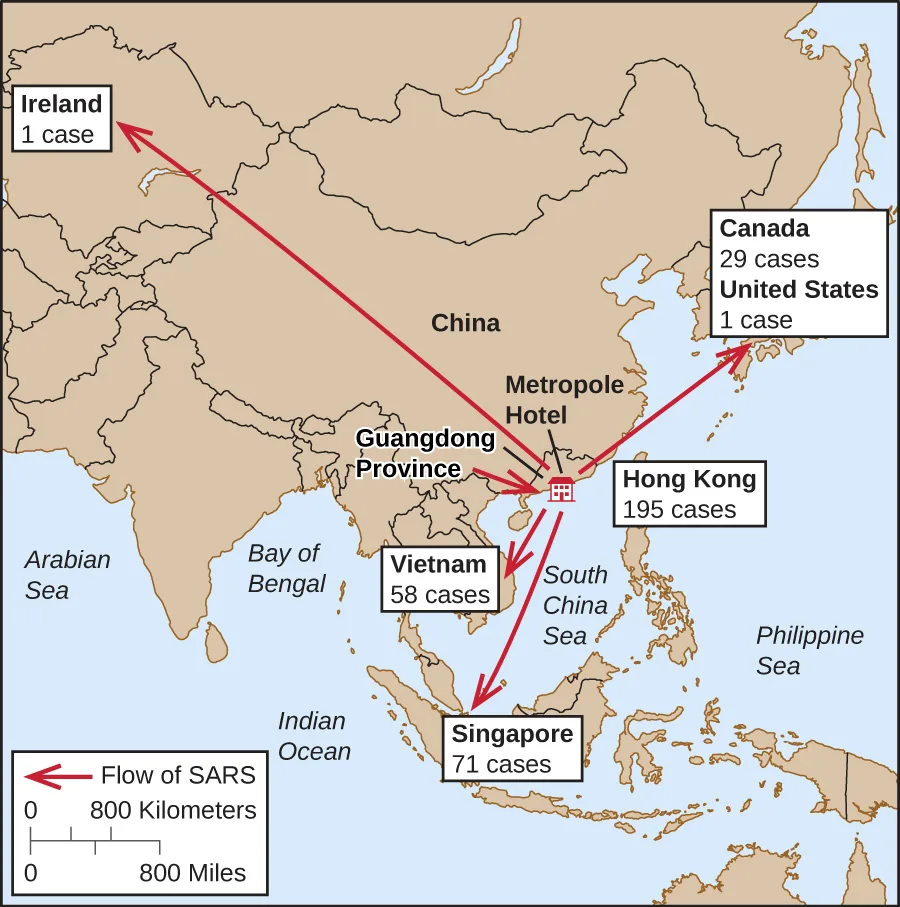
In the meantime, SARS spread to other countries on its way to becoming a global pandemic. Though the infectious agent had yet to be identified, it was thought to be an influenza virus. The disease was named SARS, an acronym for severe acute respiratory syndrome, until the etiologic agent could be identified. Travel restrictions to Southeast Asia were enforced by many countries. By the end of the outbreak, there were 8,098 cases and 774 deaths worldwide. China and Hong Kong were hit hardest by the epidemic, but Taiwan, Singapore, and Toronto, Canada, also saw significant numbers of cases (shown in the map below).
Fortunately, timely public health responses in many countries effectively suppressed the outbreak and led to its eventual containment. For example, the disease was introduced to Canada in February 2003 by an infected traveler from Hong Kong, who died shortly after being hospitalized. By the end of March, hospital isolation and home quarantine procedures were in place in the Toronto area, stringent anti-infection protocols were introduced in hospitals, and the media were actively reporting on the disease. Public health officials tracked down contacts of infected individuals and quarantined them. A total of 25,000 individuals were quarantined in the city. Thanks to the vigorous response of the Canadian public health community, SARS was brought under control in Toronto by June, a mere four months after it was introduced.
In 2003, WHO established a collaborative effort to identify the causative agent of SARS, which has now been identified as a coronavirus that was associated with horseshoe bats. The genome of the SARS virus was sequenced and published by researchers at the CDC and in Canada in May 2003, and in the same month researchers in the Netherlands confirmed the etiology of the disease by fulfilling Koch’s postulates for the SARS coronavirus. The last known case of SARS worldwide was reported in 2004.
Extended description
An icon for the Metropole Hotel sits beside Guangdong Province as the outbreak’s starting point. From there, arrows labeled ‘Flow of SARS’ fan out: one points northwest to Ireland (1 case); one points northeast to a shared box for Canada (29 cases) and the United States (1 case); one points to the adjacent box for Hong Kong (195 cases); one points south to Vietnam (58 cases); and one points further south to Singapore (71 cases). A scale bar in the lower left reads 0 to 800 kilometers and 0 to 800 miles.
Link to Learning
This database of reports chronicles outbreaks of infectious disease around the world. It was on this system that the first information about the SARS outbreak in China emerged.
The CDC publishes Emerging Infectious Diseases, a monthly journal available online.
Summary
- The World Health Organization (WHO) is an agency of the United Nations that collects and analyzes data on disease occurrence from member nations. WHO also coordinates public health programs and responses to international health emergencies.
- Emerging diseases are those that are new to human populations or that have been increasing in the past two decades. Reemerging diseases are those that are making a resurgence in susceptible populations after previously having been controlled in some geographic areas.
Key terms
- World Health Organization (WHO) — international public health organization within the United Nations; monitors and communicates international public health information and coordinates international public health programs and emergency interventions.
- emerging infectious diseases — a disease that is new to the human population or has increased in prevalence over the previous 20 years.
- reemerging infectious disease — a disease that was once under control or largely eradicated that has begun causing new outbreaks due to changes in susceptible populations, the environment, or the pathogen itself.
Practice
Describe the entities involved in international public health and their activities
The ________ collects data and conducts epidemiologic studies at the global level.
This is the same United Nations agency introduced at the start of this section.According to this section, what role does the CDC play in WHO’s global alert and response system?
Read the sentence right after WHO’s own global alert and response system is described — it names what the United States contributes and why.An Atlantic crossing by boat from England to New England took 60–80 days in the 18th century. In the late 19th century the voyage took less than a week. How do you think these time differences for travel might have impacted the spread of infectious diseases from Europe to the Americas, or vice versa?
Show model answer
Did your answer mention:
Identify and differentiate between emerging and reemerging infectious diseases
Which of the following would NOT be considered an emerging disease?
Three of these four diseases are recent arrivals or recent surges; one has been a known human disease for a very long time.Which of the following would NOT be considered a reemerging disease?
Three of these four are named in this section as reemerging because of drug resistance; one is not framed that way here.Which of the following factors can lead to reemergence of a disease?
Think about which option is an old prevention regime that has stopped working, as this section’s definition of reemergence describes.Why are emerging diseases with very few cases the focus of intense scrutiny?
Recall this section’s own definition of what makes a disease ’emerging’ in the first place.A disease that is increasing in frequency after a previous period of decline is called a ________.
This is the term this section defines right after ’emerging infectious diseases.'This section is adapted from Microbiology, Section 16.4: Global Public Health by Nina Parker, Mark Schneegurt, Anh-Hue Thi Tu, Philip Lister, Brian M. Forster, and OpenStax, © OpenStax, licensed under CC BY-NC-SA 4.0. Access the original for free at openstax.org. Changes: both figures are re-encoded as WebP and rendered as mediafigures; the media manifest guesses kind="photo" for both (both source files are JPEGs), which is wrong for both — the Ebola-cases figure is a bar graph and the SARS-spread figure is a labelled map with flow arrows, so both are explicit kind="diagram"; the SARS map gets a longdesc walking through its flow arrows and case counts, none of which the caption names. The Ebola-cases figure’s alt is rewritten from the rendered image rather than the source alt, which prints “44” for the 1978–79 bar (the image reads 34) and an extra, erroneous “There were 38 in 2006-2007” clause (2006–07 is 413; the 38-case bar is 2008–09) — both are reported to the parent as suspected source-alt defects. The SARS map’s alt is also rewritten from the image, rather than reusing the source alt verbatim, to avoid duplicating the figure’s own caption and to add the Guangdong Province/Metropole Hotel starting point the caption does not name. Both cross-reference links to these figures are replaced by a descriptive phrase (“shown in the graph/map below”) at their body position, and both figures are placed at their own document-order position rather than at the point of reference, per this book’s rule. Of the module’s two source <link url> references (the outbreak database and the Emerging Infectious Diseases journal), both are kept as Link to Learning URLs. The one footnote (the WHO budget citation) is rendered as an inline parenthetical citation after the sentence it supports, with its bare access URL dropped and the rest of the citation kept verbatim. The three body Check Your Understanding questions (one after the WHO subsection, two after the Emerging and Reemerging Infectious Diseases subsection) are rendered as self-checks at their note positions, each with a model answer and rubric assembled only from this module’s own sentences; none is graded as a multiplechoice, textin, or sortbins because none is answered by a single defined term or a short deterministic phrase — the organizations question spans two paragraphs, the “why monitor” and “how could a disease reemerge” questions each need the module’s own sibling reasons/examples restated rather than a single term, and this module names no sibling wrong answers with which to build honest multiple-choice distractors for them. Of the module’s five source exercises: all four Multiple Choice keep their source order, options, and keys; the one Fill in the Blank keeps its “WHO (World Health Organization)” key as a textin per the parent’s decision, answer WHO with accept="World Health Organization"; the one unkeyed Critical Thinking question (the Atlantic-crossing question) is rendered as a selfcheck, per the parent’s decision, because it is openly speculative and this module does not discuss historical ocean-crossing times — its model answer reasons from this module’s own sentences about how quickly transportation lets an outbreak spread and explicitly flags where the reasoning becomes inference rather than a module claim. No source exercise is dropped. The “Some Emerging and Reemerging Infectious Diseases” table is transcribed as Markdown from its cells and checked against the PDF; per the parent’s decision it gets no sortbins (its categories are diseases, not a comparison the section’s objectives ask the learner to sort). One author-written multiplechoice (the CDC’s-role item) and one term-recall textin (keyed “reemerging infectious disease”) fill the two Practice groups to this section’s floor of 8 (2 objectives × 3, raised to the section floor); the CDC item’s three distractors are this module’s own phrases for WHO’s smallpox campaign, the EU Health Security Committee’s monitoring role, and WHO’s member-state funding share, each reassigned to a wrong agency rather than invented. Key terms are compiled from the module’s 3 defined terms and the book’s Glossary appendix; all 3 are taken from the glossary (none sentence-derived).